Worksheet
Separating Your Voice From Racial Conditioning: A Grounding Practice to Pause, Sense, and Choose
This clinical resource helps individuals distinguish their authentic voice from systemic racial conditioning and absorbed societal expectations. Created in collaboration with trauma and grief specialist Tairesha "Sunflower" Flemister, LMSW, this guide utilizes embodied somatic awareness to navigate racialized pressure. By teaching clients to notice bodily sensations of urgency versus expansive space, the tool empowers individuals to pause and respond with self-alignment.

by Insight Timer in collaboration with Sunflower Flemister
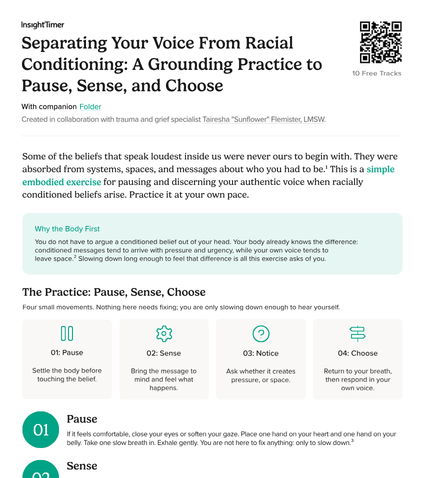
How to Use This Worksheet
Introduce this embodied four-part framework - Pause, Sense, Notice, and Choose - during somatic therapy or individual coaching sessions. Guide the client to settle their body with hand-on-heart breathing before recalling a conditioned message that arises in racialized spaces. Prompt them to track bodily responses, discerning whether the belief creates urgency and contraction or open, grounded space. Assist the client in documenting an aligned, self-authored response without rushing the process.
Who This Worksheet Is For
This guide is written for people of color, and clients experiencing racialized stress, stereotype threat, or internal pressure in systemic spaces. It serves as a gentle personal workbook to help readers unburden themselves from internalized societal expectations. Additionally, it provides a culturally responsive clinical tool for somatic practitioners, trauma specialists, clinical social workers, and counselors navigating racial identity and systemic trauma.
Expected Outcomes
- Greater ability to distinguish conditioned beliefs from authentic values
- Increased body awareness during moments of racialized stress
- Reduction in reactive or pressured responses
- Improved capacity to pause before acting on an inner message
- Greater self-compassion around inherited beliefs
- Increased insight into how conditioning shows up somatically
- A repeatable grounding practice for use outside sessions
Related Topics
References
Menakem, R. (2017). My Grandmother's Hands: Racialized Trauma and the Pathway to Mending Our Hearts and Bodies. Central Recovery Press.
Steele, C. M., & Aronson, J. (1995). Stereotype threat and the intellectual test performance of African Americans. Journal of Personality and Social Psychology, 69(5), 797–811.
Porges, S. W. (2011). The Polyvagal Theory: Neurophysiological Foundations of Emotions, Attachment, Communication, and Self-Regulation. W. W. Norton.
Frequently Asked Questions About Separating Your Voice From Racial Conditioning: A Grounding Practice to Pause, Sense, and Choose Resources
© Copyright 2026 Insight Network Inc. All rights reserved.
If you are in a crisis or any other person may be in danger - don’t use this site. Use these resources