Worksheet
Racial Trauma and Belonging: Grieving Who You Became to Fit In, and Reclaiming Your Whole Self
This clinical reflection tool provides a deeply compassionate, trauma-informed framework for exploring the hidden costs of fitting into spaces not designed for you. Created in collaboration with trauma and grief specialist Tairesha "Sunflower" Flemister, LMSW, this resource guides individuals to examine protective behaviors like code-switching, over-performing, or staying small. By integrating polyvagal theory and ambiguous loss concepts, the worksheet safely helps BIPOC individuals validate their survival strategies, grieve the parts of themselves they set aside, and gently cultivate a sense of true, uncompromised belonging.

by Insight Timer in collaboration with Sunflower Flemister
How to Use This Worksheet
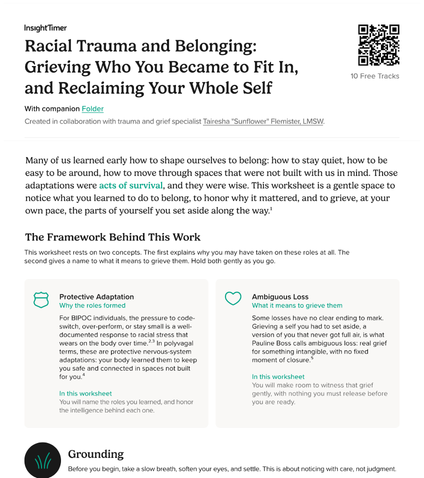
This worksheet serves as an active, somatic-experiential mapping exercise for sessions or self-directed reflection. Individuals are guided to begin with a body-centered grounding pause, identify survival roles they took on to fit in (such as "the strong one" or "staying quiet"), and honor the protective utility of those roles. Clinicians can use these structured pages to assist clients in gently naming their ambiguous grief, identifying which adaptations feel too heavy to carry forward, and reimagining relational spaces where connection does not require self-erasure.
Who This Worksheet Is For
This worksheet is primarily designed for BIPOC individuals, adult survivors of racial stress, and anyone who has historically felt pressured to alter their authentic self to gain safety and social acceptance. It is an indispensable somatic and relational psychoeducational tool for culturally responsive therapists, trauma-informed clinical social workers, grief counselors, and somatic coaches looking to support clients through systemic and internalized healing.
Expected Outcomes
- Greater compassion toward past coping roles
- Reduction in shame around code-switching or over-performing
- Enhanced language for naming ambiguous loss
- Greater clarity on what mutual, honest belonging could feel like
Related Topics
References
Comas-Díaz, L., Hall, G. N., & Neville, H. A. (2019). Racial trauma: Theory, research, and healing. American Psychologist, 74(1), 1–5.
Hewlin, P. F. (2003). And the award for best actor goes to...: Facades of conformity in organizational settings. Academy of Management Review, 28(4), 633–642.
Geronimus, A. T., Hicken, M., Keene, D., & Bound, J. (2006). "Weathering" and age patterns of allostatic load among Black and White adults in the United States. American Journal of Public Health, 96(5), 826–833.
Menakem, R. (2017). My Grandmother's Hands: Racialized Trauma and the Pathway to Mending Our Hearts and Bodies. Central Recovery Press.
Boss, P. (1999). Ambiguous Loss: Learning to Live with Unresolved Grief. Harvard University Press.

Frequently Asked Questions About Racial Trauma and Belonging: Grieving Who You Became to Fit In, and Reclaiming Your Whole Self Resources
© Copyright 2026 Insight Network Inc. All rights reserved.
If you are in a crisis or any other person may be in danger - don’t use this site. Use these resources