Worksheet
Permission Slips for the Soul: Practicing Self-Permission and Emotional Freedom
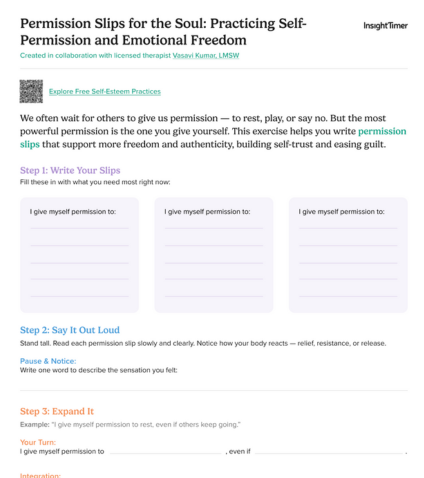
This worksheet helps you practice giving yourself the permissions you’ve been waiting to receive from others—permission to rest, to say no, to feel your feelings, or to choose your own pace. By writing and speaking your permission slips out loud, you release guilt, expand your sense of freedom, and strengthen self-trust. This exercise supports emotional authenticity and helps you honor your needs with clarity and compassion.

How to Use This Worksheet
Begin by filling in the permission slips with what you need most at this moment. Read them aloud slowly and notice how your body responds—whether with relief, resistance, or release. Then expand each permission by adding context or specifying what it means for you. Finish by identifying the permission you will commit to honoring this week, using the anchor phrase to reinforce your intention.
Who It’s For
This worksheet is designed for individuals who struggle with guilt, over-responsibility, perfectionism, people-pleasing, or emotional suppression. It is also supportive for anyone learning healthy boundaries, practicing self-compassion, or reconnecting with their needs and desires.
Expected Outcomes
• Greater freedom to meet your needs without guilt
• Stronger sense of self-permission and emotional autonomy
• Increased ability to set boundaries with clarity and ease
• More authenticity in your daily decisions and actions
• A deeper sense of self-trust and inner guidance
Related Topics
References
Kumar, Vasavi (2023). Say It Out Loud: Using the Power of Your Voice to Listen to Your Deepest Thoughts and Courageously Pursue Your Dreams. New World Library.
Neff, K. D. (2003). “Self-Compassion: An Alternative Conceptualization of a Healthy Attitude Toward Oneself.” Self and Identity, 2(2), 85–101.
Brown, B. (2012). Daring Greatly. Gotham Books.
Linehan, M. M. (2015). DBT Skills Training Manual (2nd ed.). Guilford Press.
Hayes, S. C., Strosahl, K. D., & Wilson, K. G. (1999). Acceptance and Commitment Therapy: An Experiential Approach to Behavior Change. Guilford Press.
Porges, S. W. (2011). The Polyvagal Theory: Neurophysiological Foundations of Emotions, Attachment, Communication, and Self-Regulation. W. W. Norton & Company.
Frequently Asked Questions About Permission Slips for the Soul: Practicing Self-Permission and Emotional Freedom Resources
© Copyright 2026 Insight Network Inc. All rights reserved.
If you are in a crisis or any other person may be in danger - don’t use this site. Use these resources