Worksheet
Managing OCD: Strategies for Reducing Reassurance-Seeking
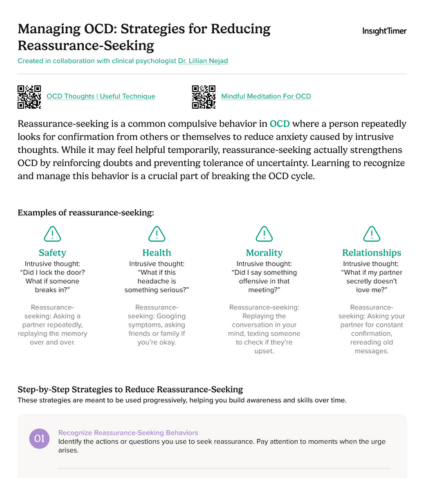
This OCD worksheet focuses on recognizing and reducing reassurance seeking—a common compulsion that offers short-term relief but reinforces anxiety and the OCD cycle. These strategies support individuals, parents, and therapists in breaking the cycle of seeking reassurance and fostering long-term resilience and control.

How to Use This Worksheet
Begin by reviewing the examples of reassurance seeking and noting personal triggers that drive this behavior. Use the prompts and exercises to identify the short-term relief of reassurance, reflect on its long-term impact, and practice techniques like response prevention and tolerating uncertainty.
Who This Worksheet Is For
This worksheet is for anyone with OCD or related anxiety disorders who struggles with reassurance seeking—including those in therapy, loved ones supporting someone with OCD, and mental health professionals seeking practical tools for treatment.
Expected Outcomes
- Increased awareness of reassurance-seeking triggers and patterns
- Improved ability to tolerate uncertainty and break the OCD cycle
- Practical experience using response prevention and alternative coping strategies
- Enhanced motivation and resiliency in managing OCD over time
Related Topics
References
Williams, M. T., Farris, S. G., & Turkheimer, E. (2023). How does “Pure-O” obsessive-compulsive disorder impact on a patient’s experience? Expert opinion and current literature. Expert Review of Neurotherapeutics, 23(12). https://doi.org/10.1080/14737175.2023.2273388

Frequently Asked Questions About Managing OCD: Strategies for Reducing Reassurance-Seeking Resources
© Copyright 2026 Insight Network Inc. All rights reserved.
If you are in a crisis or any other person may be in danger - don’t use this site. Use these resources