Worksheet
Dementia Risks and Protective Response
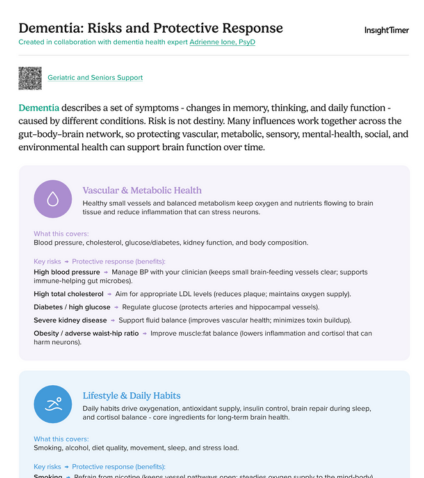
This dementia worksheet offers a practical overview of modifiable risk factors for cognitive decline and Alzheimer’s disease. Each section helps you reflect on daily choices and create small, achievable actions for long-term prevention and improved well-being.

by Insight Timer in collaboration with Adrienne Ione, PsyD
How to Use This Worksheet
Clients can begin by reviewing each category of dementia risk factors covered in the worksheet—vascular and metabolic health, lifestyle choices, sensory changes, mental health, social connection, and environmental factors. Then, reflect on current habits and health concerns and follow prompts to set specific, achievable goals—such as improving sleep, managing blood pressure, or increasing social activity—that support long-term dementia prevention.
Who This Worksheet Is For
This worksheet is designed for adults and older adults who want to reduce their risk of developing dementia through lifestyle and health changes, as well as caregivers supporting loved ones living with cognitive decline. Healthcare professionals can also use it as an educational resource to help patients understand modifiable risk factors like diabetes, smoking, hearing loss, depression, and inactivity, and create practical, preventive habits for healthy brain aging.
Expected Outcomes
- Increased awareness of dementia risk factors and protective responses
- Personalized action plan for improving daily habits linked to brain-body health
- Practical strategies for managing mental health
- Greater confidence in creating small, achievable changes to support cognitive function
Related Topics
References
Livingston, G., Huntley, J., Sommerlad, A., Ames, D., Ballard, C., Banerjee, S., … & Mukadam, N. (2020). Dementia prevention, intervention, and care: 2020 report of the Lancet Commission. The Lancet, 396(10248), 413-446. https://doi.org/10.1016/S0140-6736(20)30367-6
The Lancet Commission citation is not the most current: Livingston, Gill
et al. Dementia prevention, intervention, and care: 2024 report of the
Lancet standing Commission The Lancet, Volume 404, Issue 10452, 572 -
628
Ione, A. (2024). Dementia Grief Therapy: A Handbook for Healthcare
Professionals (1st ed.). Springer.
Modifiable risk factors for stroke, dementia and late-life depression: a systematic review and DALY-weighted risk factors for a composite outcome” by Jasper Senff, Reinier Willem Pieter Tack, Akashleena Mallick, Leidys Gutierrez-Martinez, Jonathan Duskin, Tamara N Kimball,
Benjamin Y Q Tan, Zeina N Chemali, Amy Newhouse, Christina Kourkoulis, Cyprien Rivier, Guido J Falcone, Kevin N Sheth, Ronald M Lazar, Sarah Ibrahim, Aleksandra Pikula, Rudolph E Tanzi, Gregory L Fricchione, Hens Bart Brouwers, Gabriel J E Rinkel, Nirupama Yechoor, Jonathan Rosand, Christopher D Anderson and Sanjula D Singh, 3 April 2025, Journal of Neurology, Neurosurgery & Psychiatry.
DOI: 10.1136/jnnp-2024-334925 https://scitechdaily.com/17-modifiable-lifestyle-factors-that-protect-your-brain-from-aging-and-dementia/

Frequently Asked Questions About Dementia Risks and Protective Response Resources
© Copyright 2026 Insight Network Inc. All rights reserved.
If you are in a crisis or any other person may be in danger - don’t use this site. Use these resources