Worksheet
Chronic Pain and the Pain - Tension Cycle
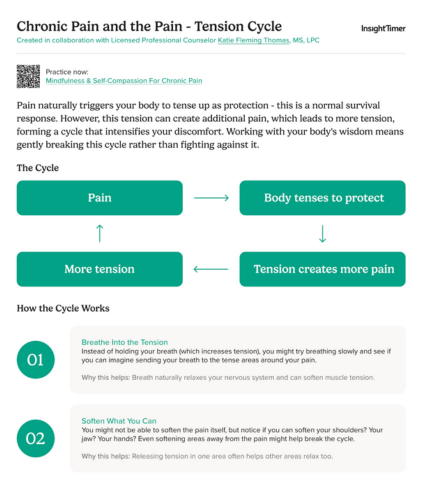
This worksheet explains how chronic pain and physical tension reinforce each other, forming a cycle that can intensify discomfort. Pain naturally makes the body tense as a protective response, but that tension can then create more pain—leading to a loop that becomes hard to break. This worksheet helps you understand how the cycle works and offers gentle, body-based practices that support working with your body instead of fighting against it.

How to Use This Worksheet
Begin by reviewing the diagram that outlines how pain triggers tension, and how tension contributes to additional pain. Then explore each practice: breathing into areas of tightness, softening what you can, adding small movements, noticing the difference between pain and tension, and identifying one area of ease in your body. These steps help you observe your body’s responses with more clarity and compassion. The goal is not to eliminate pain, but to interrupt the cycle by reducing added tension.
Who It’s For
This worksheet is designed for individuals living with chronic pain, muscle tightness, or pain-related guarding responses. It supports anyone who wants to better understand their body’s natural reactions to pain and practice gentle awareness-based strategies to reduce added tension.
Expected Outcomes
- Better understanding of how the pain–tension cycle works
- Increased awareness of tension patterns around pain
- Ability to soften secondary tension, even if pain persists
- Gentle movement options that support ease without strain
- Greater capacity to work with the body rather than against it
Related Topics
References
Blackstone, V. M., Siniako, O. S., & Gordon, A. (2024). The Pain Reprocessing Therapy Workbook: Using the Brain’s Neuroplasticity to Break the Cycle of Chronic Pain. Oakland, CA: New Harbinger Publications.
Sarno, J. E. (1998). Healing Back Pain: The Mind-Body Connection. New York, NY: Warner Books.
Lundwall, A., Ryman, A., Bjarnegård Sellius, A., & Mannerkorpi, K. (2019). Pain requires processing: How the experience of pain is influenced by Basic Body Awareness Therapy in patients with long-term pain. Body, Movement and Dance in Psychotherapy. https://www.bodyworkmovementtherapies.com/article/S1360-8592(19)30077-4/fulltext
Van der Maas, L. C. C., Koke, A. J. A., Pont, M., Bosscher, R. J., Twisk, J. W. R., Janssen, T. W. J., & Peters, M. L. (2016). Body awareness as an important target in multidisciplinary chronic pain treatment: Effects on treatment outcome. European Journal of Pain, 20(9), 1357–1366. https://pubmed.ncbi.nlm.nih.gov/26550959/
Vlaeyen, J. W. S., & Linton, S. J. (2000). Fear-avoidance and its consequences in chronic musculoskeletal pain: A state of the art. Pain, 85(3), 317–332. https://pubmed.ncbi.nlm.nih.gov/10781906/
Zeidan, F., Grant, J. A., Brown, C. A., McHaffie, J. G., & Coghill, R. C. (2012). Mindfulness meditation-related pain relief: Evidence for unique brain mechanisms. Journal of Neuroscience, 32(15), 5540–5548. https://pmc.ncbi.nlm.nih.gov/articles/PMC3580050/
Frequently Asked Questions About Chronic Pain and the Pain - Tension Cycle Resources
© Copyright 2026 Insight Network Inc. All rights reserved.
If you are in a crisis or any other person may be in danger - don’t use this site. Use these resources