Worksheet
Anxiety Workbook
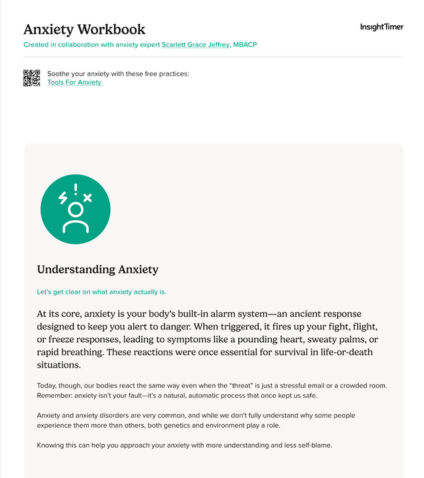
This workbook helps users understand how anxiety works and guides them through practical exercises for noticing anxious thoughts and reducing their impact. It focuses on self-compassion, awareness, recognizing cognitive distortions, and easy daily tools to support stress relief.

How to Use This Workbook
This workbook can help clients recognize anxious patterns and develop calming routines. Work through each section at a comfortable pace, using the reflection questions and exercises to build self-awareness and reduce anxiety in day-to-day life.
Who This Workbook Is For
Designed for adults and teens who struggle with anxiety in daily situations, this resource is ideal for anyone seeking practical, gentle coping strategies and greater self-compassion. It’s also suitable for mental health professionals and educators supporting clients or students.
Expected Outcomes
- Clear understanding of anxiety symptoms and triggers
- Improved awareness of thought patterns and coping skills
- More calm, control, and confidence in everyday life
- Less self-criticism and greater self-compassion
Self-Awareness
Understanding The Trigger
Anxiety often has a starting point-a trigger that sets those feelings in motion. This trigger could be a thought, a memory, a physical sensation, or something that happens around you. Reflecting on a recent anxious moment and identifying what sparked it can give you valuable insight.
For example: hearing sudden loud noises, scrolling through upsetting news, getting unexpected feedback, remembering a past mistake, or even skipping a meal.
Think about a few recent times you felt anxious. What were some common triggers in those moments? List them below.
Cognitive Distortions
Common Types Of Unhelpful Thinking
Everyone sometimes experiences unhelpful ways of thinking that can skew how we see ourselves, others, and the world. These habitual mental patterns, known as cognitive distortions, can shape our emotions and actions in misleading ways. While it's common to have these thoughts from time to time, they may cause difficulties if they happen often.
Here are some of the most common types of cognitive distortions. Read more in the Cognitive Distortions Cheat Sheet on the Therapist Hub.
All-or-Nothing Thinking: Viewing situations in extremes, with no middle ground; things are either all good or all bad.
Should Statements: Rigidly thinking in terms of how you or others "should" or "must" behave, leading to guilt or frustration when reality doesn't match expectations.
Mental Filtering: Focusing solely on the negative aspects of a situation and ignoring the positives.
Jumping to Conclusions: Making negative interpretations without actual evidence.
Overgeneralization: Drawing broad conclusions from a single event or piece of evidence, often expecting repeated failure based on one setback.
Emotional Reasoning: Believing that because you feel a certain way, it must be true (e.g., "I feel anxious, so something bad must be happening").
Learning to reframe your thoughts before they spiral can be a powerful way to calm yourself and manage anxiety. This isn't about forcing yourself to be positive-it's about bringing more balance and logic to your thinking. Anxiety often pushes us toward worst-case scenarios or harsh self-judgment, so practicing more realistic self-talk can really help.
Original thought:
"I embarrassed myself in that conversation-everyone must think I'm awkward."
Reframe:
"I felt awkward for a moment, but everyone has those times. Most people probably didn't even notice, and it doesn't define who I am."
Original thought:
"If I don't get this perfect, everything will fall apart."
Reframe:
learning."
"I want to do my best, but it's okay if things aren't perfect. I can handle whatever happens, and mistakes are part of
What are some of the common cognitive distortions you recognize in your thinking patterns? Write them below.
Can you identify any recurring thoughts that you could try to reframe? Write them below and consider how you might view them in a more balanced or compassionate way.
Anxiety & The Body
How Anxiety Affects Your Nervous System
Sometimes, anxiety can linger even after you've tried to reframe your thoughts. This doesn't mean that reframing isn't useful-practicing it regularly can be very effective over time—but it often signals that your nervous system is too activated to be soothed by logic alone.
You might notice that, even when you know your anxious thoughts aren't entirely logical, your body still feels on edge.
That's because anxiety triggers the sympathetic nervous system-the part of us wired to detect threats and prepare for action.
When this happens, your body needs reassurance as much as your mind. Below are some simple ways to help regulate your nervous system. Find more information in the Vagus Nerve Stimulation worksheet on the Therapist Hub.
- Breathwork
- Yoga and meditation
- EFT tapping
- Aromatherapy
- Acupuncture
- Acupressure
- Reflexology
- Therapeutic massage
- Grounding techniques
My Anxiety Journal
Space For You To Reflect
What were my anxious thoughts today? i.e. I'm not good enough, it's going to go wrong
Can l identify a trigger?
i.e. an event, an image, a conversation with somebody
What did I feel was at threat? i.e. my health, my safety, my social status
Did I recognise any unhelpful thinking styles? i.e. catasphrosing, all or nothing thinking
My Anxiety Journal
Reflecting On My Strategies
How I re-phrased my thoughts:
i.e. "I don't have to do things perfectly, I can find a middle ground"
I practiced regulating my nervous system by:
i.e. I practiced a breathing exercise, I tried a tapping technique
Other ways I supported myself:
i.e. talking to a friend, drinking less caffeine, taking breaks
Related Topics
References
Beck, A. T. (1976). Cognitive Therapy and the Emotional Disorders. New York: International Universities Press.
Burns, D. D. (1980). Feeling Good: The New Mood Therapy. New York: William Morrow.
Neff, K. D. (2003). Self-compassion: An alternative conceptualization of a healthy attitude toward oneself. Self and Identity, 2(2), 85–101.
Porges, S. W. (2011). The Polyvagal Theory: Neurophysiological Foundations of Emotions, Attachment, Communication, and Self-Regulation. New York: W. W. Norton & Company.
Frequently Asked Questions About Anxiety Workbook Resources
© Copyright 2026 Insight Network Inc. All rights reserved.
If you are in a crisis or any other person may be in danger - don’t use this site. Use these resources