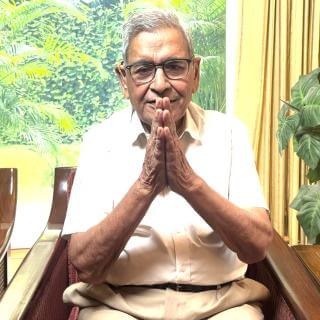
Namaskar,
Jai Jinendra,
Welcome to the 8th lecture,
Supreme trait.
Called Uttam Tyag.
Or spiritual giving up,
Sharing.
Today we discussed the eight spiritual virtues.
Tyag or giving up.
Sharing,
Charity or philanthropy.
What does Thyag really mean?
At the simplest level,
It means giving up.
Or sharing.
What we have beyond what we genuinely need.
During the early days,
Seven days,
We have discussed different spiritual values.
And practices that help us reduce our inner pain and move towards greater peace and happiness.
Today we come to another important question.
What should we do with what we have?
Jain texts describe practical giving or sharing in four broad forms.
Food,
Medicine,
Knowledge and fearlessness or protection from fear.
Giving and sharing helps us reduce our attachment to possessions and at the same time increases our own happiness.
Material possessions and even some psychological possessions.
Can become like chains.
We become attached to them.
And they begin to control us.
As our attachment increases,
We may lose sight of our natural nature.
Which according to Jain philosophy is one of peace,
Happiness and bliss.
Giving up or sharing what binds us is therefore called tyag.
Of course,
Complete renunciation is possible only for those who have chosen the life of an ascetic or a renouncer.
And have given up all worldly possessions in pursuit of spiritual liberation.
But we are householders.
We cannot simply give up everything.
So what can we do?
For us.
Tyag begins by putting reasonable limits on what we possess and then sharing whatever is beyond those limits with others who need it.
The limit will be different for each person.
What is sufficient for one person may be excessive for another.
But the important thing is to set a limit.
Once we decide what is enough for me,
Sharing becomes much easier.
For example,
Some organizations and employers encourage or facilitate regular contributions from salaries or profits of employees directly towards charitable causes.
Our Jain tradition particularly speaks of four forms of giving.
Namely food for those who are hungry,
Medicines or medical help,
To those who are sick.
Knowledge by providing books,
Education or other means of learning to those who seek knowledge and have inadequate facilities.
And fearlessness by protecting and helping others when they are vulnerable or scared or afraid of.
All of us have something that we can share.
It may be money.
It may be food.
It may be of our knowledge.
It may be our time.
It may be our skills.
Or simply our presence and care.
Giving and sharing creates peace.
Giving and sharing can become powerful means of creating peace and happiness in society.
Why?
Because sharing reduces jealousy.
Competition.
And animosity.
And its strengthens coexistence and interdependence.
But there is one important condition.
True grieving does not come with expectations or something in the time.
The moment we expect something in return,
Giving can become a transaction and expectations themselves can become a source of pain.
We can see sharing everywhere in life.
A teacher gives knowledge to students.
Students in return may express gratitude and respect.
To them.
Parents share their love,
Values and care with their children.
Families support one another.
Communities support their members.
And those who have more,
Then the need can share with those who have less.
To enhance interdependence because they also help the rich.
In some way.
This is the principle of interdependence and co-existence.
Even the richest person cannot experience true serenity if he or she does not share prosperity with those who are less fortunate.
Giving is not about money only.
We should also remember that giving does not mean.
.
.
Giving money.
I'm lonely.
I am repeating this.
Sometimes the most valuable form of giving is simply serving another person in need.
Think of a lonely person.
Think of someone who is sick.
Imagine how that person feels.
When somebody comes.
It spends time with them.
Listen to them.
Takes care of them.
Or health center.
Find a solution to their problem.
This is an excellent way of giving.
In fact,
Sometimes our time,
Attention,
Compassion and presence are more valuable than money.
We have seen many examples of this.
For example,
The campaign organized by Rohan and his father Manish.
Where they ran a marathon to raise money for the education of the poor students.
It is an excellent example of sharing.
During the COVID pandemic.
Many people donated money,
Food,
Medicines,
And other forms of help to patients and affected families.
Community health camps and charitable programs.
By Jains and others are also examples of people coming together.
To share their resources for the benefit of others.
Someone has rightly said.
In this world,
It is not what we think.
But what we give that makes us rich.
Please think over it.
Charity and social responsibility.
We should also remember that the government alone cannot take care of all the welfare needs of the society.
Individuals,
Philanthropists,
Charitable organizations,
And compassionate citizens have contributed enormously to the welfare of humanity.
We can think of people such as Bill Gates,
Warren Buffett,
And the Tata family in India.
Who have devoted substantial resources and time to philanthropy.
Let us also pause for a moment.
And think about the people.
Whom we remember most.
In history or from history.
People such as Mahatma Gandhi.
Who gave up many worldly comforts and devoted his life serving society and the freedom of India stands out.
Almost every religious and spiritual tradition in the world teaches the importance of giving charity,
Compassion and service.
Now ask yourself.
Whom do you remember most with respect?
And whom do we not want to remember?
The answer tells us something.
About the value we admire.
So let us make a conscious effort.
To do some charitable or selfless work for ourselves.
Of our choice.
It does not have to be large.
It simply has to be sincere.
As this is from the heart.
How can we practice?
Giving a tag in everyday life.
Let us look at a few simple examples.
Situations.
We start with the family first.
Be willing to serve and share with other family members rather than always demanding from them.
Ask yourself.
What can I do for my family today?
Rather than only asking,
What can my family do for me?
Second in school or college.
Offer your time and skills in educational and social activities in the school.
Help students who are weaker than you.
Be disciplined in your class and studies and other extracurricular activities.
Respect your teachers and be considerate towards your classmates and friends.
Now we move to the society.
Pay your taxes and other legitimate dues honestly.
Participate in charitable activities.
And community activities.
That's pretty long.
Capacity.
Warrant your time and skills wherever possible.
And forth we move to our own lifestyle.
Put reasonable limits on your possessions.
It's difficult,
But if you think,
You can do it.
When we reduce unnecessary projections.
We often become more relaxed.
We also free up time,
Energy,
And resources that can be used for our career,
Our family,
Our community,
And our own inner development.
The principle of interdependence reminds us that we do not live alone.
We are part of a larger community.
And when we contribute to that.
Community.
We strengthen not only others but also ourselves.
We never know when,
Where,
Or in what form.
And opportunity will come to test our compassion and generosity.
So let us remain ready.
And vigilant.
To share.
I conclude this.
Session.
By saying that the essence of uttam tyag,
Or supreme giving up,
Is not simply to give away something we no longer want.
It is to gradually reduce our attachment.
Put reasonable limits on our possessions and willingly share what we can with others.
Let us ask ourselves three simple questions.
What do I have?
What do I really need?
And finally,
What can I share?
Or simple term SPARE.
If you begin practicing this sincerely,
We will discover something very beautiful.
The more we share.
The less we feel bound by what we possess,
And the less attached we become,
The greater the possibility of experiencing inner peace and happiness.
So let us begin today.
Let us share our possessions,
Our time,
Our knowledge,
Our skills,
And our care.
And in doing so,
Enhance not only the happiness of others,
But also our own happiness.
Namaskar.
Jai Jinendra.
Thank you.