Today on Empowered Wellness Radio,
Gratitude is often presented as a list of things we ought to appreciate.
But gratitude is not an obligation,
And it is not a demand that we pretend everything is fine.
At its most useful,
Gratitude allows the brain and body to register something important.
This is difficult,
And something is helping.
It does not erase what hurts.
Refuses to let what helps go unnoticed.
Welcome to Empowered Wellness Radio with your host,
Jeanne Smith.
Jeanne is a board-certified massage therapist,
Wellness educator,
And former broadcaster with a practical,
Whole-person approach to health and well-being.
Each episode brings you useful information,
Thoughtful conversation,
And simple,
Effective ways to better understand your body,
Care for yourself,
And take an active role in your own well-being.
And now,
Here's your host,
Jeanne Smith.
Today,
We are talking about gratitude,
But not the version that asks you to override what is hard,
Force a smile,
Or search for a silver lining before you're ready.
I want to look at gratitude as something more honest,
More useful,
And much more grounded.
The simple act of letting what helps count,
Not instead of the difficulty alongside it,
Most of us have heard some version of the advice to count our blessings,
Keep a gratitude journal,
Or write down three things we are grateful for at the end of the day.
Those practices can be helpful,
But gratitude can also become one more thing we think we should be doing correctly.
One more assignment.
One more way to judge ourselves when we don't feel as positive as we think we're supposed to feel.
And that misses the point.
Genuine gratitude is not a performance.
It is a moment of recognition.
Something has helped me.
Something is supporting me.
Something brought relief,
Connection,
Beauty,
Or even a small measure of ease.
And for this moment,
I'm going to let myself notice it.
Our brains are very good at noticing what is wrong.
That is not a character flaw.
It is part of how we protect ourselves.
Pain demands attention.
Uncertainty keeps the mind searching.
And unfinished business has a way of following us from one room to the next.
The brain gives priority to information that may matter for our safety.
If something seems threatening,
Unresolved,
Or out of place,
Our attention is likely to return to it again and again.
That ability is useful,
But it can also narrow the picture.
When something hurts,
It can begin to feel as though the pain is the only thing happening in the body.
When one part of life is difficult,
It can cast a shadow over everything else.
When we are worried about what may happen next,
We can miss what is holding steady right now.
Gratitude does not ask the brain to stop noticing problems.
It gives the brain more information.
Yes,
This is difficult.
Difficult.
And this is also here.
Research on gratitude does show modest,
Meaningful benefits.
Across many studies,
Gratitude practices have been associated with improvements in well-being and positive emotion,
And with reductions in some symptoms of stress,
Anxiety,
And depression.
Some people also report better sleep,
Stronger social connection,
And more motivation to take care of themselves.
That does not mean gratitude cures disease,
Heals an injury,
Or erases depression.
And it does not mean that every physical health claim made about gratitude has been proven.
It hasn't.
What the research does suggest is that gratitude can support some of the conditions that help us cope.
It can shift what we pay attention to.
It can remind us that support exists.
It can strengthen our sense of connection with other people.
And it can interrupt,
Even briefly,
The feeling that what is wrong is the whole story.
This is where gratitude can become an agent of healing.
Not a cure.
Not a substitute for treatment.
An agent.
Something that participates in the process.
Something that helps create a little more room around what is difficult.
And there is an important difference between that kind of gratitude and emotional bypassing.
Emotional bypassing uses pleasant sounding words to shut the door on an uncomfortable experience.
I should just be grateful.
Other people have it worse.
At least it isn't,
And then we fill in the blank.
Everything happens for a reason.
Sometimes those words are offered with good intentions.
But when they arrive too quickly,
They can make a person feel more alone.
The message becomes,
Don't feel what you feel.
Find something positive and move on.
That is not the gratitude I am talking about.
Authentic gratitude does not require us to abandon our experience.
It makes room for more of it.
Grief and gratitude can exist together.
Pain and appreciation can exist together.
Anger can be present,
While love is present too.
We do not have to choose one truth and exile the other.
We can say,
This is hard.
And my feet are on the floor.
This is heavy,
And someone trustworthy is here.
This part of my body is still holding tension,
And one breath just moved a little more freely.
The difficult thing stays in the picture.
What helps is allowed to take its place beside it.
And that brings us to another distinction.
Noticing support is not always the same as receiving it.
We can name everything that should feel supportive and still not take any of it in.
We can know the chair is beneath us while still holding ourselves as if we might need to jump up at any moment.
We can know someone is trustworthy and still keep our guard fully in place.
We can know we are safe enough in this particular moment while the body continues to brace for the next one.
Knowing is important,
But receiving something we experience.
In the treatment room,
I see this in very practical ways.
A person may be lying on a table that is supporting the full weight of their body and still be holding an arm rigidly in the air for me.
They may be holding their breath during intense work without realizing it.
When I quietly remind them to breathe,
They notice.
The breath returns.
The arm becomes heavier in my hands.
The area I am working with may begin to soften.
The support was already there,
But now their body has started to receive it.
This is why gratitude does not have to begin with a grand statement about loving your life.
It can begin with something very small.
Very physical and very true.
The table is holding me.
One area has softened.
Even a little.
Someone steady is present with me.
This breath is slightly easier than the one before it.
Outside the treatment room.
It may be the chair holding you right now.
The ground beneath your feet,
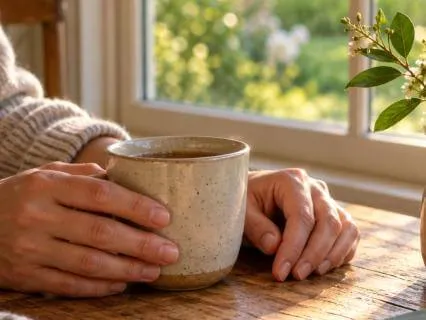
The warmth of a mug in your hands.
The person who checked on you.
The dog lying nearby.
The fact that you made it to this moment.
None of these things erases what is hard.
They simply give your attention something else that is also true.
I had a very ordinary example of this today.
I was sitting with my phone,
Working on this very episode about gratitude,
And my husband John said,
Put the phone down and let's go for a walk.
So I did.
The draft waited.
We took the walk,
And the walk was good.
There was nothing dramatic or life-changing about it.
It was simply an opportunity to notice that the person beside me wanted my company,
To let the unfinished work remain unfinished for a little while,
And to receive what was available in that moment.
That is what I mean by letting what helps count.
Gratitude does not always arrive as a powerful emotion.
Sometimes it is just the decision to stay with a good moment long enough to realize that you're having it.
If it feels comfortable,
You might try something with me now,
Wherever you are.
If you are driving,
Please keep your eyes open and your attention on the road.
You do not need to close your eyes for this practice.
Begin by noticing one thing that is supporting you in this moment.
It might be the surface beneath you,
The chair,
The floor,
The bed,
Or the ground beneath your feet.
Notice the places where your body meets that support.
You do not have to make it feel good.
You do not have to make it profound.
Just notice that it is there.
And that you do not have to hold all of your weight by yourself.
Quietly,
You might say to yourself,
This is here,
This is helping.
Let your attention rest with that support for one or two breaths.
If your mind moves towards something difficult,
That is okay.
You have not done anything wrong.
When you notice,
Simply return to the contact,
The support,
The simple fact that something is helping right now.
This is here.
This is helping.
Take one more breath with that.
And then,
Whenever you are ready,
Let the practice go and continue listening.
Healing is not only about resolving what hurts.
It is also about learning to recognize what helps and allowing that support to become part of our experience.
Practiced this way,
Gratitude can become an agent of healing.
It does not ask us to pretend that everything is OK.
It does not ask us to deny pain,
Ignore danger,
Or settle for something needs to change.
It simply reminds us that what is difficult does not have to be the only thing that counts.
At some point today,
Pause and notice one thing that is helping,
However ordinary it may seem.
And give it a moment of your full attention.
Let it land.
Let it count.
Thank you for listening.
You've been listening to Empowered Wellness Radio with Jeanne Smith.
Join us again next time for practical information,
Thoughtful conversation,
And simple tools you can put to use in your own life.
Until then,
Take good care of yourself.