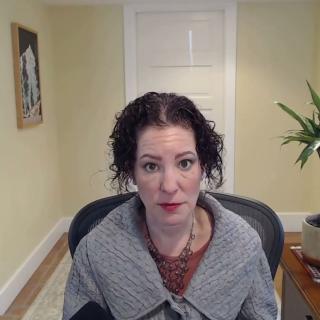
I am a huge fan of Dr.
Kristen Neff.
I call her the Queen of Self-Compassion and bow to her work and how she's helped so many of us around the world to become kinder to ourselves.
She is an Associate Professor in the Educational Psychology Department,
University of Texas at Austin.
However,
For our purposes here,
I want to talk about her self-compassion break.
Let's start with a primer on self-compassion from Dr.
Neff herself.
What is self-compassion?
Having compassion for oneself is really no different than having compassion for others.
Think about what the experience of compassion feels like.
First,
To have compassion for others.
You must notice that they are suffering.
If you ignore that homeless person on the street,
You can't feel compassion for how difficult his or her experience is.
Second,
Compassion involves feeling moved by others' suffering so that your heart responds to their pain.
The word compassion literally means to suffer with.
When this occurs,
You feel warmth,
Caring,
And the desire to help the suffering person in some way.
Having compassion also means that you offer understanding and kindness to others when they fail or make mistakes,
Rather than judging them harshly.
Finally,
When you feel compassion for another,
Rather than mere pity,
It means that you realize that suffering,
Failure,
And imperfection is part of the shared human experience.
There but for fortune go I.
Self-compassion involves acting the same way towards yourself when you are having a difficult time,
Fail,
Or notice something you don't like about yourself.
Instead of just ignoring your pain with a stiff upper lip mentality,
You stop to tell yourself,
And care for myself in this moment.
Instead of mercilessly judging and criticizing yourself for various inadequacies or shortcomings,
Self-compassion means that you are kind and understanding when confronted with personal failings.
After all,
Whoever said you are supposed to be perfect You may try to change in ways that allow you to be more healthy and happy,
But this is done because you care about yourself,
Not because you are worthless or unacceptable as you are.
Perhaps most importantly,
Having compassion for yourself means that you honor and accept your humanness.
Things will not always go the way you want them to.
You will encounter frustrations,
Losses will occur,
You will make mistakes,
Bump up against your limitations,
Fall short of your ideals.
This is the human condition,
A reality shared by all of us.
The more you open your heart to this reality,
Instead of constantly fighting against it,
The more you will be able to feel compassion for yourself and all your fellow humans in the experience of life.
She goes on to talk about the three elements of self-compassion.
They are,
Number one,
Self-kindness versus self-judgment.
Self-compassion entails being warm and understanding toward ourselves when we suffer,
Fail,
Or feel inadequate,
Rather than ignoring our pain or flagellating ourselves with self-criticism.
Self-compassionate people recognize that being imperfect,
Failing,
And experiencing life difficulties is inevitable,
So they tend to be gentle with themselves when confronted with painful experiences rather than getting angry when life falls short of set ideals.
People cannot always be or get exactly what they want.
When this reality is denied or fought against,
Suffering increases in the form of stress,
Frustration,
And self-criticism.
When this reality is accepted with sympathy and kindness,
Greater emotional equanimity is experienced.
Number two,
Common humanity versus isolation.
Frustration at not having things exactly as we want is often accompanied by an irrational but pervasive sense of isolation,
As if I were the only person suffering or making mistakes.
All humans suffer,
However.
The very definition of being human means that one is mortal,
Vulnerable,
And imperfect.
Therefore,
Self-compassion involves recognizing that suffering and personal inadequacy is part of the shared human experience,
Something that we all go through rather than being something that happens to me alone.
And number three,
Mindfulness versus over-identification.
Self-compassion also requires taking a balanced approach to our negative emotions so that feelings are neither suppressed nor exaggerated.
This equilibrated stance stems from the process of relating personal experiences to those of others who are also suffering,
Thus putting our own situation into a larger perspective.
It also stems from the willingness to observe our negative thoughts and emotions with openness and clarity so that they are held in mindful awareness.
Mindfulness is a non-judgmental,
Receptive mind state in which one observes thoughts and feelings as they are without trying to suppress or deny them.
We cannot ignore our pain and feel compassion for it at the same time.
Mindfulness also requires that we not be over identified with thoughts and feelings so that we are caught up and swept away by negative reactivity.
The following are my words.
Self-compassion is an ongoing practice.
I confess that while I profess that everyone practice self-compassion on a daily basis,
Often multiple times a day.
I am not always good at doing this myself.
Try as I might,
I am human and I often return to old habit patterns of being hard on myself.
I was in a session with my own therapist recently and she gently pointed this out.
It was a very humbling moment indeed.
She asked me in a soft voice,
Esther,
Have you heard of the self-compassion break?
No,
I had not.
My immediate reaction was a sharp rising of heat in my body,
Followed by feelings of shame and embarrassment,
Because I thought that I,
A supposed teacher of self-compassion,
Should have at least heard about this particular exercise.
A cosmic joke was being played on me,
And I decided to laugh with it instead of beating myself up.
Thus,
I was able to shine the light of self-compassion towards myself in that moment by finding the humor in the situation.
Then my therapist walked me through the steps using an example I had brought up of where I was being particularly hard on myself regarding a painful situation in my life.
I share it with you here in the hopes that it brings you as much peace,
Clarity,
And lightness as it did for me.
Again,
This is from the wonderful work of Dr.
Kristen Neff.
Everything the self-compassion break.
Think of a situation in your life that is difficult,
That is causing you stress.
Call the situation to mind and see if you can actually feel the stress and emotional discomfort in your body.
Now,
Say to yourself,
Part one,
This is a moment of suffering.
That's mindfulness.
Other options include,
This hurts,
Ouch,
This is stress.
Part two,
Suffering is a part of life.
That's common humanity.
Other options include,
Other people feel this way.
I'm not alone.
We all struggle in our lives.
Now,
Put your hands over your heart.
Feel the warmth of your hands and the gentle touch of your hands on your chest.
Say to yourself,
Part three,
May I be kind to myself?
You can also ask yourself,
What do I need to hear right now to express kindness to myself?
Is there a phrase that speaks to you in this particular situation?
Such as May I give myself the compassion that I need?
May I learn to accept myself as I am.
May I forgive myself.
May I be strong.
May I be patient.
This practice can be used any time of day or night and will help you remember to evoke the three aspects of self-compassion when you need it most.
I am doing this practice myself almost on a daily basis and I'm finding it absolutely transformational.
Try it out and see for yourself.
I hope it really helps you too.