The Railway Children by E.
Nesbitt Read by S.
D.
Hudson Chapter 1 The Beginning of Things They were not railway children to begin with.
I don't suppose they had ever thought about railways,
Except as a means of getting to Maskline and Cooks,
The pantomime,
Zoological gardens and Madame Tussauds.
They were just ordinary suburban children and they lived with their father and mother in an ordinary red brick fronted villa,
With coloured glass in the front door,
A tiled passage that was called a hall,
A bathroom with hot and cold water,
Electric bills,
French windows,
And a good deal of white paint,
And every modern convenience,
As the house agents say.
There were three of them.
Roberta was the eldest.
Of course,
Mothers never have favourites,
But if their mother had had a favourite,
It might have been Roberta.
Next came Peter,
Who wished to be an engineer when he grew up.
And the youngest was Phyllis,
Who meant extremely well.
Mother did not spend all her time in paying dull calls to dull ladies,
And sitting dully at home waiting for dull ladies to pay calls to her.
She was almost always there,
Ready to play with the children and read to them,
And help them do their house lessons.
Besides this,
She used to write stories for them when they were at school,
And read them aloud after tea.
And she always made up funny pieces of poetry for their birthdays and for other great occasions,
Such as the christening of the new kittens,
Or the refurnishing of the doll's house,
Or the time when they were getting over the mumps.
These three lucky children always had everything they needed.
Pretty clothes,
Good fires,
A lovely nursery with heaps of toys,
And a mother goose wallpaper.
They had a kind and merry nursemaid,
And a dog who was called James,
And who was their very,
Very own.
They also had a father who was just perfect.
Never cross,
Never unjust,
And always ready for a game.
At least if at any time he was not ready,
He always had an excellent reason for it,
And explained the reason to the children so interestingly and funnily.
You will think that they ought to have been very happy.
And so they were.
But they did not know how happy till the pretty life in the red villa was over and done with,
And they had to live a very different life indeed.
The dreadful change came quite suddenly.
Peter had a birthday,
His tenth.
Among his other presents were a model engine,
More perfect than you could ever have dreamed of.
The other presents were full of charm,
But the engine was fuller of charm than any of the others were.
Its charm lasted in its full perfection for exactly three days.
Then,
Owing either to Peter's inexperience or Phyllis's good intentions,
Which had been rather pressing,
Or to some other cause,
The engine suddenly went off with a bang.
James was so frightened that he went out and did not come back all day.
All the Noah's Ark people who were in the tender were broken to bits,
But nothing else was hurt except the poor little engine and the feelings of Peter.
The other said he cried over it,
But of course boys of ten do not cry,
However terrible the tragedies may be which darken their lot.
He said that his eyes were red because he had a cold.
This turned out to be true,
Though Peter did not know it when he had said it,
And next day he had to go to bed and stay there.
Mother began to be afraid that he might be sickening for measles when suddenly he sat up in bed and said,
I hate gruel,
I hate barley water,
I hate bread and milk.
I want to get up and have something real to eat.
What would you like?
Mother asked.
A pigeon pie,
Said Peter eagerly.
A large pigeon pie,
A very large one.
So Mother asked the cook to make a large pigeon pie.
The pie was made,
And when the pie was made it was cooked,
And when it was cooked Peter ate some of it.
After that his cold was better.
Mother made a piece of poetry to amuse him while the pie was being made.
It began by saying what an unfortunate but worthy boy Peter was,
And then it went on.
He had an engine that he loved with all his heart and soul,
And if he had a wish on earth it was to keep it whole.
One day,
My friends,
Prepare your minds,
I'm coming to the worst.
Quite suddenly a screw went mad,
And then the boiler burst.
With gloomy face he picked it up and took it to his mother,
Though even he could not suppose that she could make another.
For those who perished on the line,
He did not seem to care,
His engine being more to him than all the people there.
And now you see the reason why our Peter has been ill.
He soothes his soul with pigeon pie,
His gnawing grief to kill.
He wraps himself in blankets warm and sleeps in bed till late,
Determined thus to overcome his miserable fate.
And if his eyes are rather red,
His cold must just excuse it.
Offer him pie,
You may be sure,
He never will refuse it.
Father had been away in the country for three or four days.
All Peter's hopes for the curing of the afflicted engine were now based on his father,
But father was most wonderfully clever with his fingers.
He could mend all sorts of things.
He had often acted as veterinary surgeon to the wooden rocking horse.
Once he had saved its life when all human aid was despaired of,
And the poor creature was given up for lost.
And even the carpenter said he didn't see his way to do anything.
And it was father who mended the doll's cradle when no one else could,
And with a little glue and some bits of wood and a penknife,
Made all the Noah's Ark beasts as strong on their pins as ever they were,
If not stronger.
Peter,
With heroic unselfishness,
Did not say anything about his engine till after father had had his dinner and his after-dinner cigar.
The unselfishness was mother's idea,
But it was Peter who carried it out,
And it needed a good deal of patience too.
At last mother said to father,
Now dear,
If you're quite rested and quite comfy,
We want to tell you about the great railway accident,
And ask your advice.
All right,
Said father.
Fire away!
So then Peter told the sad tale and fetched what was left of the engine.
Oh,
Said father when he had looked the engine over very carefully.
The children held their breath.
Is there no hope?
Said Peter in a low,
Unsteady voice.
Hope?
Rather,
Tons of it!
Said father cheerfully.
But it'll want something besides hope.
A bit of brazing,
Say,
Or some solder,
And a new valve.
I think we'd better keep it for a rainy day.
In other words,
I'll give up Saturday afternoon to it,
And you shall all help me.
Can girls help to mend engines?
Peter asked doubtfully.
Of course they can.
Girls are just as clever as boys,
And don't you forget it.
How would you like to be an engine driver,
Phil?
My face would always be dirty,
Wouldn't it?
Said Phyllis in unenthusiastic tones.
And I expect I should break something.
I should just love it,
Said Roberta.
Do you think I could when I'm grown up,
Daddy?
Or even a stoker?
You mean a fireman,
Said daddy,
Pulling and twisting at the engine.
Well,
If you still wish it when you're grown up,
We'll see about making you a firewoman.
I remember when I was a boy.
Just then,
There was a knock at the front door.
Who on earth?
Said father.
An Englishman's house is his castle,
Of course,
But I do wish they built semi-detached villas with moats and drawbridges.
Ruth,
She was the parlour maid and had red hair,
Came in and said that two gentlemen wanted to see the master.
I've shown them into the library,
Sir,
Said she.
I expect it's a subscription to the vicar's testimonial,
Said mother,
Or else it'll be the choir holiday fund.
Get rid of him quickly,
Dear.
It does break up an evening so.
And it's nearly the children's bedtime.
But father did not seem to be able to get rid of the gentlemen at all quickly.
I wish we had got a moat and drawbridge,
Said Roberta.
Then,
When we didn't want people,
We could just pull up the drawbridge and no one could get in.
I expect father will have forgotten about when he was a boy if they stay much longer.
Mother tried to make the time pass by telling them a new fairy story about a princess with green eyes.
But it was difficult because they could hear the voices of father and the gentlemen in the library.
And father's voice sounded louder and different to the voice he generally used to people who came about testimonials and holiday funds.
Then the library bell rang and everyone breathed a breath of relief.
They're going now,
Said Phyllis.
He's wrong to have them shown out.
But instead of showing anybody out,
Ruth showed herself in and she looked queer,
The children thought.
Please him,
She said.
The master wants you just to step into the study.
He looks like the dead mum.
I think he's had bad news.
You better prepare yourself for the worst.
Perhaps it's a death in the family or a bank busted or.
.
.
That'll do,
Ruth,
Said mother gently.
You can go.
Then mother went into the library.
There was more talking.
Then the bell rang again and Ruth fetched a cab.
The children heard boots go out and down the steps.
The cab drove away and the front door shut.
Then mother came in.
Her dear face was as white as her lace collar and her eyes looked very big and shiny.
Her mouth looks just like a line of pale red.
Her lips were thin and not their proper shape at all.
It's bedtime,
She said.
Ruth put you to bed.
But you promised we should sit up tonight because father's come home,
Said Phyllis.
Father's been called away on business,
Said mother.
Come,
Darlings,
Go at once.
They kissed her and went.
Roberta lingered to give mother an extra hug and to whisper,
It wasn't bad news,
Mummy,
Was it?
Is anyone dead or.
.
.
Nobody's dead,
No,
Said mother.
And she almost seemed to push Roberta away.
I can't tell you anything tonight,
My pet.
Go,
Dear,
Go now.
So Roberta went.
Ruth brushed the girls' hair and helped them to undress.
Mother almost always did this herself.
When she had turned down the gas and left them,
She found Peter still dressed,
Waiting on the stairs.
I say,
Ruth,
What's up?
He asked.
Don't ask me no questions and I won't tell you no lies,
The redheaded Ruth replied.
You'll know soon enough.
Late that night,
Mother came up and kissed all three children as they lay asleep.
But Roberta was the only one whom the kiss woke.
And she lay mousy still and said nothing.
If mother doesn't want us to know she's been crying,
She said to herself as she heard through the dark the catching of her mother's breath.
We won't know it.
That's all.
When they came down to breakfast the next morning,
Mother had already gone out.
To London,
Ruth said,
And left them to their breakfast.
There's something awful the matter,
Said Peter,
Breaking his egg.
Ruth told me last night we should know soon enough.
Did you ask her,
Said Roberta with scorn?
Yes,
I did,
Said Peter angrily.
If you could go to bed without caring whether mother was worried or not,
I couldn't.
So there.
I don't think we ought to ask the servants things mother doesn't tell us,
Said Roberta.
That's right,
Miss Goody-goody,
Said Peter.
Preach away.
I'm not goody,
Said Phyllis,
But I think Bob is right this time.
Of course,
She always is in her own opinion,
Said Peter.
Oh,
Don't,
Cried Roberta,
Putting down her egg spoon.
Don't let's be horrid to each other.
I'm sure some dire calamity is happening.
Don't let's make it worse.
Who began?
I should like to know,
Said Peter.
Roberta made an effort and answered.
I did,
I suppose,
But.
.
.
Well,
Then,
Said Peter triumphantly.
But before he went to school,
He thumped his sister between the shoulders and told her to cheer up.
The children came home to one o'clock dinner,
But mother was not there and she was not there at tea time.
It was nearly seven before she came in,
Looking so ill and tired that the children felt they could not ask her any questions.
She sat into an armchair.
Phyllis took the long pins out of her hat,
While Roberta took off her gloves,
And Peter unfastened her walking shoes and fetched her soft velvety slippers for her.
When she had had a cup of tea and Roberta put eau de cologne on her poor head that ached,
Mother said,
Now,
My darlings,
I want to tell you something.
Those men last night did bring very bad news and father will be away for some time.
I am very,
Very worried about it and I want you all to help me and not to make things harder for me.
As if we would,
Said Roberta,
Holding mother's hand against her face.
You can help me very much,
Said mother,
By being good and happy and not quarrelling while I am away.
Roberta and Peter exchanged guilty glances.
For I shall have to be away a good deal.
We won't quarrel,
Indeed we won't,
Said everybody,
And meant it too.
Then,
Mother went on,
I want you not to ask me any questions about this trouble and not to ask anybody else any questions.
Peter cringed and shuffled his boots on the carpet.
You'll promise this too,
Won't you?
Said mother.
I did ask Ruth,
Said Peter suddenly.
I'm very sorry,
But I did.
And what did she say?
She said I should know soon enough.
It isn't necessary for you to know anything about it,
Said mother.
It's about business and you never do understand business,
Do you?
No,
Said Roberta.
Is it something to do with government?
For father was in a government office.
Yes,
Said mother.
Now it's bedtime,
My darlings,
And don't you worry.
It'll all come right in the end.
Then don't you worry either,
Mother,
Said Phyllis,
And we'll all be as good as gold.
Mother sighed and kissed them.
We'll begin being good the first thing tomorrow morning,
Said Peter as they went upstairs.
Why not now?
Said Roberta.
There's nothing to be good about now,
Silly,
Said Peter.
We might begin to try to feel good,
Said Phyllis,
And not call names.
Who's calling names?
Said Peter.
Bobby knows right enough when I say silly,
It's just the name as if I said Bobby.
Well,
Said Roberta.
No,
I don't mean what you mean.
I mean,
It's just a.
.
.
What is it father calls it?
A germ of endearment?
Good night.
The girls folded up their clothes with more than usual neatness,
Which was the only way of being good that they could think of.
I say,
Said Phyllis,
Smoothing out her pinafore.
You used to say it was so dull,
Nothing happening,
Like in books.
Now something has happened.
I never wanted things to happen to make mother unhappy,
Said Roberta.
Everything's perfectly horrid.
Everything continued to be perfectly horrid for some weeks.
Mother was nearly always out.
Meals were dull,
Sad and dirty.
The between mate was sent away and Aunt Emma came on a visit.
Aunt Emma was much older than mother.
She was going to Germany to be a governess.
She was very busy getting her clothes ready and they were very ugly,
Dingy clothes.
And she had them always littering about.
And the sewing machine seemed to whir on and on all day and most of the night.
Aunt Emma believed in keeping children in their proper places.
And they more than returned the compliment.
Their idea of Aunt Emma's proper place was anywhere where they were not.
So they saw very little of her.
They preferred the company of the servants,
Who were more amusing.
Cook,
If in a good temper,
Could sing comic songs.
And the housemaid,
If she happened not to be offended with you,
Could imitate a hen that has laid an egg,
A bottle of champagne being opened,
And could mew like two cats fighting.
The servants never told the children what the bad news was that the gentleman brought to father.
But they kept hinting that they could tell a great deal if they chose.
And this was not comfortable.
One day,
When Peter had made a booby trap over the bathroom door,
And it had acted beautifully as Ruth passed through,
That red-haired parlour maid caught him and boxed his ears.
If you don't mend your ways,
You'll go where your precious father's gone,
So I tell you straight.
Roberto repeated this to mother.
And next day,
Ruth was sent away.
Then came the time when mother came home and went to bed and stayed there two days.
And the doctor came,
And the children crept wretchedly about the house and wondered if the world was coming to an end.
Mother came down one morning to breakfast,
Very pale,
And with lines on her face that used not to be there.
And she smiled as well as she could and said,
Now,
My pets,
Everything is settled.
We're going to leave this house and go and live in the country.
Such a ducky,
Dear little white house.
I know you'll love it.
A whirling week of packing followed,
Not just packing clothes like when you go to the seaside,
But packing chairs and tables,
Covering their tops with sacking and their legs with straw.
All sorts of things were packed that you don't pack when you go to the seaside.
Crockery,
Blankets,
Candlesticks,
Carpets,
Bedsteads,
Saucepans,
And even fenders and fire irons.
The house was like a little furniture warehouse.
I think the children enjoyed it very much.
Mother was very busy,
But not too busy now to talk to them and read to them,
And even to make a bit of poetry for Phyllis to cheer her up when she fell down with a screwdriver and ran it into her hand.
Are you going to pack this,
Mother?
Pointing to the beautiful cabinet inlaid with red turtle shell and brass.
We can't take everything,
Said Mother.
But we seem to be taking all the ugly things,
Said Roberta.
We're taking all the useful ones,
Said Mother.
We've got to play at being poor for a bit,
My chigga-biddy.
When all the ugly,
Useful things had been packed up and taken away in a van by men in green bays aprons,
The two girls and Mother and Aunt Emma slept in the two spare rooms where the furniture was all pretty.
All their beds had gone.
A bed was made up for Peter on the drawing-room sofa.
I say,
This is larks,
He said,
Wriggling joyously as Mother tucked him up.
I do like moving.
I wish we moved once a month.
Mother laughed.
I don't,
She said.
Good night,
Peterkin.
As she turned away,
Roberta saw her face.
She never forgot it.
She whispered all to herself as she got into bed,
How brave you are,
How I love you.
Fancy being brave enough to laugh when you're feeling like that.
Next day,
Boxes were filled and boxes and more boxes.
And then,
Late in the afternoon,
A cab came to take them to the station.
Aunt Emma saw them off.
They felt that they were seeing her off,
And they were glad of it.
But all those poor little German children she's going to governess,
Whispered Phyllis,
I won't be them for anything.
At first,
They enjoyed looking out of the window.
But when it grew dark,
They grew sleepier and sleepier,
And no one knew how long they had been in the train.
When they were roused by Mother shaking them gently and saying,
Wake up,
Dears,
We're there,
They woke up,
Cold and melancholy,
And soon shivering on the drafty platform while the luggage was taken out of the train.
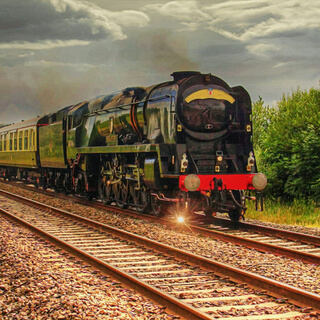
Then the engine,
Puffing and blowing,
Set to work again and dragged the train away.
The children watched the tail lights of the guards van disappear into the darkness.
This was the first train the children saw on that railway,
Which was in time to become so very dear to them.
They did not guess then how they would grow to love the railway,
And how soon it would become the centre of their new life,
Nor what wonders and changes it would bring to them.
They only shivered and sneezed and hoped the walk to the new house would not be long.
Peter's nose was colder than he ever remembered it to have been before.
Roberta's hat was crooked,
And the elastic seemed tighter than usual.
Phyllis' shoelaces had come undone.
Come,
Said Mother,
We've got to walk,
There aren't any cabs here.
The walk was dark and muddy.
The children stumbled a little on the rough path,
And once Phyllis absently fell into a puddle and was picked up damp and unhappy.
There were no gas lamps on the road,
And the road was uphill.
The cart went at a foot's pace,
And they followed the gritty crunch of its wheels.
As their eyes got used to the darkness,
They could see the mound of boxes swaying dimly in front of them.
A long gate had to be opened for the cart to pass through,
And after that the road seemed to go across fields,
And now it went downhill.
Presently a great dark lumpish thing showed over to the right.
There's the house,
Said Mother.
I wonder why she shut the shutters.
Who's she?
Asked Roberta.
The woman I engaged to clean the place and put the furniture straight and get supper.
There was a low wall and trees inside.
That's the garden,
Said Mother.
It looks more like a dripping pan full of black cabbages,
Said Peter.
The cart went on along by the garden wall and round to the back of the house,
And here it clattered onto a cobbled stone yard and stopped at the back door.
There was no light in any of the windows.
Everyone hammered at the door,
But no one came.
The man who drove the cart said he expected Mrs.
Vahey had gone home.
You see,
Your train was that late,
Said he.
But she's got the key,
Said Mother.
What are we to do?
Oh,
She left that under the doorstep,
Said the cart man.
Folks do hear abouts.
He took the lantern off his cart and stooped.
Ah,
Here it is,
Right enough,
He said.
He unlocked the door and went in and set his lantern on the table.
Got a candle,
Said he.
I don't know where anything is.
Mother spoke rather less cheerfully than usual.
He struck a match.
There was a candle on the table and he lighted it.
By its thin little glimmer,
The children saw a large bare kitchen with a stone floor.
There were no curtains,
No hearth rug.
The kitchen table from home stood in the middle of the room.
The chairs were in one corner and the pots,
Pans and brooms and crockery in another.
There was no fire and the black grate showed cold,
Dead ashes.
As the cart man turned to go out after he brought in the boxes,
There was a rustling,
Scampering sound that seemed to come from inside the walls of the house.
What's that?
Cried the girls.
It's only the rats,
Said the cart man.
And he went away and shut the door and the sudden draft of it blew out the candle.
Oh dear,
Said Phyllis.
I wish we hadn't come.
And she knocked a chair over.
Only the rats,
Said Peter in the dark.