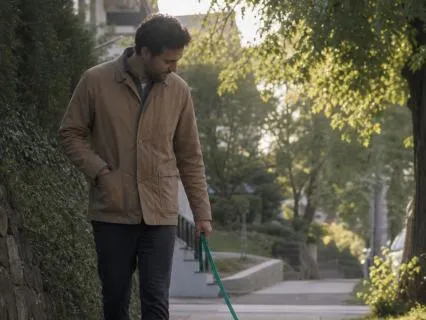
Theo is sitting at his kitchen table at 11 at night with a printed letter in front of him and a cup of tea he made 40 minutes ago and forgot about.
The tea has gone the color of the table and there is a skin on it.
The kitchen is the kind that goes very quiet after 10,
So the fridge has the room to itself and every so often it clicks and settles and starts again.
North of where he lives.
It runs for two years.
It is the kind of job he has described at parties as the thing you would do if you were braver.
And now it is on his table in a font he finds slightly too small.
He has 11 days to answer.
Theo is invented.
The letter,
The cold tea,
And the 11-day deadline hold a question many people know.
He is 34.
He has read the letter enough times that the words have gone quiet and the shape of the paragraph is what he sees.
He knows where the line breaks full.
He knows there is a comma in the third sentence that somebody should have removed.
He has squared the paper to the edge of the table twice this evening,
The way you tidy a thing you are about to be honest with.
And here is what Theo has been doing with those 11 days and with the 5 months of conversation that came before them.
He has been waiting for the decision to tell him something.
Explain the last 10 years and organize the next 10.
He wants the letter to hand him a direction,
In the way a road sign hands you a direction,
So that he can stop holding the question and start being somebody with a life that makes sense from the outside.
That is a great deal to ask of a job in a city four hours north.
Shape of a saucepan he owns.
When a friend asked him about a week away in October,
He said he would know more soon.
He has been saying he will know more soon since April.
That sentence has become the thing he says.
He hears the shape of it leaving his mouth now.
He can feel it land softly on the person in front of him and he watches them accept it because it is a reasonable thing for a person to say and then he carries it home and puts it down in the hallway with the boxes.
There is a note on his phone with two columns in it.
The note has 31 lines.
He has read it in bed,
On trains and once in a car park outside a supermarket with the engine running and the heater on for 20 minutes in his coat.
He has changed the headings on those columns twice.
He has added lines and taken lines away.
The note has grown longer and steadier and more detailed,
And it has stayed exactly as open as it was in April.
He has asked six people what they would do.
Every one of them gave him a thoughtful answer,
And each thoughtful answer worked for about an hour.
It would sit in him like a decision for the length of a walk home,
And then it would thin out and the note would come back out of his pocket.
He has begun to feel a small private embarrassment about asking,
Which is why the sixth conversation happened with somebody he barely knows.
So let me take you through one day of his,
Because that is where this goes.
He wakes at 6.
40,
A few minutes ahead of the alarm,
Which has been happening for weeks.
He lies there for a while,
With the decision already running,
The way you might lie there with a song already playing.
He can hear her kitchen behind her,
A tap,
A cupboard door,
Something being poured with real commitment.
The fact that the post ends after two years and then he is 36 and starting again somewhere with a new set of colleagues and a new set of boxes.
Ruth listens to all of it.
She is good at listening and she waits until he is properly finished,
Which takes a while.
Then there is a small gap on the line where she decides whether to say the thing she is about to say.
And then she asks him a question.
Question that sits well outside the columns.
She says,
What do you actually do on a good day?
Theo says,
What do you mean a good day?
And she says,
A day where you get into bed and it was a good day.
What happened in it?
Here is what Theo does and I think it is deeply human.
He answers with the columns again He says a good day would be one where he had made the decision He says he will be able to answer that question properly once he knows what he is doing with the next two years He hears himself do it There is a half second in the middle of his own sentence where the question and his answer sit apart from each other and he can feel the distance between them and he keeps going because the columns are the material he has been holding for five months.
Ruth lets it go because one of her children is doing something in the next room that needs her immediate attention.
She tells him she loves him and she will call at the weekend and she goes.
And the question stays behind in his kitchen after she has gone.
He puts the phone face down on the ladder,
Which is where the phone lives now.
He has 20 minutes before he leaves and he spends four of them standing at the sink with the tap running over a bowl he has already washed.
At 7 he leaves the flat because at 7 he always leaves the flat.
Three doors down there is a woman called Eva who is 81.
In February an ambulance came for her at 4 in the morning.
Theo stood on the pavement in a coat over his pajamas while they brought her out.
The blue light went round and round the fronts of the houses and the street did that thing where the upstairs windows come on.
One at a time.
He watched the doors close.
He went back inside and lay awake and listened to his own heating come on at 6.
He carried it for two days.
Then he wrote his number on a piece of paper and put it through her door.
He did it mostly because he felt strange about having watched and he stood on her step for a second afterwards with the feeling that he had done something slightly odd.
She rang him.
That is the part he still finds surprising.
She rang him three weeks later,
After the hip,
And her voice was smaller than he expected and completely direct,
And she asked whether he might walk her dog in the mornings until she was steadier on the stairs.
She offered to pay him.
He talked her out of it and they settled on the walk being free and Eva being mildly irritated about it,
Which is an irritation she renews every few weeks so that he understands it is still live.
The dog is called Basil.
Basil is nine and shaped like a footstool.
Five months later,
Theo is still doing the walk.
The door is on the latch at 7.
There is a saucer on the hall table with a spare key in it and two dog biscuits.
The saucer is put there the night before by a woman with a new hip who has to come down the stairs to do it.
There are 14 stairs.
Theo knows the number because he has stood in that hallway and heard her come down them,
Slowly,
One hand on the rail and one hand flat on the wall.
Eva says the same two things every morning.
She says been fed and she says take a coat whatever the weather is doing.
She says both things from the landing at the top of the stairs in a dressing gown with one hand on the rail and the whole smells of toast and of a radiator that has been on since 6.
The route takes 40 minutes.
Bezel stops at the third lamppost on the main road and will stay there for as long as anybody allows it.
There is a man with a newspaper on the corner by the bridge who says good morning to the dog and ignores Tio entirely.
And Tio has come to look forward to this.
There is a place halfway round where the path goes under trees and the sound of the road drops away for about 90 seconds and then comes back.
Tio has done this walk roughly 150 times.
He has done it with a cold and on the morning after a very long night and in rain that made the whole arrangement faintly ridiculous alongside dog who has strong views about rain.
And on this particular morning,
Somewhere under the trees,
With the road gone quiet and Basil deeply involved with a smell at the base of a fence,
Ruth's question comes back.
What do you actually do on a good day?
And what arrives is this.
He has a note on his phone with 31 lines in it describing two possible lives in a great deal of detail.
Outside all 31 lines.
He has been treating these 5 months as a corridor,
A waiting area between the life he had and whichever real life the decision is going to hand him.
And 150 mornings have happened inside that corridor.
150 times he has got up and put his shoes on and gone three doors down and let himself in.
There is a woman a few meters from his front door who arranges her morning around him.
She goes down 14 stairs the night before to put biscuits in a saucer so they will be ready at 7.
That is a fact about how his life currently works.
And it has been true the whole time the large question has been sitting open on his kitchen table.
And what he feels standing there under the trees has a warm edge of embarrassment in it.
He has spent 5 months asking 6 people a very large question.
Ruth's question is a small one.
Answering itself in a saucer three doors from his own front door at 7 every morning for 150 mornings.
He stands there a while,
Basil has finished with the fence and is looking back at him with the particular patience of a dog who is being kept waiting by a human being having a thought.
Here is that idea again now that the morning has shown you what it looks like.
You can live what matters to you inside a day that is still undecided.
Let me be exact about what I mean.
Basil is a dog who wants his walk.
Eva's hip is a hip that had to be mended.
The ambulance came in February because a woman of 81 went down in her own flat at 4 in the morning.
Theo's letter is still a letter with a deadline on it.
The meaning in this story comes from Theo's response,
In the peace of life he could reach.
What I am pointing at is small and steady.
Theo already knows something real about what he values.
The evidence has been sitting in his mornings for 5 months,
At 7,
3 doors down,
In a hallway with a saucer on the table,
And he has been looking straight past it,
Toward a decision he expects to hand him the answer in a sealed envelope.
If you ask Theo directly what he values,
He would give you a decent set of words,
And they would be the words most of us give.
Words like those describe a whole population at once,
Which is exactly what makes them comfortable to say out loud.
The version sitting in his actual mornings has a narrow and useful shape.
He is somebody another person can arrange their morning around.
That is the thing he does.
Of a woman he had only ever seen at a distance.
It is what he has done 150 times since,
At seven,
In whatever the weather was doing.
It has a street attached to it,
And an hour,
And a saucer,
And a dog with strong views about rain.
And that quality is available to him today.
It is available in the city four hours north and it is available on his own street and it was available all the way through the five months he has been describing to himself as a corridor.
It travels with him because he is the one carrying it.
Here is what I would take from Theo's morning.
Could rely on.
The repetition matters.
A single generous moment can be chance.
A pattern tells you how you have actually been meeting your days.
Theo's pattern is the walk at 7 repeated 150 times.
Put your pattern into a plain sentence you would be comfortable saying out loud.
Theo's sentence is I am somebody another person can arrange their morning around.
Yours can use your own language and stay close to what you really did.
It.
Then continue that pattern once inside the next 24 hours.
Keep the action at its ordinary size,
With a real person or a real piece of work at the end of it.
The reason for the 24 hours is that it puts the action inside the piece of time you can actually reach.
Your larger question can stay open the whole time,
Your decision can stay open all week and all month and all year,
And the thing you do this evening still counts,
And it counts on its own terms.
You may want to set all of this down for now.
That is a good answer,
And you are welcome to stay exactly where you are.
Some stretches of life are for getting through,
And a stretch like that has its own dignity,
And the only thing it asks of you is that you get through it.
This will keep.
Because Theo is invented,
I can tell you how the day ends.
He calls Ruth back at nine that night.
She is on the sofa with the television turned down low and she is surprised because he usually messages.
He says,
I have an answer to your question.
She says,
Which question?
He says,
What do I do on a good day?
And he tells her about the saucer.
He tells her about the two biscuits and about a woman with a new hip going down 14 stairs the night before so that they will be sitting there ready at seven in the morning.
And he says,
On a good day,
I am somebody another person can arrange their morning around.
Ruth is quiet for a second.
Then she says something that makes him laugh because she is his sister and the moment was becoming sincere.
The letter is still on the table when the call ends.
He still has 10 days.
He is still 34 with two boxes in the hallway and 31 lines in a note on his phone.
And the decision is exactly as open as it was that morning.
He goes to bed with all of it and he sleeps a little better.
Reasons that live outside the columns and the next morning at 7 he lets himself in and Eva says the two things she says and he clips the lead onto Basil's collar and at the door on the way out he tells her the truth he says there is a job in another city and he might take it and he should know inside nine days he says that if he goes he will find somebody for Basil before he leaves and he will do it properly and she will meet whoever it is while he is still here.
That is the whole action.
It takes about 25 seconds and it happens with a dog lead in his hand and his shoes still on.
Eva looks at him for a moment.
She says she would like to meet them on a morning,
With the dog there,
So she can watch how the dog goes on with them.
Then she says,
Take a coat,
Notice what that was.
It was the quality put into one specific action inside 24 hours,
While the large question stayed completely open.
He told the person who is counting on him early enough for it to be useful to her.
He handed her 9 days of knowing.
Notice what it cost him as well.
About 25 seconds and the small discomfort of saying a true thing out loud in a hallway at 7 in the morning to somebody it affects.
That was available to him on a morning when his own answer was still open,
And something like it is available to you today.
The shape will be different because it will be your quality and your person and your own 24 hours.
You may be waiting for something to resolve,
A result,
A decision,
A conversation somebody else has to begin.
The waiting can carry on for as long as it needs to.
And your answer can take as long as it takes.
And it can arrive in its own time and in its own way.
And the day you are in is already yours.
You already know something real about what matters to you.
And the evidence may be in a pattern repeated so often that it has stopped registering as evidence.
Find the pattern and continue it once before this time tomorrow.
When it arrives.