Observe the history and mythology of the British Isles with a bird's eye view in tonight's folklore-inspired bedtime story.
Sleep and Sorcery is a folklore and fantasy-inspired sleep series.
My name is Laurel,
And I'll be your guide on tonight's fantastical journey.
Sleep and sorcery is one part bedtime story.
One part guided meditation and one part dreamy adventure.
Follow along with my voice for as long as you like,
And whenever you're ready,
Feel free to let go of this story and relax into sleep.
If you are still awake as the story concludes,
I'll guide you through a gentle meditation to shift your perspective.
In tonight's folklore and mythology inspired sleep story.
You are the Raven Master,
The official caretaker for the birds at the Tower of London.
As you call the birds in for the night,
You reflect on the history and folklore of why ravens are kept at the tower.
Tales of mystery,
Magic,
Adventure,
And triumph.
But to bear the mantle of Raven Master,
You must do more than listen to the stories of the mythic past.
You must embody them.
Yet right in the middle of it all,
We still have the tower.
It has seen it all,
Done it all,
Been part of it all.
Christopher Scaife.
The Raven Master.
Beyond the walls,
A global city bustles.
Clouds reflect off the gleaming surfaces of skyscrapers.
Their windows the shards of a glass sky.
Innumerable vehicles sit in gridlocked traffic.
Bridges bear the weight of cars and pedestrians,
Tourists and locals.
Passengers ooh and ah at the view from the top of the monumental observation wheel.
Gazing out over the river Thames.
And the landmarks that populate its banks.
All this is happening every day.
As the world spins herself into an increasingly cacophonous,
Interconnected future.
Even the modern finds itself painfully out of date beyond these walls.
London rushes by.
A lens flare.
A long exposure.
A constant drone.
But here.
Inside the walls.
In the shadow of a castle built a thousand years ago.
All that noise collapses into the chatter of tourists,
The rustle of wings,
The shuffle of footsteps on cobblestone.
When one sets foot within the ramparts,
One travels instantly through time.
The world outside seems distant.
Cloaked.
Unreal.
Hear the bombastic beef-eaters,
Or yeoman warders,
As they prefer to be called,
Lead masses of visitors through the alleys,
Plazas,
And chambers of the old fortress.
A thousand years of history stain this place.
A white tower with a legacy of deep darkness.
Here was the stronghold of William the Conqueror,
Who set sail from Normandy with an army at his back and took the kingdom of England at the Battle of Hastings.
The legacy of his conquest,
Woven as indelibly into the fabric of the modern world as it is in the fibers of the Bayeux tapestry,
Is but the bedrock of this place.
Built stone by stone and brick by brick in the shadow of kings,
Queens,
And empire.
Even the tower's tiniest nooks and crannies,
Old treasure troves of history.
In its centuries of standing on that hill,
Overlooking the Thames.
The tower has been a royal residence,
A military stronghold,
An armory.
A seat of power.
A menagerie.
A stop on the coronation procession.
An infamous prison.
And a protected historical site.
But though its function may have changed countless times over the generations,
Passing hands from one ruling dynasty to the next,
Overseeing seismic changes in the world order,
It has always remained a potent symbol of England's might.
The hill upon which it rests is charged with legend and lore,
Having been traversed by the greatest kings,
The most hated kings,
The condemned,
And the vindicated.
Through it all.
The Tower of London remains.
When you first came into service at the tower.
You were already quite well versed in its history.
To assume the role of one of its ceremonial guardians.
You have to have toiled for years in the service of this country,
After all.
But knowing something from a book.
Is very different from knowing something in your body.
You can still recall the chill you got the first time you walked the courtyard in your warder's uniform,
Treading the same stones as Richard the Lionheart.
William the Conqueror.
Guy Fawkes,
And so many icons and iconoclasts.
You did more than commit their stories to memory,
Ready to recite them for crowds of international visitors.
You let them live in your bones.
And body.
You allowed yourself to be swept along the autumn leaves of chilly November to the days of the powder plot.
Or along the rushing current of the Thames to the white cliffs of Dover,
Glimpsed from the bow of a ship in 1066 by William and his armies.
When you told the tales to your tour groups,
You enacted them with such emotion and gusto that you swiftly earned a reputation outside the Tower's walls as one of its most beloved bee feeders.
You could make visitors laugh at the absurdity of your costume.
Shudder and weep at the mysterious fate of the young princes,
Gasp at ghost stories of Anne Boleyn and Lady Jane Grey,
The Nine Days Queen.
But there's nothing about your act,
If you can call it that,
That stirs more amusement or wonder than your interactions with the tower's liveliest legacy.
You have a way.
With the Ravens.
There are,
And have been for hundreds of years,
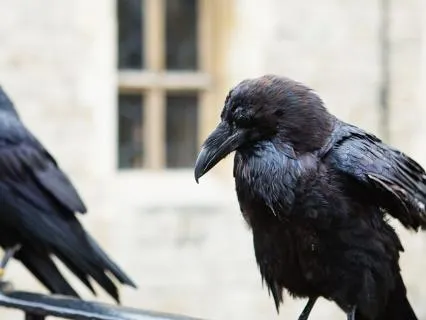
At least six captive ravens in residence at the Tower of London.
And each of them is a creature so curious,
So captivating,
And so unique.
That you could tell them apart from leagues away.
By the patterns of their flight.
The particular angle of their head.
By the way their voices change when they spot food or a friendly face.
And ever since you began your service here,
The birds have gravitated toward you.
You've always had an affinity with animals,
But the way they took to you with no delay was a surprise to your colleagues.
Most of the warders look upon the birds as a fun little trifle for the tourists,
But they rarely care to get close.
You've even seen bee feeders who were outright scared of them.
Not you.
You stepped into their midst and it was like you were part of the flock.
It was only a matter of time before you accepted the rank of Raven Master at the Tower.
When your predecessor retired after many long years of caring for the birds,
In addition to their daily responsibilities,
There was no question of who should pick up the reins.
Now,
You are proud to call yourself the steward of the ravens,
A friend to the flock,
And the keeper of the tower's most beloved legends.
Just now,
As the autumn sun begins to depart,
Casting an amber hue across the Thames and the streets of London,
And you do your nightly checks on the property.
Lenore hops eagerly a few paces behind you.
You can always count on her to clean up any dropped food scraps or trinkets that have fallen between the cobblestones.
She emits a garbled croak,
Pecks at something on the ground,
And with a flutter of wings,
She flits to your shoulder,
Dropping her quarry into your open hand.
It's only a bottle cap this time,
So you'll let her keep it to furnish her roost.
Other times she's rescued diamond earrings,
Foreign coins,
And other small shiny valuables,
Most of which now languish in a forgotten lost and found.
Anyone with a passing familiarity with ravens and their corvid cousins can tell you they're more than just birds.
Astonishingly intelligent,
They've a knack for collecting small objects,
Little treasures that might be anything from sweets wrappers to gold chains.
You've always found some humor in the fact that the dark-eyed residents of the Tower of London,
Famously the home of the British Crown Jewels,
Should also be moved to hoard shiny things.
They are a remarkably social animal,
Interacting within and beyond their species,
Even forming lifelong friendships with humans.
Amongst themselves,
They communicate and problem-solve collectively.
Demonstrate the ability to utilize tools,
Engage in play,
And perform feats of memory.
They're simply marvelous and beautiful too,
Large and sleek.
With feathers so black,
They shine blue in the sunlight.
Still.
You understand why so many people and cultures have associated them with fear and mortality.
As carrion birds,
They scavenge for food,
Often congregating around the dead.
Where there is death.
There are ravens and crows.
So why wouldn't they be considered ill omens?
Their majesty and mystery have captivated the human imagination for millennia.
Infiltrating myth and art.
The names of the birds in residence here reflect that.
You're hopping.
Bottle cap collecting shadow.
Lenore.
Takes her name from the lost love.
Of Edgar Allan Poe's forlorn narrator in The Raven,
A poem of dread.
And longing.
You've always refrained from taking a favorite among the six ravens of the tower.
But no one can refute the closeness between you and Lenore.
Most of the birds keep their distance during the day,
Enjoying the freedom to fly about the premises.
But this bird rarely leaves your side.
It's likely because she's the youngest of the flock.
Brought here from Somerset as a fledgling.
So she's known you all her life.
When she follows you on tours,
The visitors ooh and ah at your duo dynamics.
She'll hop to your shoulder at a whistle and occasionally mimic simple words you say.
You've made it a personal mission to teach her to say the word,
Nevermore,
To delight tourists at All Hallows' Eve.
Tonight,
As she prances along the cobblestones behind you,
You absentmindedly recite Poe's verse.
Though thy crest be shorn and shaven thou,
I said,
Art sure no craven,
Ghastly grim and ancient raven,
Wandering from the nightly shore.
Tell me what thy lordly name is on the night's Plutonian shore.
Quoth the Raven,
After a momentary pause,
Lenore responds with something like a gurgling sound.
Close enough,
You think,
Chuckling.
You find Maka and Munin perched atop the chapel of the Wakefield Tower,
And you give them a sharp whistle to alert them it's time to head in for the night.
Munin croaks a response,
Swoops down immediately,
And then disappears toward the roost on the south lawn.
Makkha takes more convincing,
But you've anticipated this.
After the rustling of a few unshelled peanuts,
She at last agrees to come down from her perch.
She nabs a peanut from your hand,
Then follows Munin to the cages.
It is rare to see Munun without his brother Hugen,
So you suspect the other bird can't be far off.
You find him quickly enough,
Rummaging around the bins for extra scraps.
They've already been taken out for the day,
Little one.
You say to the disappointed bird.
Who chatters back at you.
It's suppertime anyway.
Go find your friends.
Ugin seems to reluctantly accept the dearth of sweets and snacks to scavenge,
And heads off in the same direction as the other two.
Huginn and Muninn are one of two sibling pairs currently residing at the tower,
And they're the oldest.
Captive ravens can live for several decades,
And you get a kick out of telling some of your tour groups that these 30-something birds are older than many of them.
The pair were named,
Of course,
After the two ravens who served the Norse god Odin.
Hogan,
A name that alludes to complex meanings,
Thought,
Desire,
Awareness,
Mood.
And moon in.
Alluding to memory.
Mind,
Will,
And intention.
Were Odin's eyes throughout the nine realms.
The God himself,
After all,
Had only one eye.
He sacrificed the other to the waters of a sacred well in exchange for wisdom.
You like to think of these two as new incarnations of their namesakes.
The way Odin's ravens traveled up and down the world tree Yggdrasil,
Collecting secrets and whispers to bring back to the wandering god.
You're Hoogan and Moonen.
Gather up the stories of the Tower of London.
Hoarding them the way Lenore hoards shiny treasures.
They overhear the legends of Richard III and Anne Boleyn.
But they also pick up the new stories that pass through the gate each day.
If you spoke the same language.
What pearls of wisdom might they pass along,
You wonder?
Maka,
Meanwhile,
Takes her name from another mythological tradition.
From the Irish three-fold goddess of war,
Poetry,
Prophecy,
And sovereignty.
The more again.
In the tales in which she features,
The Morrigan appears in many guises.
As maiden,
Matron,
Crone,
And crow.
And under many names.
Among these names are Bhave,
Anu,
And Maka.
The towers,
Maka,
Like the Irish goddess.
Prefers a bird's-eye view of all things,
And she rarely comes down from her high perch during the day.
She's one of the quieter birds in residence,
Reserved and standoffish.
She uses her voice so infrequently.
That when a bellow or a croak does come from her,
Everyone in the complex stops to listen.
In the old stories,
The Morrigan would shapeshift into a crow or a raven to fly high over the battlefield.
There she would speak prophecy or incite war through her powerful voice and poetry.
The folklore of ravens runs deep in these aisles and spreads far across the world.
They appear as tricksters and creator deities in the traditions of the Haida and other indigenous peoples of the Pacific Northwest.
In Hindu tradition,
Ancestors may take the form of ravens and crows.
The great black birds stand as liminal figures on the threshold between worlds.
Between life and what comes next.
Between thought and memory.
Between destruction and creation.
There's one last pair of ravens to be called in for the night.
Another pair that hatched together.
You spot them not perched atop ramparts or rummaging through refuse,
But soaring overhead.
The playful pair love to show off with mid-air dives and rolls,
Looping through the open skies.
There was a time when all the ravens at the tower had their flight feathers closely clipped.
But in recent years.
There's been a desire to give them more freedom.
They can all come and go as they please,
But given how well they're treated,
The birds rarely go past the walls of the premises.
It delights you to see their jubilant displays,
And you're almost sorry to call them in for supper.
These are Bran and Bran I.
These two bare names connected most deeply with the mythology of the British Isles and the Tower of London itself.
The tale is preserved in the manuscript commonly called the Mabinogion,
In a story called Branwen,
Daughter of Lear.
Branwen,
A princess of the Isle of the Mighty,
Whose name translates to something like Blessed Fair Raven,
Is married off to Mithalic,
The King of Ireland.
He treats her poorly,
So she sends word via a starling to her brother,
Vendigade Fran,
Or Bram the Blessed,
King of Britain.
Bran is a giant who can cross the channel with only two strides,
And he sends his forces in to rescue the bride.
The events of the tale climax in a devastating war between the two armies.
The Irish king possesses an enchanted cauldron which restores life to the dead.
As Mithalich tosses the bodies of his fallen soldiers into the cauldron,
They emerge reborn,
Renewing the Irish forces again and again.
After the battle,
Only seven British men survive.
Bran,
Mortally wounded,
Commands that his men cut off his head and bear it home with them.
But the head of Bran the Blessed continues to speak.
The company departs with the head of their king in tow,
Following his instructions for the journey.
They stop on the island of Harlech,
Where they spend seven years feasting,
Lulled into bliss by the songs of the birds of Rhiannon.
Then to the island of Guales they go.
And here they spend eighty years entertaining the head of Bran and joyously feasting.
The mirth is so abundant that the heroes forget their sorrows,
Forget their earthly lives,
And remain eternally youthful.
In their magnificent feasting hall,
There is a door facing Cornwall.
Each man knows he should not open it,
Lest the endless joy be broken.
But,
As it always is in myths and fairy tales with forbidden doors and locked chests,
After 80 years,
One of the men opens it.
And once all the company's memories come flooding back to them.
Including the miseries of war.
On the instruction of their king,
The surviving men bear the head of Bran the Blessed back to London.
They bury it on the White Mount,
Overlooking the Thames,
Where it serves as a talisman to ward off invasion of the islands.
It was on that very spot,
The White Hill,
That William the Conqueror built his tower.
In the 11th century.
The legend goes that ravens are still kept on the property today.
To secure Bran's ancient ward.
Ensuring that the British crown never falls.
It is easy to nurture superstition in a place with so much history baked into its foundations.
London is a city that operates on ritual,
On scheduled ceremony.
The changing of the guard at Buckingham Palace happens each day at the same times with meticulous attention to detail.
The official regalia of the British monarch.
Which lies just behind the doors you pass through each day,
Is trotted out for events solemn and joyous.
The Ceremony of the Keys,
During which the yeoman warders lock the gates of the Tower of London.
Has never been cancelled in nearly a millennia.
And always follows the same specific steps,
Objects,
And words of power.
This is an island that puts tremendous stock in symbols.
Around such symbols.
Jewels,
Scepters,
Kings,
Queens,
Rivers,
Towers,
And ravens.
Legends never fail to grow.
The very last light is leaving the sky as you heard the six ravens of the tower into their housing for the night.
You've prepared a healthy and hearty supper for them,
Which they dig into eagerly.
Lenore stashes her bottle cap in with a cache of other minuscule treasures she's collected.
A plain silver cufflink.
Inhale.
A scrap of ribbon.
Endless curios to excite the young avian mind.
You feel a sense of keen relief and calm wash over you as they settle in.
Another day is done.
And the ravens are all at home.
All six of them.
Bran's ancient ward lasts another day.
And the tower still stands.
Your day is not finished until the ceremony of the keys is complete.
But there is a lull in your duties between now and the start of the nightly locking ritual.
Time to breathe and observe the quiet within the walls.
In this place that exists somehow outside of time and deeply enfolded within it.
Near a white tower,
Stained with deep darkness,
Casts its shadow over lamplit cobbles.
Near the ghosts of history may wander.
Escorted by ravens between worlds.
Thousand years of history,
Legend,
And superstition are laid brick by brick in this corner of London.
The fortress itself is a corvid,
You think.
It is a raven.
A collector of memories.
Stories.
People.
Jewels and shiny things.
It is a treasure hoard of specters and spirits.
A cabinet of curiosities.
A catalog of the ages.
Beneath the legends,
The superstitions and the sensational.
There is deep symbolic truth.
You only need to look into the eyes of the ravens.
To know there's magic about them.
In a world changing faster than you can keep up with.
There's comfort in the ancient mystery of your avian friends.
In knowing they'll always be there to guard the thresholds.
Just as you and your cohort guard the gates of the tower.
Soon,
Another crowd of guests,
Those who opted for the privilege of observing the ceremony of the keys,
Will shuffle onto the cobbled alleys.
Waiting with bated breath for the enactment of another age-old ritual.
You can understand why ritual and story bring comfort to people.
Knowing that some things always stay the same.
Even as the world outside speeds by.
When you don your warder uniform.
You step into the shoes of all those who came before you.
The guards who witnessed the building of the tower.
Those who stood watch over the prisoners and trainers once impounded.
And those who oversaw the locking of the crown jewels behind the tower's doors.
When you greet the ravens.
You greet the legacy.
Of not only the tower,
But the whole world's fascination with them.
The Old Myths.
The Wandering Gods.
The legendary kings and queens.
The lost loves of poets.
All these memories are carried with them.
With the birds.
With you.
And with every brick in the tower's foundation.
A yeoman warder approaches the trader's gate.
A single flickering candle felled out before him.
He carries the keys to the kingdom.
The ravens,
Sated from their supper,
Sleep.
The river Thames flows onward.
To the North Sea.
Quiet your mind.
And let your breath and body settle.
Slowing down.
Loosen the muscles of your face.
Softening the jaw.
Relax the brow.
And the temples.
Letting your lips part gently if that's comfortable.
Just relax into the surface of your bed.
Or wherever you are resting.
And breathe.
Start to deepen your breaths.
Inhaling deeply to fill the belly.
Holding for a moment at the top of the inhale than letting it all out.
With your next breath in,
Allow your consciousness to drift ever so slightly beyond the edges of your body.
Just an inch or so.
And breathe out.
Become expansive with your inhales.
Spreading out.
Moving beyond your body.
Outward and upward.
Little further with each inhale.
And with your exhales,
Push your awareness even further.
Expanding.
.
.
Floating.
Hovering above your body until you nearly touch the ceiling.
Looking down upon yourself.
Observing your body.
The room around you.
Breathe deeply.
And continue to expand.
To float outside yourself.
Moving through the ceiling.
Through the roof and into the open air.
Until you hover above the rooftops.
Among the clouds.
And the birds.
Let yourself be light.
Weightless even.
Observing the landscape beneath you.
The buildings.
The trees and greenery.
The waterways.
All from above.
Notice patterns of color.
Intersections of green space.
Notice the flow of things.
Keep breathing deeply.
Letting your inhales expand your perspective.
And your exhales push you higher.
As if you are zooming out endlessly.
Looking down upon a world that grows more immense,
More complex.
And yet more distant.
Its distinct features blending into incomprehensible patterns.
Large swaths of blue and green and swirling white.
Let the wind of your breath buoy you.
As if you are a bird.
Afloat on the air.
Feel the breeze through your flight feathers.
As you look down at the earth beneath you,
Wild and delicate.
Recognize its cohesion.
Its resilience.
It's aliveness.
Imagine the epochs this world has seen come and go.
The stories it has absorbed.
And encoded into its landscapes.
The memory it holds.
And recognize that you your body.
Well below.
Is stitched into all that memory.
All that mythology.
That you carry the entire earth within you.
All of history.
All the future.
Even if it's not always easy to see.
Breathe.
Soften and let go.
Allow your awareness to float.
Like a feather or a leaf.
On a current of breeze.
Gently downward.
As if your body is calling you home.
Little by little.
Breath by breath.
Level by level.
Down.
Down.
Down to earth.
Down to your neighborhood.
Down to your place.
Down to your body.
Soften into yourself.
As if you are being poured back into a vessel.
De-count it.
Having breathed for a time.
With all the universe.
Let all those stories.
.
.
All that memory.
Now infuse your breath.
And your body.
As you soften toward sleep.
Sweet dreams.
You