Thanks for joining us today.
Today's episode,
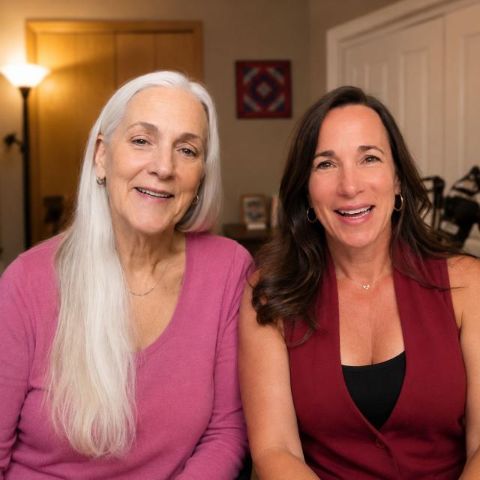
We're going to talk about how we came up with the name Midlife Mavens because it was a difficult process.
And part of that,
Don't you think,
Carol,
That we both had some kind of emotional reactions to the words that really describe this phase of life.
And so we thought this would be a good topic to talk about.
How does it feel to be considered our age group,
How does it feel to be midlife?
And it seemed like there was a lot of overlap with societal norms,
Societal expectations,
Just the view of women and aging that feels really different than maybe how men would feel about being considered an older man or an aging man.
So we thought we'd have an episode about the words that we use to talk about women and aging and some of the ways that gender intersects with aging and how that feels for women.
I think,
Too,
We talked about how different it is than how we thought of ourselves or how others talked about us,
Us women,
When we were at earlier phases of our life.
So there feels like there's shift as we've moved into what we're calling midlife,
But some would call older age range.
There's a shift in how we see ourselves,
How we think others see us or how others do see us,
And how we talk about that shift.
In that new phase of life that we're in.
And it was,
I think you're right,
The emotional response that we both had to looking up,
Right?
Because the words that we came up with when we looked up other words for midlife,
We didn't like the sound of that by itself.
So we both separately did these dictionary searches for other words and they were terrible words.
Hag mature woman.
Of a woman of a certain age.
Right?
It was all of those really words that don't,
We don't,
We,
You and I,
Did not feel like they applied to us.
And so trying to find something that was some sort of a middle ground of one that we could get behind,
The whole idea of Mavens feeling more empowering,
If we were going to pair that with being in the mid-lot.
So that's kind of how we ended up here.
Yeah.
Yeah.
And really,
It's kind of funny because for me at first,
My reaction because I think you came up with the term and it's got nice,
What is it,
Alliteration?
I'm a big fan of alliteration.
So that's typically my job is to come up with the alliterative phrases.
So it got great alliteration,
But I think because I grew up Jewish and it's a Yiddish word,
My initial reaction in my mind,
I kind of saw an old grandma type looking woman as like a maven.
And then like having to Google that and find out that really that wasn't,
That's not really what it even,
That doesn't even have to be a woman,
Which I didn't even know that.
I always in my mind thought Maven was a woman.
Yeah,
Me too.
Yeah.
But to kind of see that it's really an expert in any specific field,
Or it could also be something that you're passionate about.
And so I think,
You know,
Helping women with this phase of life and providing a space for talking about that and a forum for talking about that is something that I think we're both passionate about.
So it,
It fits more.
But at first,
My first reaction was kind of like,
Oh,
Isn't that little old thinking of my Yiddish grandmother,
Right?
Well,
So I could be a ballooning maven.
Because I'm passionate about my hot air ballooning hobby.
And the two of us could be psychology mavens.
And that's how we kind of talked about this,
Too,
That there are,
Thankfully,
A lot more podcasts,
Books,
Interviews about midlife now that,
Thankfully,
That is starting to grow in terms of women's health.
And there's a lot more dialogue that I think we're hearing.
And we were talking about what do we have that's different to offer.
And I think one of the things is that psychology piece.
How do you integrate this into your life?
How do you feel about aging emotionally?
Not get so caught up in maybe what society views as mature women or aging women.
Yeah,
I remember when you and I were first tossing this idea around about whether or not we wanted to do this podcast and whether there would be interest in it.
I run this consultation group that meets a couple times a month.
Of other mental health therapists,
And I went to them.
They all.
.
.
Are kind of in the 40s,
50s,
60s,
They're all there.
Older.
In our age range,
Women.
And I said,
What do you guys think of a place where we can talk about issues that don't often get talked about?
And what are the kinds of topics that you would like to see us talking about?
And so many of them talked about how they feel like they've moved from this place of being perceived as valuable and maybe because they're moms or because they're attractive or because they possess something that others want.
To being invisible,
Right?
One of the,
I remember one of the women saying,
It's both a blessing and a curse.
I don't get hit on anymore.
But I also don't get hit on anymore.
And there was a grief to that.
I used to be the kind of woman that got hit on.
I don't get hit on anymore.
And I think that shift feels like a loss of some kind that needs to be dealt with from a psychological perspective,
Not just a Are you in the medical?
Are you in menopause,
Perimenopause kind of thing?
Yeah,
I think it definitely speaks to how we identify.
And if that piece that identifies somebody who's attractive,
Who gets hit on,
Who this is a part of my life,
And then all of a sudden that's gone,
There is a piece of maybe relief,
But then also Wow,
That's different.
That's not how I see myself.
And the same thing applies more to you than to me,
Because you've raised kids.
I have not.
But the emptiness,
Right?
Who are you and how does that change things in your life,
In your relationships,
In your job?
When you're not,
I don't want to say you're not raising kids anymore because they'll always be your kids and you're still connected to them,
But you're not day to day responsible for them.
Right.
They're not living in your home.
They're not depending on you in the same way that they did when they were younger,
Because both of your kids are out of your house.
Both of them are out.
And I do think there's a gender piece to that.
I mean,
In general,
You know,
I think certainly there are some men who take more of an active role in childcare and getting up the kids in the night and all that stuff.
But in general,
That does tend to still fall more on women.
And I know for me,
Like,
I would wake up the first couple of years that my kids were not necessarily gone,
Because my youngest was still living with me,
But she was,
You know,
In college.
Well,
More independent.
More independent.
I would wake up in the middle of the night with this,
Like,
Fear that I forgot to do something,
That there was something around them that I forgot.
For her?
Yeah,
For,
Yeah,
Like,
There was some parenting thing that,
You know,
And I'd have to,
Like,
Remind myself,
No,
They're grownups now.
It's okay.
Yeah,
Boy,
That's a transition.
I don't have any connection to that.
Having raised kids,
That's different.
Yeah,
That one was a really,
Really hard one.
And this,
You know,
Still I think even the balance,
How do you balance how present you want to be in their lives with how present they want in their lives and how present is healthy for you to be in.
There's so many issues around empty nesting.
And I think different,
They hit,
Like you were saying,
They hit differently for men,
For dads than probably.
At least from what I'm hearing,
Than they do for moms who have had a different kind of a role.
N.
Those responsibilities around the house,
And how does that change now that,
Or does it change much for a dad once their kids go off?
Are they worried about them in the same way?
Are they waking up a couple of times a night thinking,
I've forgotten something,
Where's my kid?
Do I know where my kids are?
Yeah.
Yeah.
I'm sure some like my partner probably will because he's been a single dad for a really long time.
And so he will probably have that same experience when his son.
Right.
It differs.
I'm sure it differs depending on how responsible you are.
For the child-rearing roles,
If that's been very gender-divided family or not.
If you've been a single parent,
Obviously,
You're not sharing those primary responsibilities with somebody else.
That would be harder and different,
I suspect.
So yeah,
So definitely speaks a whole lot to identity and the ways that we change as we get older and our roles change.
Yeah,
And how much we accept that and are able to integrate those changes and seek out new roles,
Expand our identity.
As we talked about today,
The words we use to describe ourselves can shape how we see ourselves.
You might take a moment to notice some of the words or labels you've inherited about who you're supposed to be at this stage of life.
Which ones still fit?
Which ones don't?
And what words would you choose for yourself now?