So welcome everyone.
And thank you.
Thank you for listening.
And thank you for being here.
So you are doing something unremarkable when it arrives?
Putting the shopping away.
Halfway through an email.
Standing at a sink with the tap running and your hands in the water and then it is there.
The drop.
The weight the all-familiar heaviness.
Arriving without announcement in the middle of a day that had nothing wrong with it.
And you think as you always think.
I thought I had dealt with this.
Here is what I want to say to you.
And I will spend the rest of this saying it properly.
You have not gone backwards.
Nothing has reopened.
And you have not failed at anything.
Something happened to you?
And I do not need to know what it was.
And you may not entirely know either.
And I will come back to that.
You have done a great deal since.
Years of it probably.
And it still comes.
That is not evidence that the work did not work.
It is evidence that you are a person to whom something happened.
Let me deal with that first.
Because I have watched it cause a particular kind of private shame.
Some people can name it.
There was a day.
And a before and after.
And they could tell you the date.
But a great many cannot.
They just know something is wrong.
They know the shape of what they carry.
And when somebody asks what happened,
There is nothing to produce.
No incident.
Nothing that would sound like anything if you said it out loud.
And so they conclude quietly.
That they must be making it up.
That they are somebody with a personality problem?
Who has been dressing it as an injury.
So the clinical picture here is quite clear and it is worth having.
Memory has more than one system.
There is the one that stores events,
What happened,
When,
In what order.
That is the one you can tell somebody.
It has a beginning and an end.
And it forms a story.
And there is another that stores something else entirely.
How things felt?
What you learn to expect.
The rules of the place you were in.
And it works without words.
It does not produce recollections.
It only produces states.
And the second system is running long before the first one is probably online.
Long before you have language.
Long before your brain can build a narrative about anything.
So if what happened to you happened early,
Or if it was not an event at all but a climate going on for 10 years,
Maybe just the ordinary weather of a house.
Then it may never have been stored as a story.
There was no story.
There was just temperature.
Which means the absence of memory is not a gap in your evidence.
It is what this kind of thing looks like from the inside.
So you are not required to produce a scene in order for what happened to you to have happened.
Now what have you done about it?
Because I suspect the list is long.
Therapy maybe,
More than once Possibly medication Books A great many books More than most professionals have had time to read Courses Something with a name and initials.
Breathwork maybe at some point.
In a room where everybody else seemed to be having a bigger experience than you were.
And there were real gains in there.
I want to say that.
Because people in this position often discount them.
You understand yourself now far better than you ever did.
There are things that used to knock you over for a fortnight that now may only take a day.
You caught something last month that you would not have caught five years ago.
And that is not nothing.
That is a great deal actually.
And it still comes.
So here is the thing that nobody says and I think it is said too rarely because it does not sell anything.
Some of this does not finish.
Some of this does not finish.
Not all of it.
A great deal genuinely resolves.
And I will come back to what the evidence actually shows.
Because it is more hopeful than you've been led to believe.
But there tends to be a residue.
And the residue is not a sign of incomplete work.
And what I have watched over and over.
Is that the residue is not what exhausts people.
What exhausts them is the argument with the residue.
Now there is an old teaching about two arrows and it is about two and a half thousand years old.
And I have not found anything since that improves on it.
The first arrow is the thing itself that happened to you,
Which you remember or you don't remember,
Just comes up in your body.
Let's call it the wound or the ache.
The ek lands when it has to and you get no say in it The second arrow is what we do about the first.
The resistance.
The outrage that it is still there.
The interrogation.
Why is this happening to me?
Why is this happening again?
What did I do wrong?
What have I missed?
Why can't everyone else manage this?
And across a lifetime.
The second arrow does more damage than the first.
Considerably more.
You can watch this happen in real time.
The ache arrives and it lasts perhaps 40 minutes.
But the argument with it lasts for three days.
And there is a mechanism underneath this which is worth knowing.
Because it stops it feeling like a moral failing.
The effort to not have an internal experience is one of the more reliable ways to keep that experience in place.
It has been studied a great deal and the finding holds up.
Suppression and struggle predict persistence.
Always.
So the reason is not so mysterious.
To successfully not look at something.
You have to know where it is all the time.
So the avoiding requires continuous monitoring.
And the monitoring is what keeps it alive.
What does this mean?
This means the years you spent trying to get rid of it were not wasted.
Exactly.
But they were expensive.
And part of what they bought was the very persistence you were trying to end.
And I know that this is an unpleasant sentence.
But I would rather tell you than not.
People expected to arrive on a date.
Sometimes it does.
Far more often it arrives for no reason you can find.
The wound does not give you any notice,
Which is one of the most disorienting features of the whole thing.
And that is because it is not being triggered by meaning.
It is being triggered by conditions.
A tone of voice.
The particular quality of silence in a room after somebody has left it.
Light at a certain angle in a hallway in February.
The way a door closes.
Being unwell.
And dependent on somebody and unable to get up.
So your system stored the conditions,
Not the narrative.
And it recognizes conditions with extraordinary speed.
And offers you no explanation whatsoever.
Because the part doing the recognizing has no words and never had any.
So it arrives at the sink on a Tuesday,
And you go looking for a reason in the present day.
And you find one.
A comment somebody made.
A decision you're unsure of.
Your own character.
And you then build a case that would stand up in most rooms.
It is a false premise reasoned from beautifully.
And I have a week in the year when I'm not much good.
And it took me an embarrassing number of years to notice that it was the same bee.
And that I had been finding an entirely new explanation for it,
Annually.
So the other thing worth knowing about the rhythm is that the quiet stretches are also real.
You will have months where it is nowhere.
But you would tell somebody honestly that you were finished with it.
And then it's back at full volume.
As though nothing had been achieved at all.
Poo-tah-tru The dormancy was not a delusion.
And the flare is not a return to the start.
It is a thing with weather.
And you've been reading each front as the climate.
Now just for a bit,
I want to stop explaining.
And I want to do the thing instead.
What we are going to do,
Might be the opposite of what you may have been doing.
We are not going to work on what happened to you.
Nothing is going to be resolved.
And nothing is going to be reduced.
We are going to sit in the same room as it,
Without arguing.
If it is dormant tonight,
Leave it dormant.
Do not go looking for it to have something to practice with.
That would be your old habit wearing new clothes.
Just settle now,
However you are.
Eyes open or eyes closed.
Whatever helps you feel safe,
Dropped in and present.
Finding now your breath.
Finding now your feet on the floor.
Maybe your hips being held by the chair,
The mat,
The car seat,
The hard surface,
Wherever.
Slowly,
Gently we are taking a little bit of attention into the body from the conscious mind.
And we don't want anything to stop.
Your spine against the chair.
The back of your hands.
And the weight of your heels.
Now this is the ground that you're feeling.
And we are not going anywhere without it.
Spine,
Heels,
Back of my hands,
Ground.
Now without going into any stories.
Is there anything right now in your body?
That you are aware of.
A sensation,
A tightness.
A numbness,
A warmth,
A cold or something else.
Is anything present today?
And if it is,
Where is it?
Chest.
Fruit.
Low in the stomach.
Or somewhere else.
Just locate it now.
Do not enter it.
And stand near it.
The way you would stand near a fire.
Rather than in it.
And now,
The move.
And it is the only technique in this entire talk.
Whatever is present right now,
Wherever it is,
Do not try to make it smaller.
Instead make the room around it larger.
Let your awareness now also include the ache,
And also your feet.
Also the chair.
Also the sound outside.
And also the fact that you are a whole person sitting somewhere.
With the life around you.
Now something to say to it.
And save it slowly.
You can stay.
I am not fighting you tonight.
You can stay.
I am not fighting you tonight.
You can stay.
And I'm not fighting you tonight.
Notice what happens in the chest when you say that.
Just for this evening.
We are attempting to put the second arrow down.
A little bit slower.
You can stay.
I am not fighting you tonight.
And now.
The last thing.
And it is the one I most want you to have.
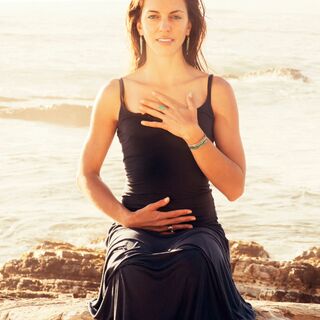
Put your hands somewhere on yourself.
Anywhere.
I am allowed to still be affected.
For as long as it goes on.
I am allowed to still be affected.
For as long as it goes on.
I am allowed to still be affected.
For as long as it goes on.
And let it go now.
Feet on the floor.
Eyes around the room.
And let the ordinary space come back.
Feet on the floor.
Eyes around the room.
And let the ordinary space come back.
If your eyes were closed,
You can open them.
And if you want to stay in this space longer,
You can simply pause and continue.
I want to say something about time.
Because I think we carry a picture of it that makes this harder than it needs to be.
We imagine the past as a place behind us that we are walking away from.
And on that picture,
If something old arrives,
You have turned around.
You have lost ground.
Here is the thing,
Nothing is behind you.
There is no corridor.
What there is,
Is a present moment that contains everything.
Including a part of you that was never told what year it is.
Because it was stored in a system with no clock in it.
Nothing came back because nothing had gone anywhere.
And there is something else about the past that I have found genuinely consoling.
And I offer it as a philosophy rather than comfort.
The past is the only part of your life that is permanent.
Everything else can be taken from you.
Your health,
Your circumstances,
The people,
The future you had planned.
All of that is provisional.
What happened cannot be undone,
Which is the cruel half,
And it also cannot be interfered with,
Which is the other half,
And almost nobody says it.
The good is in there too.
And it is equally permanent.
The person who was kind to you once.
The afternoon,
That was actually alright.
The fact that you got through the thing you did not think you would get through.
That is now a fixed feature of the universe and nothing can reach in and change it.
So you are not carrying only the wound.
You're carrying an entire completed archive.
And the wound may be the loudest item,
But it's not the whole collection.
Now there was a French philosopher,
Simone Weil.
Who wrote about this with more precision than anybody.
And she made a distinction that I found useful.
She said there is suffering.
And then there is something she called affliction.
Which is different in kind rather than degree.
Affliction marks a person.
It gets into the soul as she puts it.
It does not simply pass and it does not simply resolve and she was clear that pretending otherwise was dishonesty.
So I feel she was not being bleak.
She was refusing to be cheap.
And what she said the afflicted person needs is not an explanation and definitely not encouragement.
It is attention.
Somebody able to look at what happened without flinching.
And without hurrying to make it better.
And she called this attention the rarest and the purest form of generosity.
Which I would say is the whole of my job.
And most of what any of us can offer each other,
Sometimes even offer it to ourselves.
Now there is something in this country I think about often in relation to all of this.
The holy wells,
There are thousands of them,
A few in nearly every parish.
And most of them older than the churches beside them.
A good many of them older than Christianity.
And what a holy well actually is,
Physically.
Is a break in the ground.
A place where the surface is broken and something comes up through it.
It is a wound in the landscape.
That is the geology of it.
And these are places people have gone for healing for thousands of years.
Not the smooth ground,
Remember.
But the broken bit.
Where the water gets out.
Here is the part,
Again,
I find most moving.
Nobody went once.
You went on the day.
The pattern day.
The same date every year and you walked the rounds same circuit same number of times same prayers in the same order and you left something behind A rag on the bush maybe?
And then the following year,
You came back and you did it again.
So nobody experienced that as failure.
Nobody arrived at the well thinking,
I was here last year,
Why am I not finished?
The returning was not evidence that it had not worked.
The returning was the practice.
So that is a completely different relationship to a recurring pain than the one we have now.
And I think ours is worse.
We have been taught to treat every return as relapse,
But they understood as a rhythm.
Some things are attended to annually for the whole life.
And this is what tending looks like rather than what failure looks like.
And their rags are still on the bushes.
You can drive to one this weekend maybe and see them.
People are still going.
Now I don't want to leave you with only philosophy.
Because there is real and specific hope in this.
And it deserves saying it plainly.
This responds to treatment.
Not vaguely but measurably.
And better than most people carrying it have ever been told.
When researchers look at the psychological treatment for people with these histories,
They find large reductions in symptoms,
And those reductions largely hold at follow-up also.
So the approaches that do best are the ones that begin with a phase on steadiness and relationships before opening up the difficult material.
And in one longer-term study of an intensive program,
60% of people no longer met the criteria for complex post-traumatic stress at the end of treatment.
And were still below the threshold.
When they were followed up more than two years later.
So,
I want to be honest that this picture is not standard,
It's not uniform.
People whose difficulties may have began in childhood tend to see somewhat smaller effects than those whose came later.
And that makes sense,
In a way.
In my experience.
Here is what actually moves.
What moves is the frequency,
The intensity.
How long a flare lasts before it lifts.
How quickly you recognize,
Oh,
This is something from my past.
Oh,
This is the old me.
Oh,
This reaction is coming from my past.
And most of all,
How much of your ordinary life carries on while all this is going on.
Whether you still go to the thing,
Still ring that person and you still get through your week.
Those are the numbers that clinicians actually watch.
Nobody is actually measuring whether it has gone or not.
There is information out there today.
Which makes you feel,
If you're still feeling like this,
You're doing something wrong.
And only if you do this,
This or this,
It'll completely go away.
I would say maybe sit with that information first and check in and see how you feel.
Anything that puts you in a state where you look at your own self and your own healing with shame may not be aligned for you.
The goal here is to coexist with the thing that happened and the thing that shows up rather than eliminating it.
So it will come again.
Probably not on the date,
Probably at a sink or in a car park or maybe halfway through something extremely ordinary.
And you will think for a moment that you've gone backwards.
You have not.
Something without a clock has surfaced in the body.
On an afternoon that has nothing to do with it.
You don't have to fight it.
You don't have to explain it.
And you don't have to be finished by it by any particular birthday.
You can do what people here have done for 3000 years,
Which is to go to the broken place.
Walk the round.
Leave something on the bush and go home.
And come back next year if it asks you to.
That is not a failure to heal.
Always been Tending.
That was always what tending looked like.
Take what resonates.
Thank you for listening,
For being here,
For giving yourself this time.
And please go gently,
Especially on the days that it aches.
Until next time,
Namaste.