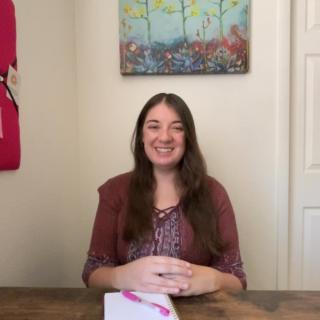
Hi friends.
My name is Rochelle and I am a life coach.
And today we are going to be using some coaching strategies to help us identify a goal,
But then also create an action plan that hopefully takes away some of that overwhelming feeling,
Um,
Making it really easy for us to kind of build momentum and get started as well as hopefully finding some joy in the journey as you go through your goal or habit that you're trying to put in place.
So let's go ahead and get started.
I have a new book with me today.
I like to have something where I can write it down and record it.
So if you want to pause and go grab something to write with,
You can.
I like having notebooks.
Some people want to just throw it in their notes in their phone.
Or if you want to,
Just close your eyes and think about it.
The purpose for my notebook is just so I can come back to it later,
Because we will go through quite a few steps,
But you don't have to.
Please use this time where it makes the most sense for you.
I want you to feel like you can get the most out of this session.
So whatever you need to do to get ready,
Pause,
Go do it,
And then when you're ready,
Go ahead.
Ahead and resume the video and we'll get started.
With that,
Feel free to pause as much as you need to throughout this video.
I'm going to go through it fairly quickly.
And so I want to make sure I'm going at a good pace for everyone.
But some people,
The answers will come immediately to them.
Others,
You might want to just sit and think a little bit longer.
So when needed,
Pause,
Rewind,
Fast forward,
Do what you need to to feel like you've gotten the most reflection time out of this session.
But as I go through,
I'm going use my own example just so you kind of have something to get ideas with and kind of see how I would do this reflection for myself but again this is your time do what makes the most sense for you.
Okay let's go ahead and get started.
We're going to start by identifying our goal.
For this,
This could look like a habit you want to put in place.
This could be a habit you're trying to break.
This could be a big project you're working on.
This could be a one-time goal and then you're done.
So whatever the item is,
I want you to go ahead and if you need to brainstorm a list,
Brainstorm a list and then choose one,
Just one for today.
That doesn't mean you can't come back and try the strategy with other items on your list.
But for the sake of today's video,
We're going to start with one.
We're going to do it.
We're going to do it well.
Then you can always come back to your list when needed.
So for me,
I am going to say the goal I'm going to work toward is it's going to be a one time goal of just I need to post this video.
So I'm recording it right now.
And then I want to post the video and get it onto the website.
So video posted,
That's going to be my goal.
Again,
This doesn't have to be a one time goal.
This could be a habit,
This could be a routine,
This could be whatever the whatever makes sense for you today.
But some things to think about as you try to choose what your goal is going to be is What pops up in your brain just as we're talking about it?
Is there anything that's time sensitive?
Is there anything that would just feel like a relief to get off of this list?
Is there anything that's kind of been living on your list for a long time and creating an action plan would feel really nice?
Is there anything that just feels easy and it would be just a nice thing to get started with?
So whatever it is,
Go ahead and pick one and choose it and we want to make sure we identify it.
All right,
So now that we've identified it,
And again,
Pause if you need to,
But identified our goal,
The next step we're gonna do is we are going to ask ourselves,
Why does it matter?
We ask ourselves,
Why does it matter?
Because this is the heart,
This is the purpose.
On the days where it feels hard and we don't wanna do it,
We need to come back to the reason behind it.
Our brains know to kind of go to the path of least resistance.
And so if a goal is hard and challenging,
It makes sense that our brain is going to avoid it and just not wanna do it.
Remember the purpose and the why,
The easier it is for our brain to get motivated to actually start.
So the strategy we're going to use today is called the three whys.
It's a strategy we use in coaching and that is to try to dig below the surface level Y of why we were gonna do this,
And really,
Really see if we can get to the main core reason behind it.
So let me model for you how to do this,
And then again,
You can pause and do this for yourself.
So my Y.
Well,
Why do I want to post this video?
Well,
It lets me share the strategy,
Right?
Okay,
Well,
Why does it matter for me to share this strategy?
It matters because.
.
.
It's gonna help people hopefully achieve their goals.
I hope so.
Okay,
Well,
Why does it matter to help people achieve their goals?
I think it really matters for me because I want to support people and making sure that they don't feel overwhelmed.
I want them to feel like it's easy to work toward their dreams because I know that feeling of overwhelm.
Sometimes it just feels like too much and I've been guilty of that all or nothing and I just,
I kind of freeze and I've put my dreams on hold way too many times.
So if this video helps anybody just take that one step forward and feel a little less overwhelmed and a little less alone with making their goals and working toward their dreams,
Then I think it's worth it.
So yeah,
I think that there's the why,
Right?
There's my main why is I want to help people feel like they can work toward their dreams and reduce that overwhelm.
Okay,
Hopefully that makes sense.
So again,
I could keep going more and more,
Right?
I could ask myself,
Well,
Why does it matter that people achieve their dreams?
Why does this strategy help them with it?
And we could go deeper and deeper.
But for today's exercise,
We're just gonna ask ourselves why three times.
If you want to go longer,
Go as long as you want.
The more you ask yourself why,
The deeper you get into that heart of the reason,
The more you get into that purpose.
And you might surprise yourself with some of the answers you come up with.
So again,
Three why strategy.
If you need to pause it,
Pause it now,
But then when you're ready,
We'll go ahead and go to the next step.
Okay,
So,
So far we've identified our goal,
We asked ourselves why,
And we did the three why strategy,
Which was fun,
And now we're gonna go and make it specific.
So I said I wanted to post my video.
I need to be a little bit more specific about what this goal really is.
So there's a couple steps.
I need to re-watch this video.
I need to edit if needed.
I need to update the video format so it will upload onto the website.
And then I need to write a description and then press post.
So notice what I'm doing is I'm kind of just listing out exactly what this is going to look like,
Right?
This helps with that overwhelmed feeling because instead of it just being this big idea in my brain,
Now I can see,
No,
It's just steps,
Right?
These are just clear action steps I need to take.
So get specific.
Again,
Pause if you need to,
But make it very specific.
What is it that you're working toward?
If this was,
For example,
Instead of a one-time goal like I'm doing today,
And instead I was working on making a habit.
So,
For example,
Let's say I wanted to post a video every week.
Well,
I can get specific with that too,
Right?
So,
Every week I want to post one video,
And it's going to be three minutes long,
And I'm going to post it on Friday,
Right?
So,
You can do this for a habit as well.
With that,
You're just kind of getting more specific about how often,
When you're doing it.
So,
Think through what are the specifics for it.
All right,
Recap,
And again,
You pause when you need to,
But we've identified,
We asked ourselves why three times,
And then we just got specific so we can see clearly what it is that we're working toward.
Now we are going to talk about making it measurable.
So when I'm talking about making it measurable is how am I going to track this.
Again,
With a habit I'm forming versus a one time goal it might look a little different and that's okay.
So,
For my example if I'm going to track it.
I have my one notebook where I'm writing my thoughts,
But I have a second notebook.
This is my notebook where I keep all the things that I need to get done for my coaching care tasks.
One of them is creating this video.
So when I'm done,
I already have it on my list.
I will check it off,
Right?
So that is an example of how I'm going to track my progress.
This could also look like if I was making it a habit.
So for example,
Let's say I was doing this every week I wanted to post.
Well,
Then I could set a reoccurring alarm in my phone.
I could have it on my care tasks.
That every Friday there's a little message for me to post.
So get creative with it.
It could be one of those examples.
It could be your own example you come up with.
But how are you tracking your progress on this?
Where?
Is it physical?
Is it in your phone?
Is it on a sticky note?
Where are you going to keep this progress and track it to make sure you're actually making the progress you want to with it?
So if you need to,
This would also be a good time to go make that resource that you need.
Maybe write it down.
Maybe put it in your phone.
But if you haven't the time I would suggest putting it in now just so that you don't have to think about it later.
So again the question for making it measurable is how am I tracking it?
For me,
I have it already written in my journal.
I'm gonna cross it off when I'm done,
Because for me,
This is a one-time goal.
If it's reoccurring,
It's gonna look a little different.
Then you're gonna ask yourself,
When will I know this goal is achieved?
Well,
I'm going to know it's achieved because it's going to be posted,
And I'm going to be waiting for it to be reviewed.
So for me,
Again,
It's a one-time goal.
So I know once it's posted,
It's done.
Once I feel good about the video,
I like the quality,
I've done the description,
I've written it,
And I've posted it,
That's the end mark for me.
If this is reoccurring,
You might not have a clear deadline.
So instead,
Then I ask you,
Well,
When are you going to pause and reflect?
Because it's really important with ongoing goals or ongoing habits that we're working toward that you have designated times where you reflect on how it's going so that you can make adjustments if needed.
So think through that one as well right now.
And then the last thought I want you to think about with measurable is making sure that this is something that's fully in your control.
Sometimes we make the mistake with our goals of releasing our control to someone else or something else.
And so I want you to just definitely be cognizant of that as you're setting your goal today and making sure that it is something completely in your control and that you're not giving away your control because then you're just setting yourself up for failure.
So an example of this could be,
I want to get a million views on my video.
That is out of my control.
Would it be awesome?
Oh my goodness,
Yes.
That would be wonderful.
I hope that happens.
However,
That is not out of my control.
I cannot force people to watch my video.
All I can do is focus on the quality of it,
Get it posted,
And share it out.
So just make sure as you set your goal that it is something in your control.
If it's not,
We need to go back to the specifics and see what we can adjust to make sure it is in our control.
Yeah?
Okay.
All right,
So real quick recap.
And again,
We are pausing as needed,
Because I know I'm talking faster than you probably can think through.
Plus,
I'm not giving you a lot of silent time to process and reflect.
So pause as needed.
But we've identified our goal.
We asked ourselves,
Why does it matter?
We did it three times.
We then said,
How is it going to be specific?
And then we talked about,
How is it measurable?
How do we track it?
How do we know what our goal is achieved?
Is it fully in our control?
Next step,
And I need to change pages on my notebook because I filled it up,
Is is this attainable?
So is the goal you set for yourself realistic?
Do you have the time?
Do you have the energy?
Do you have the resources to do it?
I think I can.
At least for me,
I know that I have some time this morning before my next coaching session,
So I should have enough time to go and get this posted.
So I think yes,
I think at this time I've set a realistic goal.
If I had something right after this video recording and I knew I wasn't going to be able to post it,
Then that's less obtainable.
I need to at least change the deadline on when I expect for it to get it done,
Or I need to take smaller steps with it.
So just think through,
Is this actually a realistic,
Obtainable goal?
All for yourself.
Okay,
Next question I have for you is the relevance of this.
Why does it matter?
So you could have chosen any goal for us to make an action plan on today.
Why now?
Why are you choosing the one that you chose?
So for me,
I think it's relevant because I have this same video as a live session and sometimes in our live session we go a little bit fast and people need to be able to take it at their own time.
Thinking this is a good time for it right now because I want people to be able to come back after a live session and rewatch and rewind and pause and take it at their own pace when needed.
I love doing it as a live session,
One of my favorite things to do,
But I do think it makes sense to have a prerecorded recording for them so that they can come back.
So that's why it's relevant for me now.
As my other live sessions,
They already have videos to go with it,
This is the next one on the list.
So that's my relevance.
Okay,
So pause if you need to,
Ask yourselves,
Why now?
Why does this matter?
And then we'll go to the next one.
This is timely.
So for timely,
We're asking ourselves,
When specifically am I working on it?
Remember,
If this is reoccurring versus a one-time or it has multiple steps,
Your answer might change.
But really thinking through,
When does it realistically make sense for me to work on this?
So for me,
It's a one-time goal.
I think I'm going to be able to achieve it and finish it by today.
I hope so.
So with that,
I think I'm going to finish recording this.
And then I am going to edit right after,
Post or upload,
Do all the fun things that I need to for it.
I think I could be done by noon.
That's when I think I'll be done by.
If life happens,
Which it does,
It is okay for me to reflect and make adjustments as needed.
But the important part of it is we're trying to set ourselves up for success by giving a realistic timeline.
And then if we need to make adjustments,
We just look at it with curiosity,
Not with judgment.
We do not judge ourselves,
But we just look at it with curiosity,
See what obstacles came up that made it that we weren't able to,
And then tweak it as needed,
Right?
The important thing is that we don't abandon it.
We don't want to just drop it completely.
We want to make a plan to make sure that we can be successful in the future if the timeline we originally give doesn't work out,
Right?
That's okay.
Life happens.
We're going to be okay with that.
We're going to give ourselves some grace,
But we do want to just check in and see,
Well,
What was the barrier?
What can I do to adjust?
So with that,
I think I'm going to try for noon.
If it doesn't work out at noon,
I'm going to reflect and make a game plan for when else I could do it if it doesn't,
But I think I'll get it done by noon.
All right.
The next question I have for you is when will it be accomplished?
This is something where you don't have a deadline.
It's going to be reoccurring.
This is when we're setting a time for reflecting.
So let's get specific right now.
I think I'm going to be accomplished by noon.
So I'm going to work on it this morning.
I think I'll be done by noon.
If I'm not done,
I'm going to reflect after lunch.
Getting specific.
What does that reflection look like,
Right?
So for me,
It's just going to ask myself,
Well,
What came up to make it so I wasn't able to accomplish it?
How did it go?
Do I need to adjust anything,
Right?
If this was a reoccurring,
Maybe every week,
If I was saying I was going to post every week on Friday,
Well,
Every Saturday,
I'm going to reflect and ask myself how it went,
Right?
So think about it,
Tweak it as you need to,
But the more specific and the more consistent you can get with something that is reoccurring,
The easier it is for you to keep it in your brain.
So do what you need to.
To set alarms,
Reminders in your phone,
Set little visuals out for yourself so that you do know there is a designated time to pause and reflect on this,
Yeah?
Okay,
Next area is going to be that reflection aspect.
So let's get specific about the reflection.
When are you reflecting?
And how will you reflect?
So we already kind of talked about the when,
We talked about setting a designated time for when we're going to reflect,
Or if we do need to reflect,
If it's ongoing,
Or if we do finish it,
When does that reflection occur?
But now I want you to ask yourself,
How are you doing it?
Are you going to keep paper pencil?
Are you going to keep it in the apps in your phone notes?
Are you going to just do it in your head?
Do you have specific questions you're going to ask yourself when you do reflect?
So for example,
For me,
I could reflect and say,
Well,
Did I like the quality of this video?
Did it match my original why behind this video?
Does it help people work toward their goals and their dreams and not feel overwhelmed?
These are questions I can write down now and come back to later.
So when I do reflect,
I already have done a lot of the work.
Now I just need to actually do the reflecting parts.
For me,
I'm a paper pencil person.
Person.
I like to have it visually in front of me.
I think it's the easiest way.
So I am just going to write my questions.
Right on here and then I am going to this afternoon reflect on them.
So again,
My questions for me were,
Does it match my why?
And did I like the value it brought out?
Did I like the quality?
I might also ask myself,
When am I gonna make my next video?
So I have it,
I'm gonna do it this afternoon.
While I'm talking about it,
I'm just gonna set a quick little alarm on my phone so I don't forget.
I said after lunch,
So.
Reflect.
And I like emojis,
So I'm throwing an emoji in there.
I'm going to throw a little journal emoji in.
I think that will remind me.
OK.
All right.
I have it set.
Hopefully you do as well.
But that's just a quick way for us to set some designated time to reflect and get specific about what it looks like.
Next category is going to be my favorite,
And that is accountability.
You've already probably done a couple of these accountability steps,
But let's talk about why it matters.
Accountability is just creating visuals,
Alarms,
Systems in place to make it easier to follow through with actually accomplishing the goal you're setting out for today.
So with this,
The more things we have placed around us,
The more alarms,
Things that are going to remind us of it,
It is being kind to our future self.
So instead of constantly thinking about,
Oh,
I have to do this,
I have to do this,
I have to get this done,
I am not going to think about it until the designated time comes.
When the designated time comes,
I have a plan,
I'm locked in,
I know what I'm going to do,
But I don't need to constantly be telling myself I need to do this when I already have a plan in place.
So with accountability,
You could put a sticky note out,
You could set alarms,
You can put,
You can do body doubling.
So there are systems online where you can join a match with somebody and get projects done.
You could go and partner with a friend,
A family member,
You could habit stack.
So first I'm going to do this,
Then I'm going to do this.
We are just being kind,
Our sweet little brains.
So do a few things while you're thinking about it to make it so you don't have to constantly think about it.
For me,
I already have it.
I already have it written down into my journal,
But I could also add a sticky note.
I could throw it in my phones.
I already have my reminder set,
But maybe I set a reminder for like half an hour from now just to check in and say,
Hey,
Are you actually posting it or did you get sidetracked doing something else?
But set the alarms,
Put the accountability now.
The more you see it,
The harder it is to forget.
And it's easier so that your brain doesn't have to constantly be thinking about it.
We don't need to constantly think about it until the designated time.
So go do the accountability.
Go do it right now.
All right.
Thing I want us to do is to do a strategy that we use in coaching and that's visualization.
Visualization is just kind of getting our brain into the mode of thinking about our goals so that as the goal comes we already kind of have that dopamine going,
We're getting excited,
We're feeling motivated to do it.
So humor me,
Close your eyes,
And we're going to just talk through the visualization strategy.
I'm going to do it as well,
But I have to read my questions.
So I'm going to open my eyes for a second,
And then I promise I'll close my eyes as well.
So for visualization,
Let's start with,
How are you going to feel when you're accomplished?
So I'm closing my eyes.
I think after I post this,
I'm going to feel accomplished because it's something that's been on my list for a while.
So maybe relief,
I think it'll be nice to have it done.
With that,
It's been something where during my live sessions,
I always want to tell people like,
Oh,
You can go and watch this video later if you need to.
So I think just that supportive,
I think,
I don't know if that's the word I want to go with,
But I'm going to say it,
But like there's a support system in place for my people during live sessions,
Which will be really nice.
It makes me happy just to think about how this could help other people work toward their dreams.
So again,
What we're doing,
We're closing our eyes,
We're just visualizing how am I going to feel when I get this accomplished.
The next question I want you to ask yourself is who will benefit?
So again,
Close my eyes.
OK,
I benefit because the video is out there,
And I can reference back to it.
I also know the people watching my live sessions will be able to benefit because they can come back to it.
And then all these lovely people who have stumbled upon my video today,
I hope you're benefiting from it.
I hope it's going to make your life easier and that you're able to take that first small step toward your goal and that you're getting excited and really starting to build that momentum because I know your dreams matter.
And even though I might not know what your dreams are going to be,
I hope this helps.
I hope this helps you take a step for the right direction.
And then last question,
How is your life going to change?
Bye,
Guys.
I think.
.
.
Even though this won't have a huge impact in my life,
I think it is just a reminder of the small steps matter.
So for me,
Every time I post another video,
I put my messages out there.
I get to help people.
I get to support them as they work toward their dreams and goals.
And so I hope this is just one more step of finding people and finding people that want to do the work and put themselves first.
And I hope this helps.
I hope this helps them,
But I also,
This helps me as well because it,
It just continues echoing the messages that I care about and I'm really passionate about.
And so yeah,
Small steps,
I think small steps matter.
All right,
Did you do it?
Did you close your eyes?
Did you use the visualization?
The reason we do this is we are training our brains to kind of see the end,
Right?
We wanna see the end in mind.
And when we do that,
We create some dopamine,
We build that momentum,
And it just gets a lot easier to actually take that first step.
So thought for you,
When you do go to take your first step today or whenever you've chosen to take it,
Your first step toward your goal.
If you're feeling like there's a barrier coming up,
Two suggestions.
One,
Make it smaller.
Make your first step smaller if it feels overwhelming.
But then the other thing to do is do this strategy.
Close your eyes.
Imagine what it will feel like when you're done.
Imagine the benefits of it.
Imagine the purpose and remember the why behind it.
It's just going to make it easier to get started.
So use the visualization whenever you need to.
It can be a very,
Very powerful tool for working toward our goals.
All right,
My honeys,
So we are on the very last step,
And that is thinking about what is the next step?
What is the next thing we're going to do to work toward our goal?
And like I just said,
If it feels overwhelming,
If you feel any sense of barrier in your brain right now,
I want you to make it smaller.
Make it so easy that your brain feels no resistance and goes,
Ah,
That's easy,
Let's go ahead and get started,
Right?
So for example,
My next step probably just ending this video and re-watching it and to make sure it was the way I wanted it to,
Right?
If that feels overwhelming,
Maybe it is setting a designated time where I pause,
Maybe I go grab a coffee first,
I get comfortable and then I watch the video,
Right?
So take it small steps,
Make sure it feels realistic,
That doesn't feel like a huge chunk.
We don't want huge bites,
We want it to be bites and that's going to make things a lot easier.
So go ahead,
Pause if you need to,
Figure out what is that next small step.
And then when you're ready,
You're about to go get started.
So,
My friends,
Just to real quick recap what we've done.
We started with identifying our goal.
We asked ourselves,
Why does it matter?
The heart,
The matter,
The purpose,
Right?
We made ourselves specific because we want to really see exactly what we're doing versus this big scary idea in our head.
No,
It's just specific steps,
Right?
Then we made sure that it was measurable.
So how are we tracking it?
When are we going to reflect on it?
Is it something in our control?
Then we talked about,
Is this attainable?
Do I have the time,
The energy,
The resources?
If it's not,
What can I do to adjust it?
Is this relevant?
So why now?
Why are we choosing to work on this?
And then the last thing I want us to think about is when we are working toward this goal,
How are we going to think about when are we going to work on it,
Right?
The timeliness of it.
When do we think it will be accomplished or if it's ongoing,
When do we pause reflect with our reflection.
When are we going to do it?
How are we going to do it?
How are we going to hold ourselves accountable?
And then the last thing is just using that visualization strategy when needed and thinking,
OK,
What is our next small step?
So thank you for coming.
Thank you for showing up.
If you want to share in the comments what your goal is going to be,
You're more than welcome to.
But I just want to acknowledge that you have sat here,
You pushed yourself through it.
I hope that this was helpful in just creating an action plan.
And I hope you just find so much joy in this journey.
Remember small steps lead to our dreams so just keep taking it one small step at a time.
Okay bye honeys.