Hello.
And welcome to Restful Journeys.
I'm glad you're here.
Tonight.
We'll be on a relaxing journey on the night train to Larkmore.
But before we begin.
.
.
Take a moment to make yourself comfortable.
Whether you're settling in for the night or simply taking a little time for yourself.
Allow the busyness of the day to gently fade away.
There's nothing you need to do right now,
Nowhere else you need to be.
Just relax,
Listen,
And let the story carry you somewhere peaceful.
And now,
Let's board the night train to Larkmoor.
The station clock reads a quarter past five.
And the October afternoon.
Is giving way to evening.
You stand beneath the great iron canopy of Harrow Street Station.
Your bag resting against your boot.
And let your shoulders drop.
It has been a long day.
The errands and half-finished thoughts are still tidying themselves away somewhere behind you.
They can wait.
Nothing here is asking anything of you.
This building has spent 150 years sending people off into the dark and welcoming them home again,
And it has never once hurried.
The ceiling rises high above.
A lattice of black girders hung with small round lamps that give off a honey-colored glow.
Steam from a coffee cart drifts up towards them and disappears into the light.
The pigeons have tucked their heads away for the night.
The stone floor is warm smooth and a little hollow where generations of travelers have walked.
And it is cool beneath your shoes.
You breathe in.
The air smells of cold rain,
Warm bread and the faint metal of the rails.
Your train is waiting at Platform 4.
A long line of deep green carriages,
Trimmed in cream and brass,
Stretches away down the track.
Warm light glows in every window.
Each pane with a little condensation,
So the whole train looks like a string of lanterns laid gently on the rails.
Along the nearest carriage,
In gold lettering softened by age,
Are the words,
The Larkmore Night Express.
You've been looking forward to this for weeks.
Before you board,
There is one small pleasure.
Near the edge of the platform stands a kiosk with a striped awning.
And behind its counter.
A woman in a knitted cap is pouring something steaming into paper cups.
The warmth reaches you before you reach it.
Cinnamon,
Orange peel and something darker underneath,
Like toasted sugar.
Spiced pear tea.
She says,
As though she had been expecting you.
It's the only thing I sell after four,
And I've never a complaint.
You hand over a few coins,
She presses the cup into your palms and the heat sinks slowly through the paper into your fingers.
You hold it close to your face and let the steam settle over your cheeks.
It smells like an orchard in autumn.
Mind the step.
She says,
Nodding toward the train.
It's taller than it looks.
You walk down the platform.
Your bag is light.
The tea is warm.
The lamps pass overhead.
One by one.
Each laying a pull of gold on the stone and releasing you into shadow before the next.
You pass the man in a long grey overcoat,
Reading a folded newspaper.
An elderly couple sharing a single scarf,
And a dog in a tartan jacket.
Who gives you one grave approving look and goes back to dozing against his owner's ankle.
No one is rushing.
A night train,
It seems,
Is not something you hurry toward.
At the door of the fourth carriage stands a man in a dark green uniform,
A lantern hooked over one wrist.
His brass buttons gleam,
And his face has the weathered kindness of someone who has spent a lifetime seeing people safely to their beds.
Good evening.
He says.
His voice is low and unhurried.
Like a cello.
May I see your ticket?
You find it in your coat pocket.
A small rectangle of cream card,
Still warm from being close to you.
He studies it with great courtesy.
Private Sleeper Number 7 A good one.
Quiet End of the Carriage He hands it back with the smallest of bows.
I'm Mr.
Illary.
If you need anything tonight.
A blanket.
A hot water bottle.
A little conversation.
You only have to ring the bell by your door.
Thank you.
You say.
Not at all.
Step up carefully now.
The step is indeed taller than it looks.
He steadies your elbow without making a fuss of it.
And then you are inside.
And the sounds of the platform fall away behind you.
The air is warm,
The way a room is warm when the sun has been on it all afternoon.
The corridor curves gently ahead,
Paneled in dark walnut that glows where the lamps touch it.
A brass rail runs at hand height,
Polished by decades of passing palms.
The carpet is a deep urgandy,
Patterned with tiny gold leaves,
And it swallows your footsteps completely.
You walk slowly.
From behind one door comes the soft murmur of someone humming.
From another,
The quiet clink of a spoon against a cup.
They are the sounds of other people settling into their own small,
Safe rooms.
Number 7 is near the end.
You slide the door open.
And it moves on its tracks.
With a hush.
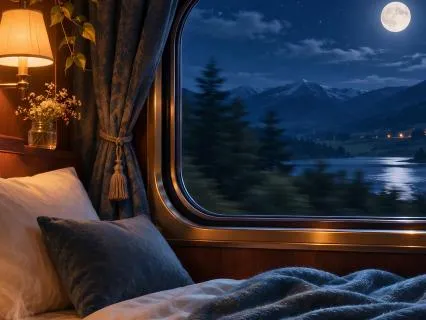
The compartment is small,
And every inch of it has been thought about.
A bed is made up against the left wall,
With crisp white linen and a thick oatmeal-colored quilt.
Its corner folded back,
As if to say,
Whenever you're ready.
Two plump pillows lean against the headboard,
And above them hangs a lamp with a pleated silk shade.
Across from the bed,
A wide low window is framed in dark wood and hung with heavy green velvet curtains,
Tied back with a tasseled cord.
Beneath it,
A narrow table holds a small glass bottle of water with a paper label that reads for the night.
And a thimble-sized vase with a single sprig of dried lavender.
You set your bag on the rack above the door and hang your coat on the brass hook.
You sit on the edge of the bend.
And the mattress gives just enough.
And you let out a long breath.
You are here.
There is nowhere else you need to be.
For a few minutes,
You simply sit,
Sipping the pear tea and watching the platform through the window.
The man in the grey overcoat folds his newspaper and climbs aboard a carriage further down.
The woman at the kiosk lowers her shudder.
The lamps hum quietly in their cages.
From somewhere far ahead comes a long,
Low note.
Softer than a whistle.
Almost a sigh.
The floor gives the faintest shiver,
As if the whole train were stretching.
And the platform begins,
Very slowly,
To slide away.
There is no choice.
The motion arrives the way the tide arrives,
So gradually you cannot say when it began.
The station lamps drift past the window.
Won.
Then another,
Then a whole string of them,
Stretching into the long streaks of gold.
The canopy slides by overhead.
And then the end of the platform,
And then the open evening.
The wheels find their rhythm.
Even pulse that rises to the floor and onto the base of your spine.
Your breath begins to fall in with it.
Slow in,
Slow out.
Without any effort at all.
Outside,
The city begins to loosen.
Rows of brick houses pass,
Their windows lit in squares of orange and yellow.
A kettle on a stove,
A cat on a seal.
The houses thin.
There is a canal,
Black and still,
With the lights of a bridge laid across it,
Like a necklace.
There is a row of allotments.
Their little sheds tucked up for the winter.
A single street lamp stands at the edge of a field.
Shining over nothing in particular.
With each light that slides past the glass,
A little of the day goes with it.
The errand you meant to finish.
The message you meant to answer,
The thing you almost said.
Each one drifts out into the dark behind the train,
And is left there,
Small and far away,
And none of them are yours to carry tonight.
Then the last of the town slips behind.
And the land begins to lift.
Hills gather on the horizon,
Then rise into the mountains.
And the low light lies across their slopes in russet and gold.
There is a quiet knock at your door,
Two gentle taps.
Harden the intrusion.
Says Mr.
Ellery when you slide it open.
His cap is tucked under one arm.
The dining car is open for supper.
Nothing grand,
But Mrs.
Youngston has a pot of leek and potato soup.
She's been nursing since noon.
And the bread came out of the oven an hour before we left.
Third Carriage Along and when you've eaten.
There's an observation lounge at the very back of the train,
If you'd like to watch the evening go.
Your stomach,
Which had been politely quiet until now,
Gives a small,
Honest answer.
I'll take that as a yes,
" he says and his eyes crinkle.
You leave your shoes by the bed,
Slip on the soft slippers you packed,
And step into the corridor.
The train sways beneath you,
Slow and easy,
Like a hammock in a light wind.
And you move with it.
One hand trailing along the polished rail.
Between carriages there is a short vestibule where the wheel sounds louder for a moment,
And a rush of cool air at your ankles smells of rain and pine.
Then you cross into the next car,
And the warmth wraps back around you.
The dining car is a room made of gold and shadow.
Small tables with white cloths line both sides,
Each lit by a brass lamp with a tiny fringed shade.
Beyond the windows,
The hills are turning blue.
There are only a handful of other passengers.
The elderly couple from the platform sit near the far end.
The scarf now draped across both their laps.
A young man in spectacles writes in a leather notebook with a pencil worn down to his stub.
The dog in the tartan jacket has curled beneath the table.
Nose tucked into his tail.
A round woman with silver hair,
Pinned in a loose knot and a dish towel over her shoulder,
Appears from the gallery.
You'll be seven.
She says.
Sit anywhere you like,
Love.
You take a small table by your window.
Within a minute,
A wide white bowl is set in front of you.
The soup is thick and pale gold,
Flecked with chives,
And it smells of butter,
An onion cooked slowly,
And potato.
Decided,
She sets a basket with a cloth over it.
And under the cloth is a loaf,
Still warm,
Its crust crackling faintly as it cools.
You tear off a piece.
The inside is soft and slightly springy.
The steam curls from it in a thin silver thread.
You dip it into the soup.
And for a moment,
The world narrows to this one warm,
Plain,
Perfect thing.
You eat slowly.
Outside,
The mountains slid by,
Their maples and birches going from flame to ember in the fading light.
Now and then,
A lone farmhouse drifts past with a light in its kitchen window,
And you wish whoever is inside A good night.
As you finish the last of the bread,
The elderly woman stops beside your table on her way to the galley.
The scarf looped over her arms.
Forgive me.
She says.
We couldn't help noticing that you ate that soup the way it deserves.
You smile and tell her it may be the best thing you've eaten in a long time.
41 Octobers we've taken this train.
She says.
The first was our honeymoon.
We couldn't afford a sleeper.
So we sat up all night in this carriage,
Over one pot of tea.
Mrs.
Youngston's mother ran the galley then.
She let us stay until morning.
And never sent a bill.
From their table,
Her husband lifts one hand in greeting.
Tell her about the scarf.
He says.
It's mine.
She says,
He has never once bought his own.
She rests her hand lightly on the back of your chair.
It's the one night of the year we don't talk about anything that matters.
We just ride.
I hope you will do the same.
Sleep well.
Her husband adds.
At the next table.
The young man in spectacles has looked up from his notebook.
I write a letter on every night train.
He says,
Almost to himself.
My sister has never ridden one.
Tonight's is mostly about soup.
He bends over his page again and the pencil resumes its slow scratching.
When the bowl is empty.
Mrs.
Youngston returns with a cup of something steaming and brown.
Cocoa she says.
Real chocolate shaved from the block.
And a drop of cream.
Because it's cold out.
It is thick and rich,
And not too sweet.
You wrap both hands around the cup.
At the far table,
The elderly couple's heads have drifted slowly towards one another.
The young man's pencil has stopped moving.
The whole carriage feels like a breath being slowly let go.
You thank Mrs.
Youngston,
Who waves you off with her dish towel.
And make your way toward the back of the train.
Carriage by carriage,
The rocking of the floor passing through you,
Like a slow song.
The observation lounge is the last carriage and is a room built for looking.
The roof curves up and over in a long arc of glass so that the sky seems to rest right on the walls.
The lamps are turned very low,
Just a faint amber glow in the corners.
At the center of the far wall sits a small black wood stove.
Its door ajar to show embers breathing slowly orange.
Around it are deep armchairs in warm green leather,
Each with a woolen blanket folded over one arm.
Beyond the stove,
A glass-paneled door with a small enameled sign reads,
Open platform.
A heavy wool coat hangs on a peg beside it,
With a card pinned to the sleeve.
For those who forget.
You leave it where it is.
You would like to meet the evening as it is.
You lift the latch.
And step out.
The air finds you at once,
Cool and clean.
Full of smells you have forgotten were available.
Wood smoke from some distant chimney,
Wet leaves,
Pine resin,
Cold stone.
The train is climbing a long grade,
Slowly,
So the wind is only a breeze.
A steady hand that lifts the hair from your forehead and combs it back.
You close your eyes and let it.
When you open them,
The whole mountainside is spread out behind the train.
Like an unrolling quilt,
Maples glue scarlet on their lower slopes.
Higher up,
The birches and aspens have turned a pale,
Buttery yellow.
And between them the oaks hold a deep copper.
A dark column of hemlock rises through all that color,
Like a green candle.
The sun has slipped below the western ridge and left its lights on the peaks,
Which glow rose and amber in the folds of the hills below.
Blue shadow is gathering,
And thin white mist lifts from the hollows.
Behind the train,
The two rails run together into a single silver thread.
And disappear around a curve.
A creek flashes beneath you as the train crosses a low trestle.
A quick bright stripe of water,
Tumbling over stone,
And then.
.
.
It is gone.
Out here,
The wheels sound gentler,
A slow thin clicking,
Like a clock in a quiet house.
Beneath it,
You hear the wind in the trees.
And from high on the ridge a single bird calling twice and then thinking better of it.
A leaf comes loose from a branch and spins along beside the train for a moment in no hurry.
It lands on the railing by your hand.
It is a maple leaf,
Red as cherry,
With a thin,
Dark stem.
You pick it up and turn it between your fingers.
It is dry and almost weightless.
And when you hold it up.
The last of the sky shows through it in deep,
Glowing crimson.
You stay a while,
Your forearms resting on the cool rail.
Little by little.
The chill begins to make its case.
First,
Your fingertips.
Then the tip of your nose.
Than a small shiver at your collar.
The breeze that felt so tender has a thread of real cold in it now.
The first breath of night coming down from the high places.
The color is draining from the slope.
The scarlet deepens to wine,
The gold to bronze,
And the eastern ridge of a single star appears small and white and patient.
You slide the leaf into your pocket and take one last long look at the mountains,
Settling into the blue.
Then you open the door and the warmth of the lounge closes around you.
Your cheeks begin to tingle as they thaw,
And your fingers curl gratefully into your palms.
The stove has been fed while you were away,
And its small orange window flickers on the floor.
Behind you.
The door clicked shut.
And the cold stays politely outside.
Above you.
The arched glass has filled with night.
You choose the chair nearest the stove and sink into it.
The leather sighs around you.
You pull a blanket over your knees.
It is heavy and warm,
And smells of cedar.
The sky above you.
Is enormous.
You hadn't noticed in town how many stars there were.
Out here,
They lie across the dark in thick,
Quiet drifts.
Some bright and steady,
Some so faint you only see them when you look slightly to one side.
A thin curl of cloud passes over them.
Silver Edge.
Then the stars returned.
Unhurried.
The train carries you through a long valley.
On either side,
The mountains rise in rounded shoulders,
Black against the stars.
The higher slopes pale with the season's first frost.
There is a river down there.
Starlight catches in its places,
A slow ribbon of pewter winding through the fields.
Then the train crosses it on a long iron bridge.
And the sound of the wheels deepen into a gentle drumming that rolls out across the water and comes back as an echo.
Below.
The river slides by.
Black and smooth.
Carrying a scatter of stars on its surface.
They break apart and gather again as the current moves.
And you watch them until the far bank returns and the drumming softens back into the usual hum.
A log shifts in the stove,
And a few sparks fly.
Lift and fade.
Your eyelids are pleasantly heavy now.
The warmth has settled all the way into the center of you.
The soup.
The cocoa.
The blanket.
The glow.
Your hands rest open in your lap.
Your jaw has loosened without your noticing.
Nothing at all is required of you.
After a while,
You rise slowly,
Fold the blanket over the arm of the chair and turn back toward your own carriage.
The corridor has changed while you were away.
The lamps have been dimmed to a low,
Honeyed glow.
The doors are closed.
One after another,
And behind each is the faint sense of someone sleeping.
Or very nearly.
Somewhere,
A person is snoring lightly and without any embarrassment.
Like a cat.
Purring in another room.
At number seven,
Your door is slightly ajar.
Inside.
A small lamp has been lit by the bed.
And the quilt has been turned down further.
At the foot of the band.
Lies a hot water bottle with a knitted cover.
Pleasantly warm when you touch it.
On the pillow is a folded square of flannel,
Which turns out to be.
.
.
A pair of pajamas,
Soft and faded,
Patterned with tiny blue stars.
Mr.
Ellery's doing.
You suspect.
But you hadn't packed these.
But they are exactly your size.
Behind a curtain in the corner,
There is a small wash basin.
With soap that smells of oatmeal and honey.
You wash your face in water that is warm,
Though you never saw anyone heat it.
The towel is thick and a little rough,
The way good towels are.
And it smells of sun and clean air.
You set the maple leaf on the little table beside the lavender.
You change slowly.
The flannel is cool at first.
And then,
After a breath or two,
Perfectly warm.
You fold your clothes onto the shelf and turn the lamp down.
Until it is barely a glow.
And then,
You climb into bed.
The sheets are cool and smooth,
And the quilt settles over you with a lovely weight.
Like a hand on your shoulder,
Like being told that everything is all right.
You push your feet down toward the hot water bottle,
And the warmth spreads up through your ankles and calves,
And a long,
Slow sigh leaves you.
You let it go on as long as it wants.
Mr.
Ellery has drawn the curtain almost closed,
Leaving a narrow slice of night.
Through it,
You can see that the moon has come up at last.
Low and round and pale gold.
Riding along beside the train.
It slips behind a hill.
And is out again.
Behind a ridge of trees.
And is out again.
Never leaving.
As if it had decided to see you home.
Then a cloud draws across the moon and the rain begins.
It starts so softly,
You aren't sure you're hearing it.
A faint tick against the glass.
Then.
Another.
Then,
A gentle scattering.
It grows into a soft even pattern that runs the length of the carriage roof.
Like fingertips drumming slowly on a quilt.
Raindrops gather on the window and slide down in long wandering lines.
Inside.
You are dry and warm.
And entirely hell.
The wheels go on beneath you,
Steady as a pulse.
There is a slow sway to the left and a slow sway to the right.
The way a cradle moves.
Or a boat tied up at a dock.
A quilt rises and falls with your breath,
And you cannot tell anymore which of you is leading.
Somewhere in the walls,
The old wood creaks.
A comfortable sound,
Like a house settling in for the night.
Far ahead,
The engine sends one more long soft note out into the rain.
And it travels over the sleeping fields and fades.
Your thoughts have grown loose now,
Like beads slipping slowly off a string.
A bowl of soup,
A lantern on a platform.
The kinder lines around Mr.
Ellery's eyes.
The river with its scatter of stars.
Each one drifts through your mind,
Glows for a moment,
And floats gently away.
You do not need to follow any of them.
Start with your feet.
May rest against the warmth of the hot water bottle,
And they have carried you all day You let them be carried now.
The warmth loosens your toes.
Within the arches.
Then the hills.
And they sink into the mattress.
And stop holding anything up.
The warmth moves into your ankles and your calves.
The long muscles let go,
One by one.
Like knots being patiently undone.
Your knees soften.
Your thighs grow heavy and still,
Resting wholly on the bed,
As though it had always meant to hold them.
Your hips settle.
Your lower back,
Which has kept you upright all day,
Melts into the mattress,
One small bone at a time,
As if it were made of warm sand.
Your belly rises and falls on its own.
Your chest is wide and quiet.
Your shoulders drop.
Further than you thought they could.
Your arms grow heavy from the shoulder to the elbow to the wrist.
And your hands lie open on the quilt.
Fingers curled slightly,
Holding nothing at all.
Your neck lets the pillow take the weight of your head.
Your jaw loosens.
Your tongue rests.
The small muscles around your eyes,
Which have worked all day without thanks,
Finally let go.
Your forehead smooths.
Your whole face is soft.
The rain taps on,
The rails sing their low hum.
Far away now,
The train is carrying you toward a place called Larkmoor.
Which you will reach in the morning.
When the sky is pink and the frost is bright and the first tea of the day is waiting.
But that is a long time from now.
That belongs to another version of you.
A rested one.
Who will wake with the light.
For now.
There is only the sway.
And the warm.
And the hush of the rain.
Your breath slows,
The train sways gently to the left,
And you breathe in slowly for a count of four.
One,
Two,
Three,
Four.
Four,
The train sways gently to the right.
And you breathe out longer for a count of six.
One,
Two,
Three.
For war.
Five.
Sex.
Again,
In with the sway to the left.
1.
.
.
2.
.
.
Three,
For war.
And out.
With the sway to the right.
Slow and unhurried.
Five.
Sex.
Once more.
End.
And Al.
You no longer need to count.
The rocking carries your breath,
And the wheels keep the time.
The quilt is heavy and kind.
The night is wide.
Engine toll.
And has.
No edges.
And somewhere between one soft turn of the wheels and the next,
Without any moment you could ever point to,
You asleep.
Good night.