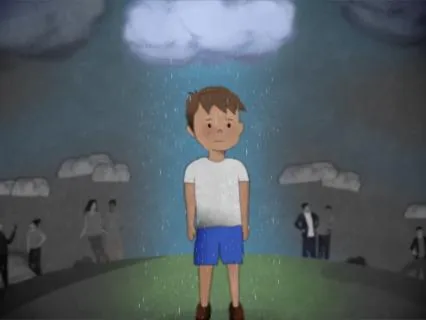
One way of looking at depression.
Is to see it as an adaptive response learnt early in life.
A strategy we employed as children or adolescents to navigate complicated and distressing life situations and relationships in our families of origin.
Every child is dropped into a situation where,
In addition to their immediate physical needs,
They seek security.
And the affirmation,
They're okay.
To achieve this,
They must be aware of the feelings and agendas of the immediate group around them.
Sometimes there is no way to either please,
Fit in,
Or ask for what we want.
And in these situations,
We may learn to pull back to protect ourselves.
Depression then is similar to hibernation.
A protective withdrawal from the world.
Depression in this view is a safe space.
Because the effects of this withdrawal can be so overwhelming and distressing.
It can feel like an illness.
And indeed at times it may be useful to treat it as such with antidepressant medication.
And this may restore balance so you can move forward again.
If I'm stressed and have a headache,
I take an analgesic.
This treats the headache,
Not the stress.
But without the headache,
I may be more able to address the stress.
In the same way,
Treating the symptoms of my depression may be helpful.
Ultimately however,
Thinking of depression as a disease to be treated may miss the point.
Depression was originally a protective strategy.
So it is best to imagine depression not as a disease or as the enemy.
But as a once helpful part of you.
Attacking depression or trying to cut it out is attacking yourself.
And trying to eradicate your own safe space.
We may not be able to love our depression,
But treating it as a mysterious external affliction is not helpful to understanding it.
And understanding.
Is the best route to change.