Mindfulness Meditation Steps 1-6 Step 1 Get into a comfortable posture.
Experience yourself sitting cross-legged or on a meditation cushion,
Or with your legs extended straight out,
With your back against the wall for support,
Or sit in a chair with a firm back,
Keeping your feet on the floor and your spine straight,
And tucking in your chin slightly to keep your vertebrae aligned properly.
If you have any back or pelvic or neck pain,
Back support is essential.
In fact,
You may want to lie on the floor or on a couch or bed with your head propped up at a 45 degree angle.
Alternatively,
Sit in an aerodynamic office chair with lumbar support.
If you're sitting up,
Close your eyes,
But if you're lying down,
Keep your eyes half open to prevent yourself from falling asleep.
Step 2 Focus your eyes.
With your eyes closed,
Focus them on one spot.
You may wish to focus them towards the tip of your nose or on your third eye,
The chakra or energy point identified in yogic and meditative systems,
The area in the middle of the forehead,
Often known as the mind's eye.
Allow your eyeballs to roll upward.
Alternatively,
Look straight ahead at the inside of your eyelids.
Whichever eye position you choose,
Make certain it feels comfortable and that your eye muscles are relaxed.
You can also focus on the muscles at the back of your eyes,
Relaxing them,
Resting the back of your eyes in that warm,
Dark space.
If you have any heightened anxiety or fears or you're dealing with a trauma,
You may want to open your eyes halfway or even fully,
Looking straight ahead at a spot on the wall or out the window at a stationary object in order to ease those feelings.
For example,
Try sitting about three feet from the wall and with your back straight,
Slightly tilt your head downward and find the spot where the wall and the floor meet.
With your eyes slightly opened and relaxed,
Gaze steadily at this point.
You may also wish to close your eyes and imagine being in a place where you've always felt relaxed,
Safe and secure,
Such as when you are a small child sitting on your grandmother's lap or on the swing in your backyard.
You might even imagine such a spot if you can't remember one.
This will immediately assist you in decreasing any fear or anxiety about entering into the meditative state.
Step three,
Pay attention to your breathing.
With your eyes closed,
Fixating them on one spot,
Breathe in with awareness of your lungs and your diaphragm.
As you inhale,
Say to yourself,
In.
Exhale from your lungs and then your abdomen,
Saying to yourself,
Out.
Do this each time you breathe.
You can also use the words rising and falling away or comfort and letting go or surrender and release.
Step four,
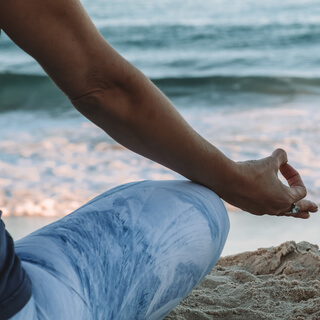
Place your hands in a relaxing and energizing mudra,
Which is a hand posture.
In Buddhism,
The mudra or position of the hands in meditation is important because it affects the flow of energy throughout the body.
There are three traditional mudras.
The first is to touch the thumb and the first finger to each other and then hold your palms up with your other fingers relaxed and straight and rest the back of your hands on your thighs.
The second,
Which is more common in Zen Buddhism,
Is similar.
You bring your gently cupped hands together at your abdomen,
Thumbs facing away from you and palms up with the fingernails of your first three fingers touching.
The third,
Also a Zen mudra,
Is to hold your right hand in your lap at your navel with the palm turned upward,
Thumb facing away from you and other fingers straight.
Then place your left hand on top of the right hand,
Also palm up with the thumb facing away from you so that your two thumbs form a triangle with your left index finger.
Step five,
Be aware.
As you breathe in and out,
Mentally note the thoughts,
Feelings,
Sounds,
Tastes,
Smells,
And physical sensations such as itching,
Temperature changes,
Pain or discomfort,
Or feelings of heaviness or lightness that you experience in each and every moment as you experience yourself breathing in and breathing out.
Don't try to analyze any of what you're noting.
Simply become present,
Open,
Alert,
And watchful as you allow the witnessing mind to emerge.
Observe the quality of the sensation if it has one and categorize it.
Heaviness in shoulders,
Bitter taste,
Lawnmower outside,
Painful thought about sun,
Thought about the call I should make,
And so on and so on.
Don't explore this thought or feeling unless it occurs more than twice,
In which case ask yourself,
Is this something I can come back to later after I've meditated?
If the answer is yes,
Let go of the thought as you exhale,
But do come back to it later and write about it in your mindfulness journal.
Contemplate upon it or talk to a friend or counselor about it.
If you determine that what keeps coming up for you should be addressed right away,
Allow yourself to be present with that sensation,
Feeling,
Or repetitive thought.
At the same time,
Allow the witness aspect of your consciousness to observe yourself without judgment as the feeling,
Thought,
Or sensation fades away or lessens in intensity.
Step 6.
Slowly coming back into ordinary consciousness.
Take three long,
Slow,
Deep breaths,
Breathing in through your nose and out through your mouth.
Rub the palms of your hands together to generate heat,
And place the palms over your eyes and face.
Open your eyes and slowly lift your hands away from your face as you return to awareness.
Inhale deeply and stretch your arms up over your head,
With your hands interlocked.
Bend slowly to the right,
Then to the left,
And do this several times,
And then bend forward towards your feet.
Reflect on whether anything of importance revealed itself to you,
And that you wish to write about it in your mindfulness journal.
Think about or attend to it.