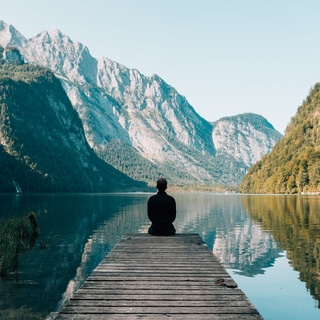
So this short talk is one for people who are looking to implement a daily mindfulness meditation practice into their life,
Or a daily practice in general,
Be it meditation or exercise or anything else.
The proposition here is simple.
Just one minute,
Just one minute done daily over time will lock in this practice,
Form a habit and enable you to expand from there.
Let me convince you.
There's an analogy to exercise that I love here.
If you were to do just one minute every day,
Push-ups or sit-ups or squats or a sprint even,
Just one minute every day,
Consistently,
Your body would thank you.
You'd become faster,
Fitter,
Stronger,
Healthier.
Now if you think about that going into the future,
Seems like a possibility.
But imagine if every day for your entire life you'd already done that one minute.
Don't you wish that was already the case?
Because it's so easy to find one minute.
There's barely an excuse to procrastinate and it's over very quickly.
And the same thing is true for meditation.
Obviously more is better,
But beyond all of that being consistent will yield the best results.
Don't get me wrong,
An hour of exercise once a month is better than zero exercise in the month.
And an hour of meditation or just one guided session on a nap is better than nothing.
But the best thing that you can be doing for yourself is developing a consistent practice.
And there's two ways to do this,
But what they involve is overcoming the inner blocks.
The first one is finding the time and the motivation.
And the second one is seeing progress.
So we've talked about the finding the time and the motivation,
But just one minute,
Just one minute done daily.
I like to peg things to behaviors.
For example,
You wake up,
You get yourself sorted,
Then you meditate and exercise.
It's like it's pegging it to the morning wake up.
And if you're a morning person that works,
But maybe it's as you're about to leave the house for work,
Or as you arrive at work,
Or in your lunch break,
Or after work,
Or at home,
Just before bed,
Just after or before dinner,
Find a time that works for you and your life and stick to it.
But peg it to something,
Because that way it's like,
Oh,
It's lunch break,
One minute meditation.
You see how that works?
And because it's only one minute,
It doesn't take too much from your life.
Because it's only one minute,
It doesn't detract from things.
You can just do it because there's no one in this world who doesn't have one minute spare in their day.
Because if I was to ask you to establish a 20 minute or an hour long session every day,
You might be able to do it with motivation at the start,
The New Year's resolution sort of thing.
But life has a way of creeping back in.
You can push away those jobs,
Push away those responsibilities,
Push away all of the stuff that you're normally doing.
But if you do it too soon,
If you overdo it too quickly,
You'll find that you actually have no time for it and that life will come back.
So how do you avoid this?
Some people can just push through cold turkey style,
But most people need to build it up.
That's why I suggest starting with one minute a day,
Establish that one minute habit,
Lock it in,
One minute done daily.
I like to practice mindfulness meditation.
So basically you take a seat,
Choose a meditation object,
For example,
The sensations of the breath of the nose,
And you just focus there.
Your mind orders you bring it back,
Your mind orders you bring it back.
I've talked elsewhere on how to establish your mindfulness practice,
But that's my practice.
You could also use this one minute for calm breathing or stretching or whatever other meditation you want to put in there.
But we're just doing one minute at a time.
But now we're going to look at progress because you're like,
Oh,
Okay,
I'm doing this one minute,
But what's the point?
How's it worth it?
I suggest everyone has a yearly calendar put up on their wall and every day they do the activity they're wanting to grow and establish.
For example,
In this case,
Meditation,
You put a little M or a little cross or a little tick into the box that represents the day.
And your goal is,
It's a little bit of a game against yourself,
To see how many ticks in a row you can get.
Can you get to 10 ticks,
10 days in a row?
Can you get to 20?
Can you get to 30?
And in this way,
You're growing and establishing and seeing the meditation practice.
Because over time,
The results compound.
Yes,
Anything is better than nothing,
But consistency is better than everything.
Get the consistent practice on point and see how many days in a row you can get.
And if you miss a day,
That's fine.
Challenge yourself to get up to that amount of days again and beat it.
And then once you've carved out that one minute of meditation time every day,
Maybe add another minute.
Now you're doing two minutes a day.
Once that's locked in,
Add a third and a fourth and a fifth and so on.
Just don't jump up too quick because you'll get this habit locked in.
And you're like,
Yeah,
I'm doing it.
I could increase this to five minutes,
To 10 minutes,
To 20 minutes,
To an hour.
Maybe you can,
But chances are it'll become overwhelming.
Chances are you will go too soon,
Too big too soon,
Rather.
And that's okay.
Learn from the mistake,
Pull it back to where you were managing.
If you can maintain it for 30 to 60 days,
It's locked in.
You're doing it.
So you could make a little rule to yourself.
Okay,
Every day I'm going to meditate for one minute.
And every time I get to a 30 day streak,
I'm going to add one minute.
So after 30 days,
It becomes two minutes.
After 30 days again,
It becomes three minutes and so forth.
So by the end of the year,
You're going to have established a 10 to 20 minute meditation habit.
And it won't feel like that time has just been taken from other things because you will have learned and adapted and grown.
So if you haven't already,
Find a time to meditate in the day,
Set a timer for just one minute and do it,
And then track your progress.
And slowly over time,
Up it by one minute each day.
Have a great day.
Do that one minute right now.
Cheers.