Greetings,
I'm Jerry Givens.
Today we'll practice diyarga pranayama,
Or the three-part yogic breath.
This breathing technique combines three different types of breathing.
Diaphragmatic,
Thoracic,
And clavicular breathing.
But you don't have to remember all that right now,
I'll lead you through it.
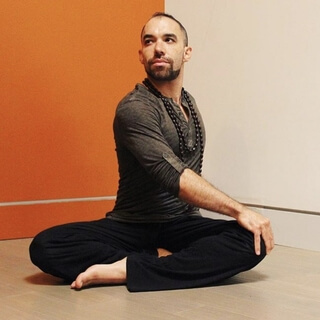
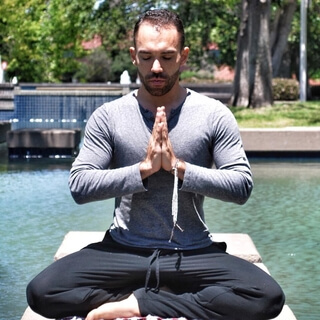
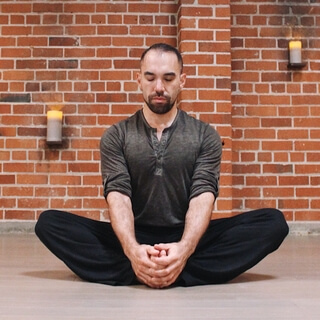
So this is best done seated.
You can also do it lying down if you need to.
Make yourself comfortable.
And as your eyes close,
Just become aware of the movement of the breath in your body and its relaxed state.
You may notice the chest and rib cage expanding and contracting.
And then become more acutely aware of the movement of your abdomen.
The inhale,
The navel expanding away from the spine.
The exhale,
The navel relaxing towards your spine.
Other parts of the body may still be moving and that's fine,
But just notice the movement of the abdomen.
Expanding on inhale.
And relaxing on exhale.
The navel expanding away from the spine as you inhale.
And contracting towards your spine as you exhale.
Keeping the breath relaxed,
Move your awareness to the widening and narrowing of your rib cage.
As you inhale,
The rib cage widen,
Expand.
And as you exhale,
Feeling the rib cage narrow or contract.
Again,
Other regions of the body may be moving,
But just notice the movement of the ribs.
Inhale and exhale,
Widening and narrowing.
Rib cage expanding on inhale.
Rib cage narrowing on exhale.
Now again,
Keeping the breath relaxed.
Notice if you can sense any breath behind your collarbones.
Very topmost region of the lungs.
And if you're not feeling it with the breath in its relaxed state,
Maybe take just a little bit more breath into your body to really feel the breath expand behind your collarbones.
Of course,
Feeling the exhale,
The breath relaxing from behind the collarbones.
So now we'll blend these three aspects of breathing.
So go ahead and exhale completely.
And with your next inhale,
Feel the abdomen expand first.
Partway through the inhale,
Feel the rib cage then expand.
And then at the top of your full inhale,
Feel the breath come behind the collarbones.
And then with your exhalation,
Feel the collarbones deflate,
The rib cage narrows,
And then lastly,
The abdomen contracts.
So again,
That is inhaling the abdomen first,
Then feel the rib cage widen,
And then the breath comes up behind the collarbones.
Exhale,
Collarbones,
Then the ribs,
Then the abdomen.
Inhale,
Abdomen,
Rib cage,
Collarbones,
And exhale,
Collarbones,
Rib cage,
And abdomen.
Please continue on your own.
And it's okay if you're not able to compartmentalize the breath as I'm mentioning.
Just keep the intention that you're filling the body with breath from the base all the way up to the collarbones on inhale.
And you're emptying the body from the collarbones all the way down to the base on exhale.
Three part inhale.
Exhale.
Three part exhale.
Inhaling abdomen,
Rib cage,
Collarbones,
Exhale,
Collarbones,
Rib cage,
And abdomen.
Three part yogic breathing.
Inhale,
Filling the body from the base to the top.
And exhale,
Emptying the body from the top down to the base.
Continuing this practice for just a little bit longer.
Three part yogic inhale,
And three part yogic exhale.
The efforting in this practice becoming less and less,
This three part breath feeling more and more natural.
Good.
So take your time getting there,
But as you complete this next three part exhalation,
Relax the technique.
Just notice as your breath comes to its now normal state.
Noticing how you feel in your body.
Noticing how you feel in your mind.
And when you're ready,
Go ahead and take a deeper fuller breath.
Take your time as you open your eyes,
Gently bringing your awareness back to the space around you.
Thank you so much for sharing in this practice.
I hope it serves you well.
Take care.
Namaste.