Unhooking from thoughts.
Thoughts are a part of everyone's human experience.
You don't need to push them away in order to practice.
Learning to bring your mind back from its thoughts is the practice.
But how do you let go of the thoughts once they've pulled you in?
This exercise offers one way to unhook yourself from those thoughts and simply let them be.
Without pushing the thoughts away or denying their presence,
You can be aware of the thinking mind while remaining unattached.
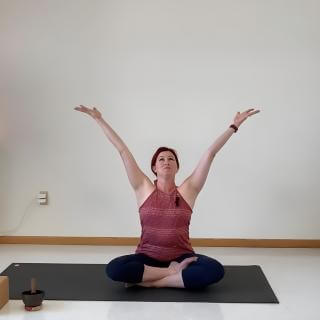
Settle into a seated posture and close your eyes.
Notice the energy in your mind and body.
As you come into a period of mindfulness practice,
You may notice the energy of your day resting in your mind and body.
The mind may be active,
The body may feel worked up,
Or you might notice a bit of lingering anxiety.
Think of a shaken snow globe with all that energy swirling around.
As you rest,
The little snowflakes fall gently to the ground.
Think of yourself as a snow globe and every snowflake as a thought.
In this way,
Watch as each and every snowflake falls to the ground.
Do not force yourself to calm down.
Let it happen slowly and organically.
Do not force yourself to calm down.
Let it happen slowly and organically.
Bring your attention to the breath in the body.
Choose one spot where the breath is felt easily.
It may be the center of the chest,
The abdomen,
The shoulders,
Or the nostrils.
Observe the physical sensation of the body breathing.
Continue to observe the breath and bring the mind back when it wanders.
Stick with the snow globe visualization,
And as thoughts begin to rise up,
Observe as they slowly settle back down.
Do not force yourself to calm down.
Let it happen slowly and organically.
Do not force yourself to calm down.
Let it happen slowly and organically.
Bring your attention to the breath in the body.
Do not force yourself to calm down.
Open your awareness to include your thoughts and your general mental state.
Instead of returning to the breath when the mind wanders,
Notice what the mind is doing.
You may notice yourself planning,
Fantasizing,
Figuring out,
Or replaying past experiences.
Whatever you observe the mind doing,
Let it be.
When you recognize a thought,
What happens?
Try not to encourage the thought,
But don't push it away either.
Allow it to be,
And allowing it to go on its own.
See if you can watch the passing of the thought as it follows its natural trajectory and leaves the mind.
Return to the breath and patiently wait until another thought arises.
Notice it,
Watch the thought,
And come back to the breath again.
Continue with mindfulness of the breath and the thoughts.
Notice when you are lost in thought or when the mind wanders for some time.
If self-judgment arises,
Notice that just as you would any other thought.
You can always return to the breath for a few moments to ground yourself back into the practice.
Notice your mental states when they arise.
If the mind grows anxious or frustrated,
Acknowledge that it has done so.
Mental states like these may be present with or without concrete thoughts arising.
To conclude your practice,
Take one last deep,
Mindful breath.
Let the thoughts float down like the snowflakes and gently open your eyes.
Enjoy.