Hello,
Let's learn the purpose and the meaning behind the Ashtanga opening sequence,
Opening mantra,
Opening chant.
We say this opening chant as a blessing,
It's a prayer offered to the lineage of teachers and students who have come before us and have enabled Ashtanga yoga to continue for thousands of years.
We recognize their diligence to the practice and how we're able to allow the practice to carry on.
This also,
The chant cleanses the space that we're going to practice.
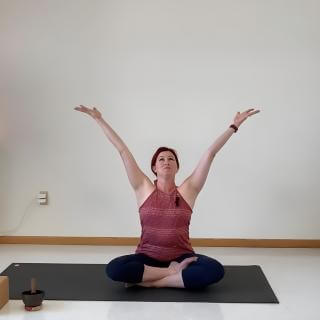
This is my space in my home.
We cleanse the space in order to practice our Ashtanga yoga.
It also prepares our mind and our body for the emotions and the sensations that we will experience in the forthcoming Ashtanga practice.
So we start with the sound of om.
Om is a humming sound through the throat and through the lips that represents the sound and the hum of Mother Earth.
We get grounded,
We go back to our roots of Mother Earth.
So just feel the vibration in your throat and your lips as you say,
Om.
It usually lasts as long as your exhale.
So make it a good inhale and a nice deep exhale on the om.
Then we move into the chant,
Bande gurunam charanabhinde,
Which means I bow to the lotus feet of the Supreme Guru.
Let's just say that together.
I'll say it.
You repeat in your mind or out loud.
Bande gurunam charanabhinde.
The next line,
Sandah shita svatma sukavabodhe,
And it means which awakens insight into the happiness of the pure being.
Let's say it together.
Sandah shita svatma sukavabodhinde.
The next line.
Nisrey yase jalikey yamanay.
It's hard to say without singing it.
This means which is the refuge of the jungle physician.
Let's say it slowly together.
Vishray yase jalikey yamanay.
Next line.
Samsara halahalah moshantay.
And it means which eliminates the delusion of the poisonous herb of samsara,
Which is a conditioned experience.
Let's say it slowly together.
Samsara halahalah moshantay.
The next line.
Abahu purashanakaram.
That one's a little bit of a mouthful.
It means the sage who has thousands of radiant white heads like the serpent,
The divine serpent,
Anahata.
Let's say that slowly together.
Abahu purashakaram.
We'll practice that when we chant it together,
Of course.
The next line.
Shankashuka sidarinam.
And this means and who has as far as his arms,
So we're still talking about the serpent,
Assumed the form of a man.
The honored serpent becomes a man.
Let's just say it slowly together.
Shankashakara.
It's a long word.
We'll say that one again.
Shankashakah.
See,
That one's easy.
Darinam.
We'll get it,
I'm sure.
Next line.
Sahas sirisam svetam.
And this one means holding a conch shell.
So that's a divine sound.
You make the sound in the conch shell.
A wheel.
So that represents time or light,
Never ending.
And a sword.
And that is discrimination or discernment.
Discerning with the sword,
The sharpened sword.
So that said slowly is sahas sirisam svetam.
That one's not so bad.
The last line,
We're almost there.
Pranamami patanjalim.
Hopefully you recognize that last word.
This means before him,
The sage,
Patanjali,
I prostrate,
I bow.
Say those two words with me.
Pranamami patanjalim.
And then we close the chant again with om,
Bringing it full circle.
Om.
Very nice.
Those are tricky words,
The Sanskrit words.
I'm not the expert on pronunciation.
I do my best.
I hope you will also do your best and just understand the purpose and the beauty behind recognizing this ancient practice that we still get to honor today.