In tonight's sleep story,
You will journey to the time-shifted village on a cool September evening,
Where the first golden leaves are beginning to appear and the warm glow of a little tailor's shop invites you inside.
You'll meet Mr.
Rowan,
The village tailor,
Who believes that well-loved things are worth caring for and that nothing beautiful is ever hurried.
Autumn Wool,
Discover the village tradition of Mending Week,
And spend a peaceful evening beside the tailor's window watching ordinary life unfold as lanterns begin to glow.
As night settles over the village,
You'll wrap yourself in a newly made shawl,
Wander through the quiet lantern-lit streets,
And retire to a cozy room above the shop where Mr.
Rowan leaves you with a comforting reminder about change,
Patience,
And becoming yourself.
You're listening to The Tailor's Window.
This story is part of the Time-Shifted Village series,
But if you haven't listened to the others yet,
This story stands nicely on its own.
Welcome to the Whispering Willow.
I'm Diana,
And tonight I invite you to return with me to the time-shifted village.
This is a quiet place,
Where clocks still mark the hours,
But no one seems particularly interested in hurrying them along.
Tonight,
Summer has not quite left the village.
Flowers still spill from window boxes.
The trees are still mostly green.
And during the afternoon,
The sun still warms the old stone walls and cobblestone streets.
But evening comes a little earlier now.
The air carries the first hint of coolness.
Here and there a leaf has begun to turn gold around the edges.
Apples are appearing in baskets outside the market and in the windows of the little shops.
Linen and cotton are slowly being replaced by wool.
But the village is beginning to prepare for another season,
And tucked along one of its narrow streets is a small tailor's shop,
Where a lamp glows warmly in the window.
Beautiful fabrics are stacked upon wooden shelves,
And an old tailor understands that becoming something new does not mean leaving everything you once were behind.
It simply means allowing yourself to change,
One small stitch at a time.
Tonight there will be nothing for you to accomplish.
You don't need to know what comes next.
You don't need to have everything figured out.
You don't even need to be ready.
For now,
You only need to rest.
So find the position that feels most comfortable to you.
Allow your head to settle into your pillow.
Let your shoulders fall away from your ears.
Relax your hands,
Your fingers… Your jaw.
And simply allow yourself to arrive in this space.
Notice the support beneath you.
You do not have to hold yourself up this evening.
Take a slow breath in.
And imagine breathing in the coolness of a September evening.
Clean air drifting through an open window.
The faint fragrance of flowers that have not quite finished blooming yet,
Mingled with the first earthy scent of fallen leaves.
And breathe out,
Relaxing any tension or tightness,
Allowing your body to become just a little heavier.
Settle into a comfortable rhythm of breathing in,
And out.
Imagining warm lamp light glowing behind a window.
A comfortable room waiting beyond the glass.
A kettle warming.
A wooden chair beside a work table.
And soft lengths of beautiful fabric folded neatly upon shelves.
With each exhale,
Let the day begin moving further away.
There may be things in your life that feel unfinished.
Questions you haven't answered,
Decisions that haven't been made,
Plans that are still taking shape.
But unfinished does not mean something is wrong.
September understands this better than any month.
It's not quite summer.
Yet not quite autumn.
The trees do not rush to change their leaves.
The evenings do not become cool all at once.
One season simply begins to scoot over and make room for another,
Little by little.
And perhaps tonight,
You can allow yourself that same kindness.
You don't have to rush toward whatever comes next.
You are allowed to be exactly where you are right now.
Somewhere in the distance,
Rain has begun to fall lightly over the time-shifted village.
This is not a storm.
Only a soft September rain.
Polite and gentle.
Darkening the cobblestones,
And making the lantern light shimmer in the street.
And through the rain,
One particular window is glowing.
Warm.
Golden.
And welcoming.
Behind it sits a tailor,
Working beneath the light of an old brass lamp,
Just as he does every night.
But tonight,
Your path will lead you to his door.
It's time to wander.
The rain has softened by the time you reach the narrow street where the tailor's shop waits.
Only a few drops remain now.
Slipping from the edges of awnings,
Darkening the cobblestones,
Gathering briefly along the iron railings,
Before falling away into nothingness.
The village feels especially peaceful after rain,
As most places do.
September still holds a little warmth in the golden stone buildings and late summer flowers.
But the evening air has changed.
It feels a little cooler now,
Carrying the first quiet suggestion of a new season to come.
You have returned to the time-shifted village without much of a plan.
Perhaps because it is becoming a tradition.
Perhaps because you have learned that some of the loveliest evenings begin without knowing exactly where you are going.
So tonight you simply wander.
Ahead,
A broad window glows beneath a dark wooden frame.
Above it hangs a small brass sign.
The tailor's window.
And beneath the name in smaller lettering.
Nothing beautiful is ever hurried.
You pause beneath the awning and look through the glass.
Shelves rise along the walls,
Holding carefully folded lengths of fabric in every color imaginable.
Cream,
Moss green,
Deep blue,
Soft brown,
And muted gold.
Near the window rests a wooden work table.
On it you see scissors,
Spools of thread,
A box filled with buttons,
A measuring tape hanging from a brass hook.
And beside the table,
A man sits sewing.
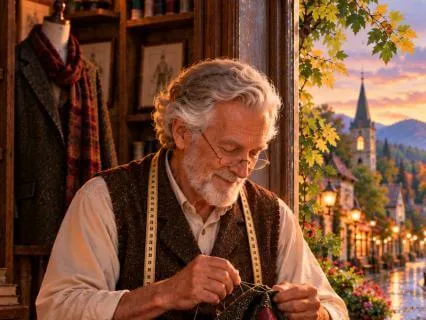
His silver hair catches the lamplight and a pair of round spectacles rests low on his nose.
In his hands is an old travel coat.
The wool has softened with years of wear.
One pocket has already been reinforced.
A nearly invisible patch rests near the shoulder.
And now,
Beneath the tailor's careful hands,
A new lining is being stitched into place.
The needle passes through the fabric,
In and out.
The tailor smooths the seam,
Then begins again.
And you stand there watching until he happens to look up.
His face brightens with an easy smile.
He gestures you to come in.
You open the door and step inside.
A small brass bell gives one quiet note above you,
And the warmth of the shop gathers around you.
The room smells of wool,
Cedar,
Polished wood,
And lavender.
The tailor gestures toward a chair near the window.
Make yourself comfortable,
He says.
It's colder outside than it looks.
You thank him and step farther inside.
There is something immediately reassuring about the shop.
Nothing seems new simply for the sake of being new.
The wooden floor bears the marks of many footsteps.
The work table has been polished smooth by years of use.
Baskets hold ribbons and scraps of fabric too beautiful or useful to discard.
And on one shelf beside the window,
You notice a folded length of deep blue cloth.
Something about it seems familiar.
Perhaps you have passed this window before.
Then you seemed to recall another rainy evening when you wandered through the village and noticed a tailor's lamp glowing beside a piece of deep blue fabric.
You smile at the thought of the village continuing while you are away.
It feels comforting.
The tailor returns to his stitching.
For a while,
Neither of you speaks.
The silence feels relaxing.
You hear the faint crackle of the small fire,
The occasional sound of rainwater dripping outside.
And the whisper of thread passing through cloth.
Eventually,
You nod toward the coat.
You sit and watch him work for a few moments.
Eventually,
You nod toward the coat.
Is someone replacing it?
The tailor looks down,
Then smiles.
No,
He smooths one sleeve between his hands.
It is simply becoming ready for another winter.
You look again at the old coat,
At the places that have been repaired.
At the new lining being added to something that has already traveled through many seasons.
How old is it,
You ask?
Old enough to have some stories,
He tells you.
His fingers pass over the reinforced pocket.
This one has traveled quite a bit.
You can tell?
Usually,
He says,
Lifting the coat toward the lamplight.
Sometimes from the wear,
Then he turns it slightly,
Revealing a careful line of stitching beneath one arm.
Sometimes from where it's been mended.
He lowers the coat and settles it across his lap again.
You find yourself looking more closely now.
Surprisingly,
The repairs do not make the coat appear any less beautiful.
If anything,
They seem to belong to it.
Mr.
Rowan threads his needle once more.
Well may things change with us,
He says,
And then he returns to his work.
No further explanation,
Only the quiet pull of thread through the wool.
You sit beside the window and listen.
Outside a single leaf,
Still mostly green but touched with gold along its edges,
Drifts from a maple branch and lands on the rain-darkened street.
Somewhere beyond the rooftops,
A clock tower begins to mark the hour.
Its mellow notes travel through the village.
Mr.
Rowan pauses to listen.
When the final chime fades,
He looks toward the window.
Still plenty of evening left,
He says.
Then he smiles and bends once more over the old travel coat.
And somehow,
In the time-shifted village,
There always seems to be.
Mr.
Rowan finishes the row of stitches and draws the thread carefully through the wool.
He studies his work for a moment,
Then reaches for a small pair of scissors.
Snip!
The thread falls free.
He folds the travel coat across the corner of his work table and smooths it once with his palm.
Then he looks toward you.
Now,
He says,
Let's see what September has done with you.
You smile,
Unsure whether he is joking.
But Mr.
Rowan is already reaching for the measuring tape hanging from the brass hook beside his table.
It's pale and soft with age,
Its markings slightly faded from years of use.
Do you measure your customers every September,
You ask?
Most of them,
He tells you.
He gestures toward another small wooden platform beside the long mirror.
Even the ones I've measured before.
You step onto the platform.
Outside the window,
The last drops of rain continue to fall from the awning.
Mr.
Rowan settles the measuring tape across your shoulders.
It feels cool at first,
But it warms quickly.
He notes the measurement in a small book,
Across the shoulders,
Down one arm,
Then the other.
Around your waist.
He works with the same quiet attention he gave the old coat.
Nothing about the process feels rushed.
There is no sense that he is evaluating you or looking for something that needs to be changed.
He is simply noticing.
Measuring what is here.
What is true today.
When he finishes one measurement,
He writes it down before moving to the next.
You glance toward the open book.
Names fill the pages beside dates and rows of carefully written numbers.
Some appear year after year.
Why do you measure everyone again if you already know their sizes,
You ask?
Mr.
Rowan considers the question as he measures the length of your arm.
Summer changes us,
He tells you,
Making another small note.
Then he adds not only our bodies,
You look at him in the mirror.
His attention remains on the measuring tape.
People carry different things from one season to the next,
He says.
Sometimes more.
He loosens the tape slightly.
Sometimes less.
Outside,
A single drop of rain slides slowly down the window.
You think about how much can happen between one season and another.
Journeys,
Work.
Conversations.
Ordinary days.
Things taken on.
And things finally set down.
It seems to you we rarely notice these changes while they are happening.
Mr.
Rowan finishes the final measurements and returns to his work table.
A garment should fit the person standing in front of me,
He says,
Closing the little book.
Not the person who stood here last spring.
For a moment,
You look at yourself in the long mirror.
You still look like yourself.
And yet,
Perhaps that doesn't mean you are exactly the same.
You ponder this thought for a moment.
Beyond the window,
The village seems to be making its own small adjustments.
The baker across the street turns his chalkboard around.
Tomorrow's offerings have already been written across it.
Apple bread,
Cinnamon buns,
Pear tarts.
Two children walk past carrying a handful of leaves they have collected beneath the maple trees.
Most are green.
One is yellow.
Summer is still here.
And yet something else is beginning to arrive alongside it.
Mr.
Rowan follows your gaze.
The seasons are quite good at this,
He continues.
At what,
You ask?
Changing without becoming something they aren't.
He begins winding the measuring tape loosely around his hand.
September doesn't wake one morning and decide to be October.
You laugh softly.
No?
Never known it to,
He says,
His eyes crinkling with amusement.
It just takes its time.
Mr.
Rowan hangs the measuring tape once more on its brass hook.
Then he closes the little book and places it carefully beside the old travel coat.
You glance toward the window.
The rain has stopped now,
But somehow you aren't quite ready to leave.
Would you mind if I stayed for a while,
You ask?
Mr.
Rowan looks mildly surprised by the question.
I was rather expecting you would.
He gestures toward the shelves of folded fabric.
Besides,
A small smile appears on his face.
We haven't found out what this season needs yet.
And with that,
He invites you to choose a fabric.
Mr.
Rowan crosses to the shelves along the far wall.
Now that you are standing closer,
You realize how many fabrics the little shop holds.
They are arranged in neat folds from floor to ceiling.
Light linens and cottons,
Brushed fabrics with a little more warmth,
Fine wool,
Cashmere,
Velvet,
And on the lowest shelves,
Heavier cloth waiting patiently for the truly cold days.
You Mr.
Rowan runs one hand along the folded fabrics.
Most people choose with their eyes,
He says.
He looks over his spectacles at you.
I prefer hands.
He carries several lengths of fabric to the broad wooden table beside the window and unfolds them in front of you one by one.
Go on,
He says.
See how they feel to you.
You reach for the first.
Linen,
Smooth and light beneath your fingertips.
You lift one corner and feel how easily it moves.
It reminds you of open windows,
Long afternoons,
And summer evenings that seem to hold the sunlight forever.
Beside it lies a piece of brushed cotton.
You run your palm across its surface.
This is softer,
Warmer.
Still light enough for a September afternoon,
But with just enough weight to feel comforting once the sun goes down.
Then Mr.
Rowan unfolds a length of fine wool.
Its color reminds you of dried sage.
You press your palm against it.
It feels warm and soft.
Reassuring Every season has its fabric,
He says.
You glance toward the linen.
Summer,
Linen,
And cotton.
And Autumn?
He touches the wool.
Eventually this.
You smile at the qualification.
Not quite yet.
And winter,
You ask?
Mr.
Rowan glances toward the heavier fabric on the lower shelves.
Winter isn't particular.
He lifts a piece of dark velvet,
Then a thick wool.
Either of these,
His eyes move toward a stack of quilts at the back of the shop.
And anything else that keeps the cold weather where it belongs.
You laugh softly.
He smiles and returns the velvet to its shelf.
You continue exploring the fabrics with your hands.
There is something comforting about choosing this way.
Not asking which is the prettiest,
Not wondering which one you ought to prefer,
Only noticing.
One feels too light.
Another is wonderfully soft but seems meant for a cooler evening than this one.
Then your fingers find another length of wool.
You stop.
It is finer than the others.
Still soft and warm,
But not heavy.
You lift one edge and drape it loosely across your forearm.
It settles there easily.
Mr.
Rowan notices.
Ah,
He says.
You look at him.
That's usually how it happens.
He offers no further explanation.
You run your fingers across the wool once more.
It feels right for this particular moment of the year.
Not winter.
Not quite autumn.
Something to wrap around your shoulders when the warmth of the day gives way to a cooler September evening.
Mr.
Rowan opens a box filled with spools of thread.
He holds two beside the fabric.
One matches almost perfectly,
Disappearing.
The other is just a shade darker.
He chooses the darker one.
Why that one,
You ask?
A perfect match hides the stitch,
He says.
He turns the spool between his fingers.
I don't mind seeing where something was made.
He says smiling.
You remember the old travel coat.
The little repairs that remained visible.
Perhaps he's right.
There is something comforting in that too.
Mr.
Rowan gathers the other fabrics and returns them to their shelves.
The linen has not become less beautiful because summer is beginning to fade.
The velvet has no need to hurry toward winter.
Each waits for the season in which it will be useful.
And the wool before you seems suited to the season that exists right now,
The one still deciding what it will become.
Mr.
Rowan lifts the fabric.
Now,
What shall we make?
You hadn't thought that far ahead.
For a moment you imagine a coat,
A scarf.
Then you picture something simple enough to wear on evenings like this one.
A shawl,
You tell him.
Mr.
Rowan nods at you,
Smiling.
A shawl it will be.
He spreads the wool across the cutting table.
It settles over the polished wood in one long,
Soft sweep.
Outside,
A breeze moves through the village.
Somewhere nearby,
The warm fragrance of apples and cinnamon drifts from the bakery.
Mr.
Rowan reaches for his tailor's chalk.
With one practiced movement,
He draws across the wool.
There,
He says.
Now we know what it's becoming.
And beneath his careful hands,
The fabric waits for the first cut.
Mr.
Rowan begins cutting through the wool.
The scissors move steadily across the table,
Opening and closing with a soft,
Satisfying clicking.
Snip.
Slide.
Snip.
Slide.
When he reaches the end,
He sets the scissors aside and folds the newly cut piece of wool over the back of a chair.
Then,
Rather than continuing with your shawl,
He reaches beneath the work table and lifts a wicker basket onto its surface.
Inside are several obviously well-loved things.
A child's red sweater,
A pair of worn leather gloves,
The faded corner of an old quilt,
A knitted scarf,
You look from the basket to Mr.
Rowan.
More work,
You ask him?
Always,
He smiles.
But this week is different.
He lifts the little red sweater from the basket.
One elbow has been worn thin,
And several stitches near the hem have begun to ravel.
Mending week,
" he states.
You look at him curiously because you've never heard of such a thing.
Once a year when the evenings first begin to cool,
The village brings me the things it wants to carry into another season.
He lays the sweater on the table.
For seven days I make nothing new.
Your eyes drift toward the wool waiting for your shawl.
Mr.
Rowan follows your gaze.
Almost nothing.
He looks at you smiling,
And you laugh gently.
He chooses a spool of red thread.
Mostly I mend.
He settles into the chair beside the window and begins repairing the worn elbow.
His needle disappears into the wool,
Then emerges again.
A small stitch.
Then another.
How long has the village done this,
You ask?
Mr.
Roan considers.
Longer than I've had this shop,
He pauses.
Longer than my father had it.
Before you can ask anything more,
The brass bell above the door gives a quiet ring.
A woman enters carrying a folded quilt.
Its colors have softened with age.
Deep reds faded toward rose.
Blue softened almost into gray.
Small squares of patterned cotton worn smooth by years of love.
One corner has begin to fray.
Mr.
Rowan spreads it across the table and runs his fingers over the worn place.
My grandmother made this,
The woman says.
Mr.
Rowan nods.
Then we'll take our time with it.
Nothing more needs to be said.
The woman smiles,
Thanks him,
And steps back into the September evening.
The bell rings once more as the door closes behind her.
Mr.
Rowan folds it carefully and places it beside the little sweater.
As the afternoon passes,
A few more things arrive.
An apron with a loose strap.
A scarf with a loose edge.
A small stuffed rabbit with one ear beginning to come free.
Mr.
Rowan accepts each one with the same attention.
He never asks whether something is valuable.
He simply asks what needs mending.
And after a while,
You begin to notice that mending week extends beyond the tailor's shop.
Through the broad window,
You see the baker across the street repairing the handle of an old bread basket.
Farther down the lane,
Someone oils the hinges of a garden gate.
A woman sits outside her shop doorway polishing the glass panes of a lantern before the evenings grow darker.
The entire village seems to be tending to itself.
Not preparing for winter.
Not yet.
Only looking around at what has carried it through another season and giving a little care to the things it hopes to carry forward to the next.
Mr.
Rowan lifts the child's sweater,
The elbow completely mended now.
If you look closely,
You can see the new stitches.
They aren't hidden.
You remember what he told you earlier.
He doesn't mind seeing where something was made.
Perhaps the same is true of where something has been mended.
Wouldn't it be quicker to replace some of these things,
You ask?
Mr.
Rowan looks toward the basket.
Certainly,
He tells you.
His answer is so immediate that you smile.
Then why don't people do so?
He picks up the old quilt and smooths the faded fabric beneath its palm.
Because useful isn't the only reason we keep something.
And he says nothing else.
Throughout the village small preparations have begun,
But nothing is being hurried away,
Nothing discarded simply because another season is coming.
Instead,
What has been loved is being tended.
What has been worn thin is being strengthened.
What is still worth carrying is being made ready to continue.
Mr.
Rowan bends over the old quilt.
The needle passes through the faded cloth,
Then emerges again.
One careful stitch,
Then another.
And another.
Until what had begun to come apart quietly holds together again.
Mr.
Rowan finishes the last few stitches in the quilt.
The light beyond the window begins to change.
The pale gold stretching long shadows across the cobblestones,
Catching on the wet rooftops,
And settling warmly against the buildings across the street.
Mr.
Rowland ties off the thread and folds the quilt carefully.
Then he returns to his chair beside the window.
You have noticed that chair several times since arriving.
There are other places he could work.
A large cutting table stands beneath a bright lamp.
Another chair waits near the fire.
But Mr.
Rowan always seems to return here,
Beside the window.
He picks up the little red sweater and begins reinforcing the other elbow.
Is this the best light,
You ask?
He glances up.
The window?
You nod.
Mr.
Rowan looks outside.
Sometimes he smiles,
But that's not why I sit here.
The needle passes through the wool.
And and out.
I like my stitches to witness a little ordinary life,
" he tells you.
You turn toward the glass.
At first you aren't sure exactly what he means.
Nothing particularly interesting seems to be happening.
A woman crosses the square carrying a basket.
Someone closes an upstairs window.
Two children crouch beneath a maple tree,
Searching for more leaves that have begun to change.
One finds a small yellow leaf and holds it up proudly.
The other keeps searching.
Across the street,
The baker is stacking a few pieces of firewood beneath the shelter beside his shop.
Not much,
Only enough for the first cool evenings.
Farther down the lane the florist stands outside her doorway,
Arranging dried wheat and seed heads in a tall clay vase,
Green and gold,
Sharing the same window,
You notice.
Summer,
And whatever comes next.
Mr.
Rowan's needle passes through the sweater again,
And you continue watching through the window.
Two neighbors stop in the street to talk.
Neither seems concerned about reaching wherever they had been going.
After a moment,
One reaches into her basket and hands the other an apple.
They smile at one another,
Then continue in opposite directions.
No,
Nothing remarkable is happening outside and yet you find yourself still watching.
Perhaps this is what Mr.
Rowan means,
You think.
The window is not looking out upon grand things.
It's looking out upon people living,
And somehow,
That feels more important.
How long have you worked beside this window,
You ask him.
Mr.
Rowan thinks for a moment.
Long enough to know when the baker starts using cinnamon again,
He tells you.
As though summoned by the words the bakery door opens,
Warm air slips into the street,
Carrying the unmistakable fragrance of apples and spice.
Mr.
Rowan raises his eyebrows.
Right on time,
He says.
And you laugh gently.
Even through the slightly open window,
You can smell it.
Apples,
Cinnamon,
Warm bread.
And beneath it all the clean fragrance of the rain-washed streets.
You settle a little deeper into your chair.
The clock ticks softly on the wall,
Unnoticed as usual.
The fire gives an occasional crackle and every so often you hear the faint whisper of thread being drawn through the fabric.
N.
And out.
Outside someone begins polishing the glass panes of a lantern,
Preparing for evenings that are arriving a little earlier now.
Mr.
Rowan looks up from his work.
His gaze passes over the street,
The children beneath the maple tree.
The baker,
The florist,
And finally,
The length of deep blue cloth folded beside his window.
He reaches over and smooths one curled corner.
Cloth should remember sunlight,
He says.
You look at the fabric surrounding you.
Some have rested on these shelves through summer mornings,
Rainy afternoons,
Winter evenings,
And springs when the windows were opened again after months of cold.
Perhaps they have absorbed something of this room.
The warmth of the fire.
The sound of rain against the glass.
The conversations held beside them.
The ordinary lives passing beyond the window.
The thought is fanciful,
You know,
But here it does not seem impossible.
The sun lowers until one final ribbon of light reaches the work table.
For a few moments,
Everything there is touched with gold.
The scissors,
The measuring tape,
Mr.
Rowan's Hands and the folded wool that will become your shawl.
You reach out and rest your fingertips against it.
The fabric is warm from the last sunlight of the day.
Perhaps clothing really can remember sunlight,
You think.
Or perhaps people can.
Outside the first lantern turns on.
Then another farther down the street.
Then another.
Because the village likes to be ready for the evening and you remain beside the tailor's window watching an ordinary September evening.
Slowly becomes something worth remembering.
The last ribbon of sunlight slips away from the work table.
In its place,
The lamps inside the shop seem to grow warmer.
Mr.
Rowan rises from his chair and crosses to the wool you chose earlier.
Your shawl has been waiting patiently across the back of the chair.
He carries it to the table and spreads it beneath the lamplight.
Now,
He says,
Let's finish this.
You move a little closer.
The fabric has already begun to look different.
The edges have been carefully shaped and the simple lines Mr.
Rowan drew earlier have become something recognizable,
Something made for you.
He chooses the darker thread from the wooden box and settles once more into his chair.
Then the stitching begins.
The needle slips through the wool,
The thread follows,
A small pull,
Then another stitch.
Needle Thread.
Pull,
Again.
Needle,
Thread.
Pull.
The rhythm is surprisingly soothing.
And after a while you stop watching his hands and simply listen,
Closing your eyes,
The quiet passage of thread through wool,
The ticking of the clock.
The occasional settling of wood in the fire.
Outside,
Footsteps pass along the damp street and slowly fade.
One stitch follows another.
Each seems almost too small to matter.
Yet,
As you open your eyes,
You see that beneath Mr.
Rowan's hands,
The unfinished edge is slowly becoming complete.
Does it ever feel tedious?
You ask him.
The stitching?
You nod silently.
Mr.
Rowan considers this while making another stitch.
No.
He draws the thread through.
One stitch is a very small thing.
Another stitch follows.
But that's usually how useful things are made.
You watch the shawl take shape.
Not all at once,
But through dozens of small movements,
Perhaps hundreds,
No single stitch accomplishing very much on its own,
Yet together they become something large.
The thought settles quietly within you.
Mr.
Rowan continues working until,
Without warning,
He stops.
He places the needle on the table.
"'Tea?
' he asks you.
You glance at the shawl.
But you're almost finished.
"'Exactly,
' he says,
Standing.
The work can wait.
A smile touches his face.
Tea should never wait.
" At the back of the shop a small kettle has begun to steam beside the fire.
Mr.
Rowan pours warm apple tea into two pottery cups and carries them to a little table near the window.
Beside them he places a small loaf of spiced bread,
A dish of butter,
And a jar of honey.
You sit together.
For a while neither of you speaks.
The tea is warm beneath your hands.
It tastes faintly of apple and cinnamon.
With just enough spice to remind you that cooler evenings are coming.
Mr.
Rowan cuts two slices of bread.
You spread yours with butter and a little honey.
Outside the window the village has entered that lovely hour between day and night.
Lanterns glow beside doorways.
The bakery is closing.
Someone walks across the square carrying a basket beneath one arm.
The children who had been collecting leaves have gone home now.
Even the florist's door is closed,
Her new arrangement visible behind the glass.
The clock tower marks another hour.
Neither of you checks the time.
You sip your tea.
Mr.
Rowan takes another bite of bread.
And for several peaceful minutes,
There is nothing else to do.
No need to hurry back to the unfinished shawl.
The work will still be there.
The evening will continue.
But for now,
There is warm tea,
Spice bread,
A glowing window.
And the quiet comfort of sharing a table with a new friend who understands that finishing something is not always the most important thing that needs to be done.
Eventually,
Mr.
Rowan lifts his cup and takes the last sip.
He looks toward the shawl waiting beneath the lamp.
All right,
He says.
Now it's ready.
You aren't entirely sure whether he means the shawl or himself.
Perhaps both.
He returns to his chair.
The needle slips once more through the wool.
Needle.
Thread.
Pull.
One stitch,
Then another.
Until,
At last,
After time,
Mr.
Rowan reaches the end.
As he draws the final length of thread through the wool.
Mr.
Rowan simply looks at his work for a moment.
Then comes the familiar sound of his scissors.
He sets the needle aside and lifts the shawl from the table.
In the lamplight the wool looks even softer than you remember.
The darker thread you chose together traces the edges in small visible stitches.
Not enough to call attention to themselves,
But enough to show the path Mr.
Rowan's hands have taken.
He turns the shawl once,
Checks one corner,
Smooths another spot,
Then nods.
Come here,
He tells you.
You stand.
Mr.
Rowan unfolds the shawl and settles it across your shoulders.
The wool holds the warmth of the shop and something else you can't place.
It rests easily against you,
Soft around your neck.
Warm across your back.
Light enough for this September evening.
You look toward the long mirror.
There is nothing elaborate about it,
No embroidery,
No decoration,
Just beautiful wool,
Carefully cut,
Skillfully stitched,
And made to fit the season you are in.
It's perfect,
You say smiling.
Mr.
Rowan adjusts one corner.
Then he notices something on the floor beside you.
A small maple leaf must have blown through the open window sometime during the evening.
He picks it up.
The center is still green,
But the edges have turned a warm shade of gold.
For a moment he considers it thoughtfully.
Then he brushes it lightly across the wool before letting it fall back to the floor.
There,
He says.
Now it knows the season.
You smile.
Of all the things he has said today,
You think you may remember that one the most.
You thank him and reach for the shawl's edge,
Drawing it a little closer around you.
Mr.
Roan glances toward the street.
You should take it outside.
Now you ask him?
Of course.
He opens the door.
The brass bell gives its quiet note.
Cool evening air enters the shop,
Carrying the fragrance of rain,
Damp stone,
And something sweet lingering from the bakery across the street.
You step outside.
The village has changed since you arrived.
Not dramatically.
The same buildings line the narrow streets.
The same fountain rests in the square.
The same clock tower rises above the rooftops.
But now lanterns glow in the windows.
Warm pools of light spill across the damp cobblestones.
Above you,
The clouds have broken apart,
Revealing a deep blue September sky.
You begin to walk.
And you feel the pleasure of moving through the evening with no destination in mind.
The new shawl keeps the coolness from your shoulders.
As you pass the bakery,
You notice that the chairs have been placed upside down on the tables.
The day's bread has been put away.
But one lamp still glows behind the window.
Farther along,
The florist's shop is dark,
Except for a lantern beside the dried flowers she arranged earlier.
And further away,
Near the square,
You see another familiar glow,
The Rain Lantern Café.
Its windows shine warmly against the deepening evening.
For just a moment,
You remember another rainy night,
A warm cup held between your hands.
And the comfort of discovering that there was nowhere else you needed to be.
The memory feels nice.
Just another small part of the village that has remained here while the seasons moved forward.
You continue toward the square.
A few people are out.
Someone walks home carrying a loaf of bread wrapped in paper.
Two neighbors sit together on a bench beneath a lantern.
From an open window upstairs comes the faint sound of dishes being put away.
No one seems rushed to do anything.
The clock tower gives a single mellow chime and you look up.
For once,
Though,
The sound does not make you wonder what time it is.
It simply belongs to the evening.
A breeze moves through the square,
The first few leaves stir along the stones,
And you draw the shawl closer around your shoulders.
It feels warm and comfortable and perfectly suited to who you are on this particular September evening.
And that feels like everything you need.
You wander once around the fountain.
Then,
As the last blue light begins to fade from the sky,
You turn back toward the tailor's shop.
The broad window is still glowing.
And above it another window has begun to shine.
A small room beneath the eaves.
Curtains move slightly behind the glass.
Mr.
Rowan mentioned earlier that there was a guest room upstairs.
Looking at it now,
With the village growing quieter around you,
You realize how tired you have become.
The comfortable kind of tired.
The kind that comes after warm tea,
A peaceful walk.
And an evening that has asked nothing from you.
You make your way back toward the tailor's door,
The shawl warm around your shoulders,
The lanterns glowing beside you.
And upstairs,
A quiet room is waiting just for you.
Mr.
Rowan is waiting just inside when you return.
He glances at the shawl around your shoulders and smiles.
Better out there than on the table,
Isn't it?
You nod.
It is.
He closes the door behind you and the brass bell gives one final quiet sound for the evening.
The shop feels different now,
Sleepier somehow.
The fire has burned lower.
The lamps have been turned down.
The fabrics on the shelves have softened into deeper shades of blue,
Cream,
And gold.
As though they are settling into the evening.
Mr.
Rowan gathers the scissors from the work table and places them carefully into a drawer.
The spool of thread follows,
Then the measuring tape.
He winds it slowly around his hand before returning it to its wooden box.
Everything has a place here,
And nothing is left hurriedly unfinished.
In fact,
There's no hurry at all.
When he has finished putting the shop to rest,
He gestures toward a narrow staircase at the back of the room.
Your room is just upstairs,
He tells you.
You follow him.
The stairs curve beneath the low ceiling.
Wooden steps worn smooth in the center from years of use.
At the top,
Mr.
Rowan opens a small door.
Warm lamplight spills into the hallway.
The room beyond is simple.
And wonderfully inviting.
A wide bed rests beneath the sloping roof.
A feather quilt lies across it in soft layers of cream and sage green.
Curtains frame the open window.
A folded blanket waits at the foot of the bed.
And beside the window sits an old wooden rocking chair.
Nothing in the room feels decorative for the sake of being beautiful.
Everything feels chosen because it is useful,
Comfortable,
And cared for.
You step inside.
The cool September air moves softly through the open window.
From here you can see much of the village below.
The square,
The clock tower,
The Glowing Windows the little pools of lantern light resting along the wet cobblestones.
Farther down the street,
The Rain Lantern Cafe still shines warmly through the evening.
The bakery is dark now.
The florist windows have gone quiet.
And here and there,
Upstairs lamps are beginning to disappear one by one.
The village is settling.
You sit on the edge of the bed.
The mattress gives beneath your weight,
Soft yet supportive.
The shawl is still warm around your shoulders.
For a moment,
You simply remain there,
Listening.
A distant door closes.
Someone laughs softly in the square.
Footsteps move along the street below,
Then fade.
Leaves brush lightly against the roof.
And above it all,
The steady ticking of the clock tower continues somewhere beyond the window.
Mr.
Rowan stands near the doorway.
He does not seem in any hurry to leave.
For a while,
The two of you simply look out across the village.
Then,
He says,
Most people spend their lives trying to become someone else.
You turn toward him.
He folds his hands loosely in front of him,
Still gazing out the window.
I've found,
He says after a pause,
They're usually really becoming themselves.
The words settle quietly into the room.
Outside a small breeze moves through the trees.
A gentle rain begins to fall again.
And one leaf releases from a branch and drifts past the open window.
You think of the old travel coat,
The new lining,
The repaired quilt,
The changing measurement.
The wool chosen for this particular season.
Nothing needed to become entirely new,
Only cared for,
Maybe adjusted a little,
But allowed to continue.
Mr.
Rowan reaches for the lamp beside the door and lowers the flame slightly.
There,
He says,
His voice softer now.
That should do.
You thank him,
And he smiles at you.
Sleep well,
He says.
Then he steps into the hallway and closes the door behind him.
The room grows still.
You remove the shawl and fold it across the rocking chair.
For a moment,
Your hand rests against the wool,
Soft and warm.
Mark along the edge with small visible stitches.
Then you prepare for the evening and climb into bed.
The feather quilt settles over you.
The pillow receives the weight of your head.
And your body seems to understand immediately that the day is finished and it can stand down.
Through the open window,
The September night continues without you.
Lanterns glow below.
Rain falls gently.
Leaves move quietly against the roof.
The clock tower marks another peaceful hour.
But here,
In the little room above the tailor's shop,
There's nothing more to measure,
Nothing more to mend.
Nothing more to prepare.
Everything that needed doing tonight.
Has been done.
And everything else.
Can wait until morning.
Now the village begins to grow quieter still.
The last footsteps have faded from the street below.
The final doors have closed for the evening.
One by one the lanterns and the windows across the square begin to dim.
And you simply rest.
The feather quilt lies warm and comfortable around you.
The pillow feels cool beneath your cheeks.
And through the open window,
The September air drifts quietly into the room,
Carrying the faint fragrance of rain,
Damp leaves,
And somewhere far below,
The lingering sweetness of apples and cinnamon.
Your breathing becomes slower,
Easy,
And natural.
There is nothing you need to do with it,
Nothing you need to change.
And you just settle in and allow this bed to hold you.
Downstairs the tailor's shop is dark.
The scissors have been put away.
The measuring tape rests inside its wooden drawer.
The old travel coat waits for morning,
Its new lining folded inside.
The mended quilt rests in its basket.
And across the room your September shawl lies folded over the wooden rocking chair.
Gathering in the warmth of the remaining fire for tomorrow.
Nothing in the shop is interested in hurrying toward morning,
And neither are you.
The clock tower gives a distant chime.
Then silence returns.
Another hour has arrived.
But your awareness softens.
And time continues without your attention.
Its edges faded and dimming.
September continues its quiet work of becoming.
And perhaps you can do the same.
Little by little,
Your thoughts let go.
And the day moves farther away.
The room becomes softer around its edges and sleep draws nearer.
Because like every season,
It knows when it is time to arrive.
You do not have to become someone different simply because life is changing.
Some parts of you will grow.
Some will soften.
Some may need a little mending.
And some will remain exactly as they have always been.
Still useful.
Still beautiful.
Still yours.
The night grows deeper,
And you remember the words written beneath the tailor's window.
Nothing beautiful is ever hurried.
Not the changing seasons.
Not the work of careful hands,
And not the quiet becoming of you.
Good night.