Thank you for joining me for this pelvic wellness meditation.
The pelvic floor can be a part of our body that many of us are very uncomfortable with exploring.
We may have unhealthy beliefs about this part of our body,
Traumatic memories that come up when we think about our pelvic region,
Or have pain somewhere in the area that we avoid in every way possible.
This meditation is intended to get you more comfortable exploring this part of your body in a safe and intentional way through touch,
Breath awareness,
Movement,
And relaxation.
We'll begin by taking a comfortable seat.
You may be seated in a chair or on the floor,
Maybe have a pillow,
Blanket,
Or a bolster beneath you.
Elongate your spine.
Let's set an intention to explore the body in our practice today with curiosity and compassion.
Making yourself comfortable.
I'd like us to first connect to the pelvic floor with gentle touch.
So if you take a moment,
I want you to feel your pubic bones,
The bony protrusions at the front of your pelvis,
Several inches beneath your belly button.
As you connect to the seat beneath you,
We find the perineum.
So sliding your fingers down a few more inches,
And this will be the space between your anus and our genitalia,
Your external genitalia.
Even further back,
We can use our opposite hand and feel your tailbone underneath your seat.
So between the pubic bones at the front of your pelvis and the tailbone at the back of your pelvis,
The perineum at the center is a hammock of muscles,
Three layers of muscles.
And in addition,
You reach one hand around underneath your right glute and the other hand underneath your left glute,
You'll find your sits bones on the right and left.
They're bony protrusions that you are sitting on.
You're gonna feel the sits bones,
And they connect also like a hammock across the body from left to right.
So you have these two little hammocks that lay across the body from front to back and from side to side that make up your pelvic floor muscles.
In addition,
You can now take your hands and bring your hands to your lower belly.
So above the pubic bone and beneath your navel,
We connect to our sacral area.
And as you feel here,
I want you to take a deep breath,
A deep breath and notice.
Can you feel the breath descending down low into your abdomen?
Maybe it takes some concentration.
You might notice that there's more movement in your upper belly underneath your diaphragm.
You might notice that there's more movement in your chest or your shoulders than there is down below your belly button.
Using your right hand,
We're going to take clockwise circles around the abdomen.
So place your right hand just above your right hip where your ascending colon is and massage upward across the diaphragm underneath your chest and then to the left and downward towards the front of your left hip where you have your descending colon.
So moving around in a big clockwise circle,
Massaging with your right hand your entire abdomen,
Feeling the belly and the body with gentle touch,
Breathing smoothly and slowly and mindfully.
In this region,
We have the sacral chakra,
The Svadhisthana chakra and it is often associated with the color orange,
Governing our sexuality,
Our relationships and our creativity.
And there's also a sound connected to this part of the body.
The sound is VAM,
V A M.
So conclude your massage and place your hands once again on your lower abdomen.
Feel the breath there again.
Feel the rise as you breathe in and the contraction as you breathe out.
The belly falling towards the spine on your exhale.
And if you still don't feel a rise under your fingertips as you inhale,
It's okay.
Just imagine or set an intention to keep your attention in the lower abdomen beneath your belly button in the pelvic space.
And try or imagine to feel the slightest movement with your breath.
Breathing in and breathing out.
Inhaling through the nose and if you can,
Exhale through the nose.
So now that you have the rhythm,
We're going to incorporate the sound of VAM that stimulates this area,
This pelvic region of our body.
So let's take a breath in together and as you exhale,
Make the sound of VAM.
Try again,
Inhale through the nose.
Once more,
Inhaling.
Let's do it one more time together and this time I want you to notice if you can feel or sense the vibration in your pelvis.
Now come back to slow breathing,
Natural breathing,
Easeful breath.
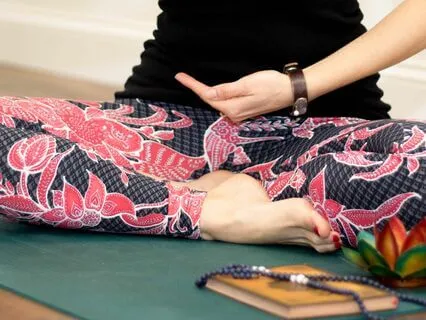
I'm going to create a gesture of the hands or a mudra and this is one of my favorite mudras to direct attention and energy to the pelvic region of the body and it's called a Pana Mudra.
A Pana Mudra is the downward flow of energy.
So we're going to bring the thumb tip to touch the middle and the ring finger or your third finger.
Extend your index finger and your little finger outward.
A Pana Mudra brings in a Pana Vayu,
Which is a downward flow of energy or prana that encourages the elimination of toxic waste and our emotional burdens.
A Pana Vayu is one of the five vital forces of prana.
A Pana Mudra helps to regulate and balance this downward flow of energy and helps to control the organs between the navel and the perineum.
Take a moment to close your eyes if they're open and turn inward and notice if you connect your thumb to your middle and ring fingertips and place the palms facing upward on your lap.
Notice if the mudra might direct your energy towards feeling more grounded or maybe towards this sense of breath beneath your navel in the pelvic floor.
This mudra can help regulate menstrual cramps,
Pelvic pain,
Help to regulate elimination,
And to relieve overall stress and attachment that we have to this part of the body.
Now even if you don't feel any sense of direction or energy flow,
That's okay.
Just try it and see how it resonates with you.
Our pelvic floor functions are supportive and they hold our organs in.
They help to prevent fecal and urinary incontinence,
They enhance our sexual experiences,
And they also affect our lymphatic health.
The pelvic floor can be affected by trauma,
Inflammation,
Muscular imbalance,
Injury,
Improper breathing patterns,
And sitting too much or sitting with poor posture.
The pelvic floor is a diaphragm just like the diaphragm in our ribs beneath the heart.
We also have a thoracic diaphragm up throat,
So the jaw is often directly related to pelvic floor dysfunction.
That means if you have a tight jaw,
If you grind your teeth when you sleep,
If you tend to pop or click in the jaw joint or have pain in your jaw,
These can be potential signs that you're holding tension also in your pelvic floor muscles.
So take a moment and notice your jaw.
Is your jaw tight at the moment?
Can you let your lower jaw drop towards your heart?
Just slightly letting it drop towards your heart,
Place the tip of your tongue at the roof of your mouth,
Just behind your two top front teeth.
Separate your teeth just slightly and notice your lips might part slightly as you relax your whole mouth.
What do you notice happens when you soften your jaw,
When you relax your mouth?
If it's comfortable,
Continue to hold upon mudra and start to breathe in,
Inhaling through your nose for a count of 5,
4,
3,
2,
1 and retain the breath for 5,
4,
3,
2,
1.
Exhale for 5,
4,
3,
2,
1 and hold the breath out empty for 5,
4,
3,
2,
1.
Continue counting your breath as you inhale for a count of 5.
Feel the pelvic floor expanding down towards the chair or the floor and then hold your breath.
Continue to feel it stretch downward and outward in the pelvic muscles as you exhale for a count of 5,
Let it go.
Feel the pelvic floor soften moving back upward and then hold your breath out empty for a count of 5.
If 5 seems too long or too strenuous,
Then decrease the number to 4 or 3,
Making it comfortable for your practice.
Breathing in,
Feel the expansion,
The ballooning of your belly pressing outward and the diaphragm under your rib pressing your abdominal organs downward into the pelvic cavity.
Feel the muscles stretch between the sits bones and the pubic and tailbone and hold it while you hold your breath expanded and then slowly for a count of 5,
Let it go,
Softening the pelvic muscles.
Continue for a few more rounds on your own.
Even if you can't feel your pelvic floor moving,
Imagine it.
Keep your awareness on this moment and flow in your breathing and the rhythm of breath moving these body parts of yours as one.
Some of you may know this breathing pattern as box breathing,
But when working with the pelvic floor,
I call it a reverse Kegel.
So we know our Kegels or Kegels are contracting or lifting the pelvic muscles to tighten them,
But this is more about the emphasis of softening and stretching versus squeezing.
Many of us are already tight in our neck,
Our shoulders,
And our jaw,
And most of us without knowing it are also tight in the pelvic floor.
We hold our stress and tension everywhere.
Everything in the body is connected and rather than contracting,
We are lengthening.
We're creating space.
We're creating softness.
Notice your posture now as well.
Have you begun slouching or rounding into poor habits?
Maybe realign your spine and elongate.
Sit up a little taller again.
This promotes healthy breathing.
Continue to practice breathing in for a count of five,
Holding for five,
Letting the breath go for five,
And holding the breath empty for five.
You may remove your right hand or your left hand from the mudra and just feel beneath your belly,
Beneath your navel,
At the pelvic floor muscles,
The front of your pelvis,
Our sacral chakra,
And see if you feel movement there as you breathe in and expansion.
As you breathe out,
A drawing in,
An emptiness.
You might also take your hand and place it underneath you between the pubic bone and the tailbone,
And notice if you feel downward pressure as you breathe in.
You might feel a bit of expansion as the abdomen presses down,
The diaphragm presses the abdominal organs into the muscles,
The hamacum muscles beneath you,
And then as you breathe out,
You might feel it draw back and away from your fingers.
Sometimes visualization can help.
You might visualize a jellyfish moving through water.
A jellyfish will expand and contract or soften to propel its way through the water.
As we inhale,
The diaphragm presses down on the abdominal organs,
Which causes our belly to expand outward and our pelvic floor to stretch downward.
As we exhale,
The pelvic floor and abdominal organs and diaphragm ideally will come back as one.
So sometimes if you can't make the connection or the sensation to this feeling in your body,
We can connect to the visual.
The diaphragm and the pelvic floor working together,
Breathing together.
The pelvic floor receiving breath,
The pelvic floor holding the abdomen in the stretch position while you retain your breath,
And then feeling the pelvic bowl releasing as you breathe out,
Feeling it soften back upward towards your body with the diaphragm.
When you finish your next cycle of breathing,
Let it go and come back to your normal natural breath.
And if you need to readjust your position or change your seated position,
Now is a good time to do so.
As you return to your natural breathing,
Take your hands and place them on your lower belly once again,
Connecting to the sacral area of your body,
Visualizing your muscles and your bones to the best of your ability in your mind as you connect and stay connected to this part of your body.
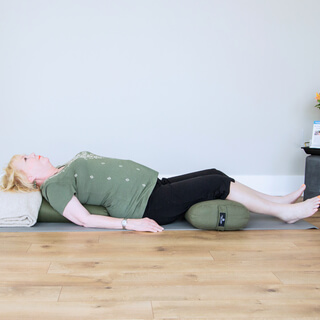
Now,
You may be seated in a comfortable position,
You might be lying on your back.
If you're seated in a chair,
You might lean back into your chair,
You're sitting on the floor,
You might use a wall to lengthen your spine and allow the energy to flow upward and downward with your breath smoothly.
If you've released the mudra,
A pan mudra,
The hand gesture,
You might wiggle your fingers or relax your hands in a more comfortable position.
So settle in,
Relax.
If your eyes are open,
Once again,
Close your eyes and begin to inhale through your nose and exhale through your nose.
You might already be feeling relaxed and connected to your pelvic floor.
See if you can relax your body a little bit more,
Creating more space in the physical body for breath to move slowly through it.
And as you connect to the breathing,
You might imagine that your breathing can dissolve pain or discomfort.
You might have pain if you have pelvic floor dysfunction in your SI joints,
In your lower back,
And in your hips.
You might even feel pain in the pelvic floor.
And sometimes pelvic floor dysfunction goes misdiagnosed with digestive disorders.
So connecting all of your lower body,
Begin to dissolve any blockages of a physical,
Mental,
Or emotional nature.
Begin to let go of any stories that you've created about this pain or this part of your body.
Let go of anything that you've been told over time that might make you feel guilty or shameful or uncomfortable when you think about the pelvis.
For now,
Let all of that go and allow your thoughts and emotions to flow you effortlessly.
Allow the body to open up more and allow the mind to empty.
Allow your heart to open to this new experience,
These new thought processes.
Remaining relaxed,
Experiencing your pelvic floor as it is right now.
Aware of any tension in your pelvic floor.
Maybe around the sit bones where you have the sciatic nerve,
Around the piriformis or the hamstrings where we sometimes feel tightness,
Constriction,
Or pain.
Wherever you feel tension,
Observe the outer hips,
The groin,
Your lower back,
And set an intention to release this tightness,
Constriction,
Or pain,
Creating space in this part of your body.
Slowing down,
Lengthening the breath,
Creating this mind-body connection.
We find space for a deep,
Long breath to expand the belly,
Moving your diaphragm downward,
Moving the abdominal organs downward into the pelvic bowl.
Relaxing the floor of the pelvis as you exhale,
Feeling the diaphragm and pelvic floor move back up into position together.
Inhale and expand downward and outward.
And exhale,
Contract or retract the pelvic floor muscles softly inward and upward.
Inhaling,
Creating space.
Exhaling,
Letting go,
Allowing any tension,
Physical,
Mental,
Or emotional,
To rise to the surface and be released.
Within the sacral chakra,
We have fluidity.
This is the water element.
So imagine that as you're breathing in and out,
The breath is like a wave in your pelvis.
Inhaling,
Wave of breath.
Exhaling,
Wave of breath.
Wave of breath in.
Wave of breath out.
Letting go.
Letting go of fear,
Preconceived thoughts.
Letting go of pain.
Feeling the pelvic floor relax,
Open,
Expand,
And be filled with life force,
Prana.
Imagine right now that as you breathe out,
The exhale releases all blockages,
All toxins,
All impurities.
Like a wave exhaling all negativity and fear.
The breath continuing to become more relaxed and the mind more quiet.
Until the flow in and out becomes effortless.
You may choose to continue to hold upon mudra or take upon mudra again.
Breathing in and out,
Letting go of your breath holds for this portion and just breathing vitality to the pelvic area,
To the sexual organs and the elimination organs.
And with each out breath,
We're relaxing more and more through the pelvic floor muscles.
Relaxing more and more through the jaw.
Feeling more and more connected,
More and more relaxed.
Feeling the ground supporting you,
Feeling safe.
All of our worries subsiding.
Calm waters within.
Feel your breath as it travels in through your nose into your throat and your lungs.
Chest and belly expanding,
Ribs expanding as the breath is filtered.
And then feel the breath.
Exhale back up through your nose,
Warm over the upper lip as the lungs deflate.
Feel the air go into your belly,
Into your pelvic bones,
Into your pelvic floor muscles,
Everything grounded and heavy.
And then feel the whoosh of letting go,
The softness,
The tenderness.
If you've experienced trauma to this part of your body,
Allow your breath and the water element to soothe and smooth any heal and heal and heal any hurt.
You might visualize this fluid orange color at the center of your pelvis.
Orange waves like the sun.
And feel as each breath rises and falls,
The waves spread outward and downward,
Inhaling.
The breath free,
Releasing any tension.
Wave of breath continuing to dissolve any pain or discomfort in the pelvis.
Dissolve any emotional hurt.
Releasing any preconceived notions,
Hurtful words.
The body is sacred.
Your body is sacred.
You are filled with freedom,
Passion,
And creativity.
Letting go of all self-limiting thoughts.
Take these last few moments to place your hands again on your pelvis if you'd like.
Feeling,
Touching,
Connecting through your loving hands.
And with loving thought,
Loving energy,
Breathing into this space.
When you're ready,
You might start to move around a bit.
Moving your toes or ankles,
Your hands or fingers.
Bringing yourself slowly back into awareness.
This space around you,
The floor,
The chair beneath you.
A taste in your mouth.
This aroma.
Sounds that you hear in the space that you're in.
And as you bring yourself back,
Notice how you feel.
Move freely in any way that feels good in your body in this moment.
Notice if you feel that continued connection to your pelvic floor.
Notice if it feels more easily understood or felt.
And leave your practice today with gratitude.
Thank you for listening.