Find yourself in a quiet place now,
If you can.
It's fine to sit on a chair or on a cushion.
If you're in a seat,
Put your legs straight out and down,
Uncrossed.
If you're on the floor,
It's good to elevate your spine by sitting on some kind of cushion,
One that's a few inches thick.
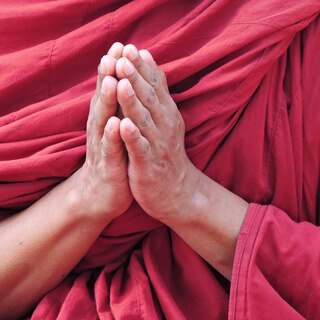
You can place your hands on your knees or one hand atop the other in your lap,
Your right hand can go on top of the left with your thumbs touching.
Leave a little space between your arms to let air circulate around your body.
Then try to adjust your spine.
That's the most important aspect of the meditation posture,
To get a straight spine.
You can just tilt your spine forward and back until it feels like your spine is aligned,
Where you feel not just comfortable but alert.
Your posture supports focus.
And then you can tilt your head down slightly so that it's aimed at a spot on the ground,
Maybe four feet in front of you.
And then your eyes,
You can half close or almost all the way close to let just a little light in.
But adjust this however you like.
If your eyes nearly closed makes you sleepy,
Open them.
And if you're distracted,
You can close your eyes fully.
Then try and relax the muscles in your shoulders,
Your face,
Your eyes,
Your brow,
Your neck.
Just tell all those parts of your body to relax.
You can slightly open your lips and touch your tongue to the roof of your mouth.
And then,
Very briefly,
Establish a motivation to honestly and curiously explore our minds,
To understand better who we are beneath all those thoughts,
To find a state of contentment and peace in the present moment for our own lasting happiness and also for the happiness of everyone we encounter.
It's nice to reflect on our natural goodness here,
That good qualities lie at the core of our being,
That they are our very nature,
And that we can see these qualities in others.
Our natural good qualities can be strengthened and even perfected in ourselves just by letting go of the disturbing mental habits,
Letting the natural clarity and warmth of our mind shine through.
Now bring your attention to your breath.
Touch your mind to your body,
Trying to put all your focus on your breath coming in and out of your nostrils or with the rise and fall of your abdomen,
Just for two minutes to help stabilize the mind.
Wow.
.
.
.
And now,
We turn the mind upon itself.
Just let whatever arises in your mind appear naturally.
But as it does,
We focus on the mental aspect of perception.
Notice how your mind is able to differentiate experiences.
Notice how the mind perceives sounds of the traffic outside,
Airplanes in the sky,
Voices in the distance,
Or my voice as you listen to it.
How your mind takes something that is continuously varying and how it wraps it in a little package,
Puts a mental label on top of it,
So that the experience seems separate,
Clearly identified.
And it's the same thing with feelings in your body.
You might feel some pain or discomfort,
Or feel warm or cold.
Focus on the perception aspect of your experience,
How something without a label gets that label attached,
How your mind divides phenomena from each other.
And now,
We turn the mind upon itself.
Now watch thoughts arise.
Notice how you compartmentalize thoughts,
How the continuous experience of thought gets broken into discrete parts,
And we can say,
That is a memory,
That's a plan,
That's a feeling,
That's a worry.
Try that yourself just for 30 seconds.
Quietly look at the perception aspect of your mind.
And now,
In the same way,
Without trying to control what arises in your mind,
Look at the feeling component of your mind.
Notice how whatever arises in your mind gets colored with liking or disliking,
Whatever it's just perceived.
A pleasant feeling,
An unpleasant feeling,
Or feeling neutral,
Indifferent.
If you hear the sound of voices in the distance,
You might feel completely indifferent,
That it's something just in the background.
Or you might feel an annoyed,
Negative feeling,
That the sound is interrupting your concentration,
Or distracting you.
Or you might feel pleasant with the voices in the distance,
That they give you a sense of camaraderie,
Or that those sounds give a rhythm to your thoughts,
Or remind you of positive past experiences,
So that there's a pleasant feeling associated with that sound of voices in the distance.
It's the same with your body.
Pain is any sensation in your body that you don't like,
That you don't want to continue,
That you don't want to return.
If you feel warm and comfortable,
That may be something you like,
That's pleasant.
Or if this experience of meditating is something you're enjoying,
Then you might have a pleasant feeling associated with it.
Or if it's difficult,
It might feel unpleasant.
So again,
Just for a minute on your own,
Let anything arise in your mind naturally,
But pay attention to the feeling that's associated with any perception,
Any sound,
Any thought,
Any body sensation.
.
And now,
Let's look at that next mental factor of volition.
Notice how some of the thoughts and feelings that occur in your mind are stronger,
That drive us to action,
Like our plan to go and eat lunch could be quite strong,
Or whatever we're intending to do after meditating.
See how part of your mind doesn't just experience the thoughts and perceptions,
But actually creates an intention to act.
So for a minute again,
Just let whatever appears in your mind arise,
And notice how there's a component of volition.
It can be quite subtle with many of the mental phenomena,
And then very strong with others.
But there's a component of volition wrapped up with every moment of consciousness.
.
And then the last thing we look at is the stage of the mind,
The fourth factor of consciousness or awareness.
Try to let the thoughts and feelings and perceptions become a little distant,
And let the space itself in which they appear dominate.
Let's just examine it with some curiosity,
Some open-mindedness.
Does this space of consciousness seem to have any color to it?
Is it dim or is it bright?
Is it colorless or does it have a hue?
Is it pure darkness?
Does the space stay the same or does it change?
Does the space of our mind have a size?
Is it contained within our skull?
Is it contained within our whole body?
Or does it expand out?
Does it encompass parts of the room or the vehicle that you're in?
Does the space of your mind seem to even overlap with others?
Look at how objects appear within the mind.
It's as if whatever it is,
Whatever texture and color and shape that the mind has,
It gets sculpted into the form of whatever you're perceiving through your eyes or your ears or your imagination and memory.
And then notice the temporal aspect of the mind more closely,
How you can experience moments of consciousness that have a beginning,
A middle,
And an end.
That the mind is a series of moments of consciousness that keep coming one after the other.
But these moments of consciousness,
They have a beginning part that touches the past and an end part that touches the future and then some middle.
And so if it has a duration,
It can be sliced in half.
And so keep doing that.
And as you do,
You find the paradox that every moment can be sliced forever.
And that there's no real past,
It's gone.
There's no real future,
It's not here yet.
By chasing this paradox,
You can arrive at the incredible,
Mysterious phenomenon of the present.
So for a moment,
Try to let go of any thoughts and feelings and perceptions.
In this present moment,
The nature of your mind without thoughts has a clarity to it.
And it has a knowing aspect,
A deeper way of knowing,
A direct way of knowing.
Then,
You can gently steer yourself back to the grosser aspects of awareness.
But with a motivation to try to stay aware of the subtler aspect of your consciousness,
Even as it gets elaborated through thinking and planning,
Interacting with others,
Your commute,
Your work.
You can remain aware of the awareness underlying the grosser aspects of experience.
And you can see,
You can cultivate the underlying joy and a deeper sense of presence in everything that you experience and do.
And so,
We dedicate any good that we've accomplished through meditating together like this to our staying mindful,
Self-aware,
In touch with this deeper aspect of our awareness,
Our consciousness,
Our mind,
The subtler part of ourself.
And as you feel comfortable,
You can come out of the meditation and into your day with a deeper awareness of your mind and how it interacts with the world.