Welcome to this guided practice on neuroplasticity and healing our brains.
So before we start the guided practice,
I want to just speak to the power that our brains hold to heal.
Our brains are incredible organs that are filled with billions of neurons and trillions of neural connections.
We have all of these different structures within the brain that are connected with each other and communicating with each other every second of our lives.
Sometimes when we're dealing with chronic illness,
The brain can be heavily affected.
We can struggle with things like cognitive impairment,
Which can include memory issues,
Difficulty holding conversations,
Word recall challenges,
Amongst many many other things.
Sometimes our brains become hypersensitive,
So we become very sensitive to light and sound.
Sometimes it feels like the world is overwhelming for us,
Almost as if our brain is on fire.
So in many ways our brains might feel like an adversary right now.
Our brains might feel like the enemy because we're suffering,
So it's very normal to feel this way.
And I invite you today to stay open to a different possibility.
Jack Kornfield says,
The mind makes a poor master,
But a wonderful servant.
So how can we use the brain and the mind in helpful ways so that it serves us?
It serves our healing,
Serves our joy in life,
As opposed to letting past conditioning feel like it is dominating our life.
So I'd like to speak to this concept of neuroplasticity.
If you've never heard of neuroplasticity before,
It is a phenomenon that we all have within our nervous systems.
Remembering that the nervous system includes the brain and all of the neurons that course throughout our bodies,
And then to include the neurotransmitters,
These chemicals that signal between the neurons.
If we break the word up neuroplasticity,
Neuro is referring to the basic unit of the nervous system,
The neuron.
And plasticity is this capacity to be molded,
Changed,
And adapted.
So when we put this together,
There's immense possibility here of molding and changing the nervous system to bring about more balance,
Ease,
And improved functioning in the brain,
And therefore the wiring throughout the body as well.
So I invite you to do an experiment with me here just to demonstrate the power of the mind and the brain.
Imagine that we have a lemon sitting in front of us,
And this lemon is very tart and sour.
And you imagine that you put this lemon in your mouth,
And all of this very sour,
Tart juice comes into your mouth,
And you feel how sour it is.
Now as we are imagining this,
We might notice that our salivary glands begin to produce more saliva.
Even though we're not actually eating a lemon,
The visualization through the mind changes our physiology.
And this is a simple example of how powerful the mind is to then change our physiology in our bodies.
So in this same way,
We can use the mind to harness this power of neuroplasticity so that it works in our favor.
In this way,
We can feel hopeful.
It's interesting because our brains have come to feel impaired in this way because of this quality of neuroplasticity.
That when we have a viral insult such as COVID or Epstein-Barr,
Or we have a bacterial insult such as Lyme disease,
Or we have fungal infections,
Mold illness,
These infections and toxins can wreak havoc on the brain.
And in this way,
It changes the brain in ways that don't feel good.
The good news is,
Is we can harness this same process that led the brain to dysfunctioning.
We can harness this practice to allow the brain to function better.
So I hope you feel hopeful moving into this.
I also want to share one more thing before we start the practice.
I've had a lot of experience with visualization and using my mind to create positive change in my body.
I was a gymnast for 21 years and became the Olympic alternate 1996 and won three NCAA titles at the University of Utah.
One of the primary tools that I used for competition was visualization.
I would visualize my routines perfectly every night.
I would do this before bed and I would imagine myself performing my routine exactly as I wanted to perform it in competition.
This then allowed me to have more peak performances when the pressure was on.
So this was my first experience with visualization and how it could positively impact physiology.
Fast forward about 10 years following my gymnastics career.
I got very sick.
I had joined the army as a physician assistant and I was exposed to the anthrax vaccine and then became sick with norovirus.
And all of this together created imbalance in my immune system,
My nervous system and I basically,
I use the word crashed.
My entire system crashed in 2014 following the birth of my son.
I've been on a 10-year healing journey with what Western medicine calls chronic fatigue syndrome.
In my experience and through my lens of functional medicine,
I know it is basically a systemic imbalance in almost every part of my body.
So I've called upon this beautiful practice of visualization throughout my 10-year journey.
I've used it to bring about the relaxation response.
I've used it to encourage healing on a physiological level.
And now today we're going to use the same visualization practice to bring about healing in the brain.
I hope this information has been helpful for you.
I hope it has allowed you to feel hopeful that this practice that we're about to engage in holds immense power for bringing about the healing that you're desiring in your brain.
So I invite you to find a comfortable posture,
Seated or lying down.
You might take a moment to allow the body to settle in,
Inviting some space between each vertebrae from the low back up into the neck,
Elongating the spine so that we are in a posture that is awake and alert,
But also relaxed and at ease.
Closing the eyes if that feels comfortable,
Otherwise just softening the gaze and looking a few feet in front of you.
We might take a few slow cleansing breaths here.
Breathing in through the nose,
Breathing out through the mouth,
A nice long exhale.
You might imagine that we can let go of any tension that we're holding in our bodies on our next exhale.
And now allowing the breath to come into a natural rhythm,
Bringing mindful attention to the forefront of our awareness,
Remembering that mindfulness is intentionally present,
Letting go of judgment to the extent that we are able.
Mindfulness also includes an open heartedness,
A kindness.
We bring mindful attention to our breathing,
Feeling what it feels like to breathe just one breath at a time.
We'll begin to utilize this practice of visualization.
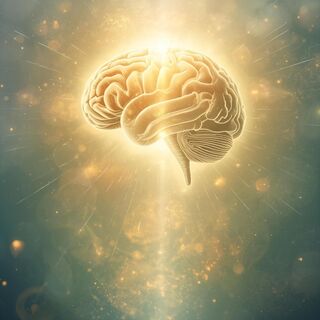
And we'll start by imagining that we could zoom in to the brain,
Almost like a camera that's zooming from a broader perspective to a more focused perspective.
Imagine that through our mind's eye,
We could see the brain.
You might see what the brain actually looks like.
Or you might see some symbol of the brain.
Sometimes when we're living with challenges that stem from the brain,
When we begin to really give our attention to this part of the body that's suffering,
We might notice that there's a symbol or an image that arises that represents what the brain feels like.
So just taking a moment as we give the brain our attention,
Noticing what you see.
We'll begin to connect with the challenges that we're experiencing in the brain.
And as we're looking at the brain,
We might even see parts of the brain that are suffering in our mind's eye.
What does that look like?
Or we might just recall how difficult it is to live with a brain that isn't functioning in the way that we want it to be.
We'll be connecting with the extent of the impairment,
Of the struggle,
The overwhelm that our brains might be experiencing every day.
We might take a moment to validate this suffering.
The brain is so central to our experiences in the world.
And when it's suffering,
We inevitably suffer as well.
Can we hold this suffering with kindness?
Can we let go of any self-blame,
Judgment,
Or criticism?
It's not our fault that this happened.
Validating all of the ways that we might be suffering because of a brain that is also suffering.
Just take your time here.
We don't have to force ourselves into extreme discomfort.
But it's important sometimes to really validate the extent of our suffering.
We might even offer an invitation,
This belongs.
We might even imagine that we're talking to our brain.
I see you.
I see that you're suffering.
I'm so sorry that you're suffering.
We might also take a few moments to look at the brain and see what parts are functioning well.
There are trillions of neural connections.
And some of those connections are still working well.
Can we take a moment to honor that?
Are we still able to see?
Maybe we are,
Maybe we aren't.
But can we hear?
Can we still smell?
Can we recall memories or can we plan for the future?
Opening to any part or parts of the brain that are still functioning well.
Without discounting the suffering,
Can we hold both experiences,
The struggle along with the gratitude for what is still working well?
We might just notice what arises when we make space for both,
Both realities.
And taking a moment to offer our gratitude,
Knowing that the brain is doing the absolute best that it can with what it has.
You might imagine a gentle bow.
Thank you.
Thank you for trying so hard every day.
I know this is hard.
Beginning now to zoom in even a little more into key structures at the brain.
We're going to start with the amygdala.
These small structures that sit in the temporal lobes,
Which are slightly off to the side of the brain.
We have two temporal lobes on the sides.
The amygdala can become overly taxed when we're sick.
The amygdala has the responsibility of keeping us safe.
So it's constantly scanning our environment for threat,
And it helps us to mount a stress response when we need it.
It's an incredibly important structure in the brain,
And it can oftentimes be on overdrive,
Trying to keep us safe.
We might begin to invite in this healing energy in any form that feels right for you.
It could be a color.
It could just be a feeling.
It could be a word.
Imagining that we can bring in the healing that the amygdala needs.
That all of the neurons that are housed here can start to settle a little bit.
Letting the brain know that we're safe at this moment.
Healing is possible.
A new experience of safety is possible.
We might imagine that this structure that has been so on edge can begin to soften.
Maybe even gets a little smaller.
Sending a signal to the rest of the brain and the body.
We are safe here.
We don't need to mount a stress response right now.
It's okay to be calm.
This signal of safety and calm begins to move into the hippocampus,
Which is very close to the amygdala in the brain.
Almost as if the amygdala is just whispering to the hippocampus,
We're safe.
We're safe.
The hippocampus allows us to learn new things and lay down memories.
In this way,
We begin to learn a new experience.
We're learning this experience of calm,
Of safety.
Of neuronal balance.
If it's helpful,
We might imagine this healing energy surrounding the hippocampus,
The amygdala.
Maybe it even has a warm temperature to it.
Has a softness.
Maybe there's a color that feels nurturing and supportive.
Taking a moment to really allow this experience of safety and calm and balance to sink in.
Almost as if we're imprinting this new experience into the neurons of the amygdala,
The hippocampus.
We're forming new neural connections through this incredible process of neuroplasticity.
We might imagine that this healing energy begins to spread out to every neuron in the brain.
Moving through the trillions of connections.
Moving to all of the regions of the brain.
The frontal lobe.
The occipital lobe in the back of the brain.
The temporal lobes on the sides of the brain.
Parietal lobes.
All of these neural connections are receiving this signal of safety,
Of calm,
Of healing energy.
In this healing light or this healing energy,
Can find and discover any connections that might be out of balance or that might be contributing to this dysfunction in the brain.
It's able to create the right amount of neurotransmitters to the levels of serotonin,
Dopamine,
GABA,
Glutamate.
All of these chemical messengers in the brain are receiving a signal of safety and they're able to be produced in the perfect balance.
In this way,
The brain begins to function optimally,
Harmoniously.
There's a smoothing out of the energy.
There's a calming down if it's overactive or there's a slight lift in the energy if it's underactive.
All of this healing energy begins to form new neural connections wherever we need it,
Sprouting these new neural connections.
These neurons are smooth.
The impulses travel effortlessly in the directions that lead to optimal cognitive functioning.
We're able to take in the world and it feels balanced.
It feels pleasant.
We're able to take in light and visual stimuli in a way that feels calm,
Feels enjoyable.
We hear sounds and it feels pleasant.
We're able to smell and taste.
We're able to talk and all of our words come out effortlessly,
Seamlessly.
We're able to listen and comprehend information without any struggle.
You can imagine that this healing energy moves into the glial cells.
These glial cells are special immune cells in the brain,
Sometimes referred to as the glue of the brain.
And when the brain has been insulted by toxins or infections,
These glial cells are on overdrive,
Producing a large amount of inflammation in the brain.
So we might imagine that this healing energy can come into every single glial cell,
Offering the same message of safety.
And as this healing energy takes care of any of the toxins or the infections circulating in the brain,
The glial cells don't have to work so hard.
You might imagine almost like a beehive that's buzzing really,
Really loudly as this healing light comes in.
This buzzing becomes quieter and quieter.
All of these cells are receiving the signal that the threat is gone.
The infections,
The toxins,
They've been taken care of.
The threat is taken care of and now things can come back into balance and harmony.
There's a rebalancing effect throughout the entire brain.
Beautiful,
Soothing,
Healing energy.
Inviting this healing light energy to envelop the whole brain,
Almost as if it's just holding the brain in a warm embrace.
We don't have to do anything.
Everything has been taken care of by this healing energy.
Seeing if we can open with some trust that the healing energy knows how to support and rebalance the brain in all the ways that it needs.
Knowing that any neural connections that were leading to the suffering in the brain have been cleared and in its place we have these new neural connections sprouting and the more we do this practice,
The more these neural connections will become our default state.
Neuroplasticity requires some intentional repetition so the more we engage in these healing visualizations,
The more the brain receives this message and it reinforces the new neural circuitry.
These beautiful new neural connections that allow the brain to function optimally.
Allows us to feel safe in the world.
Allows for all of the inflammation,
All of the over activation to be calm.
We might bring in the work of Dan Siegel here,
A renowned neuroscientist who explains a healthy brain is an integrated brain and he uses the acronym FACES.
The F stands for flexibility.
The A stands for adaptability.
The C stands for coherence.
The E is energized.
The S is stable.
We might take a moment to invite this integration into our brain where there's flexibility.
We're able to adapt to changing circumstances without overwhelm,
Without new symptoms.
We feel this coherence in the brain.
It feels pleasantly energized and we have this stability as well.
Really imagine and feel into this possibility where the brain is completely healed.
We're able to live in the world and feel connected,
Engaged,
Safe,
The perfect level of activation.
Flexible,
Adaptable,
Coherent,
Energized,
Stable.
We might close with a few affirmations.
I believe that healing is possible.
Neuroplasticity holds immense power and it will allow me to heal.
I believe healing is possible.
Neuroplasticity holds immense power and I believe I can heal.
I'm going to close with a short story that we might carry with us reminding us that the more we feed these practices of healing,
Believing in possibility,
The more this will become our reality.
There's an old story of a grandfather sitting with his grandson and he is telling his grandson,
There are two wolves that live in my mind.
There's the wolf of love and there's the wolf of hate.
The wolf of love is kind and caring,
Wants the best for me,
Wants the best for others.
The wolf of hate is bitter,
Resentful.
The grandfather goes on to explain that there's a constant battle between these two wolves of the mind.
The grandson is sitting there listening and he pauses for a moment and then he asks the grandfather,
Grandfather,
Which wolf wins?
The grandfather looks at him and he says,
The one that I feed.
So this story really explains neuroplasticity.
What we give our attention to grows.
So we can continue with this healing guided imagery,
Nurturing the brain and all of the ways that it needs.
And eventually,
One day,
We'll be living with a healthy brain.
And this in turn will allow us to live with health,
Happiness and harmony in body,
Mind and spirit.
May this practice support you in all the ways you need on your healing path.
May it restore health,
Many blessings.
Thank you