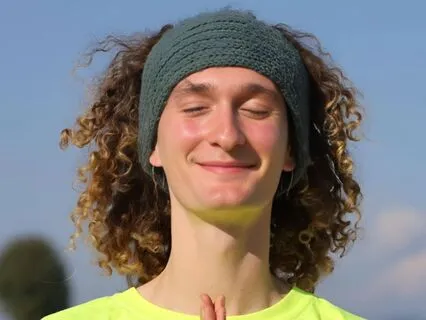
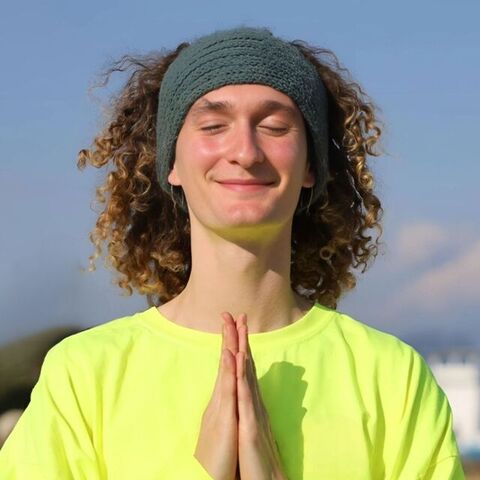
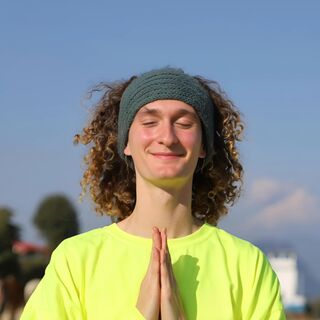
Welcome to this Breathwork Buffet Guided Meditation in which I'm going to give you five very powerful ancient proven breathwork techniques that are going to help you shift into any state of being that you choose.
We're going to go over breathwork that energizes you,
Breathwork that relaxes you,
And everything in between.
So let's begin by finding a comfortable seat,
Closing our eyes if possible.
Now that you've found your comfortable seat with your eyes closed,
Feel your sit bones grinding into the floor,
Feel your spine lengthening perpendicular to the floor.
Pretend your skull is a helium balloon and feel it rising up one inch,
Making you a little bit taller.
Bring your shoulder blades back and down,
Slightly tuck your chin to lengthen the back of your neck,
And just bring your awareness to your breath,
To the cool air entering your nostrils and the warm air leaving your nostrils.
Enjoy the sensation of breath,
Not trying to change your breath,
Just noticing it in its natural state.
Now try to imagine that every inhale,
Every exhale has with it a beginning,
A middle,
And an end.
Let your inhales originate deep in your diaphragm,
Find their middle right in your chest,
And find their conclusion all the way at the top of your head.
And then for your exhales,
Let them originate right in your nostrils,
Reach their middle point once again in your ribs,
And reach their end point all the way down in your belly button.
Let every breath have a beginning,
Middle,
And end,
And allow your breath to deepen naturally as you emphasize this arc.
Stay with your breath here for a few minutes.
Now I want you to focus only on breathing into your abdomen.
When you inhale,
Feel your diaphragm expand and keep it there.
When you exhale,
Feel your diaphragm contract and feel your belly button moving back towards the base of your spine.
For this exercise,
Avoid breathing into the chest,
Avoid breathing into the top of the head,
Just keep these breaths in your belly.
See how far you can expand your belly outwards,
And how close you can get your belly button back to your spine.
Get a feel for the muscular engagement that's necessary for this kind of practice.
And now let's move on to your chest.
Now I want you to keep your belly relatively still,
Relatively flat as we breathe.
When you inhale,
Feel your chest expand.
Feel your rib cage not only go forward,
But go out laterally like a balloon inflating.
And when you exhale,
Just feel your chest contract.
So avoid breathing into your belly or your head now,
Just breathe into your chest,
Feeling this muscular engagement.
You're no longer going to be using your diaphragm,
You're now going to be relying on your intercostal muscles.
Those are the muscles between every rib of your rib cage,
So feel that engagement.
And notice how your breath is different,
How it maybe feels different.
And now let's move on to our collarbone.
Try not to breathe into your belly or into your chest when we do this next part,
Just breathe into your collarbone area.
When you inhale,
Feel your collarbone rise up ever so slightly.
When you exhale,
Feel it drop back down.
Try to just breathe right into the top of your lungs,
Right where your collarbone is.
Notice that muscular engagement.
What kind of sensations does this breath cause?
Stay with this feeling.
Now we're going to put it all together.
So this is our first breathwork technique,
Also known as three-part breath.
We're going to put together the abdomen,
The chest,
And the collarbone.
This breathwork technique is really good for exploring your full lung capacity and getting rid of shallow choppy breaths.
It's going to give you more energy and it's going to relax you at the same time.
So let's start with an inhale.
Inhaling first into your abdomen,
Then into your chest,
Then into your clavicle,
And if you want,
Even into the top of your head.
Now exhale from your clavicle,
From your chest,
And from your abdomen.
Very nice.
Let's do that one more time together.
Inhale belly,
Inhale chest,
Inhale collarbone,
Exhale collarbone,
Exhale chest,
Exhale abdomen.
Very good.
Now continue this breath pattern on your own pace for a minute or two.
Feeling the full capacity of your lungs,
Feeling engagement from your diaphragm,
From your intercostal muscles,
And all your respiratory muscles.
Keeping your spine straight,
Keeping your posture poised as you do this.
Enjoy this breath.
Where do you feel the tingles that this breathwork technique causes?
Maybe you feel tingles in your hands,
On the top of your head,
Or elsewhere in your body.
Now gently allow your breath to return to its natural state.
See how you go back to breathing when you don't focus on engaging all these muscles.
And notice how this unconscious breath is subtly different than the unconscious breath that you started this guided meditation with.
Once again,
Feel the tingles and just be aware of your changing breathing patterns.
Think about when it might be helpful to use this breathwork practice in your day-to-day life.
Now we're going to move on to Bhastrika Pranayama,
Which is a bit more fiery,
A bit more intense.
The purpose of this pranayama is to get your body ready for action.
So to prepare,
Put one hand on your abdomen,
And feel your belly gently expand with every inhale and contract with every exhale,
Similar to what we did for our three-part breath.
But now I want you to start moving your belly a little bit faster and increasing the speed of your breathing till it gets to that kind of speed.
Keep that up.
You're going to feel your body temperature increasing.
You're going to feel your heart rate increasing.
This is warming up your body so that it can perform,
So that it can have more strength,
Agility,
And virility than it might have had before you did this.
This is called the breath of fire as well.
And the very important thing about it is that you are breathing as intensely as you can,
Breathing with strength.
You might want to increase the velocity now to like you're hyperventilating,
But with intention.
And importantly,
Make sure your belly is going in and out with your breath.
The belly is the most important thing here.
The diaphragm muscle is what enables this power to rise up through your body.
And I know it takes a lot of work,
So we're only going to keep up this first round for another three,
Two,
One,
Relax.
Allow your breath to return to its natural rhythm.
You'll definitely be feeling tingles here,
So just observe those tingles.
See where they leave you.
And prepare for a second round.
Take a deep exhale to prepare,
And now begin your Bhastrika Pranayama.
And at the end of this round,
You continue while I'm speaking.
At the end of this round,
We are going to hold our breath at empty lungs,
Just for a few seconds.
So prepare to hold your breath in 10,
9,
8,
7,
6,
5,
4,
3,
2,
Exhale fully and hold your breath for 5,
4,
3,
2,
1,
And gently release.
Allow your breath to return to its natural rhythm.
Congratulations on that breath hold.
Observe the tingles.
Thank yourself for being so strong and disciplined.
We're going to do one more round of that before we move on to more relaxing breath work.
So full exhale to prepare.
3,
2,
1,
Begin your Bhastrika Pranayama.
And hold your breath again,
This time in 5,
4,
Continue for 3,
2,
1,
Exhale fully and hold your breath,
This time for 10 seconds.
9,
8,
7,
6,
5,
4,
3,
2,
1,
Gently release and allow your breath to return to its natural state.
Observe the changes.
Think about when it might be useful to practice this breath work technique in your day-to-day life.
Return your awareness to the cool air entering your nostrils and the warm air leaving your nostrils.
Sit here in this stillness,
This simple breath,
For a minute more.
Now let's move on to our third breath work practice.
We are going to do 4,
7,
8 breath,
Which,
You know,
Similar to how it sounds,
Is inhale for 4 seconds,
Hold your breath for 7 seconds,
And exhale for 8 seconds.
This is going to relax your nervous system,
Calm anxiety,
And prepare your body for rest.
So,
Take a deep exhale to prepare,
And let's do it together.
Inhale for 4,
3,
2,
1,
Hold your breath for 7,
6,
5,
4,
3,
2,
1,
And exhale for 8,
7,
6,
5,
4,
3,
2,
1.
Inhale for 4,
3,
2,
1,
Hold your breath for 7,
6,
5,
4,
3,
2,
1,
And exhale for 8,
7,
6,
5,
4,
3,
2,
1.
One more time.
Inhale for 4,
3,
2,
1,
Hold your breath for 7,
6,
5,
4,
3,
2,
1,
And exhale for 8,
7,
6,
5,
4,
3,
2,
1.
Now continue this pattern on your own pace,
Breathing into the full capacity of your lungs,
Enjoying the stillness of breath retention,
And indulging in the surrender of exhale.
These extended exhales activate your parasympathetic nervous system,
Which cools your body down,
Slows your heart rate,
Lowers your blood pressure,
And in general prepares your body for rest and digestion.
Enjoy this 4,
7,
8 breath.
Feel your body relaxing,
Feel your heart rate slowing,
Identify where the tingles live in your body.
Do one more round,
Complete it,
And then allow your breath to return to its normal state.
Think about when it might be useful to employ this breathwork practice in your life.
What is a situation that this might save?
Next we're going to move on to Brahmaripranayam,
Also known as humming bee breath.
So how to do it is inhale deeply through your nose,
And as you exhale you want to hum while plugging your ears,
Just like this.
And the reason we plug our ears is so that the hum feels louder in our body,
And so that we're withdrawing from the sounds that are coming from outside.
And you want to extend this hum as long as you can.
Really challenge yourself to use your full lung capacity until you are out of breath.
How long can you make that hum?
So right now we're going to do three rounds together.
Inhale.
Inhale once more.
Inhale one final time.
Do one more round on your own pace,
And then return your breath to its natural state.
Think about when it might be useful to utilize this breathwork technique in your day-to-day life.
This breathwork practice is really good for calming anxiety,
For harmonizing every cell in your body,
For overcoming physical pain,
For coming down from panic attacks,
Before going to sleep,
For activating your vagus nerve.
Think about when it might be useful,
As you return your breath simply to the cool air entering your nostrils and the warm air leaving your nostrils.
Now it's time for our final breathwork practice of this breathwork buffet,
Nadi Shodhana Pranayama,
Also known as alternate nostril breath.
So the way to do it is to breathe into one nostril at a time while covering the opposite nostril with your hand.
So the pattern goes like this.
Inhale left.
Exhale right.
Inhale right.
Exhale left.
And as you inhale left,
You are going to cover your right nostril so that you're not breathing through your right nostril.
As you exhale right,
You're going to cover your left nostril so you're only exhaling from your right nostril.
This is going to balance the two hemispheres of your brain and activate all the energy channels in your body.
So I'm going to guide you through this practice now.
Cover your right nostril and take an exhale from your left nostril to prepare.
Now let's begin.
Inhale left.
Switch which nostril you're covering.
Now exhale right.
Inhale right.
Switch the nostril you're covering and exhale left.
One more time.
Inhale left.
Exhale right.
Inhale right.
And exhale left.
Now inhale left and hold your breath at full lungs covering both nostrils.
Now exhale right.
Inhale right.
Cover both nostrils.
Hold your breath.
Exhale left.
Inhale left.
Cover both nostrils.
Hold your breath at full lungs.
Exhale right.
Inhale right.
Hold your breath.
Cover both nostrils.
And exhale left.
Continue at your own pace,
Breathing as slow as you want,
Holding your breath at the top for as long as you want.
I'm going to leave you here for a minute.
Feel the harmonization of your two hemispheres.
Feel your body coming back into balance.
Feel which nostril is more congested than the other.
Which nostril feels more free.
Notice where the tingles have moved in your body.
Where do you feel the tingles now?
Maybe in your chest.
Maybe on the bottoms of your feet.
Maybe in the palms of your hands.
Next time you exhale from your left nostril,
Stop the practice and come back to normal breath.
Think about when this practice might be useful in your day-to-day life.
What is a situation that this would be really impactful in?
Now reflect on which of the five techniques we just practiced resonated most with you.
What did you like about each?
Take a moment to mentally reflect.
And now thank yourself for taking the time to embark on this practice.
On your next inhale,
Bring your palms together in prayer at the center of your chest.
Exhale,
Bow to yourself.
Inhale,
Open your palms like a book.
Exhale,
Open your eyes and look into your palms.
And try to notice something in your palms that you've never seen before.
When you're ready,
You can look back up and join the world again.
I hope you enjoyed this guided meditation,
This breathwork buffet,
And I hope that these practices stay with you.
If you want to check out other guided meditations,
I post a whole bunch,
So check out my page and I'm sure you'll find something that's perfect for you in this moment.
I love you so much.