For Buddhism,
The fundamental issue is not good versus evil,
It's delusion versus wisdom,
Or it's ignorance versus awakening.
Welcome to the One You Feed.
Throughout time,
Great thinkers have recognized the importance of the thoughts we have.
Quotes like,
Garbage in,
Garbage out,
Or you are what you think ring true.
And yet,
For many of us,
Our thoughts don't strengthen or empower us.
We tend toward negativity,
Self-pity,
Jealousy,
Or fear.
We see what we don't have instead of what we do.
We think things that hold us back and dampen our spirit.
But it's not just about thinking.
Our actions matter.
It takes conscious,
Consistent,
And creative effort to make a life worth living.
This podcast is about how other people keep themselves moving in the right direction.
How they feed their good wolf.
Thanks for joining us.
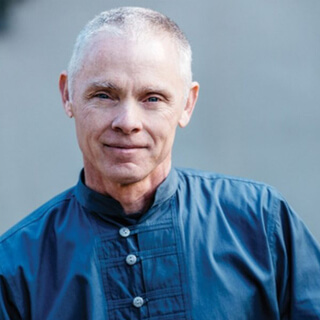
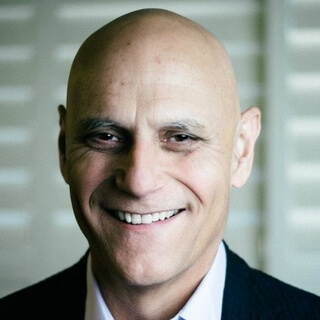
Our guest on this episode is David Loy,
A professor,
Writer,
And Zen teacher in the Sanbo Zen tradition of Japanese Zen Buddhism.
David lectures nationally and internationally on various topics focusing primarily on the encounter between Buddhism and modernity and what each can learn from the other.
He is also one of the founding members of the new Rocky Mountain Ecodarma Retreat Center near Boulder,
Colorado.
David is a prolific author of both books and magazine contributions,
Including the book we focus on in much of this interview,
A New Buddhist Path,
Enlightenment,
Evolution,
And Ethics in the Modern World.
Hi friends.
It feels good to support the things you care about.
And you can help support this show by going to oneufeed.
Net slash support and help make this podcast available for a long time to come.
And also I'd encourage you to get on our email list.
You can go to our website oneufeed.
Net.
We have a wonderful newsletter each month where we talk about guests.
I profile a book that I love.
We've got meditation tips,
Lots of different things.
And you can get a paper right now called Four Transformational Hacks That Make Habits Stick Even If You've Tried Before and Failed.
So again,
Oneufeed.
Net slash support and oneufeed.
Net to get on our email list and get the newsletter and that special paper.
And here's the interview with David Loy.
Hi David.
Welcome to the show.
Oh,
Thanks very much,
Eric.
Good to be here.
You've written a great number of books that are all fascinating,
But the one that we're going to focus on tonight is called A New Buddhist Path,
Enlightenment,
Evolution,
And Ethics in the Modern World.
So we'll get into that book in just a minute.
And there's so many things in that book that are right on point with things that I'm really fascinated and interested in.
So I think it's going to be a great discussion,
But let's start like we always do with the parable of the two wolves.
There's a grandfather who's talking with his grandson.
He says,
In life,
There are two wolves inside of us that are always at battle.
One is a good wolf,
Which represents things like kindness and bravery and love.
And the other is a bad wolf,
Which represents things like greed and hatred and fear.
And the grandson stops and he thinks about it for a second and he looks over at his grandfather and he says,
Well,
Grandfather,
Which one wins?
And the grandfather says,
The oneufeed.
So I'd like to start off by asking you what that parable means to you in your life and in the work that you do.
It's delightful to come across that story again,
Because right after 9-11,
I wrote a Buddhist response to that event,
Which ended with that particular story.
The point being that we as a nation had a choice between whether we were going to learn something from that event or whether we were going to respond in a kind of vindictive way.
And as we all know,
We responded with war,
Both in Afghanistan and Iraq.
But anyway,
That's another issue we can get into or not later on.
On the personal level,
As a Zen practitioner,
I think that the kind of practice that I'm engaged in and I teach really addresses that.
Sometimes I talk about it in terms of deconstruction and reconstruction.
The deconstruction being what happened meditating.
We're basically letting go,
Letting go,
Letting go of a lot of things,
But especially what we might call greed,
Ill will,
Delusion.
And the reconstruction,
Which actually isn't something that you do later on,
But it's something that you're really sort of integrating into your life at the same time,
Is transforming your actual motivations as you're living in the world.
The basic point about Buddhist teaching regarding karma is that when what we do is motivated by what's sometimes called the three poisons,
Greed,
Ill will,
Delusion,
Then the consequences tend to be bad,
Bad in the sense of causing suffering.
But if we can transform our motivations from greed into generosity,
From ill will into loving kindness,
From delusion into the wisdom that sort of recognizes our interdependence,
Then the consequences are much more likely to be positive.
And not only that,
But we really learn to experience the world in a different way.
When my motivations change,
The world changes because I see it in a different way and people tend to respond to me in a different way as well.
That was very well said.
I love the part about karma.
That was one of the things that was late in my notes where you talked about karma really being about our ability to change our motivation and that when we change our motivation,
We change so many important things.
And we may get back to that in a little bit.
But I want to circle back to early in the book because you start the book off by talking about Buddhism in the West today and how we've sort of got this question going on.
If you're in Buddhist circles at all,
You hear it,
Which is the mindfulness movement,
We're sort of pulling mindfulness and meditation out of this deeper tradition.
Is that bad?
Is that good?
And then further,
You talk about sort of the play between Buddhism and psychotherapy or psychological approaches.
And you frame those up in this way.
I'm just going to read what you said because I think this really summarizes it.
You say,
Traditional psychotherapeutic approaches are concerned to help heal the self.
Whereas the Buddhist model of well-being emphasizes liberating insight into the delusion of self.
And I just think that's a fascinating point because Buddhism and psychology seem to play so well together,
But there are some fundamental differences there.
I think you're exactly right that there are important tensions between what psychotherapy has to offer and what Buddhism has to offer,
Which is not to deny the fact though that they also complement each other quite nicely in certain ways too.
In fact,
I would think that the main impact of Buddhism on the West so far has been in the psychotherapeutic dimension.
It's interesting that back in the days when I started Zen,
We tended to think that,
Oh,
This is wonderful.
If everyone would just meditate really hard,
Then all of our problems would go away.
And I think we've learned since then that it's not so simple,
That you can have a kind of spiritual practice which involves a kind of bypassing where you're not really resolving your emotional or psychological issues,
But in fact sort of pushing them to the side or repressing them.
So in certain ways,
They can complement each other.
But it's nonetheless true exactly what you say,
That fundamentally psychotherapy is about healing the self and also helping us sort of tend to fit into the world better,
To harmonize,
To be a better spouse,
Better friend,
Better worker,
Parent.
Whereas I think the Buddhist tradition,
Although the practice can include those kinds of transformations,
I think it goes much deeper as far as really giving us,
Or at least opening us up to the possibility of an insight,
A deeper insight into the nature of the self and the delusion of separation that we're usually motivated by,
Because we feel separate from the people and feel separate from the rest of the world.
Yeah,
Let's get to that in a second,
Because it's my current favorite topic of conversation.
But the other way I think that Buddhism and therapy have a little bit of a challenge with each other,
Or where I run into is I'm looking at them both and I understand them both fairly well,
And I look at it and I go,
Okay,
There's a little bit of a conflict here.
And Buddhism is really about abandoning anger and being patient and don't avoid hatred.
And therapists,
On the other hand,
There's a lot of encouraging to feel our emotions and to make sure we express those.
And so I'm often torn between those two things also.
How do you reconcile when is the case where I should look at that emotion and try and transcend it versus where should I look at that emotion and experience it deeper and find out what there is to learn from it?
I think we have the same tension within Buddhism.
It's very commonly taught that anger is very bad,
One of the fundamental problems.
But nonetheless,
There's also the sense that anger is fundamentally a kind of an energy that gets distorted often in terms of delusion of self and we lash out.
But in fact,
It can be very beneficial.
I'm just thinking of a few incidents with my son when he did something really dangerous and I got quite angry.
And the anger can be expressed really badly with a slap,
But it can also be expressed in a way that would really grab his attention.
It wouldn't have to be violent.
If the anger is fundamentally a kind of energy,
It's an energy that can be channeled in a more non-dual and a more beneficial way.
Or maybe a better example of that is something like grief.
If someone close to us dies,
How do we respond?
And again,
There's a tension in the tradition.
Some people would say within Buddhism,
The kind of non-attachment,
We should be cool,
We should be aloof,
We shouldn't be affected by that.
And yet another stream would emphasize rather than repressing or denying it,
Actually become one with that grief,
Acknowledging,
Understanding that that's something that we need to feel.
It's important not to get stuck there indefinitely,
But it's something that we need to feel and to work through.
So it's quite interesting that what you were expressing,
I think,
Is also somewhat of a tension within the Buddhist tradition.
I think it definitely is.
You can find it in both places.
And then the other tension that comes up between these two and within Buddhism is the goal to transcend the world,
Is the goal to fit in well with the world.
And this is really where you kind of go to the third direction,
Right?
You see,
The goal isn't to transcend it necessarily,
Or to adapt to it 100%.
But the third way is to see it differently,
To recognize that we are not this isolated self that we think we are,
That causes our feeling of separation.
So let's talk through that a little bit.
What do you mean by that when you say that the sense of self that we have is not as solid or real as we think it is?
Well,
That brings us back to what I was saying at the beginning,
Talking about deconstruction and reconstruction of the self and of the relationship between the self and the world.
But I think it needs to be understood in context,
Because a lot of the Buddhist tradition,
Like most other religions,
It's talking about transcendence.
The goal,
For example,
In the Pali Canon,
In the earliest teaching,
Does seem to be a nirvana that involves not being reborn.
And in some way,
We do transcend this world.
Of course,
Many of us in the modern world were sort of suspicious of those kinds of transcendence and even the concept of rebirth.
So a lot of the secular appropriation of Buddhism has been,
As we were saying,
Sort of psychotherapeutic,
Helping us to fit into the world better.
And I think both of those really miss the point that what's going on in practice is,
In a way,
We are learning to undo the ways that we have been experiencing the world,
Including ourselves.
Normally,
We don't realize that our usual way of experiencing the world is a kind of psychological and social construct that can be deconstructed and reconstructed.
So in meditation,
We're letting go of the habitual ways of thinking and feeling and acting and so forth that sort of maintain the delusive sense of separation between ourselves and other people.
And then bringing us back to the karma,
Like you said,
The idea of transforming or reconstructing our motivations is applying that in terms of how we actually live in the world.
This reminds me of my all-time favorite quotation,
Which I think was in the book somewhere,
Quoting these Arghadatta,
Actually,
Not a Buddhist,
But a Neil Vadantin,
Right?
And he said several times,
When I look inside and see that I am nothing,
That's wisdom.
When I look outside and see that I am everything,
That's love.
Between these two,
My life flows.
And I think that's so much right.
And it shows the relationship between wisdom and love or wisdom and compassion,
Which are like the two fundamental pillars of the Buddhist tradition,
Seeing through the delusion of a separate self is the wisdom,
But learning how to live in the way that that implies is the love,
Right?
Because if I'm not separate from the rest of the world,
Well,
I'm obviously going to be relating to it in a somewhat different way without the delusion of a separate self whose well-being is separate from what's going on in the world.
If we can see through that,
Then we're going to become more compassionate and more concerned about the welfare of everyone.
This episode is brought to you by Casper Mattress.
And Casper is a sleep brand that makes expertly designed products to help you get your best rest one night at a time.
A little bit of info about the mattresses themselves.
They are very cleverly designed to mimic human curves,
Providing support and comfort for all kinds of bodies.
And of course,
Since we spend one third of our lives sleeping,
We should be comfortable.
I think about that all the time.
I think about it with mattresses and I think about it with shoes.
The mattresses have a breathable design and it helps you sleep cool and kind of regulate your body temperature throughout the night.
They have over 20,
000 reviews and an average of 4.
8 stars across Casper,
Amazon and Google.
So Casper is becoming the internet's favorite mattress.
Now Casper offers the original Casper mattress,
Which combines multiple supportive memory foams for a quality sleep surface with just the right amounts of both sink and bounce.
They also offer two other mattresses,
The Wave and the Essential.
And the Wave has a patent pending premium support system to mirror the shape of your body and then the Essential has a streamlined design at a price that won't keep you up at night.
They are all designed,
Developed and assembled in the US.
And the amazing thing is they have complete hassle-free returns if you're not completely satisfied.
So they deliver it right to your door in the small kind of how do they do that sized box and then,
You know,
Free shipping and returns in the US and Canada.
And the most exciting part about all this for me is that I am actually now the proud owner of a queen size Casper mattress and it is so incredible.
It's really kind of hard to put it into words but what it kind of reminded me of when I first got it,
I got it all set up.
I had a really nice box spring that I put together and I basically feel like I'm sleeping in like a five-star hotel.
It is just so fantastic.
The other nice thing is that I was able to just do all of this myself.
It's just a box.
I open it,
Follow the very simple instructions and basically have the whole thing set up within minutes.
So I think everybody kind of deserves to have that kind of a sleep experience at least once in their life.
And with the hassle-free returns,
If you're not completely satisfied,
Then you literally could just try it for a couple nights,
See if you like it.
I can't imagine anyone in their right mind would ever be sending this thing back once you actually had the opportunity to sleep on it.
You can be sure of your purchase with Casper's 100-night risk-free sleep on it trial and better yet,
You can get $50 towards select mattresses by visiting casper.
Com slash 1Ufeed.
That's all spelled out O-N-E-Y-O-U-F-E-E-D and use the same promo code 1Ufeed at checkout.
Terms and conditions apply,
So again go to casper.
Com slash 1Ufeed,
Use the promo code 1Ufeed at checkout and get $50 off towards select mattresses.
And now back to the interview.
Let's circle back to the sense of self again because if we aren't the self that we think we are,
Then what are we?
Well,
You know,
Curiously there are different answers within the Buddhist tradition about that,
But most of them have something to do with what's called emptiness,
Right?
Realizing that the constructed sense of self,
If we're able to sort of let go of that and have a non-dual experience,
Then it does in fact reveal something about our true nature as well as the true nature of the world.
Again,
We seem to be focusing on these sort of tensions within the Buddhist tradition.
Sometimes emptiness in Buddhism is simply understood as sort of denying the reality of everything in the sense that nothing has any self-existence of its own,
Everything is dependent upon everything else,
Which is something I think we can sort of see pretty readily.
But it can also be understood in a more profound way that the sense of self as normally experienced is actually obscuring something about the nature of our own minds,
Which in and of themselves have no form,
No color,
No particular attributes or characteristics.
So this is,
Well,
We talk about it in terms of mind,
But we could just talk about it in terms of basic awareness too,
That the point is to liberate our awareness,
Which is normally stuck,
Grasping at one thing or another,
Because we're always trying to secure ourselves.
But if we can really liberate our awareness,
It's something that in and of itself doesn't need to get stuck anywhere and therefore can really take any form.
So there's a kind of a freedom here when the self is no longer needing to objectify or secure itself,
Then this is I think the kind of liberation that Buddhism and other wisdom traditions point to.
I don't think I said that very well.
Does it make any sense,
Eric?
Yeah,
Yeah,
It does.
And I think in the book you laid it out very well.
I love the way you discussed that what we are in a certain respect is a collection of psychological processes that are happening.
You know,
That there's all these things that are happening in the mind.
And you talk about how before we go into meditation,
We think that we're having the thoughts.
And the emotions and when we meditate for a little bit,
We start to realize like,
We're not having anything to do with them.
Like they are,
They are happening,
Right.
And I think that's a useful metaphor,
At least for me,
In that sense of self not being what we think it is in that there is no one thing,
There's no entity that I can point to in the middle of all those processes.
They're,
They're all happening and occurring.
But if I look closely for the eye in that,
It's kind of hard to find,
It can never be found.
Right.
Yeah,
That's even a better way to say it.
But I think that trying to find it is an important part of the process,
At least it seems to me.
You know,
I think that's exactly right.
Trying to find it and eventually deeply realizing the sense in which it can't be found,
Because that which is looking is that which we are looking for,
You know?
Right.
Yeah.
There's another way to say it's that consciousness isn't something that the self has or maybe doesn't have,
Like when we're asleep.
But rather,
The self is,
As we normally experience it,
This collection of interacting momentary processes of thinking and feeling and acting and reacting and remembering and planning and tending,
That these are forms,
Something we can't name,
Something that we can never fixate,
That we can never grasp.
These are forms that that takes,
And the point of the practice is a kind of opening up and liberating there so that the awareness can manifest itself more non-dually,
More compassionately,
Because it doesn't need to secure itself.
And I think that's the other really important point.
Our usual sense of self,
I talk about it in the book,
That it's haunted by the sense of lack,
That it feels always insecure and it's always trying to cling to something to give itself some security.
Whether it's money or fame or even some self-image or some ideology,
Our minds naturally tend to do that,
And yet they can never find an object,
Whether it's psychological or physical,
That's stable enough to give them that security.
And the practice and the true fruit of the practice is being able to let go of that and realize the true nature of our awareness when it doesn't need to do that.
Yeah,
I love the way you refer to that in the book.
You call it the sense of lack,
Which is the shadow that usually dogs our self-consciousness.
And I just think that's such a great way of saying it.
And you go on to say that there's almost a perfect fit between this fundamental sense of lack that we have and our current economic system,
Which uses advertising and other devices to persuade us the next thing we buy will make us happy,
Which of course,
We almost all know it won't,
And yet that illusion is so strong in most of us that it rises back up again,
At least for me,
Again and again.
I feel like I've seen through it a thousand times,
Like,
That won't make me happy,
That stuff's not going to do it.
Then the next thing shows up,
And I'm like,
Oh,
That might be,
You know,
It's just funny how persuasive and how persistent that illusion is.
Well,
For a lot of us,
It's because we don't know what the alternative is,
Really.
I mean,
I think traditionally,
And in most pre-modern societies,
I think the sense of lack is what generated religion.
The idea of religion,
You had rituals,
Think of the Catholic Church,
You know,
You have confession,
Penance,
Communion,
Etc.
,
Etc.
You had rituals to help you deal with the sense of lack,
Which they called sin,
Whether it's your sins or original sin.
But in the modern world,
In the secular world,
Most of us don't believe in that kind of sin anymore,
And yet we still have this sense of lack.
So how do we deal with it?
And I think consumerism is perhaps the number one way that it comes out.
And it's,
Of course,
Increasingly unfortunate,
Because as we know,
Consumerism just really isn't consistent or an ever-growing economy that is built on consumerism isn't consistent with the kind of biosphere we live in,
Which is already much damaged and in danger,
Given how we're treating the earth.
If you're enjoying this conversation,
I hate to be the bearer of bad news.
We are nearing the end of it.
Wish you could keep listening once the episode ends?
Well,
I've got some good news too.
You can.
The interview continues over at 1Ufeed.
Net slash support.
There,
If you pledge at the $10 level,
You'll get access to this additional exclusive content as well as many other bonus conversations that have been recorded with our guests.
We really need and appreciate your support,
So we hope you'll head over to 1Ufeed.
Net slash support and pledge to access this additional weekly content.
And now,
Back to the interview.
One of the things that you talk about is how we tend to look for an economic system or a governmental system or something out there that can fix all this.
And while that's important,
You argue,
It's equally important that we transform the greed,
Hatred,
And delusion that's at the heart of humans,
Because it's impossible to design a system that humans won't outsmart when they're greedy,
Hateful,
And deluded,
Right?
So talk a little bit about that.
Well,
The interesting thing about lack is it does seem to provide a kind of transition between the kind of individual psychology that Buddhism is usually talking about,
Right?
Individual suffering and so forth with our collective situation.
And one of the things I've explored at some length in a number of places,
Including this book,
Is what I might call a kind of Buddhist social analysis,
Where I think we can see pretty clearly that unlike in the time of the Buddha,
Today we have much more powerful institutions as well as technologies,
And these institutions tend to take on a life of their own,
Which is to say that they tend to have their own motivations.
And if we look at it from that perspective,
I think what we can see is institutionalized greed.
I mean,
If greed is you never have enough,
Well,
It's not just consumers that never have enough,
But corporations are never profitable enough,
Their market share is never big enough,
Stock prices never big enough.
And if you think in larger terms,
GNP,
GDP is never big enough,
Right?
But also,
Frankly,
I think our sort of military industrial system is also institutionalized ill will.
I mean,
If you evaluate how militaristic a society is by the amount of resources that it puts into its military,
I mean,
It's truly horrifying.
We are by far the most militarized society in human history.
And the other danger with that,
Of course,
Is when you spend so much money on the military,
Well,
You have to keep finding enemies.
You have to keep finding ways to rationalize that expense.
And then finally,
I think we've institutionalized illusion,
Especially in terms of the media,
Which aren't really that concerned about educating or informing us about what's going on.
But for the most part,
They're corporations that make their money from advertising.
And so their primary concern is finding ways to grab our eyeballs and sell them to the highest bidder,
Which means that they're not really going to emphasize the problems with consumerism.
They're part of the same package.
They're always pushing consumerism.
And when you put these three things together,
The institutionalized greed of our economic system,
The militarism that supposedly defends it,
The role of the corporate media,
It presents a pretty difficult situation that we're in.
But I do think it constitutes a kind of economic social analysis of where we're at.
And it also suggests what needs to be changed.
Yeah.
And I love how you talk about that,
Because when it's easy to listen to that and hear there's just these bad people out there that have got these things,
But you talk about how these things kind of just have a life of their own and we're all a part of it.
You know,
It's not like there's these five evil people that have dreamt all this up and these are,
Like you said,
Institutionalized systems that are running of their own accord at this point.
They have so much momentum behind them and that we can't,
As individuals,
Pull ourselves out of it.
We have to look at what our role is in it also,
I think is the way I'd put it.
I think there's an interesting contrast here between the kind of Judeo-Christian background of Western civilization,
Including the U.
S.
,
Of course,
Where the emphasis,
The fundamental duality is between good and evil.
And that's not the Buddhist approach at all.
I mean,
For Buddhism,
The fundamental issue is not good versus evil,
It's delusion versus wisdom or it's ignorance versus awakening.
And that's a very different perspective on what's going on,
Especially when we realize that we're all sort of implicated.
We all have roles within those systems of delusion.
And it's not a matter of identifying and defeating the bad people,
But getting some insight into how those systems work.
Also not vilifying those people,
But finding ways to work together to sort of change those systems.
Yeah.
I'm going to read a paragraph from the book that I think sums up what we are talking about very well.
And you actually start the paragraph off by saying,
To sum up,
We cannot expect either the economic or ecological transformations we need to succeed without personal transformation as well.
And the history of Buddhism shows that the opposite is also true.
Teachings that promote individual awakening cannot avoid being affected by social structures that promote collective delusion and craving.
As the sociological paradox puts it,
People create society,
Yet society also creates people.
And I just think that is so well said and really sums this up that we have to come at these things from both sides.
And it takes us kind of all the way back to the beginning of the conversation where we were talking about the Buddhist approach into the modern world,
And what is Buddhism losing as it moves into the modern world,
And what is it gaining as it moves into the modern world.
And I think those are fascinating questions.
What I find fascinating is the fact that globalization means that these two quite different worldviews are coming into conversation with each other,
Right?
If we go back to the Judeo-Christian emphasis on good versus evil,
I mean,
In certain ways,
We can certainly see it's been problematical.
If you look at the Middle Ages and the heresy trials and the inquisitions and the witchcraft and all of that,
The tendency to vilify the other.
But at the same time,
There's been something very important,
The idea of the prophetic coming out of the Old Testament.
And I think when you combine that with the ancient Greece,
Which is the other main source of Western Civ,
The idea that we can transform our society.
If we don't like the way our civilization is structured,
We can change it.
Bringing those two things together,
Especially at the birth of the modern world,
I just think that that's been so revolutionary,
So powerful.
It's led to so many transformations,
Overthrowing kings,
Enabling also religious freedom,
Overcoming slavery,
More recently,
Civil rights movements,
Union.
I mean,
In many ways,
The concern for transforming how we live together has been wonderful and very effective.
But I think we can also see today the limitations that somehow the idea that it's enough just to transform the social structure without transforming us individually,
That just doesn't work.
And this is where Buddhism has something so important to contribute.
The way Buddhism developed,
The Asian Buddhist countries,
They weren't democratic.
And those kinds of social justice concerns that we tend to take for granted now in the West,
Or in the modern world,
Those aren't traditional Buddhist concerns.
But what Buddhism has been so really good at is these ways,
These contemplative and meditative practices that can help us transform ourselves.
And what I find exciting right now is that not only is the world in a very critical situation in a number of ways,
But we can see the coming together of these two different perspectives.
Individual transformations such as the West has traditionally emphasized,
But also individual transformations such as the way that Buddhism has focused and bringing those two together.
I think it's very,
Very exciting and certainly timely.
Certainly,
It seems to me we need them.
Yeah,
Absolutely.
It makes me think of that other concept from Buddhism a lot,
The middle way,
Right?
We need both those things coming together and meeting in the middle for us to solve some of the challenges that we collectively face.
Well,
David,
Thank you so much for taking the time to come on.
I loved the book and I love this conversation.
So thank you so much.
I really appreciate your time.
It's really been my pleasure,
Eric.
Thank you for this invitation.
Okay,
Take care.
Thanks.
I'll see you next time.
If what you just heard was helpful to you,
Please consider making a donation to the One You Feed podcast.
Head over to oneyoufeed.
Net slash support.
The One You Feed podcast would like to sincerely thank our sponsors for supporting the show.