So,
Welcome to everybody to day one of our 21-day challenge.
This video is going to be in two parts.
In the first part,
We'll have a little bit of explanation,
And the second part will be the actual practice of meditation so that you can keep that for yourself to continue on your own.
So,
We've set on that this 21-day challenge that it's working with our minds,
It's working with our mental state to make it a better,
Happier place to be.
The reason for that,
As also we've briefly mentioned,
Is this very,
Very clear and undeniable reality that the majority of what we experience in our life is a creation of our mental state,
Not a creation of the external world.
Indeed,
Our minds are the most important place to look at and work with if we wish to be happy,
If we wish to be fulfilled,
If we wish to live a meaningful life and so forth.
So,
In a sense,
The first challenge for you is to accept and acknowledge that and recognize that.
Think about things.
Is it the food itself when you go to a lovely restaurant?
Is it the food itself that makes you happy,
Or is it your mental dealing,
The way you deal with that through the way you react to that?
Is it the thing you buy?
If you buy a new dress,
It may make you feel very happy,
Or a new pair of shoes,
It may make you feel very happy.
Is it the shoes themselves that are making you happy,
Or is it your mind state?
Certainly,
If I bought a new dress myself,
I don't think it would make me very happy at all.
So,
The same article or the same external phenomena can make somebody happy and somebody else not happy.
Therefore,
What we should understand from that is that it's not those external things which are creating our happiness,
But rather it's our internal mental state.
We all know this to some degree,
But we don't really think about it.
And to be fair,
We are very deceived and misled by advertisers who are telling us that buying something will make us happy,
That eating something will make us happy,
That doing well in a certain job or going on a certain holiday will make us happy.
They force this down our throats and we're brought up in this way.
So,
It's not really our fault that we believe what we're told in these ways,
But the reality is these things are not true.
Happiness does not come from those things.
It comes from our state of mind and that only.
And when we look again,
When we look at sort of things like quantum physics,
When we look at psychology,
When we look at philosophy,
And of course when we look at spirit traditions,
All of them,
Whichever one they may be,
If it's a valid spiritual tradition,
They will agree also that happiness is an internal quality,
Not something that comes from outside yourself.
So,
This is very clear.
But it's something I want you to think about.
I want you to take as part of your day one challenge to go through your day and think,
What's actually making me happy?
Is it the other person or is it the way I relate to that other person?
Is it my job or is it the way I think about my job?
And what it will hopefully conclude is that happiness is a state coming from inside ourselves,
Not coming from outside.
Now,
Having said that,
Having said that and having accepted that,
Then if we're looking for happiness,
If we're looking for well-being,
Then that's the place we should look within ourselves,
Not outside,
Not somewhere external,
But within ourselves.
And that's what we're doing in this challenge.
We're looking at our mental state and we're beginning to improve it and make it a better place to be.
And that's so important because for that simple reason that if we make our mental space a better place to be,
Then the world which it's constantly creating 24 hours a day becomes a better world,
Becomes an experience,
Something which we experience in a much more positive,
Healthy way.
So,
That's the first thing.
Now,
How do we begin to work with our life?
How do we begin to engage with this challenge and work with our minds?
The first thing we have to do,
And this is the same for any discipline in the world,
The first thing we have to do is become aware of what we're working with.
So,
If you're working with a certain,
Say you want to grow something in a field,
The first thing you want to do is look at that field and say,
What's the state of it?
Become aware of it.
Become knowledgeable about what you're working with.
Without that,
There's no way to be able to do anything with it.
You have to have that awareness to begin with.
For example,
If you're fixing a car,
You need to first of all become aware of the car,
Know how to fix the car,
And then you can begin to do something to it.
If you don't have any knowledge of it,
If you don't have any awareness of the state of the car,
Then of course,
You know,
Your ability to fix it is limited or non-existent.
Same thing with our body.
If we're trying to train for something,
We're trying to become a marathon or we don't jump in and suddenly run the 26 miles straight away,
We build up to it,
We train to it,
We understand where our body is,
And we gradually work with our body to improve it.
So,
That awareness,
That knowledge of our body is the foundation of being able to practice with the body.
And the same thing is true with the mind.
The first step,
Which is our first-day challenge,
Is to begin to cultivate awareness of our own minds.
Now,
That awareness has to be of not just our mind in general because it's difficult to be aware of your mind when your mind is jumping here,
There,
And everywhere.
In just the same way,
It's very difficult or if not impossible actually to fix a car while it's running around,
Running along the road 100 miles an hour.
We have to slow the car down,
We have to stop the car,
We have to turn the engine off,
And once we've done that,
Then we can begin to fix the car.
Same is true of our minds.
The first step in bringing this awareness into our life is to calm the mind down,
To bring some stability,
Some peace into the mind,
And then we can begin to look at it.
If we don't do that in the first place,
If we don't bring that peace,
If we don't calm the mind down,
Then we're lost in every obsessive thinking and incredibly fast movement of the mind,
Thinking about this and remembering that,
Planning that,
Getting lost in our thoughts.
So,
Our first technique,
Our first practice,
Which is our challenge for day one,
Is to begin to slow things down,
To begin to slow the mind down and bring some calm into the mind.
Now,
This practice,
Calm abiding practice in the mind,
Is something which is useful not just to calm the mind down and begin to work with it,
Which is the main reason,
But just this simple calming of the mind.
That itself brings enormous amount of benefits.
That itself brings so much more peace into the life,
So much more ability to deal in a constructive,
Helpful way with events.
Because if our minds are constantly agitated and busy all the time,
Then our ability to focus on the things we need to do becomes very limited.
So,
This practice of calm abiding is not only useful to begin to observe the mind,
Calm the mind down and therefore create a mind that we can work with.
It's also a wonderful practice to bring immediate benefit into our lives.
A calm mind is so much more better,
Is so much more useful to work with,
Is so much more beneficial as far as we deal with things,
Whether it's our job,
Whether it's our personal life,
Whether it's our family,
Wherever it may be,
Everything becomes easier if the mind is in a calm,
Peaceful state.
So,
This is our first task,
To bring to calm the mind down.
We're going to do a meditation on this,
Which is going to start to work with this.
And your challenge for this day is to do this meditation once we've done it together,
To do it again two more times before the next day challenge.
So,
That's your challenge,
To bring the video and do this meditation two more times.
Now,
The meditation we're going to do is taking an object,
Because one of the qualities of our minds is that there is always some sort of object,
There's something that our mind is aware of.
In fact,
Awareness and the object which we are aware of work in tandem.
They need to be there like two sides of a tripod,
Or three sides of a tripod,
Or two sides of somebody connecting together.
So,
The object,
There's always an object in our mind.
So,
We're going to take that fundamental principle and we're going to apply it to observing a particular object,
And that particular object is going to be our breath.
So,
We're going to observe the breath.
Now,
What we're doing is not a breathing exercise,
We're not trying to breathe differently,
We're not trying to force our breath or even consciously calm our breath.
What we're trying to do is just let the breath be what it is,
But place our observation,
Place our attention upon the breath.
Now,
To make that easier,
We'll divide the 10-15 minute meditation that we're going to do into three parts.
In the first part,
We're going to observe the breath by watching it going in,
Out,
And counting.
So,
We breathe in,
Breathe out,
Count one.
Breathe in,
Breathe out,
Count two.
Go up to ten,
And then go back and start from one again.
So,
We count up to ten,
Back to one,
And up to ten,
Etc.
,
Etc.
In the second part of the meditation,
When I let you know,
We will drop the counting and we will just simply observe the breath without counting.
Again,
Breathing normally.
And in the third part of the meditation,
We'll be observing the breath just at the tip of the nostrils.
Just that little sensation as the breath goes into and out of the nose.
So,
Those are the three parts to the meditation.
It's as simple as that.
Now,
What will happen when you try to do this,
As some of you I'm sure are already aware,
Is that your attention will wander.
You'll think about what you're going to have for lunch,
What you did last night,
What you're going to plan to do next week.
The mind will wander.
Thoughts will come in.
The first thing to say about that is not to be upset,
Not to fight the thoughts,
Not to be aggressive towards them or trying to aggressively stop the thoughts.
That's not what we're trying to do.
We're not trying to stop thoughts completely.
We're trying to work with our thoughts.
So,
Rather than aggressively stopping the thoughts,
The idea is just to try and let them go,
Just to see them as being just thoughts.
They're not something you have to identify with.
Just see them as like a cloud through the sky that just comes and passes by or a fish swimming through water that springs past.
Or you can imagine your mind as like a room with two doors and the thoughts come in one door,
Just let them go out the other door.
So,
Letting go of the thoughts is what we're trying to do.
If you try in any other way to stop the thoughts or interact them with another way,
You're just going to increase thoughts and that won't help.
So,
When thoughts arise,
Just let them go and return yourself to the breath.
And you may find that you're returning back to the breath many times during the meditation,
But don't worry about that.
That's perfectly normal.
And it's a good thing because what you're doing is you're beginning to work with your mind.
Every time you consciously come back from a wandering thought,
You're teaching your mind that you don't have to be in your thoughts.
Your thoughts are not who you are.
They're just thoughts.
And when you come back from them,
Your mind is learning that.
So,
Bring your mind back when your mind wanders gently.
Other than that,
We should be relaxed.
We're not trying to achieve something here.
We're not trying to,
Despite the fact that it's a challenge,
We're not trying to go somewhere or become something or be a great meditator,
Any of those things.
We're supposed to be in a relaxed state just in the moment.
Just be here with yourself.
That's what you're doing.
You're not trying to do anything else.
You're not trying to achieve something.
Just be relaxed.
Be relaxed in your body,
In your speech and in your mind.
Okay,
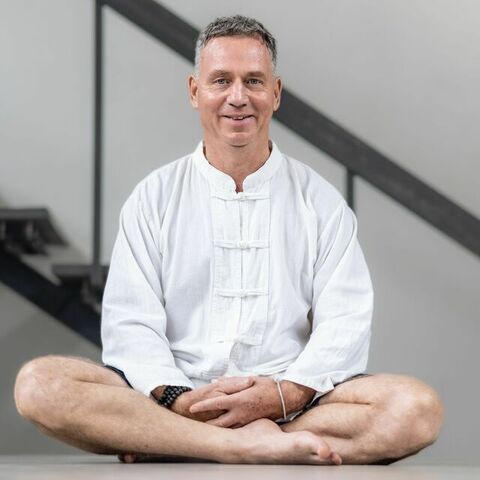
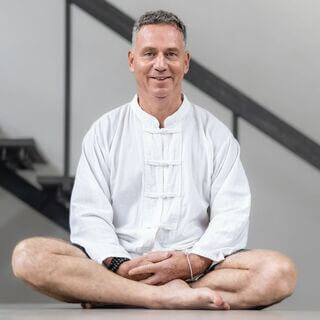
Let me introduce position-wise.
Cross-legged is great if you can do it.
If not,
You can sit on a chair.
Because sitting on a chair keeps your legs apart rather than crossed,
That's the first point.
The second point is to have our,
If you're sitting cross-legged,
Putting a cushion under your bum is a good way to raise yourself up and keep the body straight.
So,
Be cross-legged or sitting in a chair.
If you're sitting in a chair trying not to lean back,
Trying to come forward a little bit,
The principle is upright but comfortable through meditation.
So,
The second point is to keep our back straight.
The third is to keep our shoulders slightly back so they're very straight as well.
The fourth is the head.
The head should be looking down just towards the floor in front of you about one or two meters.
There's a comfortable place where the head is just naturally slightly pointed downwards.
The eyes,
Ideally the eyes should be almost closed.
Just a little bit of light coming into the eyes is ideal.
You can close your eyes if you wish but be careful of that,
Making you feel sleepy.
Meditation is the very opposite from sleep.
We're being aware,
We're not being sleepy or dull.
So,
Ideally a little bit of light coming into the eyes is good.
Tongue against the top of the mouth just stops too much saliva while we're meditating.
And then the hands,
You can either put your hands on your lap with the right hand on top of the left and the thumbs gently touching like that or you can put your hands on your knees facing downwards or facing upwards,
Whichever you prefer.
All of those are fine.
So,
That's the positions for meditation and that's the technique,
Those three parts,
Watching the breath with counting,
Not counting and watching the breath at the tip of the nostrils.
So,
The next audio will be the actual meditation practice.
So,
Follow that audio,
Do the practice with the audio and keep the audio to do again at least one more time before you move on to the next session.
Thank you very much.