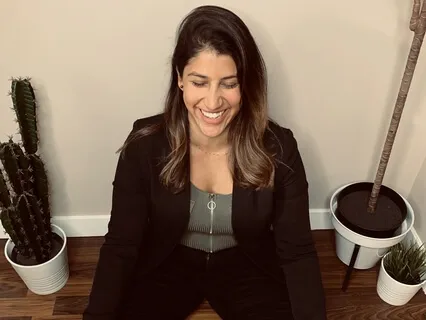
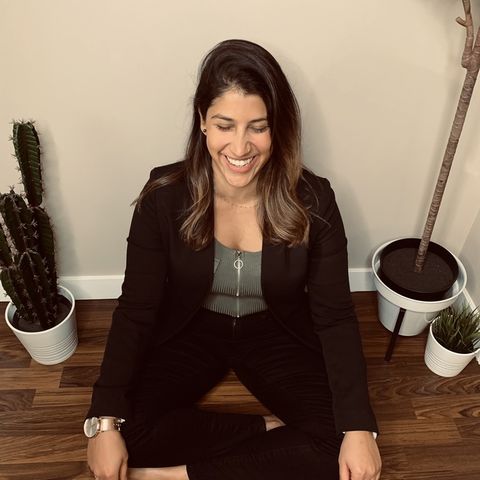
I invite you to move yourself into a position where you're feeling comfortable and relaxed,
But also alert and aware.
Perhaps you're sitting on the ground,
Maybe on a chair.
If you're on a chair,
You can keep your feet firmly planted on the ground.
And if you're sitting,
Allowing your seat to root you into the ground.
Lengthening your spine,
Dropping your shoulders,
Allowing our posture to shuffle and support us as we move through this meditation practice to help us develop some focus and train our attention.
Allowing your forehead to soften,
Your cheeks to drop,
And your jaw to release.
You can tuck in your chin to lengthen the back of your neck,
Allowing your spine to rest straight and firm.
Allowing your arms to soften.
We'll begin here by just connecting to our breath,
Noticing the sensation of our inhale and our exhale.
Perhaps becoming aware of the abdomen rising and falling.
Maybe it's the chest.
Just rest your awareness here on your breath for a few moments.
When your mind wanders,
That's okay.
It's normal.
You can cut yourself a little bit of slack here and just redirect yourself,
Redirect your attention back to your breath in a kind and gentle manner.
The interesting thing here is that we spend most of our day multitasking,
Distracted,
Doing several things at once.
So our attention is short and can be rampant.
So when we sit for practice like this and our mind begins to wander,
We often become self-critical because we don't want it to wander in this moment.
We've actually trained our minds to be that way for several hours a day,
Several years of our life.
So as we work on our focus and our attention,
Allow some space and grace to redirect when our mind wanders.
For us to redirect and course correct,
The benefit is every time we do redirect our attention,
It's an opportunity for us to strengthen our muscle of awareness.
The more opportunities there are,
The stronger this neural pathway in our brain becomes.
The stronger it becomes,
The easier it is for us to access and put this sense of concentration and focus into action.
As we're focusing on our breath here,
Allow everything from your day to just fall away.
You are right here,
Right now,
And that's all there is.
You can begin to imagine yourself on a train platform.
You're just standing on the platform there.
And as trains go by,
You're not getting on any train.
You just observe them going past.
The trains are a metaphor for thoughts that come into your awareness that can distract you and make you want to get off the platform.
The trains might be sensations that distract you and want you to get off the platform.
They might be feelings,
Emotions.
But all we're doing in this practice is just observing,
Just watching the trains go by.
We're here to stay on the platform,
Keep our awareness in one place,
And allow everything else to just go by.
You might notice a thought coming into our awareness,
In which case we can label it.
We can say thought,
Or we could say feeling,
Or item from my to-do list.
It can help to label what's coming up,
To just acknowledge it,
But not get on that train of thought and get carried away.
So we start to cultivate our sense of concentration as we stay on the platform and just watch things go by.
This is your personal train station.
What do you notice about the trains going past?
Are they very fast,
Racing?
Maybe there's lots of thoughts and emotions and sensations and things coming up for you,
And that's okay.
Just take note.
Just observe that.
At some point,
When we don't get on the trains of thought,
It will start to slow and have more of a smooth,
Regular cadence.
So every time you sit to do this meditation,
The trains will come at different speeds,
They'll look different,
They'll feel different,
And that's okay.
That's because we're always changing.
Doing your best to stay on the platform,
Not getting on to any trains,
The thoughts that come up.
Perhaps there's an opportunity to ask,
Who's the conductor?
Is somebody else driving that thought?
How can you take over and put a stop to it or direct it in the way it needs to go in the future?
Right now,
You're just noticing,
Just observing who's the conductor of that train.
With any sensations that may come up,
Perhaps an itch,
Not getting on the train would mean not itching it.
Can you stay on the platform and just allow that sensation to arrive and pass?
If it's really strong,
Maybe give yourself three breaths before you scratch that itch.
Allow a little bit of space between this stimulus of a sensation and your response.
So often in our world,
In our day,
We're faced with several different triggers and stimuluses.
What happens is we begin to react instantaneously without realizing.
Know that there is an opportunity there.
There's a bit of space that you can take to create a response instead of a reaction.
A reaction is often out of the past and a response is from the present,
Bringing awareness to that sensation that's arising and choosing if you're going to give in.
With any emotions that come up,
Just observe that train,
Observe that emotion,
Notice it coming into the station,
Notice it going through and past,
But allow it in,
Allow it to come through and to pass through.
And notice,
Oh,
I'm feeling frustrated right now.
I'm experiencing some anger right now,
But allow it to pass and do not get on that train at this moment.
We also don't want to stop the train before it gets into the platform.
So often we try to suppress and push away our feelings.
We notice something coming in and we instantly try to shove it away.
But what would happen if you allow it to pass through?
What if?
Perhaps an opportunity to test here and allow emotions to pass through.
If you found yourself on a few trains,
That's okay.
Get off at the next stop.
The key here is really the awareness of when you get on that train.
Once you know you're on it,
You then have an opportunity to choose.
Are you going to stay on or will you get off?
This is often what happens with negative thoughts that can spiral.
Practice standing on this platform.
Basically what we're doing here is doing nothing.
We're just standing on the platform,
Watching,
Becoming a little bit of an observer to what's going on in our mind.
We think that doing nothing can be easy.
That you might have found here that doing nothing can be hard because our minds are always going.
There's always something cropping up.
And that's okay because it's how we're wired,
How we've trained ourselves.
But this is an opportunity to train something different.
Allow ourselves to rest in one place and not push away any thoughts or feelings or emotions or sensations or anything,
Any type of thought that's coming up.
Just allow the train to pass.
Allow yourself some space from the thoughts and feelings and emotions and sensations that we so easily get wrapped up in.
I invite you now to get ready to leave your train station,
The platform.
If you're underground,
You can climb the stairs.
Just return to your breath,
Allowing your awareness to rest here on your breath.
Again,
Becoming aware of your inhales and your exhales.
Knowing that you spent a little bit of time to cultivate some sense of attention and focus,
And also a little bit of space from these thoughts and emotions that we can feel so easily compelled by,
So easily driven by.
Allowing your breath to be at its normal pace,
Not trying to push it or pull it or control it in any way,
Allowing it to be as it is in a restful state.
When you're ready and it feels complete,
You can open your eyes,
Bring a little bit of movement into your fingers and toes,
Maybe do a little stretch if you need.
Take what you need right here before you move into the rest of your day and perhaps see how you can carry this sense of renewed focus and attention into the rest of your day.
Thank you for joining me in our Do Nothing Meditation today.
I hope you have a wonderful rest of your day.