To invite you into the present moment and think about why we're here in our class,
Or sat saying,
To study self-awareness.
I thought today we'd go back to basics.
We'd start,
Kind of start with why are we here?
Well,
The reason there is a class is because we're growing.
We're learning,
Growing,
And evolving.
There's an inner calling,
An innate intelligence compelling us to learn and grow and evolve.
To what end,
We might ask?
To what end?
What are we supposed to evolve to?
And that's a very good question to ask.
So let's start the class today by asking,
Evolve to what?
And that process of evolving is the process of enlightening.
That self-evolution is our self-awareness,
Our self-realization.
And our self-realization leads to our God-realization,
Our enlightenment of our consciousness,
Enlightenment to knowing who we are and why we were born,
Which is our purpose,
To know who we are and why we were born,
So we can then fulfill our purpose.
And so most of the world's still kind of asleep,
Just chasing after desires or resisting things,
Having aversions and resistances and likes and dislikes and whines,
You know,
The forensic mind,
You know,
You all have a brain.
So let's invite our brain to chill out.
And that's what meditation is really.
So let's take a moment in this moment to withdraw from the day and our mind and really our persona and think of our body and mind as a garment we can leave on the lounge as we step into this jacuzzi of consciousness together.
And as a metaphor,
We simply close our eyes and sit up straight and imagine we're sitting in a hot tub or a jacuzzi or a mineral bath,
And we're allowing a warm feeling to soak in.
So when we're together,
Whenever we connect,
The idea is to connect in with our energy,
Our life force,
Our Shakti,
Our spirit.
And the way the spirit energy moves through our body,
The yogis call the Kundalini.
So I wanted to dedicate this talk to discuss Kundalini Shakti.
What is the Kundalini?
Like there's a big mystery behind it.
But coming from the Judeo-Christian heritage,
What we're really saying is,
What is the spirit?
In other words,
What is that that animates our existence and continues on after the body expires?
Or what is that innate intelligence?
What is the underlying beingness?
In science,
We recognize that there's an energy.
There's energy moving in our nervous system,
In our chi,
In our electromagnetic fields.
We also note that there's an innate intelligence.
There's patterns that form the RNA and DNA in our cell structures.
And we see that the way that both the elements and compounds and the cells come together forming patterns,
There are systems of organizing intelligence in our biology,
As well as in our ecology and solar system,
Galaxy and the universe.
We see that orders are rising out of chaos within us and around us.
And so it behooves us to check in with that.
If there is a God and God created the universe,
And thus God created everything in the universe,
And we were created and we're in the universe,
So God created us and is creating us because we're not done being created.
The idea is there's something intrinsic in all of life.
But since it's within us,
Let's look within us.
And that's the essence of what Kundalini yoga or meditation is really all about.
It's checking in with the life force within us that is us.
It's checking in or becoming aware of the awareness that is us.
Becoming aware in other words,
Self-aware.
So when we look at India,
We hear these different words Kundalini,
Kriya,
Shakti,
Or Shaktipat.
We don't always,
You know,
There are oftentimes they're aligned with a certain lineage.
And really,
These are aspects of the one path to God.
Just different gurus explain things differently or they focus on a certain technique that would utilize one method rather than another,
Depending on what level you're at in your practice,
Or what teacher you study with.
So let's sit back.
Take a deep breath.
Imagine you're completely immersed in the hot tub.
So the warm waters come up above your shoulders.
And as you exhale,
You can just kind of either say or make the sound in your mind.
Just let the tension go kind of work with it.
Let yourself go and ease into the feeling.
Let the tension go,
Let the ik go,
Let the past go,
Let your mind go and breathe in and feel life and just say I'm open to receive.
And I like to start with a prayer.
I always say,
Lord,
Help me to be a pure vehicle for your love,
Light and wisdom.
There's a sense of openness and maybe just,
You know,
Whatever way you pray or recognize the divine.
Recognize the divine,
Recognize that there's life,
Recognize that the universe exists and it's expanding.
And let's check in with that.
Say,
What's that about?
What are we about?
And what is our relationship to the universe and how it's unfolding?
Let's think big for a minute.
Breathe in and open your heart.
So as you inhale,
Remember you're pulling in the electromagnetism that encircles the globe.
From the North Pole to the South,
There's an electromagnetic field.
It's acting kind of strange right now because we have a lot of solar radiation,
What are called coronal mass ejections or solar wind.
And there's a lot of activity hitting the field around us creating,
Well,
I should say a shakiness in the field.
But if you breathe in,
You can feel that energy.
It's very alive right now.
So breathe in and just note,
Just like your compass needle points north because it feels the energy,
Just kind of tune in as you focus your attention at the point between the eyebrows.
Use that as your on switch way to get aligned,
Way to turn on the energy or Kundalini,
Matter of fact.
So we've got energy running through our nervous system.
That's the Kundalini.
End of story.
There's the big mystery.
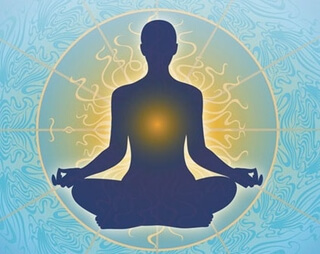
Yogis that we have chakras.
It's not a coincidence that they happen to be where the endocrine glands are in our sympathetic nervous system.
These are the areas where energy is converted into chemical components we call hormones that help the operating system of our biology reach its homeostasis.
It's how the body communicates through chemicals.
The chemicals are created depending on what energy vibration is.
The vibration sets the pattern.
The vibrations change as it moves higher up the spine.
It works through a different gland.
The glands operate at different hertz.
And so there's the chakra system 101 in two minutes.
So you go from the Moledohara to Svajasthan to Manipuram to Anahat to Vishushuddha to the Asana center to the sashra,
Chara.
So what does all that mean?
It sounds like hocus pocus in the West.
Well,
Yogis who are describing first the areas we call the sexual or vital center,
The root center,
Even in Hebrew it's Melkut which means root.
This is either the ovaries or the testicles depending on your gender,
The place where the hormones produce estrogen and testosterone and those kind of hormones that are related to life itself,
To creation of life,
Estrogen,
Creation of the life cycle,
The birthing cycle,
The reproduction of the egg,
Or the onomat,
The energy to reproduce,
The sexual energy itself,
The yang,
The male energy through the seed in the testosterone that go out and get it,
Make it happen.
And so the balance of this yin and yang is important.
So we can,
As we're reflecting on this in class today,
Let's make it a meditation as you sit imagining we're all in this jacuzzi of consciousness together,
Just kind of getting high on God.
Take a deep breath and feel the electromagnetism being absorbed into your lungs and you're actually taking in electromagnetism from the atmosphere.
And you kind of know this innately.
When you breathe more,
You're more energized.
If you're kind of sleepy in the classroom and you take a few deep breaths,
It helps you wake up a little bit.
If you start running around the block,
You have to breathe more.
You start panting to get more air because you need more energy.
Once you sit down and relax,
Your breathing slows down.
You don't need as much energy.
So what we want to,
And this is called pranayama,
So we want to reflect on this now.
As I'm speaking to you,
Sit,
Breathe in and just be aware of your breath.
This is the pranayama meditation,
Inhaling.
Be aware of the electromagnetism being absorbed into your nose.
And it runs down what's called the inda and the pingala.
There are these two channels.
The inda is on the left,
The pend on the right,
The correspond to nerve conduits running down the side of your spine.
And they mix at the base of the spine.
Imagine that.
And then as you exhale,
You might just imagine the energy then running up to the center of the spine,
Which is called the shishumna nadi.
So the ancient yogis that were studying how the energy moves in their body by observing it,
Looking within themselves,
Said,
Hey,
There's energy that moves up through the vertebral column,
Spinal column,
The center of the spine.
This is the innate intelligence.
Well,
That's your nervous system,
Dude.
Look how smart they were to know that the energy that's interconnected with the brain and sending the signals all through the body runs through the nervous system,
Right?
Well,
That's your kundalini.
That's the innate intelligence.
Now,
It operates at different levels.
So it's not quite as simple as I'm making it,
But it starts at a base that we can all understand,
Which we call our sympathetic nervous system.
So just imagine the ovaries and the testicles at mola dahara.
And then as we go up higher,
And sometimes that's visioned as red.
And as long as we're going through them,
We might just picture the energy there,
Maybe squeeze our PC muscle,
The pubic coccygeus,
Like a Kegel exercise,
Or just squeeze your rectum,
Just like you're stopping a urination.
That muscle group just enables you to kind of feel where that part of your body is.
And just imagine that red.
And so when we talk about the kundalini,
The way you say the serpent is coiled at the base of the spine.
So you've seen the kadusha,
Which goes way back before the Greeks,
Goes early to actually pre-Flood era period where the snake rides up the pole.
It changes at the six points,
Opens at the seventh,
Which is of course at the crown chakra.
And there are wings representing the transcendence of the consciousness and the pole that goes up the metal.
So you've got this pole,
Which is your sushumna nadi,
It's your nervous system.
So the energy goes from moladohara,
Now picture it going from red into orange as it moves up to the second center.
So this is basically above the pubis and below the belly button.
That's the broad area,
And it's known as swajasthan.
And it corresponds to the adrenal glands and kidneys.
It's the orange color,
Represents emotions.
And of course the adrenal glands secrete such hormones as adrenaline,
Which is the fight or flight emotion,
The emotional center.
You hold emotions down here,
Don't you?
So everyone breathe into your navel center.
Let's just feel that energy opening up.
So a lot of times in Kundalini practices,
You actually do a lot of breathing.
Breathing through a chakra,
Breathing up and down the spine,
Breathing with a mantra.
And sometimes Kundalini exercises are also correlated or similar to Kriya exercises.
You hear these two aspects where Kundalini is generally referring to the shumna nadi,
The main central vesicle moving up the spine.
Kriya kind of refers to a broader opening or release.
There's 72,
000 nadis or energy centers that are conducting this electromagnetism.
And as they open up,
Sometimes different sounds or movements or things can kind of,
Your body might just make a funny movement.
All of a sudden,
Something's opening up like the un-crimping of a pipe.
So those are called Kriyas.
So you'll have Kriyas as you're practicing Kundalini.
And as you're practicing Kundalini,
You'll have Kriyas.
They're related.
And I'll talk about that a little bit when I go into the Gurus.
But I want you to just stick with the chakras for a moment as we go into Swajasthan again.
Just breathe into the orange area below and see if you can push the energy as you're breathing in.
Push it down into that area as you kind of expand that area above the pubis and below the belly button.
The Tan Tien,
If you know martial arts.
And then breathe out and tighten slightly.
That can help relax you.
Your eyes are closed.
You're gazing at your mind's eye.
But now picture the light moving up to your navel center.
So from the belly button to the sternum.
This is generally the diaphragm.
This area we want to open up as we breathe.
This is a big part of yogic breathing.
It's learning to breathe to the lower part of the lungs and below them.
Use the diaphragm and the muscles in the stomach to open up the lungs like an accordion.
And that number one absorbs more breath,
Which means you absorb more of the magnetism,
The prana.
So prana is the vital air.
Pranayama is the law or the construct,
The control of.
So pranayama is the control of the breath and the prana,
The control of how the energy is moving through the body.
And this is all a part of Kundalini and Kriya practices.
So when you look,
Let's keep going with the chakras up to the heart now.
Here is yellow.
Maybe take one more breath into the diaphragm.
This corresponds,
By the way,
With your pancreas and your spleen.
And these help regulate your blood sugar levels,
Which regulate your mental states.
So this is considered like the mental center.
It's yellow.
We want to see our pancreas and spleen balanced and regulated.
Not too much sugar in your life.
You guys,
Sugar is a poison.
So you're going to be weaning yourself off of sugar,
Particularly processed sugar.
So feel this energy opened up in your navel center.
And you can just… the best way to open it up is just to push your navel out.
And now release and let go.
And just feel the ahhh.
Matter of fact,
The ahhh sound just made at the navel center.
Ahhhh.
Just let go.
Feel that release.
And then bring your attention up to your heart center on a heart.
And this is where your thymus gland is.
This is your assimilation center.
We all know kind of intuitively that our heart,
A sense of love,
A sense of being.
There's something special about this center.
I want you to breathe in and feel your heart opening.
Because really it's through grace that we enlighten,
Isn't it?
So feel your heart opening.
Lord,
Help me to be a pure vehicle for your… Let God in.
Let the Lord in.
Let the light in.
Let yourself be loved.
Breathe out.
Feel that sense of letting go.
I like to say let go and let God in.
Maybe bring your hands up if you'd like.
So in all my classes in Self-Worthness Institute,
We do Shakti Paat.
So this is another way of engaging Kundalini Shakti or life force.
So bring your hands up and see if you can feel energy in your palms as you hear the sound of my voice.
Just connect like psychically.
Just kind of like tune in intuitively maybe.
Breathe in and feel the love.
Let the love in.
Love,
Love.
That's all this is really.
It's like I'm tuning into the presence of God.
That makes me feel all this love.
And then there's the sense of wanting to share the love with you.
So you pick your hands up.
What we're really doing is letting a confluence of spirit or life force flows through us.
The Holy Spirit.
And if you're with me,
You're with Christ because He lives in my heart.
So just know that there's this loving feeling coming through.
And your palms now are like little satellite dishes that can tune into my station.
And just breathe in and let it come down your arms into your heart.
Feel your heart expanding.
And just know you are loved and that you're protected and guided by the Divine in all your activities,
Day and night in all places.
Go ahead and bring your hands back down.
Gazing into your mind's eye.
Just feel the radiance in your heart glowing and imagine your entire body enshrouded in a cocoon of golden white light.
Just know you are the light.
You are the light.
You are the truth.
You are loved divine.
This body is but a dream of mine.
Just know you're loved.
So breathe in.
And feel the light moving.
So this is usually a green color.
We can focus on green here for a moment if you want.
I don't think it matters too much what colors you use.
It just helps make some discernment.
Now move your awareness up to the base of the throat.
This is Vicious Shoot.
This might be a turquoise,
Aquamarine kind of color.
It's corresponding with the thyroid and the parathyroid.
And what you want to do,
This is obviously where your metabolism is in a scientific sense,
But it's assimilation.
Here's where you're taking.
So if you think of the path,
There's the physical part,
The emotional part,
The mental part,
There's the heart,
Which is really kind of the spirit.
The throat is representing now the expression.
It's your coming to being.
It's your spirit expressing through your body and mind,
Which brings you to the third eye.
So let's take a moment here to the throat and just breathe in and picture this area radiant.
Think of the symbolism.
And so when we do a meditation,
We might just meditate on these.
First of all,
Wherever you put attention,
Energy follows.
And it kind of helps to open up confluences of energy that might otherwise be stuck,
Particularly in emotional center or the heart center or the throat center.
If you've had trouble expressing yourself,
You might breathe there or concentrate there.
Different yogis have different methods.
Different things are recounted in the Vedas and Upanishads and other writings.
Now with the throat open,
Let's go back,
Continue to focus on the third eye.
And this is typically a blue color you'd focus on and probably more likely that's the color you see there.
It's usually white or a golden white or blue,
But it could be any number of colors.
It may not be any color,
But it is common to see a color here and it's most often blue.
So if it helps you,
Just imagine a blue light at the point between your eyebrows and focus on that.
This is the Ajna center,
The third eye,
The mind's eye,
The Tisratil.
This is activating your pituitary gland,
Which is right behind this point.
And the pineal gland,
The two work together,
Another part of your endocrine glands,
The master gland,
All the other endocrine glands.
So it helps kind of set the tone.
It's kind of how you can start tuning your guitar in a way.
These different strands or different levels that the energy is flowing.
This is literally a self attunement process.
This is why the yogis all look at their third eye.
It helps you one plug into the subtle energy in your body.
Energy is already there,
But most of the time we're not paying attention.
So if you want to pay attention,
If you want to plug in,
You simply look at your third eye.
So everyone breathe in and galvanize your focus at the point between the eyebrows.
So we do this in every meditation.
So in every meditation,
We're essentially engaging Kundalini,
Whether we call it a Kundalini meditation or not.
And Kundalini is just our spirit.
So if we say we're doing Kundalini meditation,
What we're saying is we're replacing our attention on spirit.
It might be on a point like a chakra,
It might be on how it's flowing through our body or might be through the breath,
For instance.
Take a deep breath.
And now bring the energy up to the top of the head.
So this is the crown chakra.
So as you're looking at your third eye,
The Kundalini is moving up the spine.
It kind of slides up.
It feels like a slow motion.
And that's why they say it slivers like a serpent.
They're not thinking of the devil or,
You know,
Something like the biblical sense of the serpent.
They're thinking of the serpent just in terms,
And matter of fact,
It's the symbol of wisdom.
And then moving up is us ascending,
Us transcending,
Matter of fact.
So the Kundalini is allowing our energy that's normally kind of wasted in our sexual and emotional centers.
If you think about it,
When we have a lot of energy,
We get horny.
It's natural to want to release it.
And that's what we call sexual arousal.
All this extra energy,
Like in the spring,
You got a surplus of energy.
It's like,
Let's mate.
The animals know it's time to breed.
Well,
They have all this energy.
They're all rested up and ready to go.
And then also we bleed or use up a lot of our energy through our emotions.
So the idea here is,
And the reason why yogis often become brahmacharya or celibate,
Is they're taking all that surplus energy,
Which I'm doing.
So I'm taking the surplus energy because I have a lot of vital energy and sex is great.
I've enjoyed it for many years.
But when you start moving it up,
Which is looking at your third eye,
It's what that happens is all of a sudden this energy starts moving up and it opens up all these other centers.
Then all of a sudden your crown starts opening up.
And really it's like a cosmic orgasm.
It's just frankly better than normal sex.
So people sometimes look at me and say,
Gee,
Poor Steve.
He's like depriving himself of some of life's great joys.
I go,
Dude,
If you only knew,
You don't know what you're missing.
You're crazy.
You're playing with tinker toys.
It's like,
I can remember one time I loved my tricycle.
And if you ever took my tricycle,
It was my favorite toy.
Can you remember that time?
We were riding a three-wheeled bicycle,
A tricycle.
Those were cool,
Man.
And then if you had ever taken it away,
I would have cried probably.
I wouldn't have liked it at all.
It was green.
I had tassels with ribbons.
It was twinkled.
It was beautiful.
It had white rims.
I can remember it very well.
And then all of a sudden I got this cool stingray bicycle with a banana seed.
And I was like,
Dude,
What's a tricycle?
I didn't even think about it again.
And then I got a car and I had to kind of make myself ride a bicycle to stay in shape.
My car was so infinitely better than my tricycle.
And that's kind of how it is with your chakras and the ascent of your consciousness and the way your life force energy can be expressed for you.
There's simply higher octaves of love and ways that your vital essence or your true being can be expressed.
And it's not to say that you can't do these other ways if you want.
That's what life is,
Learning how you can express yourself.
So take a deep breath.
Get into your mind's eye and just see if you can feel the energy flowing in your body.
All right.
So there are many different forms of Kundalini.
It goes back.
It's been represented as far back as the Harappan culture.
It's even talked about in the Bhadavad Gita.
Krishna talks about gazing into the point of your nose,
The third eye,
Ways of connecting with your life force,
Which is your Kundalini.
And then we have in the Upanishads in the 9th century,
Basically before Christ,
It's spoken about the word Kundalini is used.
And if you go today,
Like,
Well,
Who are the Kundalini teachers?
You have many different great teachers.
One of the better known ones is Yogi Bhajan,
Who I love.
I was fortunate to meet and study with him back in the,
I think it was in the 70s.
I was still in high school,
Learning meditation.
And he was one of the first guys to bring Kundalini to the United States and to the West.
And he is a Sikh.
So he wears a turban and white and has certain attire.
If you notice the people that are followers of Yogi Bhajan,
They have a certain attire that wear white and turban.
There's a thread,
They have Sikh names,
Khalsa and Singh.
Probably the most famous today is Gromukh,
Who's a wonderful teacher in the Happy Healthy Holy Organization,
3HO,
Which I went to.
It was up back then.
It was on Robertson in West Hollywood,
I think it was.
And Yogi Bhajan was a great,
Big guy,
Very tough.
He'd push you,
But he's a big teddy bear.
A lot of love.
We'd laugh a lot.
We had a great time.
I'm very fortunate I got to know him and his wife a little bit.
So his form of Kundalini,
Though,
Was very much mantra.
Now,
They use Gromukhi,
Which is similar to Sanskrit.
So you would chant like the name of God is Sat Naam.
Sat being truth,
Naam means name.
So you might have your arms out to your side and you'll be spinning them with a certain breath and you'll be going,
Sat Naam,
And over and over and over and over.
So there's a little bit of trance,
A little bit.
They'll have you control your breathing,
So they'll use some pranayama.
They'll definitely use some asanas or different postures and moving.
So if you're going to go through some Yogi Bhajan form of Kundalini yoga,
Which is probably the most prominent,
Best known,
Certainly in America,
Not in India,
But certainly in the West,
Because they had a very efficient teacher training.
A lot of Westerners signed up.
I never actually went through their teacher training.
And I knew Gromukhi.
I got to know a lot of people that are very popular now.
And they're good teachers.
So it's another way you can experience Kundalini.
I don't honestly see a lot of people enlightened,
Per se,
In the way that I know it.
But I would say some of the most fit and loving and very high conscious people that you'll find in most yoga groups,
Particularly if you're contrasting Kundalini yoga with most of the yogas practiced today.
I would have to say that 3HO or the ones practicing Kundalini yoga are doing what I would consider more authentic yoga,
More of the classic yoga,
You might say,
More that it's a spiritual-based yoga.
Another great teacher was Swami Sivananda Saraswati of the Divine Life Society.
And his protege was Sivananda,
Or Vishnu Devananda,
Who was my teacher.
And this was another Kundalini path.
But it's really more focused.
I think they would probably consider themselves more of a classic Ashtanga yoga.
So in Ashtanga yoga,
In the classic path of yoga,
Real briefly,
You start with your yama and niyama.
So yama are restraints.
The first one is ahimsa,
Non-violence.
So there's certain things you don't want to do.
Don't be violent,
Don't lie,
Don't steal,
And so forth.
Kind of like the Ten Commandments.
Then there's niyama.
There's things they recommend you do.
Study the scriptures,
Have satsangs,
Study with the teacher,
And so forth.
Involve yourself in disciplines that are worthy and develop your mind.
And then the Buddhists took another step.
They have what's called the Eightfold.
There's the Four Noble Truths and the Eightfold Path.
It kind of codified it even more.
Then you have asana,
Which is the third,
And pranayama,
Which is the fourth,
On this Ashtanga Eight Limb Path,
Which is a good basic construct for understanding yoga.
So asanas are basically your physical yoga postures that were primarily used to straighten the spine and make it convenient for people to be able to meditate for long periods of time.
Pranayama,
As I mentioned earlier,
Was control of the breath,
Usually the first form of meditation that you learn.
So let's all practice right now.
Take a deep breath in through your nose and just breathe in through your third eye this time.
Before we did our navel and went through the heart,
Another place that you can focus is on your ajna chakra itself.
So breathe in.
Imagine energy is coming into that third eye point.
And as you breathe out,
Galvanize your focus at that point between the eyebrows.
And so in a classic meditation,
A third eye meditation,
That's all you're doing is you're rolling your eyes up.
You might take a few breaths,
Say a prayer,
And then you just dive into your third eye.
And all of a sudden you stop thinking,
Particularly if you've been initiated by a guru.
If you're working with me,
You should be able to just look at your third eye and go out.
Another great teacher that I was fortunate to meet,
His name was Swami Lakshmanju.
He was the last of the Kashmir Shaivite gurus from Kashmir up in the Himalayas.
And he actually came down to Los Angeles to get surgery and I happened to be able to meet up with him.
So I didn't really get a chance to study.
I of course read his books and studied about him.
And then all of a sudden he showed up in LA and I got a chance to meet him briefly.
And I got a personal darshan and shaktipata transmission.
He's another one that was big on Kundalini.
And it's basically focusing on your body's life force energy.
Once again,
One of the great lineages of yoga was tune into the current.
There's a physical current of energy in your body.
Let's do that right now while we're talking about it.
I want you to breathe in and just feel.
As you hear the sound of my voice,
Can you feel the buzzing in your head or the buzzing in your body?
So you're really just kind of being aware of an energy that's already there.
Then by us focusing on it,
It gets stronger.
By me sending you some energy,
It can get stronger or help you focus on it or build it up so it's even stronger.
And so that's what a Shakti or Kundalini master does.
At one level,
They can help bring it up and then another level,
Their energy is strong enough that you pick up on it.
So Swami Lakshmanju was a powerful Kundalini master,
Part of the last of the Kashmir Shaivite traditions.
So you'll see a lot of Kundalini involves recognition of Shiva,
The deity,
The yogi deity,
The symbol of sitting in silence in meditation and realizing God.
Then there was Yogi Raj Satguru Naath who was really interesting.
I first met him,
I think I told you,
We psychically connected.
I was actually at another retreat with another Kundalini master in the desert and I had a vision of this guy and then someone at the retreat said they were looking for someone that was going to connect with him and I obviously just connected with him.
So they had me call him and he said he was waiting for my call.
And to make the long story short,
He came to my meditation class the next week and later that year I went to visit him in Pune,
India and got to go to his ashram and study some more Kriya with him and that's when Yukteswar appeared in his astral body at his ashram.
And now he's really big.
So I brought him to Laguna,
Got him started in America.
Now he's global.
They just did a movie about him in Australia and I bumped into him.
You know,
I was in India,
I've been in India like five years in a row,
But two years ago I was there and I happened to be with Guru Dev Sri Amarishi and I saw Yogi Raj and he says,
Oh,
I want to meet him.
So I went over and I was able to meet an old guru and friend of mine to my new guru friend of mine and we all got to sit down at the Aloha Hotel right there in Rishikesh.
And he is another one who you could say he's practicing Kriya or you could say he's practicing Kundalini in the lineage of Gorakhshara.
And his energy,
So another example would be some more chanting,
Some more breathing,
Some more moving energy in his in his form of Kriya,
Similar to what I studied with Chhuni Lalahiri up in Varanasi,
He would have you breathe up and down the spine.
You would do basically an Ujjayi breathing with a root lock and a throat lock and move this energy up and down your spine until your Kundalini was really getting hot.
It would cause your whole body to get really active and you would just melt into that feeling.
And so there are ways that you can do pranayama or breathing either up and down your spine or in and out through a certain center like we did a little bit in our navel center,
In our heart center and then through our third eye and putting our attention on either movement or motion helps focus energy there,
Which can help open up centers and help cycle this Kundalini that's already cycling in your body.
What you're really doing is kind of moving it or exercising it,
Kind of like a yoga asana or posture for your psychic or electromagnetic body.
Another great teacher I got to study with in the early days was Baba Muktananda of the Siddha tradition.
And he was a Kundalini master,
But he focused on Shaktipata per se,
Which is the passage of energy,
Kind of like I do.
But he would walk around with a feather or something and just move energy around,
Touching third eyes to get their Kundalini up.
And they would have these very powerful Kundalini awakenings.
Kriya is happening.
And now Guru Mai is one of his successors,
Who's a female guru who has Shaktipata and can awaken Kundalini.
And I've met her.
She's got a nice energy.
And her brother is Nityananda,
Who used to come to my classes back in Laguna back in the 80s.
And he's got some jagdhi too.
He practices a form of Kundalini.
I think he does mostly bhajan or sound yoga.
Another great teacher I think I mentioned briefly earlier was Amrit Desai or Guru Dev Sri Amrit Ji.
We did an amazing Kundalini intensive or immersion together.
And he has another approach.
Now when he does,
He doesn't necessarily call himself a Kundalini master,
But he is.
He's a master.
A master is a master.
And so his students,
When they feel the Kundalini,
They will go into spontaneous Kriyas.
And so if we're like when I would do Kriyas with people,
And you go into the spontaneous postures or sounds will come or sometimes you go into those postures and you start breathing and it can open up some blocks.
So what's happening is when they're having that Kriya,
That's another form of Kundalini awakening through going into those stages and those movements and by allowing themselves to just let go of control and to let the energy kind of unwind.
Sometimes really,
Really deep seated blocks get opened up,
Allowing the Kundalini to flow more.
So Guru Dev is another Kundalini master.
But of course,
As you know,
My root guru after studying would literally do it.
I could go on and I've met dozens of Kundalini masters and they're all great.
I think Kundalini is great.
But when I met the Tachika Maharishi,
He was just seemed head and shoulders above all the rest.
First of all,
The glow around his head was so strong and the Shakti was so clear and bright and he seemed to have such a lucidity about him and he was very grounded,
Very practical,
Very scientific.
He was a doctor,
Explained things in terms of endocrinology and science and all of a sudden Kundalini made sense.
And so I was very fortunate to apprentice with him and working with him in the World Community Service Center still in India.
We've got 5 million strong.
So any of you that have studied with me are essentially studying what I learned from Yogi Raj Vettateri Maharishi,
The greatest Kundalini master,
Part of the line of Tamil Siddhas.
His guru was Dr.
Rao,
A very well-known Siddha from the line of Siddhas.
Siddhas over there are also doctors.
So the Yogis tend to be also knowledge of how the universe works in general.
So they would administer medical procedures,
Which are still used today,
By the way.
And so Vettacara Maharishi left us years ago,
But he helped found our Self-awareness Institute in 1985 here in Laguna Beach.
And so whenever I go to India,
I love to stop in at the different ashrams and meditation centers in India and give a darshan and meet my brothers and sisters.
And if you ever go to India,
Be sure and step in.
Matter of fact,
There's an incredible teacher down in South India in Thiramalalai.
His name is TKS Guru or Sakguru TKS and he's just beautiful.
If you're in India and you want to meet a genuine Kundalini master,
Say,
Who would I meet?
I'd say,
Meet TKS Guru.
He's amazing.
Or just if you can find a World Community Service Center,
There'd be somebody that I can guarantee you'd be just a beautiful people.
That center has been brought together.
Swamiji brought together the most beautiful people and centers,
Particularly in Southern India.
So that's really your lineage too.
This is a part of the Tamil Siddha line of Kundalini masters.
So Swamiji trained me and founded the self-awareness Institute with me so that I could train you.
So now many of you like Jesse are now teaching it to others.
And the other great master I'll conclude with today,
Because I thought I'd leave the best for last,
Is Sivabali Yogi Maharaj.
Now,
I don't know if you'd say he is certainly a Kundalini master,
Although he doesn't claim to be one or people don't really think of him as one per se.
He's just at such a high state of spiritual evolution that just literally,
Like he doesn't go around and try and open your,
You know,
Pull energy up your spine per se.
He doesn't have you do all this breathing or any of this kind of stuff.
There are no mantras.
Just being in this presence,
Your energy starts to go off.
And his meditation is simply the one I teach you when I'm with you,
Is to focus on your third eye.
He would put his energy into Vibhuti,
Which is sacred ash,
And then distribute it to people in the room.
And they'd sit down and feel that energy in their third eye and their Kundalini would flow.
So it's just understood in India that when you look at your third eye and you plug into your Atman,
Your life force energy,
That your Kundalini begins to awaken,
Particularly if you're in the presence of a guru.
So I want to invite all of you to maybe just put your right hand up and let's focus on that.
So that'd be like a little gift to leave you with.
Most of you listening right now are in my Sunday morning class.
So you already know this,
But I'm going to put this up on enlightenment radio so that anyone's practicing.
Just put your right hand in the air and so that you can feel a little energy and by making a circle in your hand or patting your hand as you hear my voice,
You should feel a tingling or pulsing or buzzing or a heat developing in your hand.
Put your hand in the air,
Just like a snowball of light,
And then roll that energy.
Just practice till you do.
It's very faint in the beginning.
But like a radio signal,
You don't need a lot of it.
It's just enough that the energy is flowing.
And now bring that finger over to your forehead and touch your third eye.
Touch your point between your eyebrows,
Thereabouts.
So what are you doing?
You're focusing your attention there.
When you put your attention there,
Energy follows.
Well,
What goes there?
It goes to your pituitary gland.
Peptides are released.
It's going to relax your mind.
It's going to help you engage in your own energy.
So this is a relaxation response,
A biofeedback mechanism that you can use to quiet your mind,
To get reconnected,
To go to that place of inner knowing that is calling you even now.
So breathe in and galvanize your focus at the point between the eyebrows.
And let's just focus at that point for a moment.
See if you can tune into the feeling,
The sensation at that point between your eyebrows.
And if your eyes flutter,
Twitchers get sore,
Just drop your gaze.
Just trust the feeling,
Flow into the feeling and let that feeling be your guide.
Let the feeling follow you down the corridors of your own mind till it takes you back to the place before thoughts arise.
And in the emptiness of the void,
You simply allow your attention to dwell.
You allow your individual consciousness to merge into total consciousness.
You just let yourself go.
Let yourself flow.
Observe the feeling.
See if you feel a sensation.
Or maybe it's just emptiness.
Maybe there's nothing.
Maybe you're not sure.
Just observe whatever's there.
And then observe the part of you observing.
And then observe that part of you observing that part of you observing.
In other words,
Observe the observer observing.
How do you feel?
Do you feel the peace?
Do you feel the love?
Breathe in.
Just know you're loved.
And you are protected and guided by the Divine in all your activities,
Day and life,
In all places.
May the whole world live in happiness and peace.
May you enjoy good health,
Long life,
Prosperity,
Happiness and peace.
Love to your children and spouse,
To your family,
Your friends,
To all the people of this world.
May love pervade.
To Hong Kong,
Taiwan and China,
Love to the Middle East,
Love to all the places of the earth where there is fire,
Where there is tension and pain.
Love to the people of this world.
May the whole world live in happiness and peace.
Love,
Love,
Love.
Alum Shalom.
Amen.