Hello everybody and welcome to Mindfulness Live.
This week we're talking about the Buddha's last words and the Buddha's a spiritual teacher and we expect his last words to be inspiring but they're a bit scary to be honest.
Things fall apart,
Tread the path with care.
So we're going to look at that,
See what it means.
One thing I especially want to do is look at the different ways this has been translated.
The original Pali texts,
The language that the scriptures were written in,
Have only been in English for about 150 years and over that period the difference in the way that these words are translated is,
Well,
It's very revealing.
So we're going to look at that today and understand that it's not just about the Buddha said this and this is what we have to do.
It's not that simple.
We also have to interpret what he says and understand it and then we have to take it to heart.
It has to become something that is our own.
Okay,
This is the very essence of the Buddha's teaching and it's what sets it apart from all the other spiritual traditions where we're expected to believe and follow.
For him it's different.
That's just not good enough.
We have to implement.
We have to find his truth in our own hearts and that's the hard part.
It's also the exciting part.
It's what it's what's kept my interest all my life and it's quite fascinating.
So we're going to see also the advantages of having a scholarly approach to this.
Sometimes there are disadvantages too,
So we'll look at that.
But first,
Make yourselves comfortable.
Take a nice breath and let it out.
And that's all you have to do.
Just follow your breath.
And even while you're following it,
Other things come up.
Thoughts and impressions and feelings and don't worry about those.
Just pay attention to what you can.
Follow your breath as best you can.
And when you lose that thread of attention,
Just go back to it.
Pick it up again.
So going easy on yourself,
You're slowly shifting from react to respond.
React is automatic and responding is mindful.
And the response in this situation,
Where you're sitting quietly,
Is to do nothing physically.
But your mind is always responding or reacting.
Keep your eye on that.
And stay with the breath.
So when you try to see a breath,
Where do you begin?
And where do you end?
When is it this breath?
And when is it the next breath?
The breaths,
Like moments,
Merge into each other.
There's no built-in start point and end point.
It's a continuous process.
And as you watch your breath and you become familiar with it and comfortable with it,
You become comfortable with change itself.
Or at least less intimidated.
And the longer you sit with change,
The more you see and understand.
And the more focus you have,
And the more clarity.
So you just watch the breath,
Knowing when it's coming in,
When it's going out.
And you know that this is reality.
This is where you live.
This is you.
This is your body and your mind.
And this all is your experience.
Life itself.
It's not a feature of life.
It's not just something that you want to get,
Like a good meal or a nice new shiny object,
Or even a wonderful relationship.
Staying with your breath is being with life itself.
Each breath is an affirmation of life,
A commitment,
And a duty,
A responsibility.
And the more you stay with that breath and you pay attention to it,
The more you remember your focus in life.
An ethical focus based on caring.
Caring for yourself and for others.
Caring about life itself and how it unfolds.
Care not just as a passive mental activity,
But as an active way of living.
To care.
To nourish.
To pay attention to.
Contemplate.
Think about.
Care is everything.
And now,
Taking three more breaths,
Open your eyes.
Okay,
I'm going to tell you something that might surprise you.
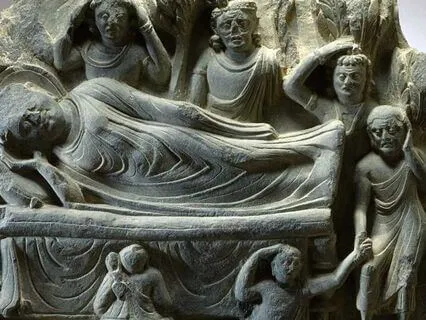
The Buddha arranged his own death.
You might say he committed suicide.
And I'll tell you what happened.
He was,
Um,
He was old and cranky and sick,
And he was fed up at a certain point.
And he was on the road with his attendant,
Ananda,
And a few other monks.
And Ananda found a place for him to stay,
The house of Kunda,
One of the Buddha's disciples.
Kunda was a blacksmith,
I believe.
And he had made a dinner for the visiting monks of pulled pork.
It was the Buddha's favorite dish.
Well,
Another thing which people are often surprised about is that the Buddha was a carnivore.
He was.
He,
Neither he nor most Buddhists are not,
Are not vegetarian.
Anyway,
He had prepared for the Buddha his favorite dish.
He was very excited about presenting it to him.
So the Buddha looked at it and he smelled it and he said,
Okay,
No one else can touch this.
And he took a portion for himself in his plate and he ate it.
And he told Kunda to take the rest of it and dig a hole and bury it in the hole,
Which he did.
And I'm sure everyone was sort of going,
Well,
What's this all about?
A few hours later,
The Buddha lies down,
He's getting sicker and sicker.
He's dying.
The food was poisoned.
Not deliberately,
Apparently.
It's a little vague in the scripture.
The story is not like every detail spelled out.
But,
You know,
Presumably Kunda didn't do this intentionally,
But the food,
There was food poisoning.
The Buddha died.
So,
But the process of death took a little longer.
So they lay him out and he tells his monks,
He says,
I'm going,
I'm off.
And they all start crying.
And he says,
Stop complaining.
What's wrong with you?
You know that everything passes,
Everything changes.
He got mad at them.
And so eventually,
You know,
He took his last breath.
And just before he took his last breath,
These are the words he said,
Vayadama sankhara,
Apamadena sampadeta.
Okay,
We're going to look at what that means.
Well,
As I've already translated it,
Not my translation,
Actually,
But the translation of Stephen Batchelor,
A friend of mine,
A very current friend,
This was his translation about five years ago.
Now,
I want to go back to one of the very first translations by Morris,
T.
W.
Rhys-Davids,
That's it,
Back in the early 19th,
Perhaps the late 18th century,
Even.
And he put it this way,
All conditioned things,
Sorry,
Wrong one,
Decay is inherent in all components things.
Okay,
Decay is inherent in all component things.
He gets that from these two words,
Vayadama sankhara.
Okay,
So he's stretching it out a bit there.
And the second phrase,
Strive,
Where are we,
Work out your salvation with diligence,
Work out your salvation with diligence.
Okay,
Apamadena sampadeta.
So Rhys-Davids was coming from a very Christian background,
Not that he was personally Christian,
But the language that he was writing in,
The language of scholarship and these things,
Especially when it came to spiritual matters,
It had a certain flavor to it.
And it was a little bit sort of pompous.
And at the same time,
He wanted to be linguistically accurate.
So he was really trying to get,
And he was interpreting the meaning here,
And he was trying to make sure that everybody understood very carefully.
So the key word in this whole thing is apamada.
Okay,
Apamada means carelessness,
Sorry,
Pamada means carelessness,
And apamada is the opposite of carelessness.
And the idea is that this carelessness is built right into us.
That's the way we are.
You might call it the side effect of automaticity.
Okay,
That we just do things because I can do it now,
I know how to do it,
I'm just going to do it,
I don't have to pay attention anymore.
All right.
So that for the Buddha is a given that we are naturally careless,
That we can overcome it,
We can do something about it,
But it takes effort.
And that's the second part of it,
Which is work out your salvation with diligence,
Or as Stephen Batchelor puts it,
Tread the path with care.
So it's this word care,
Diligence,
Care,
It's also been translated as heedfulness,
Vigilance.
Okay,
But this new translation,
The word care really gets to the point,
Because the meaning of apamada is to not be careless,
To take care.
It's a simple word,
It's a simple concept,
It's got the range of meaning that we want,
It doesn't have to be pretentious,
It's very straightforward.
And you'll notice that I use the word all the time,
Probably every single mindfulness live I've used at least once.
Care is not just a casual word,
Which I'm putting out there,
It's a very central pillar of the Buddha's teachings.
This is how,
Well,
You've got on the one hand,
All things fall apart.
And he's not joking,
All things,
Everything,
No exception,
Everything falls apart.
It's sort of scary.
It almost triggers a sense of desperation,
But then he gives you a solution,
There is a solution,
Care,
Take care,
Be caring,
Care for yourself,
Care for others,
Live consciously,
Care enough about life to live it consciously.
That's my interpretation.
Now,
I've got other interpretations here.
There's one here,
Conditions fall apart,
Persist with diligence.
That's bhikkhu and that's maybe about 20 years ago,
Where early Buddhism was coming over,
Sorry,
This second wave of Buddhism was was just beginning in the West.
And he's bringing it up to date a little bit,
And he's using psychological terms rather than religious language.
So you can see that no matter where you come from,
There is no definitive,
Ultimate,
Perfect translation.
There are only different interpretations based on who you are,
When you're talking,
Who you're talking to,
What language you're using.
So all of these introduce certain limits into the translation of these very simple four words,
Okay?
Vaya dharma sankhara,
Apamadhena sampadhetah.
You know,
I'll put it in the chat.
You can have a look at it.
I could go on about this.
This is one of my favourite topics.
We will talk more about it this week,
But I want to talk a little more now before we finish.
It's the word.
Amada is the opposite of care,
And yet it's the default.
Care is not the default.
Our ability to care is there,
But it doesn't happen automatically.
It only happens consciously,
And that's the purpose of being mindful.
I read another article yesterday about mindfulness,
Or I read the beginning of it,
And then I got a little bit impatient,
Where somebody's talking about the pleasure and the beauty of living in the moment,
And that's the whole purpose of mindfulness,
Is just to explore the beauty.
And no,
He's not getting it.
He's mistaken,
Because it's not just about beauty.
It's about everything.
Ugliness too.
It's about understanding life.
So being in the moment is nice,
And I know what he's talking about.
It feels great when you're there,
But that's not enough.
You have to use that.
You take it,
And you focus it on,
Guess what?
Care.
Heedfulness.
Diligence.
All these different words that they've used,
But bring your attention to it,
And make it your focus.
This is why we're here.
Not to think,
Not to come up with fancy words and ideas and perfect translations.
Nothing is perfect,
But to act in that way,
To act with care,
To behave,
To act as if we care.
And if we don't feel that we do,
Then just pretend.
Fake it until you make it.
There's some truth in that.
It seems obscure at first,
When we start trying to do this,
Watching our breath,
And did I really watch it?
It seems to me I was distracted more than I was paying attention.
But instead of getting caught up in those arguments and worries and concerns,
You just keep going.
You just keep trying.
Don't give up.
Sit each day for a few minutes,
For as long as you want,
And then bring the fruits of that sitting into the rest of your day.
Take a breath when you need it.
Whenever you notice that you're being distracted and acting automatically,
Take a deeper breath.
If you can,
Take three breaths.
Bring yourself back.
Remind yourself to care.
It's that simple.
Nice,
Simple word.
Care.
The antidote to carelessness.
Carelessness which is built right in,
Which we can expect of ourselves,
Along with denial,
When things don't go the way we want.
We do that.
We're human.
But when we follow that,
We get stuck.
When we face that,
Then we open the doors.
So,
Things fall apart.
Tread the path with care.
Okay,
Make yourselves comfortable.
Take a nice breath.
Feel that breath moving through you.
It's a body of air.
It's a movement.
It's a process.
There are many words you can use for it.
But you don't really need any words to experience it,
Because it's happening right here,
And right now,
And you're doing it.
You are breathing.
And you care enough to look,
To pay attention.
And caring does not mean thinking rapidly,
Or compulsively,
Or any of that.
You don't have to be running around,
Although there's a time and a place for that.
Care means paying attention.
Care about what's going on.
Care that you're here.
And care that you feel the way you do,
Whether you feel good or bad.
Care because your body's speaking to you,
Passing on messages.
You feel crappy?
There's a reason.
You feel fantastic?
There's a reason.
Connect the dots.
Care enough to see how life works,
To see how you work.
Connect the dots between what you do now,
And what you feel after.
Pay attention.
That's all that caring means.
Pay attention,
And then act with compassion.
And if you can do that,
Clarity will follow.
And you will continue to grow.
You'll get unstuck,
In whichever ways you are stuck,
By paying attention.
Taking the time to face reality.
And the reality is that things fall apart,
There are no exceptions.
This applies even to your own body,
Your own mind.
Everything dissolves,
Because everything has come into being,
Independence upon everything else.
You can't exist without the air around you,
The food that you eat,
The conversation that you have,
The emotional support,
The challenges of your life.
You don't exist in isolation,
Nothing does.
So we see the connection,
We experience the fullness of life,
Knowing that even as it's full,
It's falling apart.
And it's also being replaced,
Reborn,
But not really reborn.
It's always slightly different,
Things are always shifting.
Nothing is reliable.
When you face that truth,
You also face the craving for reliability,
The desire for stability,
For insurance,
Guarantees,
Absolute safety.
You see the craving,
You're motivated by the craving,
And yet you know,
You know it's true that things fall apart.
Always,
Inevitably,
The solar system will fall apart,
The galaxy,
The universe.
It's just a matter of time.
Nothing else required,
Just the time for all of this to unfold.
And of course,
The other side of it is that even though things fall apart,
Things also come together.
Equally uncontrollable.
Maybe a little reassuring.
But what we are,
What we know,
What we have,
This is what we face.
This is what we're mindful of.
This is where we grow.
There is no other path,
But this is where we are.
Each of us on our own path.
Our own patterns,
Our own attention.
So you stay with the breath,
Stay with your body.
Ask yourself now,
How you feel.
Know how you feel.
You may not feel very comfortable thinking about all this change and uncertainty.
That would be natural.
Don't resist.
Know how you feel without trying to fix it.
Watch out for your expectations.
And now,
Taking three more breaths,
Open your eyes.