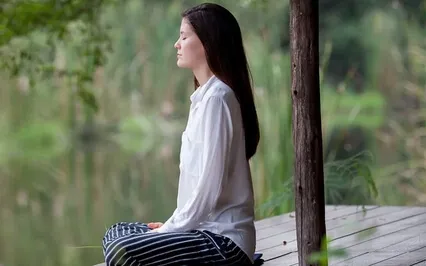
So welcome to mindfulness live.
This week we're talking about meditation.
Somebody else.
And meditation is something that you might take for granted.
And because I was thinking today,
My gosh,
Over the last two years,
We've covered so many topics and what would be a really interesting topic.
And I just kept thinking basics,
Back to basics,
Back to basics.
So today,
And this week,
We'll be discussing meditation,
What it is,
What it isn't,
What people expect of it,
How we know if it's working or not working.
There's a lot to actually think about,
Especially,
It's always good to rethink about the things that we take for granted.
Okay,
So make yourselves comfortable.
Take a nice breath.
And let go.
And you follow the breath into your body.
And you allow your attention to sit inside,
Watching the breath come and go.
And your mood generally should be relaxed,
Or should be getting that way.
Because your attention is inside,
The world seems just a little bit more distant than usual.
And you're reminding yourself of what it's like to be in your head,
In your body,
In your heart,
Inside you.
And your purpose is simply to become familiar with all this,
From this point of view.
So you watch the breath coming and going.
And you feel it.
The movement of your chest,
Your throat,
Your muscles.
You can also sort of feel the movement of mind,
Thoughts coming and going,
Feelings,
Moods,
Changing.
And you're just watching,
Not doing,
Not judging,
Not comparing,
Not worrying about whether you're getting it right or wrong.
You're just taking the time to see how you feel in your body and your mind.
And the breath comes and goes.
And as you let your mind simply be,
You're meditating.
Aware of your own thoughts and feelings,
And mood.
Aware of your own posture,
And the efforts in sitting upright.
And the efforts of paying attention.
And the awareness that everything around you and within you is changing,
Moment to moment.
Never the same twice.
Now with special attention to your body,
To your sensations.
You scan your body from the top of your head,
Down to the tip of your toes.
Starting right at the crown of your head.
Feeling a wave of relaxation.
You pass downwards through your face,
In the back of your head,
Through your jaw,
Your neck,
Into your shoulders,
Into your arms,
Elbows,
Forearms,
Wrists,
Thumbs.
Hands.
Fingers.
You are directly and intimately connected to every part of your body.
And your attention moves effortlessly.
Back up through the arms.
Through the shoulders.
And down your back into your shoulder blades.
Down your front,
Into your chest.
Feeling the chest,
Filling and emptying with the breath.
Aware of the rhythm of breath.
And the depth of your breath.
And noticing that every breath is unique.
Every moment.
Bringing your attention down into your stomach,
Your lower back,
Your abdomen,
Your hips,
And thighs,
Into your knees,
Lower leg,
Ankle,
Feet.
And toes.
And you can wiggle your toes.
Just move them.
Just to recall the instant connection between mind and body.
And to notice that by paying attention to your body,
You focus your mind.
The breath comes and goes.
And you take three more breaths,
And open your eyes.
One of the functions of the human mind is to take things for granted.
It's a sort of automaticity,
Where we sort of have settled something,
You know,
I now have a chop and onion.
And now I don't have to think about it.
I've been doing it for so long,
It just happens by itself.
I take it for granted.
Which when it comes to onions is okay.
But when it comes to meditation,
Well,
You know,
I was thinking about it this morning,
What should we talk about this week?
And something basic.
And then I thought of meditation,
I thought,
No,
There's not enough to say about it.
But that's because I was taking it for granted,
And as soon as I started thinking about it,
Then it became a vast subject.
Okay,
So we better get to it.
So first of all,
The definition.
So it comes from the Latin verb meditare,
And it means to think,
Contemplate,
Devise,
Or ponder.
Okay,
So just to turn things over in your mind.
The emphasis here is that you're doing the turning,
That it's something deliberate.
It's not just something that happens by itself.
When you walk down the street,
Or when you're driving your car,
That's a good example.
You're extremely attentive to the world around you,
But you're not necessarily focused on it.
It's interesting.
There's a lot of automaticity going on.
But if somebody suddenly steps in front of your car,
The chances are you'll stop.
You'll certainly try to stop.
Your reactions will be instant.
So that is automaticity.
That's the sort that we can rely on.
With meditation,
We're trying to make sure that there is no automaticity,
That everything is done deliberately.
And so we have this definition to think,
Contemplate,
Devise.
To devise means to actually create.
So sometimes we're trying to create a certain state of mind.
And you'll notice that none of these talk about sitting still or being silent.
And in fact,
That idea of silent cross-legged meditation,
Which we associate with Asian religions and Asian spiritual paths,
Is not a particular feature of any of those.
In Buddhism,
The word for practice,
The most important practice of all,
Is Bhavana,
Which means cultivation.
We're cultivating our mind,
But not only our minds,
We're cultivating our lives.
There's a moral perspective to it,
There's a mental,
Emotional,
Physical perspective.
And Bhavana is the process of engaging with our life in a very conscious way.
So when we talk about meditation,
Nowadays,
Most people immediately think of sitting in silence in a quiet room.
And that is a relatively recent invention.
That's what meditation means.
Now,
The Buddha did sit in cross-legged and a lot of people in Asia sit cross-legged,
Mostly because they didn't have chairs or didn't bother with chairs.
So that was the way to sit.
And sometimes you sit for a long time and you just ponder your life.
You might be sitting in an armchair,
You might not be sitting,
You might be walking.
The point is that meditation is something you do with your mind,
Not your body.
So that posture is not necessary.
It can be an advantage.
There are great advantages to it.
Okay,
So that's the basic idea of meditation,
Is you're just exploring your mind.
When we talk about meditation nowadays,
When you read about it in the press,
On meditation websites,
They mostly talk about calming the mind and reducing stress.
And meditation is good for that.
But it's only,
That's a very,
Very small part of what it can do.
As you know,
What we're trying to do here is to grow ourselves.
In other words,
Maintain that process that we started as children in becoming more mature,
More aware,
More capable with our own faculties,
Our own body and minds.
And that's a bigger project than simply sitting and becoming relaxed.
But for many people,
That is what it means.
And it is certainly one of the functions.
And that is certainly how we begin our meditation sessions,
By just slowing down,
Creating mental space.
And then we start the process of looking inside.
So that is not,
Strictly speaking,
That's not simply meditation,
That's meditation with Bhavana,
This cultivation practice.
Because we're not just looking,
It's not just passive,
But also we have goals.
Although I know I'm often telling you that meditation is not really goal oriented.
Nevertheless,
We have an ulterior motive.
It's not exactly a contradiction,
It's a bit of a paradox.
Because in order for mindfulness to work,
We need to have no agenda other than to be present and see what's going on.
And yet we have to have a reason to sit down and do this.
You have to have a reason to log on to Zoom at midday and connect with mindfulness slide.
You have to have a motive.
And the motive is to look after your mind,
To try and be peaceful.
But ultimately,
This cultivation,
It's,
I want to grow.
I don't just want to,
I don't want my habits taking over.
I don't want to become a grumpy old man.
I want to become peaceful and helpful.
I want to be a good listener.
I want to be kind.
I want to care about people.
All these motives feed into our reason for meditating.
But then when we sit down to meditate,
Especially on mindfulness,
Then the idea is to let go of all that expectation,
All those particular hopes and try and be settled.
So do we actually accomplish that?
Am I really settled?
Am I really letting go of all that?
It's really hard to say when you're doing it.
Am I?
Yeah,
Sometimes.
Sometimes not.
I don't know.
It seems to be a mood thing.
So the number one quality which we need is acceptance.
Whatever's going on is fine.
The number one obstacle is judging yourself.
I'm no good at this.
And I hear that a lot from beginning meditators.
I'm sorry,
I'm no good at this.
I can't.
And the reason for that is because their expectations get in the way.
When we sit down to meditate,
We expect to become calm and peaceful.
And we want to focus the mind and everyone will tell you to focus the mind.
But the mind does not like being focused.
It resists a lot.
And we take it personally.
That's the problem.
When you take that personally and say,
I'm no good,
I'm distracted,
Then you're missing one of the main points about meditation,
Which is it's not about you.
It's about the mind.
It's about the way the mind works,
The way the body works,
About the way things work.
And again in Buddhism,
The container for all this practice of meditation and everything else and cultivation is a sense that whatever is,
Is the way that things actually should be.
It's called dharma.
And dharma means law.
And we're not talking about a law which is created by somebody else or by God or by nature and tradition.
We're talking about the laws of nature,
The laws of the universe,
The way things work,
Not just physics,
But psychology too.
The way the brain works,
The way that we work.
And our job is in this process is to be aware of that,
Just to accept that,
Well,
Sometimes I get grumpy,
Sometimes I get angry,
Sometimes I get depressed.
And for many sorts of meditation,
This is considered a defeat.
Something's wrong.
I'm not relaxed.
I'm stressed.
I'm tense.
For us,
Practicing mindfulness,
This is not a defeat at all.
It's not a problem.
In fact,
It's exactly what we're looking for.
I need to know from day to day and from hour to hour how I'm feeling,
How I'm doing,
What sort of potential I have right now,
Whether this is a good moment to go and have a difficult conversation,
Or should I maybe postpone until tomorrow.
So the mindfulness that we practice is a constant re-evaluation of how the mind is,
How you are,
How you respond to life around you,
And especially to pay attention to how much judgment you're bringing into that,
How much expectation comes into it,
And to let go of that,
To allow your mind to become free.
And freedom does not mean that,
How can I put it,
It's not necessarily a feeling of ecstasy or bliss.
Freedom can be quite troubling.
Sometimes we want to be attached to things.
Sometimes we want to be grounded in thought.
So this sort of meditation,
Mindfulness meditation,
Is probably the trickiest of all.
Now there are basically,
Moving on,
There are basically two sorts of meditation,
And those are concentrated and contemplative.
So mindfulness is a sort of contemplative meditation,
Because when we're doing it,
We're keeping the mind open.
We're not focusing it on one thing.
We're maintaining the focus in as much as we're staying in the present moment.
But we allow everything from the present moment to come in.
Whereas when you're practicing concentration meditation,
When you're simply trying to strengthen the mind,
Strengthen your attention,
Then you focus on one object,
And it may be a statue,
It can be a visualization,
It could be a mantra,
It can be the breath.
The breath is very convenient.
And you focus not just on the movements of the breath,
You focus on the single point in your chest,
On your nostril.
And in this way,
The benefits of concentrated meditation are of course that you get focus,
But they also produce a sense of peace,
Which is a great introduction to mindfulness meditation.
So we practice breath awareness at the beginning for a couple of minutes,
And then we move on to the mindfulness part of it.
Mindfulness is where we actually grow.
The focused,
Concentrated meditation is simply a matter of strength,
Mental strength.
It will reinforce that muscle.
The more you do it,
The stronger it gets.
And the less you do it afterwards,
No matter how strong it is,
How regularly you practice,
When you stop,
That attention span becomes weak again,
And then we forget.
And then we find ourselves falling into old habits.
That's why we need to practice regularly and keep it up.
And one of the obstacles to that is the idea that meditation is,
The purpose of meditation is to reach a certain level.
For example,
Where there is no more suffering,
Where everything is blissful,
Where you're always kind and peaceful.
I think these are fantasies.
I know not everyone agrees.
My experience of trying to do those sorts of meditation,
And living in a community with people who try those sorts of meditation,
Is that there's a lot of wishful thinking,
And there's a lot of unclarity.
The way to clarity is not to try and achieve your meditation.
It's to try and experience it.
So whatever happens is what's happening.
And the Dharma,
The way things are,
The law of things,
Is operating all the time.
It's operating in your mind and your body right now,
And your job is simply to be aware of it and to accept it,
Instead of resisting.
So that's all for today,
For the talk.
We'll talk more about this on Wednesday.
In the meantime,
Make yourselves comfortable.
Take a nice breath.
And let go.
And just focus on your nostrils.
When your mind wanders,
You simply bring it back,
Back to the tip of your nose.
And now you expand your attention.
You bring your attention all the way into the body,
Feeling your chest moving in and out.
Feeling the energy flow into your body,
The energy of each new breath.
Feeling the air leave your body.
And noticing the muscular movements that make it possible.
Notice that your body is working to breathe.
Although it allows you to take it for granted,
The breath requires effort.
And it requires some sort of attention,
Even though it's subconscious,
Autonomic.
Some parts of your mind is managing breath,
Just as it manages your heartbeat,
Your metabolism,
All the processes that keep you alive.
So you're aware of body movement,
Coordination.
You're aware of sensation.
Perhaps you can feel in your body tension,
Stress or relaxation.
Or perhaps a little tension here and a little relaxation there.
Knowing your body,
You also know your mind.
Starting with your feeling.
This moment,
How does it feel?
Is it peaceful?
Is it alarming?
Is it thoughtful?
I'm experiencing any particular emotion.
Is this residual emotion left over from the morning?
Is there anticipation of the afternoon?
How do you feel right now?
What's your mood?
And thoughts.
Thoughts can go.
Sometimes we want to stop them.
They're too much,
Too complicated,
Too quick.
But thoughts come and go.
It's what they do.
It's how the mind works.
So you allow them to come and go.
You don't struggle,
Don't fight,
Don't suppress.
But also,
You don't follow the thoughts.
You keep coming back to the breath.
Back into your body.
Back to the present moment.
Paying attention to your mood.
How you feel.
And then,
Once again,
Very carefully,
Just peeking at those thoughts,
Just to know what's going on.
But without following them,
Without letting them carry you on.
And so quickly,
You turn to the breath,
To the body.
You start a little bit.
Now,
Taking three more breaths.
Open your eyes.