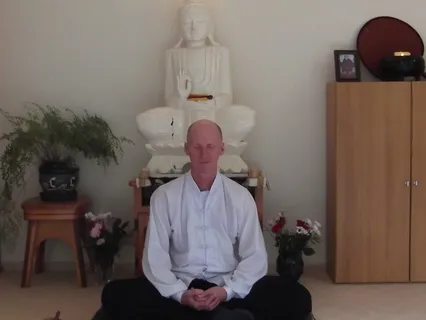
During today's talk we're going to discuss the role of our body in mindfulness meditation through the eyes of MIDL.
This will help us understand how to fully use the function of our body to develop our mindfulness meditation practice and also what it means to our daily life.
Firstly,
When discussing anything through the eyes of meditation we are never talking about what a thing is,
But rather we're talking about its function and how it's experienced.
What a thing is functions on the conceptual level.
We need to understand this to understand our meditation practice.
Let's look at the conceptual way in which we relate to our body.
So I look at my body and I think okay my body is tall or it is short,
It's fat,
It's thin,
Yeah,
It's black,
It's white.
Maybe my body,
I see my body as being attractive or unattractive,
Healthy,
Unhealthy,
Well-dressed,
And in my case not well-dressed.
These are the usual ways that we relate to our body.
All of these are just concepts.
If we approach our body in this way and read body as these concepts when understanding meditation practice,
Our meditation practice will become all about me,
It will become shallow,
It won't develop.
But let's look at the meaning of body through the eyes of meditation,
So that is its function and its experience.
How do you experience your body?
We experience our body as sensations.
This is how our body is actually experienced.
If you look what it feels like just to sit here now,
Can feel some warmth or coolness on my skin,
Yeah,
It's a warmth,
Coolness,
Some tightness,
Yeah,
Some tightness in the body.
Also feeling pressure,
I can feel my hands touching one another,
The pressure of my arms and the legs,
The touch of my bottom on the floor,
Touch of the feet.
If I'm relaxed I can feel heaviness throughout my body.
So our body is actually experienced as a series of elemental qualities or sensations.
We experience our body as a range of hard to soft,
Warm to cool,
Wet to dry,
Heaviness,
Lightness,
Movement,
Vibration,
Tension.
When we place awareness within our body,
This is how our body is experienced.
So when doing the MIDL training and I say become aware of your body,
Immerse your awareness within your body,
Remember the touch of your body.
What I'm referring to is this elemental quality,
This elemental quality of your body.
To understand this elemental quality better,
We then have to understand the function.
In mindfulness meditation,
Remember we're experiencing our body,
So we know how our body is experienced at this time.
So let's look at the true function of our body.
What's our body's function?
Our body really has three functions.
This is its purpose.
To propagate the species,
To breed,
To move around through the world,
And as a sense organ.
The first two functions really aren't that important to our meditation practice.
We're interested in the third function,
The function of our body as a sense organ.
One of our mind's function is to interpret what are called the five senses.
So there's five doorways through which the world comes into us.
There is the I doorway,
The first sense,
And the I doorway is sensitive to what?
To light.
So when light strikes the I doorway,
There is a contact there.
If light strikes your ear,
Can you see?
No,
That's right.
The ear doorway is sensitive to sound,
The nose doorway is sensitive to smell,
Tongue to,
Taste,
Yes,
And our body doorway is sensitive to,
To touch.
Our body is a sense organ.
Our body's task is to listen to the world through touch.
The world is coming in and touching you right now.
It's coming in and touching you with light,
With sound,
With smell,
With taste,
And it's also touching your body.
The air is touching you,
The chair,
The floor,
And everything else.
Whenever anything touches our body,
Our body mirrors this touch by producing sensations.
These are these elemental qualities,
Hardness,
Dry hot cold heavy light movement vibration tension all of them are reflections of the world touching you so our mind sits behind these five senses and looks out of the world the world comes in and hits our senses when it contacts our senses then our mind has the ability to interpret what is out there if I reach for Jason's hand right now and we shake hands there'll be contact between our hands now I cannot actually feel Jason yeah this is how close how intimate we can actually be with anyone or anything I can't feel him what I actually feel is the changing sensations within my body from that contact I feel warmth I feel pressure maybe softness or hardness but I can't actually feel him so our bodies function is a sense organ every flex the world through touch and here's where it starts to get interesting our mind also touches our body I like to think of my mind as having tentacles that go into my body like an octopus yeah in these tentacles touch our body our mind is a sixth sense our mind senses the five senses but it also senses thoughts memories if your mind is chewing on a problem or a painful memory the juice coming out of that thought that memory reflects through the touch of your mind in your body literally whatever your mind is chewing on whatever your mind is involved in whatever your state of mind is because your body's function is to reflect touch and since your mind is touching your body your body will reflect the touch of your mind so we have a second layer of sensations that arise within our body we have the sensations that arise from the touch of the world and then we have the sensations that arise from the touch of the mind and these sensations that arise in our body from the touch of the mind we call emotions and feelings emotions are just sensations arising within our body to reflect the touch of our mind to reflect the state of our mind so our bodies function is to be a mirror to or reflect touch and we have the elemental qualities that arise in our body due to the touch of our mind so if my mind is feeling aversive and angry then the elemental quality of anger will arise within my body anxious elemental quality arises depressed frustrated lonely elemental quality arises we see this as an elemental change literally the sensations in your body will change will alter their shape to reflect your state of mind so when using our body as a meditation object our first task is to become very intimate with the different sensations within our body to open up our sensitivity to those sensations as much as we can if we get used to the landscape in our body this is what my body feels like when the world touches me then we also can start to separate are this element of quality these sensations in my body I'm not from the world touching me but they're coming and produced by the touch of my mind this means by becoming sensitive to the elemental qualities as the world touches you arising in your body you'll start to become very sensitive to your state of mind in quality of heart so our body pays a bigger function in M.
I.
D.
L.
Practice than our mind does you could think that it would be recommended that we observe the mind because the five senses come into it but we don't the Buddha in meditation practice in the Sattipatthana Sutta uses our body as a foundation why is this because the elemental qualities in your body always tell the truth they are direct reflection a mirror does not lie so our body directly reflects the state of our mind it tells the truth so our task is meditators particularly in M.
I.
D.
L.
Practice in mindfulness in daily life is to learn to read the patterns of sensations within our body like learning another language or Braille learning to feel these different sensations and read their meaning through reading the sensations the elemental qualities that appear within our body we understand our mind we understand when it's longing for something when it's resisting something and when it's a quantum s and balanced this thing gives us a doorway to retrain the mind the elemental quality in our body always tells the truth so why don't we use the mind our mind is basing interpretation of these sensations through misinformation it interprets our senses for our past experience now if your past experience has been flawed if it's been corrupted if you've had a trauma in your life if you have had pain in your life then when your mind uses the past because what else can it identify now through when it uses the past to identify now to identify these five senses and that information contains pain then the way it interprets now will be flawed and the narrative that will supply within your head will also be flawed and this creates the world we normally live in but it's a flawed world it's a reactionary world it's not the world of reality it's not the world of truth this is why we don't believe what the mind produces but we believe the elemental qualities within the body now here comes the interesting part just to wind this up for you our body's task is to reflect the world for sensations for the sensations of touch and our mind looks out for our body yeah and also our other four senses through sights sounds smell taste and it puts them all together it assembles them to create the world that we see out there so our minds looking out for us five senses to interpret the world to protect us literally and one of the senses that looks through is the elemental quality of our body but there lies a problem our body also reflects the touch of our mind so if your mind is chewing on something if it's worrying about something if it's concerned about something well then of course its touch on your body will make sensations probably unpleasant sensations arise within it now your mind is still looking for your body is one of the senses to interpret the world around you but now the elemental quality the sensations in your body have been polluted by they're being corrupted by the touch of your mind literally the sensations the emotional qualities coming up within your body yeah have corrupted the touch of the world around you and so your mind is putting all these five senses together it's looking out for your body at the world but it's actually looking at a flawed reading the reading has been flawed by the mind itself your mind sees its own reflection within your body and it reacts as if that reflection is out there in the world around you so if its reflection is anger it looks in the world for something that has caused anger because it thinks that that reflection is the world around it if the reflection is fear it looks out of the world for fear frustration anxiety loneliness sadness so literally it's looking through this reflection and because it thinks that it's a reflection of the world it's looking for the reason for that emotional quality in your body in the world around you but what it ceases to understand is that it is reacting to its own reflection in MIDL we use seated meditation to cultivate a sense of investigation mindfulness and concentration so we can literally observe awareness observe the mind and its knowing quality once the momentum of seated meditation has been built we then transfer the meditation practice into our daily life throughout the day we observe our heart and mind how do we do this in MIDL by increasing our sensitivity to the elemental quality of the world touching us and by observing the elemental change within our body as the mind touches it this allows us to observe when the landscape of our body changes and to apply the MIDL softening into skill to relax soften deeply into our minds relationship to what is being experienced within the five senses or should I say within the six senses it's through observing this change within our body softening into our dislike of it or our like of it into our relationship that allows the mind to develop equanimity develop a mature mind mature heart within daily life have a wonderful day take care of yourselves goodbye