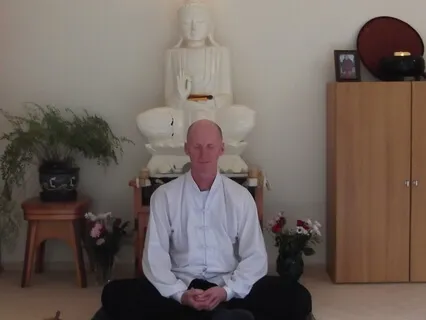
During this talk,
I'd like to discuss how the three mental factors of investigation,
Mindfulness and concentration function with awareness in MIDL meditation practice.
In terms of MIDL,
We are cultivating these three mental factors with the intention of creating the conditions for wisdom into the nature of reality to arise.
Before we look at these mental factors and how they function,
I think it is first important to understand what the Buddha meant by meditation.
A Pali word the Buddha used for meditation is Bhavana.
Bhavana is a term that means developing,
Cultivating.
Bhavana is not about sitting still doing nothing.
It is an intelligent activity during which we intentionally cultivate the conditions for certain mental factors to grow and develop.
The process of creating the correct conditions in our MIDL meditation practice can be understood by observing the cultivation of a tree to produce fruit.
First we need a healthy seed.
We then condition the soil,
Creating a good foundation for the seed to grow.
Next we plant our seed within the soil and add water so that it can start to sprout.
Our task from this time on is not to make the seed grow,
But rather to apply the right amount of water,
Right amount of food,
Light,
Protect the young tree as it grows from wind,
From bugs,
From animals.
If the conditions are poor,
The tree will become stunted,
Imbalanced.
It won't produce fruit.
If the conditions are balanced,
The tree will be strong,
And in maturity it will produce fruit.
In understanding this,
The healthy seed is our view.
If our view on life is based on separation,
And we don't see the consequences of our actions,
Then we start with an unhealthy seed,
And our meditation practice will not develop.
The conditioned soil in which the seed grows is awareness,
Immersed within the sensei quality of our body.
The balance of water,
Food,
And light is the balance of investigation,
Mindfulness,
And concentration.
Investigation waters and quenches the thirst of the heart,
And gives rise to understanding.
Mindfulness feeds the practice.
Without mindfulness our mind will look for food elsewhere and chew on distraction.
Concentration increases clarity and provides a light for wisdom to grow.
If we have too much water,
Too much food,
Or too much light,
Our meditation will not grow in a healthy way.
It will not produce the fruit of wisdom.
If there is balance between investigation,
Mindfulness,
And concentration,
Then on maturity wisdom will arise,
And when bitten into will have the sweet taste of freedom.
Protection within our meditation practice from wind,
From bugs,
From animals,
Comes from the interaction between mindfulness and softening.
Mental agitation is like the wind,
Blowing us this way and that.
Softening into the agitation protects us.
Negative thoughts are like bugs biting and sucking the life out of us.
Softening the frontal lobes of the brain protects us.
Attraction and aversion to pleasant and unpleasant feeling are like wild animals tearing us apart,
Mentally and emotionally.
Softening into our bodily sensations protects us.
Understanding this analogy,
Let's look into investigation,
Mindfulness,
And concentration in terms of MIDL meditation practice.
The Pali word that the Buddha used for investigation is dharmavichaya.
Dharmavichaya means investigating reality.
MIDL is a wisdom practice.
It is wisdom that develops the momentum of this practice.
It is wisdom that changes our relationship to what we are experiencing.
It changes the way our mind perceives the world.
This is a path of self-inquiry,
A way of looking inward,
Of getting to understand ourselves in terms of reality by applying the mental factor of investigation.
Investigation is intentional silent watching,
A silent observing.
A silent experiencing of reality through the touch of awareness.
This touch of awareness is similar to placing your hand through a hole in a wall and feeling what is there with your fingers to develop understanding about it.
During MIDL training,
We learn how to mentally touch each experience,
Feeling it with our mind by rubbing awareness against it.
Through the continued experiencing of the same thing again and again and again,
With the desire to understand,
A pattern starts to emerge and the conditions for wisdom to arise are developed.
Continued investigation of experience causes the second mental factor of mindfulness to cultivate.
The Pali word for mindfulness is Sati,
Which literally means memory or to remember.
It is a particular type of remembering,
Not remembering the past,
But remembering the present.
During our meditation practice,
We will continuously forget the present,
Forget our meditation object,
Forget now.
This is what the mind does.
Noticing this forgetting is a function of mindfulness.
Mindfulness is a very important mental factor.
Actually,
Without mindfulness it would not be possible to meditate.
We literally would become lost in the fantasy world of thinking and never come back again.
Mindfulness is also the morality factor,
Allows us to self-reflect,
To observe and navigate the reactions of heart and mind,
Developing a sensitivity to what combines and what separates within our life.
If we break down the word mindfulness,
We can start to get a picture of what is meant in terms of our meditation practice.
First let's look at mind in mindfulness.
Mind in this context means to look after,
To care for,
To protect.
It can also be used as to keep in mind,
To remember.
When we add full to the end of mind,
We can use it in a sentence as be mindful of the traffic,
Keep the traffic in mind when you cross the road.
If we forget the traffic as we cross the road,
We are in danger of being hit.
If we forget our present experience,
We are in danger of reacting in a way that leads to suffering.
In this way mindfulness protects us.
Mindfulness protects us from creating future pain.
When nes is added to the end of a word,
It means to be in a state of,
To dwell within.
It makes it active,
Continuous.
For example,
If we are continuously happy,
We would then be experiencing happiness,
We would live within it.
So nes in mindfulness means a continuous state of being mindful,
A dwelling place,
Where we live.
To help you understand this,
Sit down,
Place one hand in the other,
Close your eyes,
And see how long you can sit there and remember the touch of your hands before your mind wanders off.
Every time your mind wanders off to a thought,
Wanders off to anything without you noticing,
In that wandering you have literally forgotten now.
You have forgotten you are just sitting here,
You have forgotten your meditation object.
It is the task of mindfulness to know where the center of our awareness sits,
To notice any wanderings of attention,
To notice every time we forget our present experience.
Actually,
In the content of MIDL meditation,
Mindfulness needs distraction to cultivate,
Which is why this practice can be transferred into deadly life.
Once enough fixed concentration has been developed in MIDL practice,
We need to give up our attachment to our meditation object such as breathing,
And intentionally allow our mind to wander.
Do not be afraid of letting go of control of your mind.
It is only when we release our grip on it and allow it to wander where it wants to,
That we can start to observe the four foundations of mindfulness to develop wisdom.
One of the skills being developed in the 52 MIDL trainings is the ability to observe our mind wander to stay on the back of the wild horse.
If we use distraction in the right way,
That is,
To try to observe when we are distracted,
The mindfulness factor will become very,
Very strong,
And our ability to notice when we are distracted will increase.
Literally,
We can then notice with strong mindfulness the moment our attention shifts for our meditation object,
And also any shifts of our attention in daily life.
With continuous mindfulness,
Concentration,
The third mental factor will then cultivate.
The Pali word for concentration is Samadhi,
Which literally means to unify,
To bring together.
Concentration is the unification of Vinyana,
Awareness.
In MIDL,
Concentration has two main purposes,
To suppress distraction and to clarify awareness.
Initially,
We use concentration of awareness to suppress five hindrances to meditation.
The five hindrances are the desire to experience,
The desire to not experience so attraction and aversion,
Mental restlessness,
Mental sluggishness,
And doubt,
The flickering mind.
This is done by developing one-pointedness of attention within an experience of bodily sensation such as breathing.
By staying with the experience of sitting still and keeping the movement of the breath continuously in mind,
The five hindrances to meditation within our mind will settle down.
When we first learn to meditate,
These five hindrances are common visitors and often discourage people from continuing to meditate,
Which is sad because with proper guidance,
The hindrances are not a hindrance at all.
In this process of suppression of the five hindrances,
We have to be careful how much concentrate we develop in MIDL practice.
Since concentration has the ability to suppress our six senses,
If we become too one-pointed in attention,
We will switch from practicing pure mindfulness meditation,
A wisdom practice,
To concentration meditation,
A tranquility practice.
While each practice has its advantages and disadvantages,
We need to,
In MIDL,
To be very clear about why we are meditating.
Is it to feel very peaceful while meditating on a cushion?
Or is it to develop peace within our daily life?
If peace within daily life is the answer to this question,
Then we don't want to totally suppress our senses,
But rather observe our mind's relationship to them to develop understanding and wisdom.
Once some concentration has been developed and our mind is temporarily free from the five hindrances,
It is time to switch from fixed concentration to momentary concentration,
Kāṇikā-samādhi.
This is done by loosening our grip on a meditation object,
Allowing the six senses to reopen and the five hindrances to meditation to arise again.
Our investigation in mindfulness and concentration are now strong and balanced.
Five hindrances will no longer control our mind,
But instead can be used to cultivate wisdom by observing them.
The second purpose of concentration in our meditation practice is that it magnifies,
It clarifies experience.
The more concentrated we become,
The more magnified and clear experience becomes to us.
When our mind is free from the colouring of the five hindrances,
We can observe reality for a clearer awareness,
Free from distortion,
To allow wisdom to develop.
So observing the process of the mental factors in our meditation practice,
We can see that investigation,
The applying and rubbing of our awareness against the meditation object,
And observing the movement of attention away from it,
Stimulates mindfulness.
As mindfulness becomes stronger through noticing our attention move,
Our attention becomes more constant,
Thereby stimulating the development of concentration and clarification of awareness.
A Pali word for awareness is vijnana.
Awareness literally means consciousness,
Awareness of an object and experience.
Whenever we experience anything through any of our six senses,
The knowing of the experience that is present is awareness.
Through meditation practice,
Our task is to continuously remember awareness of our meditation object.
Awareness in its essence is pure,
Clear,
Still,
But it can literally be coloured by emotional responses,
Kalesa,
When they are triggered by a relationship to any experience that rises at the six sense doors.
This colouring from emotional response,
When it is present,
Alters the lens through which we perceive the world.
Literally the perception of the world we live in changes.
This is a problem that we encounter in our meditation practice and in daily life,
For all of us are always looking through these colourings,
Through these five hindrances.
This is why we initially concentrate awareness so that we can suppress these colourings,
So that awareness becomes clear and we can observe reality free from colouring to develop understanding and wisdom.
It is important in M.
I.
D.
L.
Practice to understand the difference between mindfulness and awareness.
Awareness-Vinayana and mindfulness-Sati are two separate mental factors.
Mindfulness remembers where awareness sits and awareness is the knowing of an experience.
Most remembering mindfulness of our present experience causes awareness to concentrate.
This is the relationship between these two mental factors and why mindfulness is so valued in the tradition.
The difference between mindfulness and awareness can be understood in this story.
Imagine you will be going away on a holiday soon,
Tropical island,
Sandy beach,
Sitting under a coconut tree with a cocktail in your hand.
You are walking down a crowded street and start thinking about your holiday,
Enjoying this wonderful daydream.
Then suddenly you are startled by feeling someone tap you on the shoulder.
You jump,
And then you suddenly notice your friend standing there.
Hi,
It's nice to see you.
Sorry,
I was just lost in a daydream.
Your friend asks what your daydream was about.
Could you tell them?
Yes,
Of course,
Because there was awareness in the daydream.
Did you know that you were standing on a busy street when you were daydreaming?
No,
The whole world had disappeared because the factor of mindfulness was not present.
So unless we are unconscious,
Awareness is functioning continuously,
Continuously striking our six senses.
The problem is that we do not know that awareness is present in every sense experience.
The task of mindfulness is to remember this awareness,
To remember,
I am aware of being aware of this.
To sum this up,
During our meditation practice,
Investigation of reality develops interest and stimulates mindfulness.
Mindfulness continuously remembers awareness,
Causing it to concentrate.
As awareness concentrates,
The five hindrances to meditation are suppressed,
And distraction is removed,
Allowing clarity of mind.
Mental clarity allows us to see experiences as they are,
Free from judgment,
Free from coloring,
Thus allowing us to develop deep understanding in regards to their true nature.
This understanding arises as wisdom,
Which then changes our mind's relationship to sensory experience.
With this change of relationship,
Our mind neither grasps nor pushes away any experience,
And equanimity of mind arises and matures.
Freedom is then experienced.
I hope you found this useful.
Thank you for spending this time with me.
Take care of yourself.
Have a wonderful day.
And goodbye.