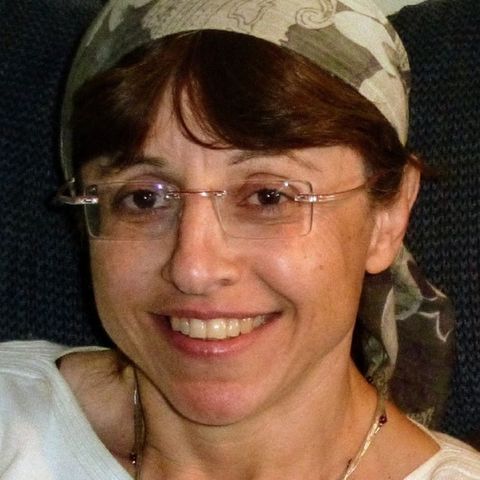
Free will in parashat Nitzavim.
Choose life.
In this week's Torah portion,
Nitzavim,
We're told that there are blessings and curses before us and we should choose life.
Rav Shimshon Rafael Hirsch explains that choosing life means that there must be effort and thought on our part.
It doesn't just happen by chance.
Free will is one of the cornerstones of Jewish belief,
But are we really free to choose?
Maimonides in his Mishneh Torah teaches that the question of free will is longer than the land and wider than the sea.
While we don't have control over much in our lives,
We can learn to control how we react or deal in different situations.
And here comes the promo for mindfulness.
When we meditate and pay attention to our breath,
We're more present in the here and now.
The breath is always right here and right now and it's always with us.
So if we can learn to be more present with whatever we're experiencing,
We can slow down and choose not to allow our habitual responses to kick in.
These responses can be knee-jerk reactions that we later regret.
So if the cashier in the supermarket tells me she's closed just as I put my stuff down after waiting 15 minutes in line,
I might have some choice in how I react after taking a few deep breaths.
I give myself some breathing room.
Mindfulness practice simply means that you choose to be aware of what you are doing when you're doing it and that you don't just respond automatically.
But is it really that simple?
How free are we really to choose to free ourselves from habits and instincts and negative reactions that harm us and those around us?
When we're mindful,
These habits and instincts are still there.
They don't disappear,
But they're less likely to control our thoughts and actions.
Instead,
They become thoughts and just feelings that we observe and then we can decide whether and how to act upon them.
So we do have some freedom to choose.
We can choose to be kinder,
For example,
To ourselves and to others if we just stop and remember that there is a possibility.
And the same is true for being patient or curious,
Accepting,
Appreciative,
Reflective,
And any number of qualities we want to foster.
These are conscious choices.
We just have to stop a moment to remember it's possible to act in a certain manner and then do so.
The choice is also in deciding whether we dwell in thoughts or feelings and get stuck in them or do we just notice them without engaging them or becoming reactive.
We first acknowledge when we notice thoughts,
Feelings,
Or sensations.
It's like a wave coming at you when you swim.
First you have to notice that it's coming.
Then you may ride it or dive underneath it.
You can't choose whether the wave comes,
But you can choose,
Maybe with some swimming practice,
How you meet it.
So when we realize that there's a choice,
That control is not necessarily in the content of our thoughts or feelings,
But rather with how we deal with them,
Then we can take control over our lives as well.
Here's a short mindfulness practice to cultivate the freedom to choose where we place our attention.
So start by finding a comfortable place to sit where you won't be disturbed.
Sit up straight if you're on a chair,
Floor,
Cushion,
And relax your shoulders.
Close your eyes or focus your gaze on a spot in front of you if you want to keep your eyes open.
And take a breath as you become aware that you're breathing.
And take a moment to notice the physical sensations of the breath,
Perhaps in your nose or your chest or your stomach as it rises with the in-breath and falls with the out-breath.
And noticing if you feel any sensations,
Say an itch,
Tingling,
Air,
Or any other physical sensation.
So take a moment to observe.
And on the next out-breath choose how you're going to react to it or not react to it.
And when a thought or thoughts arise as you sit,
Take a moment to notice them as they come up.
So taking a minute to observe your thoughts right now.
And on the next out-breath,
Invite your awareness back to focusing on your breath.
Notice which thoughts pull at your attention and which ones you can let go.
It doesn't matter how many times you need to bring your attention back to your breath.
The moment that you're aware of a thought that's distracting you or pulling away at your attention,
Escort your attention back to your breath.
And now take some time to notice any feelings that might be coming up such as frustration,
Sadness,
Joy,
Anger.
And when you notice,
Invite your awareness back to your breath.
And now bringing your awareness to any sounds around you,
Maybe traffic,
Birds,
An appliance,
The phone ringing,
The child crying.
Notice if you have a tendency to want to look or check it out.
So when you become aware of any sounds,
Take a moment,
Take a breath,
And decide whether or not the sound was worth investigating.
And now observing sensations in your body.
So if you notice a pain in your shoulder,
A discomfort in your back,
And you want to change your position,
Take a breath before you do anything.
And then make a conscious choice of moving or staying still.
It's okay to move or to shift or change positions during your meditations as long as it's done with awareness.
It doesn't matter how many times you need to bring your attention back to your breath.
The moment that you're aware of a thought or thoughts,
Feelings,
Sensations,
Or sounds that's distracting you,
That is a mindful moment.
A moment where you're strengthening your ability to choose where you place your attention.
Feel free to take a few more moments in this practice if you'd like.
And for those of you who are transitioning out of the practice,
Try applying this mindful awareness to everyday life.
Notice the point where you're triggered or distracted.
Notice emotions and thoughts that arise as well as sounds and feelings that distract you.
Observe it all and then mindfully make a decision on how to respond.
The Torah commentator Kli Akar explains that one person's behavior can affect everyone.
So my behavior and reactions not only affect me but anyone around me.
Every action I make has a consequence like a ripple in a pond.
In a few days we'll celebrate Rosh Hashanah,
The Jewish New Year.
This is a time of year when we look back and reflect on what changes we might like to make and we look at our behaviors and hopefully try to become more aware of what we need to work on in ourselves.
Mindfulness meditation can help us in this process of reflection in return to the person we'd like to be.
Shana Tova.
Thanks for joining me and I hope you tune in next week.