So last month on a longer retreat I was leading,
A student raised her hand during a Q&A period,
Question and answer,
And asked me if I could describe my own personal practice because she really wanted to hear just a little bit more about my own process.
But sadly,
Because we only had a short time left,
I thought that my answer might end up being way too long.
And so I asked if she wouldn't mind please seeing me afterwards and unfortunately she ended up not being able to connect with me.
And so in a way this talk that I want to offer is in part my attempt to answer her.
And of course,
Because everything including ourselves is constantly changing,
My answer will very likely look completely different the next time I try to answer it for someone.
To begin though,
In general,
Part of my answer is that I usually try my best to follow the Buddha's main instructions for us,
Which can be found in the Satipaṭṭhana Sutta,
Or the Four Foundations of Mindfulness,
Which is essentially a very detailed meditation manual for us and really shows us how we should practice.
And because I tend to have a bit of an overactive imagination,
I always like to think of these instructions as like a big treasure map that the Buddha has drawn out for us.
And I even like to imagine him kind of standing over it and pointing at things like he really wants us to know all the main and best routes he took and all the different roads that he thought were the most beneficial and what things to avoid,
Etc.
But essentially in the end,
We ourselves get to decide how we want to travel.
And we are each going to experience our own personal adventures along the way,
Along with having different discoveries and failures.
But hopefully,
Eventually,
We'll all arrive at the same place.
And in any case,
If I were asked to describe how I most like to travel,
I would have to say that I never ever,
Ever do anything about it.
I never ever,
Ever do it alone.
I always very deliberately take Mother Earth with me.
In fact,
I never travel the path without her.
She is always right here,
Right alongside me,
Not only supporting me and holding me and teaching me,
But truly she's never separate from me.
And of course,
I know the same is true of everyone and everything.
She is what connects all of us along to her.
For those of you who have sat with me in the past,
You might recognize that whenever I guide us into a more basic vipassana or insight meditation,
I almost always begin by asking you to sense into your innate connection with the Earth and to feel held and supported and even loved by the Earth always.
I usually also invite you to imagine maybe that your feet are like the roots that go all the way down into the center of the Earth,
Connecting you to all things.
And to imagine that your spine is like the stem of a flower that reaches all the way up towards the sun,
Not too tight,
Not too loose,
Simply alive and aware,
Just like the stem of a flower.
One of the things that I've always loved about the Buddhist teachings is that they urge us to continually contemplate our innate connection and belonging to nature and also of course to each other and to all things.
And to me,
I often feel like this is really the key,
The key that can unlock the entirety of our spiritual practice,
Every bit of it.
All of the Buddhist teachings and our rich understanding of them.
I also truly believe that this is exactly what can save us along with our precious planet because again,
We're not separate from the Earth or from one another.
And because we're all hopefully enjoying the long-awaited return of spring and just this week celebrated Earth Day,
I thought I would dedicate this month's talk to my mother Earth and explore what in the teachings are called the Mahabhuta or the great elements and how we can use these practices to discover not only more joy and ease and freedom in our lives,
But also a profound sense of love and belonging and connection,
Which I think is so needed right now.
Many of you may know that I was first introduced to the teachings more than 30 years ago now when I was studying writing and poetics at Naropa University in Boulder,
Colorado,
Which is also where I ended up writing my master's thesis on the work and writing of Annie Dillard,
Whose writing focuses on the spiritual element of nature.
So during that time,
What was happening for me is that while Annie Dillard's writing was really touching my heart in a way that felt expansive and liberating and honestly even magical,
The Buddhist teachings were showing me how to very consciously and practically practice diving even deeper into that spiritual aspect of nature.
Or maybe it was showing me how to access it on a much more experiential level.
The great Master Ajahn Chah,
Who is the teacher of my teachers,
Once famously told us this.
He said,
If one sees nature,
One sees dharma.
If one sees dharma,
One sees nature.
Seeing nature,
One knows dharma.
And so because I tend to lean in this particular spiritual direction,
The practices on the elements,
Again,
Mahabhuta,
Have always felt like an incredibly powerful way in for me,
Mostly because of the way they can so naturally help us to loosen and ease our sense of loneliness or maybe our feelings of being disconnected or maybe even unworthy,
Which as the Buddha tells us,
Is the source of our deepest and most powerful pain and wounding,
Our sense of being separate.
It's also the source of all our suffering and argument and war,
The sense of a separate self,
Which is essentially what our practice is aiming to dissolve or maybe disillusion ourselves from.
And while we can find the practices on the elements throughout the teachings,
They can be found very specifically in the Bhagavad Gita,
Which is again,
Basically our main instructions for practice.
And in this instructional sutta,
There are four of what are called the foundations of mindfulness or the four satapatanas.
And these are four main categories that we are asked to contemplate.
And to very briefly summarize,
These include body,
Feelings,
Mind and dharmas.
And these are the four main categories that we are asked to contemplate.
And to very briefly summarize,
These include body,
Feelings,
Mind and dharmas.
And you might notice of all four of these foundations,
They all arise from the very first of them,
Which is mindfulness of body.
Because of course,
This is where we live.
This body is home.
It's where we experience the entirety of our life through this spiritual experience.
And this body includes the mind,
Which is often considered the sixth sense.
So in this sutta,
The satapatana,
The Buddha tells us this.
He says,
There is one thing,
There is one thing that when cultivated and regularly practiced leads to a deep spiritual peace to mindfulness and to clear comprehension,
To vision and knowledge,
To a happy life here and now into the accumulation of wisdom and awakening.
And what is that one thing?
It is mindfulness centered on the body.
Mindfulness centered on the body.
And so as you might imagine,
The instructions that he gives for contemplating the body are extremely rich.
And again,
It's really our main practice.
It's where the entirety of our practice flows from.
It's its source,
If you will.
More specifically though,
Because our bodies are created out of the very same elements of the universe,
One of the ways the satapatana asks us to train is by very closely contemplating the body's elemental nature.
So for instance,
During our formal meditation practice,
We're being asked to deeply explore within the body itself,
The flowing,
Constantly moving sensations of earth,
Air,
Fire,
Water,
Along with space and consciousness,
Which are often considered the fifth and sixth elements,
Space and consciousness.
And of course,
This means that we're not being asked to examine something that is not real.
As we all know,
Modern science has been able to show us that we are all made up of the same material that makes up the universe.
We really truly are made of stardust.
But in the Buddhist time,
About 2,
600 years ago,
The idea that all of these sacred elements of nature were contained within this body was considered really revolutionary.
At the time,
Actually much of the spiritual practices in India were actually aimed at transcending the body or denying the body or even punishing the body.
And in fact,
The Buddha himself did exactly this for about six years of his life after he left his family's palace as Prince Siddhartha and became a wandering mendicant who went studying with various spiritual teachers.
And of course,
He nearly killed himself in the process.
He was actually in the process of dying one day when a woman who could clearly see that this monk was starving offered him some food.
And finally,
He agreed to give in and eat just to save himself.
And when he recovered,
Siddhartha made a decision that he was going to go sit down under a Bodhi tree for as long as it took until he achieved enlightenment.
And essentially,
That's what he did for 49 days.
And throughout that whole time,
He was constantly being attacked by the demon god Mara,
Who was of course not an actual flesh and blood demon,
But a representation of all of Siddhartha's fears and lust,
Envy,
Greed,
Hatred,
Shame,
Even a sense of unworthiness.
And I find it really helpful to remember that in the Pali language,
The word Mara actually means delusion,
Delusion.
And if we're really honest with ourselves,
We might admit that we all battle with these kinds of personal demons or delusions,
Maybe even as the Buddha himself experienced on a kind of daily basis.
And for him,
As it is likely for many of us,
The most intractable delusion of all,
The strongest obstacle to his enlightenment,
Is what Mara finally decided to throw at him on the 49th day,
Which was the delusion of doubt,
Doubt.
And here you might even imagine that you are Siddhartha,
And that you're sitting all alone under this big tree,
And this huge,
Fierce demon is towering above you with all his massive army surrounding you,
And continually over and over trying to shame and diminish you.
You might even imagine this demon saying things to you like,
Who do you think you are?
Or look at you,
There you are,
You're all alone,
You don't belong,
You don't know what you're doing,
You are not worthy of enlightenment,
Etc,
Etc.
You might even imagine this going on for days and days without end,
Until finally,
Mara decides to show you how powerful he is,
And how much better he is than you by declaring that only he,
Mara,
Is worthy of enlightenment,
And by demanding that all of his armies affirm this claim,
And then hearing them all roar in unison all around you,
We are his witness,
He is the only one worthy of enlightenment.
You might just take a moment to imagine even how that must have felt,
Right,
To be surrounded by thousands of soldiers,
All of them backing and supporting this terrifying leader who is shouting at you and asking you essentially who do you think you are?
Who is your witness?
And it was at this pivotal moment when Mara was demanding an answer from Siddhartha that he did something so simple and yet so profound.
He reached down with his right hand and he touched the earth.
That was it.
That was it,
So simple.
And when he did this,
The earth shook and with a shattering roar responded,
I am his witness.
I am his witness.
And according to the story,
Mara and his armies,
Which were again simply delusions,
They vanished into the air,
Flowers rained down,
And Siddhartha became the Buddha,
The awakened one.
And I really do think this might be my very favorite story from the entire Pali Canon,
Mostly because it is considered the quintessential moment of the Buddha's enlightenment when he finally,
Finally realized that he was just innately part of the earth.
He innately belonged and that he did not have to do anything to prove it.
He simply recognized that he was what was often called bodhikaya,
Awakened earth,
Not separate.
So essentially this was his profound message to us,
That we can all truly do this ourselves simply by remembering our innate belonging and connection to the earth and to all things.
Inside the little cottage where I live out in the country,
I have many different statues of the Buddha along with Mother Earth and also Kuan Yin,
The Bodhisattva of compassion.
And one of my very favorite statues of the Buddha is a little one.
And I keep it on a shelf above my desk.
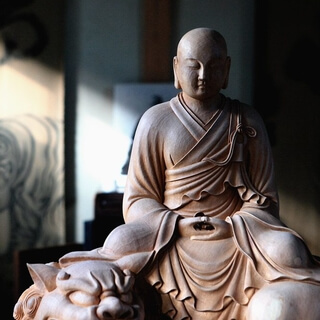
And it's one that shows him with his hand touching the earth.
And I keep that one close to me because whenever I look at it,
It reminds me that I too can do exactly the same whenever I want.
So for instance,
Whenever I'm experienced the hindrance of doubt or when I'm feeling lonely or maybe even somehow unworthy or envious or when I'm being attacked by one of my many different demons,
It reminds me that no matter how long I've had these feelings of doubt,
Unworthiness,
Et cetera,
I too can reach out and touch the earth again at any moment.
And by the way,
Because everything is made up of the same materials of the universe,
Sometimes my practice is simply to reach out and touch anything actually like a cup or a book or a curtain,
Whatever it is,
Just to remind myself of this teaching,
Which means that sometimes my hands themselves simply serve as a reminder.
Other times that little statue of the Buddha helps to remind me that again,
I innately belong and I don't need to do anything to claim that belonging.
I don't need to prove that I'm not a Buddha.
I don't need to prove my worth to anyone.
I simply need to reach out and touch the earth and remember.
It also reminds me to sense into my own body and recall again that I am actually made of the earth.
I am awakened earth,
Bodhikaya,
All of which helps me to feel held and supported and loved.
It also reminds me that everything,
Including my own doubts and worries and negative beliefs,
Et cetera,
Are often just delusions like Mara himself.
And that those beliefs and even the beliefs that I find myself in are also all impermanent,
Just like the weather,
Just like nature itself.
And so I don't need to take these things on as permanent or as a self or as an identity.
I can simply allow myself to be just like those elements,
Which are like everything else,
But also constantly changing.
So essentially when the Buddha touched the earth,
What he was telling us was this,
That the way out of our suffering and out of our sense of feeling separate is by using our practice to really get to know this body very intimately and to awaken to it in order to truly understand that we are each worthy and that we all belong.
And the main way that we're being asked to understand this is by very experientially getting to know the truth of what are often called the three characteristics of life.
This includes understanding that everything in this life,
Everything is constantly changing and also impermanent,
Which in Pali is called anicca.
And by the way,
This includes our self.
We're also constantly changing,
Which is called anatta.
And that trying to cling onto anything that is impermanent is what causes us to suffer.
In the Pali language,
This is called dukkha,
Suffering.
So anicca,
Anatta,
And dukkha,
Those three.
And in our formal practice then,
One of the main ways that we can uncover these truths is by exploring the changing nature of the elements in our own bodies,
Which can not only help us to get to know our bodies that much more intimately,
But what it can do is to train us in letting go.
That's what it's training us to do.
And so truly our practice of the elements can really be one of the main pathways that we can choose to take to discover enlightenment itself.
And so we're going to be learning to discover enlightenment itself.
And to get more specific here,
The way we do this is by investigating or even imagining within our own bodies all the sensations of earth,
Water,
Fire,
Air,
And again,
Space and consciousness.
And honestly,
There really isn't an order to this.
For instance,
We can start with just one and maybe explore that and then move on to another.
Or we could just spend our entire meditation period exploring just one of these elements because it's a practice.
We might even go further and be able to explore all of them interacting together at once,
Including space and consciousness.
To start,
Maybe we might just begin to notice where in the body we experience the fire or the sun element,
Which usually presents itself as temperature,
Warm or cold,
And all the variations of this in all the different parts of the body,
Both inside and out,
Along with our capacity to digest or to eat,
Which also requires the fire element of heat.
And what I find interesting is that with this element of fire,
We are also being asked to pay attention to the seemingly never-ending changes in these temperatures and to notice our reaction to this.
So for instance,
When we're exploring the fire element,
We might ask ourselves,
Where in the body am I sensing pleasant,
Unpleasant,
Or neutral?
Pleasant,
Unpleasant,
Or neutral?
So with the fire element especially can really help us to notice how our reactions can get us into trouble,
Especially as it concerns our wanting or our not wanting.
For instance,
We might begin to notice how much suffering we can cause ourselves by wanting things to be different than they actually are,
Simply by noticing,
Even at the subtlest level,
How we might want the temperature of our own bodies to be different.
We can really notice that here with the fire element especially.
When we're exploring the water element,
It could be super helpful to remember that this implies not only water,
But also blood,
Saliva,
Urine,
Sweat,
Tears,
Et cetera,
Some of what we might consider the yucky stuff,
Which is actually a practice that's designed to help us to let go of attaching so much to our bodies.
Again,
Not clinging to them or create an identity around them.
Sometimes when I'm exploring the water element,
I'll start by noticing the saliva in my mouth and maybe the dryness of my lips.
Then I might sense the fluid around my eyes,
Maybe even by moving them around a bit so that I can get a better sense of it.
Then I might imagine the blood flowing through the body,
Maybe by sensing the tips of my fingers,
Maybe feeling a pulse there,
Or by trying to sense the pulse in my chest or my neck.
I might even explore the fire element here and sense where the heat of the blood might be,
Maybe in the tummy where it often lives.
Then I might sense into the fluidity of the entire body and get in touch with the ocean-like quality of that,
Remembering that we are all about 60% water.
When we're exploring the water element,
We're also being asked to consider that water is actually considered a binding element,
As in,
Quote,
That which makes things hang together,
Which is how it's described in the sutas.
As an example,
If you add water to flour,
You get dough,
Something solid,
That which makes things hang together.
Since the majority of our body,
Again,
Is fluid,
We might imagine that if we didn't have this binding element,
We would all just turn to dust,
Just like flour.
That's one of the things that we can also examine.
As we continue then,
We might explore the air or the wind element in the body,
Which often means exploring our breath,
As well as the constant movement and flow of our own body and how we create ripples out into the world just by moving through it,
Just like wind moves through the trees.
We also create a ripple.
And to get a little more specific on this element,
We might examine the breath,
For instance,
As it flows through the nostrils or the throat or the chest or the belly,
Or maybe we might examine it all the way through as it's flowing in and out.
Watch that whole flow.
Or we might examine the sensation of the whole body as it expands and contracts.
Or we might even examine the pauses between the inhale and the exhale,
Etc.
And of course,
As we all know,
Those of us who have practiced,
Staying with the breath sometimes can just feel completely boring or maybe it's just really difficult to maintain,
Which of course is why it's called a practice and not a perfection.
That really is our practice to come back.
And what helps me with this sometimes is to remember the different stories I've heard about monks throughout the world who are often asked by their masters every single day of the year to tell them how the breath felt different during their meditation practice that day,
Every single day.
And by the way,
Their answer can never be the same.
So they have to examine the breath that closely.
And of course,
Volumes and volumes have been written about how we can examine the breath.
And so it's really our job to be like those monks,
To maybe even imagine things like maybe the breath entering through our ears,
Or through the tops of our heads,
Or maybe the breath bathing or washing over the heart,
Or throughout all the different organs of our bodies,
Etc.
What's important here is that we just keep exploring and observing and then doing that again.
Just keep looking.
As we move on then,
We might examine the fourth element,
Which is the earth element,
Which includes anything basically that we can touch.
So this might include things like our skin,
Flesh,
Bones,
Hair,
Even the ground or water.
Basically anything that has weight to it,
Anything that can be felt.
If we're feeling ambitious,
We might even connect to the utter vastness of the globe and imagine how big and deep that is and how solid,
And see if we can sense into our connection and our belonging to the globe itself.
I find it really helpful also to explore the sensations of soft or hard in the body because the earth of course contains all of these sensations,
All of sensations of touch,
Including pleasant and unpleasant,
Pain and pleasure.
We look at all of it.
When I was studying the Satipaṭṭhāna sutta with Bhikhu Anālayo,
Who is considered the preeminent scholar on the sutta,
He let us know that we can't just talk about the sutta.
He led us in a meditation on the elements and he used a description of the earth element just exactly as it's written in a sutta,
Which describes it as hard.
And for some reason this just did not resonate with me because my own experience of the earth is also soft.
And somehow I had a sneaky suspicion that maybe a bit of the patriarchy had a sutta as it seems to creep into most all of the different religions.
And I really felt a strong need for the earth to also be soft.
And so for whatever reason,
I was a bit stuck on this.
And during a smaller group session,
I finally mustered up the courage to ask Bhikhu Anālayo about this.
And when I did,
He just smiled and told me that if the earth felt soft to me,
Then that was what was true.
And when he said that,
I immediately remembered that our entire practice is about exploring our direct experience and that we ourselves get to decide for ourselves what is true.
In fact,
One of the main reasons I was so drawn to the Buddhist teachings in the first place is because of its emphasis on direct experience.
And I think also because the Buddha himself told us not to believe a single word he said.
He said,
Don't believe a single word I say.
Instead,
He urged us to simply study the map that he created and to start walking on it and to experience the truth of it for ourselves or not.
It's really up to us.
No one else can do this for us.
And so basically,
The idea is that no one gets to tell us what the water,
Fire,
Air,
Earth,
Space,
Or consciousness elements feel like.
We're simply being asked to explore them in our own bodies and minds in order to discover the truth.
And by the way,
This also absolutely includes pain.
No one can tell us what our direct experience of pain feels like,
Whether this is physical or emotional.
Again,
We ourselves get to decide this for ourselves.
So important.
And so as we continue to explore the elements,
We might also consider exploring the fifth element,
The space element,
Which is where things start to get a little deeper,
Trickier maybe,
And that what we're exploring is space both inside and out.
So when we're exploring space inside the body,
What we're investigating is the sense of space.
What we're investigating is the sense of space that is interior to the sensations,
The space that the sensations arise out of.
For instance,
We might imagine and sense an atom and how much space is inside the atom,
The space that the atoms and the neurons move around in.
And so when we're practicing this way,
For instance,
We might imagine the space between the eyes or maybe the space behind the eyes.
Or we might imagine the space inside the tongue.
Again,
The space that is interior to the sensations that the sensations arise out of.
And we work our way through the body in this way with our awareness.
And then we might even start to imagine that our whole body maybe is filled with space.
Then we might start to sense the space outside of the body as well.
For instance,
Sensing the space below us,
Above us,
And all around us.
And then we might imagine that the space in our body is extending out in front,
Behind,
All around,
And then even further out beyond the furthest stars until we're sensing ourselves as continuous awake space,
Awareness itself everywhere.
Again,
Not separate.
And with this exploration of space especially,
We might start to sense our bodies as not quite solid.
And we might even sense our bodies as connected to the entirety of the universe.
And of course,
We can explore how this is also true for each of the bodies.
So for instance,
When we're exploring the water element,
We might recall all the different bodies of water that are the closest to us,
Or maybe ones that we remember and love,
And remind ourselves that we are made of the same substance.
And then we might extend this exploration to the other and sense ourselves as part of all the great oceans all over the world.
In a very similar way,
We can also explore what is often called the sixth element,
Which is consciousness,
By investigating our sense of being bodhikaya,
Awakened earth.
In the Buddhist understanding of this,
This means sensing ourselves as breathing,
Moving,
Awake,
Aware,
Mobile parts of this universe,
Which is experiencing itself through us,
Through these bodies.
We might even remember these words from the Zen teacher John Halifax,
Who tells us that the roots of all living things are tied together,
Deep in the ground of being they tangle and embrace.
This understanding is expressed in the term non-duality.
If we look deeply,
We find that we do not have a separate self-identity,
A self that is not a self-identity,
A self that is not a self-identity.
If we look deeply,
We find that we do not have a separate self-identity,
A self that does not include sun and wind,
Earth and water,
Creatures and planets and one another.
And I just,
I love that quote from John Halifax.
And finally,
Before I'd like to offer you a brief meditation on the elements,
I really hope that I answered my students' question in part,
At least by sharing one of my very favorite pathways in,
Which I truly believe can lead us directly to that treasure that we're all seeking,
Which is freedom,
Freedom from a sense of a separate self.
And so if it's available to you,
I'd like to lead us in a brief meditation on those first four elements.
And so to begin,
You might try to find a comfortable seat and posture,
Close the eyes.
If you're out walking,
You might sense into your body,
By sensing into your feet,
Feel yourself connected and supported by the earth.
If you're seated,
You might sense your sit bones and again,
Your connection to the earth,
Allowing yourself to feel held,
Supported.
And as you continue to do this,
You might allow the body to start relaxing just a little more,
Trusting in that support of the earth,
Really allowing the earth to hold you so that your muscles can relax just a little more.
And then you can start to feel the body,
The body,
The body,
The body,
The body,
The body,
The body,
The body,
The body,
The body,
The body,
The body.
You might allow the shoulders to drop down,
Let go.
You might notice the center of the palms,
Letting go.
You might even notice all the little muscles of the face,
Allow yourself to soften here as well.
Maybe allowing the forehead to be smooth,
Eyes soft,
Relaxing all the little muscles of the face,
Maybe allowing the teeth to be slightly parted so the jaw can relax.
Where are the breath?
You might even notice the tummy area.
See if you can let go here a little more,
Allowing the tummy to just feel natural in the body,
Like a two-year-old's belly,
Just undefended,
Just breathing.
And as you're ready,
You might start to explore the air element in the body,
Maybe by noticing the breath as it enters the nose,
Noticing the breath as it enters the nostrils and leaves the nostrils.
Inhale and exhale,
Aware of the air element in the body or the wind element.
And as you're observing this element in the body,
You might notice the temperature of the breath and how it's constantly changing.
It might be cooler on the way in,
Warmer on the way out.
And you notice when it changes from cold to warm or from warm to cool,
Noticing.
You might also notice that the body can simply breathe all on its own without any effort from you.
And you can simply use your awareness to observe this.
And if there's still some control,
No worries at all.
Just continue noticing the air element in the body.
As you continue,
You might notice where in your own body you sense the wind element the most.
So it could be the nostrils,
Throat,
Chest,
Belly.
Maybe it's the breath all the way through the body.
Might be a sense of the whole body contracting and expanding.
Just staying with this element of wind,
Observing it directly in whatever way feels best to you.
In whatever way feels best to you.
As you continue now,
You might begin to explore the element of fire in the body,
Which can show up as temperature in all different parts of the body,
Both inside and out.
So you might begin by noticing the skin and maybe noticing the parts that are covered and the parts that are not and noticing the differences in temperature.
As you continue,
You might begin to notice your own experience of the temperature themselves.
Maybe by asking yourself,
Am I sensing pleasant,
Unpleasant,
Or neutral?
Pleasant,
Unpleasant,
Or neutral with any of these temperatures in the body?
So as you continue now,
You might begin to explore the water element in the body.
So you might begin by noticing the area of the mouth and lips,
Noticing if there's any dryness or wetness here or somewhere in between.
You might notice the eyes.
See if you can sense the water element around the eyes.
As you continue,
You might begin to sense the body as a whole.
Noticing the fluidity of the body itself and how it's constantly flowing and moving,
Just like a body of water.
If it's helpful,
You might recall a body of water that's near you or a lake or an ocean that you remember,
Reminding yourself that you were made of the same element the water element.
So as you continue now,
You might see if you can connect with the element of earth in the body.
Maybe by sensing the heaviness of the body and sensing yourself connected to the vastness of the earth itself.
You might imagine your skeleton,
Maybe your skull,
All the different bones,
Sensing the heaviness and weightiness of this within the body.
As you continue,
You might explore all the different areas of softness or hardness,
Maybe noticing that the muscles and the organs are soft,
But that the body also includes areas of hardness like the skeleton.
Finally,
In the last minutes,
You might connect to one of these elements that felt the most natural for you,
Or maybe all four of them.
And really imagine or notice how you yourself are awakened or bodhikaya,
That you contain all the elements of the universe within you,
That you are not separate from the earth.
I invite you to notice how you are a breathing,
Moving,
Awake,
Aware,
Mobile part of this universe,
Which is experiencing itself through you.
And finally,
With the eyes still closed,
I'd like to invite you to listen to these words from the late great Mary Oliver,
Who tells us,
You do not have to be good.
You do not have to walk on your knees for a hundred miles through the desert repenting.
You only have to let the soft animal of your body love what it loves.
Tell me about despair,
Yours,
And I will tell you mine.
Meanwhile,
The world goes on.
Meanwhile,
The sun and the clear pebbles of the rain are moving across the landscapes,
Over the prairies and the deep trees,
The mountains and the rivers.
Meanwhile,
The wild geese,
High in the clean blue air,
Are heading home again.
Whoever you are,
No matter how lonely,
The world offers itself to your imagination,
Calls to you like the wild geese,
Harsh and exciting,
Over and over,
Announcing your place in the family of things.
Namaste and blessings.
I hope you enjoyed this talk.
These talks are always offered freely so that no one is ever denied access to these teachings and your support really makes a difference.
Dhanah is an ancient Pali word meaning spontaneous generosity of heart.
If you feel inspired to offer Dhanah,
You can do so by visiting my website at www.
Mindfulvalley.
Com.
Thank you so much.