So before I begin this talk,
I just want to apologize to those of you who listen to these talks regularly for not being able to offer one last month.
And I also want to say that the topic of this talk might help explain why I wasn't able to do this.
So in December,
I was finally able to travel up to Massachusetts for an annual two to three week retreat at a small retreat center there,
Which is something I've done for the past decade or so.
But because of the pandemic and other obligations,
I just haven't been able to be there for the past several years.
And so this retreat just felt particularly special to me.
And as I was driving up there,
I started to realize just how much I was looking forward to being back in this really kind,
Loving and very familiar place to me.
And it occurred to me that this might be what it feels like for some people when they travel home for the holidays.
And honestly,
This thought surprised me and brought on some unexpected tears.
Because I've moved around so much in my life,
I've never really felt like I can truly call any particular place home.
And as a confession,
I'm always a little bit jealous when I hear people say that they really can call someplace home.
But as I was driving up this long driveway to the center,
It occurred to me that even though my address has changed many times in the past several decades,
That retreat center up in Massachusetts has been a kind of anchor for me,
A place that really does feel a lot like what I might call home.
And because the center is actually called the Forest Refuge,
I started thinking about those two words,
Home and refuge,
And about how really the entirety of the Buddhist practice is actually very directly aimed at training us how to discover these two things,
Home and refuge.
But of course,
In the teachings,
Where we discover these two things is actually never outside of ourselves,
But instead,
And of course,
Directly within.
And the truth is,
This is really our whole practice,
To learn how to discover for ourselves that place of home or refuge right here in our own minds,
Bodies,
And hearts,
Exactly where we are.
As the great master Ajahn Chah,
Who is a teacher of my teachers,
Has famously told us,
Anyone can build a house of wood and bricks,
But the Buddha taught that this is not our real home.
Our real home is inner peace.
Our real home is inner peace.
And so for this talk,
I thought I'd dive into an exploration of what are often called the three refuges or the threefold refuge,
Which in the teachings are three things we are asked to take refuge in,
As in three things that can offer us all a sense of belonging and solace,
Safety,
Trust,
And ease,
All of those things we might associate with the word home.
And last month when I was returning home from retreat,
Still really contemplating that word refuge,
I ended up searching the internet for some descriptions because I was curious,
And I found things like shelter or protection from danger or distress,
And something to which one has recourse in difficulty,
And also a condition of being safe and sheltered from pursuit,
Danger,
Or trouble.
But then in the Oxford English Dictionary,
I actually stumbled over a really interesting definition of refuge,
Which describes it as a kind of traffic island,
As in quote,
An area in the middle of a road where you can stand and wait for cars to go past until it's safe for you to cross.
And honestly,
I just love that because as far as the teachings on this go,
This description really seems to resonate because again,
The idea is that even though none of us can escape the reality of this life,
What we can find is a kind of traffic island for ourselves,
Right?
A place where we can find refuge,
If you will,
In the middle of what is so often a lot of chaos,
Or what the teacher Don Kebbett Zinn has famously called the full catastrophe of our lives.
One of my very favorite teachers,
The modern day monk and scholar,
Tanasaro Biku,
Who's also known as Ajahn Jeff,
Has described finding refuge this way.
He writes,
Normally people will allow their happiness to depend on a whole lot of conditions,
And the more you think about those conditions,
The more you realize that they're totally beyond your control.
The economy,
Climate,
The political situation,
The continued beating of certain hearts,
The stability of the ground beneath your feet,
All of which are very uncertain.
So what do you do?
You learn to look inside,
Try to create a sense of well-being that can come simply with being with the breath.
Even though this isn't the total cure,
It is the path toward the cure.
You learn to develop a happiness less and less dependent on things outside,
And more and more inward,
Something more under your control,
Something you can manage better.
And so before we take a closer look at the three refuges,
I first want to really emphasize that these are not just quote unquote Buddhist refuges or Buddhist places of safety or home.
All three of these are refuges that people of all different faiths can find sanctuary in in their own lives.
In fact,
Many people have said that taking refuge in these three things has actually strengthened their own faith.
In the Buddhist teachings,
These three refuges are Buddha,
Dharma,
And Sangha,
Sometimes also called the three jewels or the three treasures of our practice.
And so let's explore that first refuge a little,
The Buddha,
Which has several different meanings.
So first and maybe most importantly,
What we are not doing when we're taking refuge in the Buddha is worshiping some sort of deity or saying that we are somehow true believers of Buddha,
Or that Buddha is somehow different from us,
Or that he's some sort of God.
One of the things we are doing is honoring and having great gratitude for the real human ancient teacher who is known as Shakyamuni Buddha.
We are remembering that just like us,
This master teacher was a very real person,
A Hindu prince named Siddhartha Gautama,
Who was born in a wealthy family about 2600 years ago.
This was a person who struggled with all the difficult emotions that we all experience,
You know,
Anger,
Fear,
Sadness,
Lust,
And who asked the same kind of questions like,
What does it mean to be born to a human body,
A body that eventually grows old and goes back to the earth?
Or how can we be happy in this world,
Given all the sorrow that we encounter?
All the impermanence,
How do we do that?
At age 29,
This was someone who decided to leave his home in search of some answers,
And went out and found and studied with the great spiritual leaders of his time.
And in the end,
This was someone who not only found some answers,
But very graciously decided to share them with us.
And here I think it's really important to remember that Siddhartha did not find these answers because he was some kind of supreme being or God.
He discovered these answers as someone who was absolutely human.
And the good news that he shared with us is that the ability to awaken is inherent in each one of us.
We can all do this if we make the effort.
And so when we say we're taking refuge in the Buddha,
One of the things that we're doing is showing profound gratitude for this very real human teacher who agreed to share with us how he did this,
Remembering that apparently this was something that might not have even happened.
In fact,
It is said that when the Buddha first attained enlightenment under the Bodhi tree,
The results were so profound that he just assumed no one would understand how he had gone about achieving this.
And so he wasn't truly fully convinced that he should even share it.
Fortunately,
Though,
For us,
His very presence was so incredibly peaceful and radiant that people just couldn't help but be drawn to him.
And essentially,
They begged him to teach them how they too could achieve that same kind of radiance and peace.
And for me,
Having been blessed to have met and studied with many different teachers over the past three decades or so,
I think I kind of understand this.
Some of the teachers that I've studied with just fully seem to radiate that sense of calm,
Loving presence,
Like you feel so completely immersed in a sense of peace and compassion that you simply want to be in their presence for as long as you can.
And I have to say,
I've also seen that same kind of radiance in the faces of so many people,
Both during and especially right after they've been on a longer retreat.
They're just sort of glowing.
It's kind of fantastic.
In one of the stories about the Buddha's life,
It said that soon after his awakening,
He was walking past a fellow traveler on the path.
And the man was apparently just so utterly struck by his presence that he had to stop him and ask him,
My friend,
What are you?
Are you a god?
And Siddhartha said,
No.
So the man asked again,
Well,
Are you some kind of magician?
Siddhartha again said,
No.
Are you a man?
No.
Well,
My friend,
Then what are you?
And the Buddha replied,
I am Buddha,
Which means awake,
Means awake.
And so the name stuck and Siddhartha forever became known as the Buddha,
The awakened one.
And so when we say that we're taking refuge in Buddha,
What this means is that we are making the intention to take refuge in our own capacity for freedom,
Our own capacity for spiritual awakening and relief from suffering.
And especially in the Tibetan tradition,
Which is my first tradition,
It said that what we're taking refuge in is actually our true home,
Our Buddha nature.
And what we're doing is vowing to honor that,
Again,
Our own capacity to both see and be with what is always here.
The teacher,
Robert Thurman,
Spoke about it this way.
He said,
We turn to the teaching of the reality of bliss,
The teaching of the method of achieving happiness in whatever form it takes,
Whether it comes in Christianity,
Whether it comes as humanism,
Whether it comes as Hinduism,
Sufism,
Or Buddhism,
The form does not matter.
The teacher is Buddha to us,
One who can point the way to our reality for us.
He could be a scientist.
She could be a religious teacher.
Over the years,
I've actually heard it say many times that the Buddha himself would probably really not like the term Buddhist if he heard it.
And I think I agree with that.
There's a story I love to remember about a letter that was written a long time ago to the Insight Meditation Society up in Berry,
Massachusetts,
When it first started having students there about 40 years ago now.
And the student said that when he showed up at his parents' house and told them that he was a Buddhist,
His parents got really upset and angry with him.
But he said,
When I show up as Buddha,
They just love me.
When I show up as Buddha,
They just love me.
Having said all of this,
I know many people can sometimes still become confused about this,
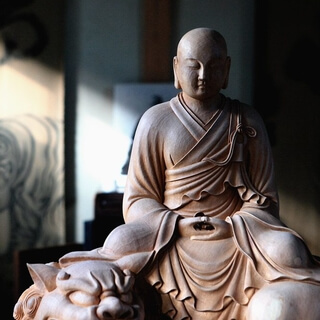
Especially during the longer meditation retreats where practitioners are often seen bowing to the Buddha,
Statues of the Buddha.
For instance,
Some students kneel down and bow three times to the Buddha statue before each set.
Others will bow to the Buddha each time they enter or exit the sanctuary.
And some will simply bow to their cushion or their bench right before they sit.
And what I always like to assure people is that,
Especially in the Theravada or Insight tradition,
Whenever we're bowing,
We are in no way worshipping the Buddha or maybe asking him for things.
Again,
We're simply bowing in gratitude for this master teacher's excellent example,
And to all the teachers that came after him,
And most importantly,
Again,
To our own capacity for awakening.
Sometimes when I bow to the Buddha,
Or when I bow to my cushion,
I'll silently say an affirmation like,
Please may I learn from this set,
Or may this set help dispel my delusion,
Or please may I keep my heart open to whatever arises,
Et cetera.
And every time I'm bowing,
I almost always feel just this great wave of gratitude for all of my teachers and all of their teachers,
And for everyone who has practiced this way for the past 2600 years,
All the way back to the Buddha himself.
The Zen teacher Robert Aiken wrote this about the first jewel.
He said it refers,
Of course,
To Shakyamuni,
The enlightened one,
But it also has a far broader meaning.
It includes mythological personages who preceded Shakyamuni and dozens of archetypal figures in the Buddhist pantheon.
It includes all the great teachers of our lineage,
But also everyone who has realized his or her nature,
All the monks,
Nuns,
And lay people in Buddhist history who have shaken the tree of life and death.
In a deeper and yet more ordinary dimension,
All of us are Buddha.
We haven't realized it yet,
But that does not deny the fact.
All of us are Buddha.
So again,
To take refuge in Buddha essentially means to take refuge in what we are.
One of the most well-loved teachers of my teachers was an Indian woman named Deepa Ma,
Who many say was a truly enlightened being in this lifetime.
And when she died in 1989 in India,
She actually did this while bowing to the Buddha.
She was that dedicated.
And so now whenever I'm bowing,
I also think of this and make that same aspiration,
Please when I die,
May I do so bowing to the Buddha.
That's my aspiration.
Which brings me to the second jewel of refuge,
Which is Dharma.
And this one also has many different meanings.
First,
The word Dharma often refers to the teachings themselves,
The whole Pali canon.
So in a sense,
We're taking sanctuary in or finding a home in these excellent teachings,
Which have been passed down for several thousands of years and have proven over and over that if we take them to heart,
They really can help us to relieve our suffering and discover more peace in our lives.
As many of you know,
These teachings are collectively known as the Noble Eightfold Path or the Wheel of the Dharma.
And what we're doing when we're practicing is turning that wheel and we're keeping it spinning.
The Zen monk Koshin Rinpoche,
Has just written a great new book about the Noble Eightfold Path called Untangled.
And in it,
He tells us this,
He says,
We turn the wheel,
But in some ways,
The wheel actually turns us.
Many people before us have turned the wheel and we benefit from their efforts.
They turn the wheel and the wheel turns us.
We turn the wheel and in doing so,
We turn the wheel.
And we turn the wheel and in doing so,
We turn the wheel for others.
And when I read that,
I just so loved that idea,
That as we practice,
The wheel turns us and that the effects of our doing this in turn affect everyone else around us.
And I was thinking this actually one day during my retreat,
When I finally ventured outside for a walk after a big snowstorm had happened the night before,
Because I hadn't been to the center for a little while.
I couldn't remember the exact path through the woods.
And so I was so relieved and grateful that someone else had been there before me and that I could follow their footsteps along the path.
And then when I was heading back,
I realized that my walking the path actually made it even wider so that even more people could find that same path.
And it occurred to me that this is very same way with the Dharma.
We walk it so that others can find their way and also walk in our footsteps.
Another great definition of the second jewel of the Dharma is as the truth and reality of our moment to moment experience,
Right?
The mystery of being here and awake to what's here.
So essentially this means taking refuge in the practice of mindfulness itself,
Which in the suttas has often been described as a kind of guard or protection for us,
Right?
Something that will keep us from harming ourselves or others with our unexamined thoughts,
Emotions,
And behaviors.
At the same time,
Our mindfulness can also keep us safe from being caught up in all of those things.
And so we can also find refuge or sanctuary in the present moment itself.
Again,
It can be like standing on that traffic island,
Watching it all go by.
I was very strongly reminded of this type of refuge during a particularly memorable moment of my retreat,
Which actually happened on the very last day.
As usual,
I was up pretty early about five 30 in the morning,
But on this day was trying to very quickly and quietly get a lot of things done in a short amount of time because I needed to leave the retreat center at about 7am.
And so I was washing my sheets and towels and cleaning my room and getting it ready for the next tenant and packing my things into my car and leaving some money in the office for things that I had purchased,
Et cetera,
Et cetera.
And as I was busy doing all of this aware of how many times I'd been walking through the center,
I suddenly became very aware of my body and also my rushing,
Which is something I hadn't been doing for several weeks.
And I became very aware of my breath,
Which was a little shortened,
My heartbeat going faster,
My skin feeling kind of warm and how focused my mind was on tasking,
Which it also hadn't been doing for a while.
And I was outside walking in the dark on one of the wooden platforms in the courtyard.
And I decided to just stop and lean my forehead onto one of the big cedar beams that line the pathway.
And for that entire retreat,
Honestly,
Every single hour for weeks,
I had been consciously touching almost everything,
The cedar,
The cool railing that leads down to the dining hall,
You know,
The trees.
On occasion,
I would just go ahead and lean my forehead onto one of the walls just to feel even more present and grounded and held.
And each time I did this,
I would focus on my heart,
On the sense of refuge,
And really lean into being there in that sacred space in that moment.
And so during my busy morning,
I decided to pause just one more time and lean my head up against that beam and breathe.
And in that moment,
Feeling the coolness of the morning and morning and smelling the cedar and seeing the snow and the bright big moon in the sky,
I suddenly heard the call of this great horned owl who was calling out so beautifully for several minutes.
And I realized that had I just kept going and not stopped,
I wouldn't have heard that or had that moment.
And it was in that moment that the teaching of the second jewel really became so much clearer for me.
The truth that the present moment itself really is a refuge for us and that it's actually always right here.
It's available whenever we remember to be in it.
In fact,
The Pali word for mindfulness itself is sati,
S-A-T-I,
Which means to remember.
There's actually a lovely quote that I like to remember from another one of my teachers,
Sharon Salzberg,
Who tells us,
In times of great struggle,
When there is nothing else to rely on and nowhere else to go,
It is the return to the moment that is the act of faith.
From that point,
Openness to possibility can arise,
Willingness to see what will happen,
Patience,
Endurance,
Strength,
And courage.
Moment by moment,
We can find our way through.
Moment by moment,
We can find our way through.
Having said all that,
Of course,
That particular moment on retreat just felt really pleasant,
Right?
But taking refuge and mindfulness through the Dharma also includes making a deep commitment to ourselves to turn towards what is right here,
Whatever it is,
Even if it means that our own hearts are breaking at that moment.
We want to become willing to be truly present for all of it.
And more and more as we practice this way,
What we eventually learn is that we can trust that this is truly what is going to open our hearts and to help us to feel more alive instead of shutting down.
And this is actually where our courage comes in,
Right?
And in the Tibetan tradition that I started out in,
What we're walking is often called the warrior's path.
And in essence,
This is because what we're agreeing to do is to face ourselves and to take a good look at our own demons,
If you will,
And learn to befriend them,
Knowing that this is actually what is going to ultimately transform us.
My favorite Buddhist nun,
Pema Chodron,
Who I think always asks the best questions,
Asks us this about refuge.
She asks,
To what do we really commit ourselves to?
To what do we really commit ourselves to?
Is it to playing it safe and manipulating our life and our whole world so that it will give us security and confirmation?
Or is our commitment to deeper and deeper levels of loving kindness?
The question always remains,
In what do we take refuge?
Just love that question.
In the Zen tradition,
There's an old story that I love that points to this,
About a man named Ye Kwan Zu who loved dragons.
Apparently,
Ye Kwan Zu had a whole library on dragon lore and decorated his whole house with paintings and statues of dragons,
And would talk on and on and on about dragons to anybody who would listen.
And then one day,
An actual dragon heard about this man and thought,
How lovely that he appreciates us so much.
It would surely make him happy to meet a true dragon.
And so this kind dragon flew all the way to the man's house and went inside to find him asleep on his bed.
And when this man awoke and saw a dragon coiled up at the edge of his bed,
He screamed out in terror and lunged at him with a sword.
And so sadly,
The dragon flew away without having had a chance to introduce himself.
And this story is usually interpreted as a representation of someone who has an intellectual interest in the practice,
And reads a lot of books about it,
Maybe decorates their homes with statues,
Who doesn't really feel a need to practice or find a teacher or take the refuges.
The Zen master Dojon wrote,
I beseech you,
Noble friends,
In learning through experience,
Do not become so accustomed to images that you are dismayed by the true dragon.
So again,
When we're taking refuge in Dharma,
It is not about reading every single Buddhist Sutta,
Or maybe learning how to speak in Sanskrit.
It is about trusting our own practice,
And being willing to find the truth for ourselves,
By being willing to look inside for the answers.
The writer Beth Ferris offers us a quote that I think speaks to this.
She writes,
Then there is the listening at the gates of the heart,
Which has been closed for so long,
And waiting for that mysterious inner voice to speak.
When we hear it,
We know it is the truth,
To which we must now surrender our lives.
When we hear it,
We know it is the truth,
To which we must now surrender our lives.
And before I move on to the third refuge,
I also just want to make sure to point out that a large part of our practice involves being on the lookout for all the ways that we might try to find sanctuary in what are often called false refuges.
So false refuges include all of those things,
People,
Places,
Behaviors that we think are going to bring us a sense of safety or comfort,
But in fact they usually just end up bringing the opposite.
In a book about this called True Refuge,
One of my teachers,
My first mentor Tara Brock,
Explains false refuge this way.
She writes,
We might,
For instance,
Have a fear of failure,
And take refuge in staying busy,
In striving to perform well,
Or in taking care of others.
Or we might feel unlovable and take refuge in pursuing wealth or success.
Maybe we fear being criticized and take refuge in avoiding risks and always pleasing others.
Or we feel anxious or empty and take refuge in alcohol,
Overeating,
Or surfing on the web.
Instead of consenting or opening to what we are actually feeling,
Our turn toward false refuge is a way of avoiding emotional pain.
But this only takes us further from real comfort,
Further from home.
As long as we pursue false refuge,
Suffering will pursue us.
As long as we pursue false refuge,
Suffering will pursue us.
And so while we are exploring what might feel like refuge to us,
We also really want to be on the lookout for these other things that we often take for refuge,
Which are not actually going to bring us safety or ease at all.
We want to be on the lookout for those.
Which brings me to the third jewel,
Which is Sangha.
And what I find so interesting about this one is that it is just as important as the first two,
Just as important as Buddha and Dhamma.
And Sangha is another refuge that also has multiple meanings.
First,
This usually means that we're taking refuge in a particular community of others who are also all seeking the truth through the practice of meditation.
It also means finding refuge in what we cherish about being in a Sangha,
In a community that includes everyone on the path,
Not only those in our particular meditation group or community.
This is often called the Maha Sangha,
The larger Sangha.
And finally,
Of course,
It means taking refuge in our own true belonging to all sentient beings,
Really knowing ourselves as a vital and loved member of this life itself.
So whenever I'm leading a class or retreat,
I usually ask for a show of hands to see how many people are part of Sangha or a meditation community.
And while it is definitely a lot more than what it used to be about 30 years ago,
It still actually surprises me how many people are trying to do this practice all by themselves.
So if you're someone who's trying to do this alone,
I really want to encourage you to find some sort of meditation group,
Especially if it has a dedicated,
Experienced teacher,
Because this can really be invaluable to have someone to guide you.
But if you can't find a group or a teacher,
I encourage you to maybe consider starting one of your own.
And please don't let this sound scary,
Because you really don't need a lot of people.
Just as a for instance,
For years,
My husband and I used to meet every Saturday with a dear old friend of ours at his meditation hut out in the woods.
It was just the three of us.
And honestly,
It was so helpful for all of us to be able to sit with a couple of other people and to have that support and also to talk about our experience and to learn more about the Dharma together.
It's so helpful.
Some people even do this at work.
So they'll find a few like-minded people who are interested in practicing and they'll maybe sit and listen to a talk while they're eating.
And then they'll discuss the talk after lunch.
It can really be that simple.
And I know just experientially through my own practice and through testimony from thousands of students that have practiced with me,
That practicing meditation with others just feels completely different than trying to do it all by yourself.
Those who have done this say they really can feel the group energy that happens.
And this energy serves again as a kind of refuge,
A place of trust and support and belonging.
Just as a for instance,
At the retreat center up in Massachusetts,
We have the option of sitting the entire time in our rooms if we want,
Or we can gather with other people in a small sanctuary.
And so often I just choose to go sit in the sanctuary mainly because even though none of us are speaking,
The presence of other people just seems to support my practice exponentially.
And I find that I can really just sit for longer and longer periods of time.
And also just really feels good to be sitting with people who are aimed at basically the same goal,
The goal of turning that wheel.
People who are all trying to open their hearts and face their own demons and learn how to be kinder,
More compassionate,
Peaceful people,
And then bring that kind of kind,
Compassionate peace out into the world.
Having said that,
Being willing to be in sangha of course also means that we're asking ourselves to courageously be with other people.
And all of the drama that can often come with that,
Right?
As well as all the drama that we ourselves can create when we're dealing with others who just like us are less than perfect.
But this is actually exactly how we learn by putting ourselves directly in that circle and becoming willing to completely fail at this and then learn from it.
The teacher Barbara O'Brien has actually said that the importance of sangha cannot be overestimated.
She writes,
Trying to achieve enlightenment by yourself and only for yourself is like trying to walk uphill during a mudslide.
Opening yourself to others,
Supporting and being supported is critical to loosening the fetters of ego and selfishness.
Especially in the west,
People who come to buddhism very often do so because they are hurt and confused.
So they go to a dharma center and find other people who are hurt and confused.
Oddly,
This seems to anger some people.
They want to be the only ones who hurt.
Everyone else is supposed to be cool and pain-free and supportive.
So we are all really important for one another because again,
As a refuge,
Sangha can provide us with a safe place where we can practice being with one another in a way that allows all of us to just be totally imperfect,
Which we are.
And it also of course helps us to practice things like patience and loving kindness and non-judgment and forgiveness.
We can all do this for one another.
It's also said that by taking refuge in sangha,
We actually become this safe refuge for others.
As the late great Zen master Thich Nhat Hanh has told us,
The next Buddha will be a sangha.
The next Buddha will be a sangha.
And finally to end,
I'd just like to invite you,
If you'd like to,
Into a brief meditation on refuge.
So as you're ready,
And if it's available,
You can find a comfortable posture,
Close the eyes,
And just take a couple deep inhales and slow exhales.
Just arrive here in the body,
Settle.
And if you're walking,
You might sense the bottom of the feet.
As you're walking,
Sense yourself grounded,
Part of the earth as you walk,
Become more embodied.
You're driving,
The same.
Maybe sensing your seat in the cushion of the car,
Your feet,
Your hands,
Aware of the breath,
Still hopefully focused on driving.
Let the shoulders soften,
Belly soften,
Let all the muscles in the face soften.
So letting the forehead be smooth,
Eyes soft in their sockets,
Might let the teeth be slightly parted so the jaw can relax,
Still breathing.
And if you're at home or somewhere where you're sitting with the eyes closed,
I'd like to invite you,
If you'd like,
To place one hand or both on the heart or one hand on the heart and one on the belly,
Just to get more in touch with the heart,
Body,
Breathing into the fingers.
As you're ready,
I invite you to consider some questions.
The first question is,
Where or how do I find refuge in Buddha,
My own Buddha nature,
My own capacity for awakening?
Where or how do or can I find refuge in Buddha,
My own Buddha nature,
My own capacity for awakening?
And stay with that question and ask your heart for the answer.
As you're ready now,
I'd like to invite you to consider a second question,
Which is,
Where or how do I or can I find refuge in the Dhamma,
In the teachings themselves or maybe what the Dhamma or the practice has taught me so far,
Something I can find refuge in more often?
Where or how do I or can I find refuge in the Dhamma?
You might even consider,
How can my mindfulness practice itself be a place of safety or refuge?
Maybe like that traffic island in the middle of all the rush and chaos.
Just consider that.
As you're ready now,
I'd like to invite you to consider,
Where or how or can I find refuge in Sangha and like-minded community,
People who support me in walking my spiritual path?
Where or how do I or can I find refuge in Sangha?
You might even consider,
How might I be more courageous in how I show up for Sangha or community?
You're just contemplating those questions.
And finally,
With the eyes still closed,
Just listening to these words from Saint Teresa of Avila,
Who tells us,
This magnificent refuge is inside of you.
Enter,
Shatter the darkness that shrouds the doorway.
Be bold,
Be humble,
Put away the incense and forget the incantations they taught you.
Ask no permission from the authorities.
Close your eyes,
Follow your breath to the still place that leads to the invisible path that leads you home,
That leads you home.
Namaste and blessings.