So,
Just this past year,
Several of my more regular students have very graciously offered to help me with the retreats that I lead as on-site managers,
And I've just been feeling extremely grateful for their care and their support.
And it's also been just such a blessing for me to be able to get to know each one of them a little better on a more intimate level.
And it's also been kind of an unexpected joy to be able to share with them all the various things that are involved in offering a silent meditation retreat,
You know,
Sometimes for over 200 people,
Which,
As you might imagine,
Can sometimes be a real challenge,
You know,
To try to create a safe,
Silent container for spiritual inquiry for a full day or even longer for so many people.
There are just a lot of different logistical things that we need to consider.
At the same time,
My managers and I have another kind of unique challenge on retreat,
Which is trying to hold the sacredness and safety of the space while also working to deepen our own personal practice.
I know from my own experience over the years that trying to find that balance can often lead to some really powerful revelations about how we're actually showing up not only for ourselves but,
Of course,
For other people,
You know,
So leading retreat can really shine a light on this.
So just recently,
One of my new managers and I were having a follow-up talk about a retreat that she just helped me with.
And the question that sort of naturally arose was,
How do we flow back and forth between occupying our role as either teacher or maybe safe space holder and then back again into a sense of self that is more defined maybe as me,
Right?
So in other words,
How do we differentiate between showing up in the retreat space with others in a more loving,
Giving,
Assisting role versus when we're just sitting alone on the cushion,
If you will,
In practice with both ourselves and others in the meditation hall?
Or,
You know,
Maybe when we're huddled in a room together discussing some difficult issue on retreat that has arisen that we need to immediately address.
Or maybe when we need to be in communication with someone who's attending the retreat.
It's really an interesting exploration.
And so my manager and I ended up having a great discussion about this because over the years I have definitely had to really examine that flow,
Especially how I experienced the fluidness of being Shell,
The meditation teacher and retreat leader,
And Shell,
The practitioner who honestly doesn't always live up to my own ideas or beliefs about how a quote-unquote meditation teacher should be showing up and leading.
And so for this month's talk,
I thought I would expand on my answer to my new manager a bit because even though we were addressing very specific or role-related questions,
The inquiry itself really applies to each one of us because it involves asking ourselves,
How can we flow between all the different roles or hats or identities that we place on ourselves every day and that kind,
Wise,
Compassionate presence within all of us that is actually free of all of those different identities?
And if we think about it,
This is really exactly what our practice is urging us to do,
Which is to start identifying more and more with that part of us that is experiencing the whole of our life from a place of wisdom and compassion and openness rather than a sense of identity or from some label that we've stamped on ourselves as quote-unquote someone or something,
Which as we all know,
Is never really the same or even accurate.
So for instance,
We might consider how we show up for and then flow from one different label or identity to another in our daily lives,
Maybe every hour or even every minute,
Right?
So we might consider,
For example,
How or maybe even how often we show up as our job title,
Which is so often the first question someone asks whenever they meet us,
Right?
That very broad question of what do you do,
What do you do,
Which is usually followed by a very brief description of this or maybe just a simple title,
Kind of like a name tag.
We might then consider all of our different identities.
Maybe our identity is a mother or a father,
A grandmother,
Grandfather,
Maybe someone like myself who sadly doesn't have any children.
It might be,
You know,
Our role is maybe a sibling,
That's our role there,
Or as a friend,
Or as a partner,
Or even as a community member,
Right?
We might even consider how we perceive ourselves as our gender identity,
Or our race,
Or maybe our physical or mental abilities,
Right?
As we're considering all of these various identities,
We might also honestly consider maybe we show up differently for each one of them,
Depending maybe on who we're with or maybe even depending on what kind of particular mood we happen to be in when we're showing up as these different selves.
Sometimes we can be one friend with some person,
Or another friend with another person,
Or maybe if we're in a particular mood,
We can be one type of friend and another type of friend.
This changes.
And this can just be such an insightful inquiry because taking a closer look at all of these different labels that we put on ourselves can often show us exactly what we're believing,
Or maybe what we've been conditioned to believe about each one of these different parts of our identity.
And so whenever we're doing this,
One of the most powerful ways I know of that we can examine these various identities is to become much more aware of all the different shoulds that are attached to each one.
As in,
Who do I think I should be in my job title,
Or as a mother,
Father,
Sibling,
Friend,
Partner,
Et cetera?
Who do I think I should be?
Really interesting question.
And the reason examining our shoulds is so important is because almost all of them are really questionable because essentially they're all conditioned.
And by this I mean our shoulds usually include all the messages and beliefs that we've acquired or adopted or absorbed through our lives and have for the most part just automatically believed is true.
For instance,
These are the messages we've received from our upbringing,
Our particular family,
All our various teachers,
Our religious leaders,
All the messages we've absorbed from the culture that we grow up in,
Et cetera.
And the reality is none of these beliefs are necessarily accurate and they also aren't reflecting the truth of who we really are.
And so for this and many other reasons,
In our practice we're urged to use it to really examine and then question our shoulds and to start to notice the truth that our shoulds are almost always toxic.
They're so toxic in fact that we might even think of them as kind of like poison in the sense that even if our beliefs about our different identities are somewhere below the surface or maybe even unconscious,
These shoulds,
If you will,
Almost always tend to make us feel bad just like poison might.
This is because for the most part our shoulds about ourselves and our lives are usually what tend to make us feel somehow not good enough or maybe not quite worthy,
Don't they?
The reason for this is simple really.
Because we're all human and each and every one of us is naturally imperfect and vulnerable and have all been wounded in relationship in some way or another,
We're rarely if ever going to be able to completely measure up to any of our mostly impossible standards of should,
Which again are likely not even accurate,
But we tend to strongly believe that they are.
And on top of that,
We also tend to compare ourselves and others to these standards almost constantly and even if we're doing this unconsciously.
It's actually a great short phrase that I use a lot that can really help us to remember to not indulge in our shoulds,
Which is,
Don't should all over yourself,
Kind of easy to remember,
Don't should all over yourself.
And here we might also include the phrase don't should on others either,
Don't should on others.
And just for a moment I want to clarify,
It is not that we don't try as much as we can to respond to ourselves and others and life itself with as much wisdom and kindness and compassion as we can or that we don't honor our intention,
Our intention to be the best friend,
Mother,
Father,
Sibling,
Community member,
Employee,
Etc.
That we can.
Of course we do,
And I actually think it's really important to remember that each one of us is really,
Really trying our best,
Every single one.
It's just that when we can start to really allow ourselves to be imperfect and to question our shoulds as well as our false beliefs about ourselves,
We might slowly start to recognize that again,
We're actually not who we think we are,
Or maybe more importantly,
Who we think we should be.
In fact,
The more we practice,
The more we might start to recognize that not only are we not our conditioning,
We're also not the main character in our own novel,
Right?
One that's written in indelible ink and permanent,
Never changing.
Instead,
Just like everything else in this world,
We too are all constantly changing and we're really,
Really never the same from one moment to the next.
And the more we can use our practice to see this,
The more we can recognize that whenever we're trying so fiercely to cling to some sort of solid or permanent identity,
Along with all of our shoulds,
This is when we really tend to suffer.
Many of you may recognize this concept or teaching as something that's often referred to as no-self,
Which in the Pali language is called anatta,
And of course this is probably the most misunderstood of all the Buddhist teachings,
And it also happens to be exactly what our practice is trying to reveal to us,
So that we can start to untangle our minds and hearts from that tight knot of self or ego that we've sort of woven together with all of our often intractable beliefs about who we think we are,
Or again,
Who we think we should be,
The knot.
The truth is,
When we can use our practice to start to loosen our strong hold on all of those various identities and live more and more in the present moment with an open heart that is willing to respond to whatever arises with our innate wisdom and compassion rather than with our strong shoulds,
If you will,
We're just naturally going to experience so much more ease in our lives when we can begin to loosen that tight knot.
And before I continue,
I really want to emphasize here that when we're examining the concept of no-self or anatta,
We are not in any way using our practice as a way of rejecting the amazing,
Unique,
Singular expression that is each and every one of us.
Whenever we're working to loosen and eventually even let go of all our various shoulds or identities,
Our uniqueness as individuals remains exactly the same.
The only thing that's different is that we've become much more identified with the open awareness that is experiencing the singularly unique expression rather than identifying as a self that again is somehow solid or never changing.
The author Stephen Joseph explains it this way.
He says,
We can still function as an apparent separate entity while enjoying the parallel reality of our infinite vast presence.
We need both realms.
When the cop pulls us over,
We still need to show him our license and not simply point to the sky.
In a really similar way,
The ancient poet Rumi told us,
Live in the nowhere that you come from even though you have an address here.
Live in the nowhere that you come from even though you have an address here.
And so to get back to my answer to my new manager,
The job for all of us really is to be fully aware of both,
Both the open,
Compassionate,
Aware flow of what is often called our Buddha nature as well as the very real human that holds all of our various shoulds,
All of our experiences,
As well as the human who is incredibly unique and special,
The absolutely singular being that both experiences and expresses this life in a way like no other.
So just as an example,
Whenever I'm teaching,
I often feel like I'm allowing these 2,
600 year old teachings to arise and flow through what I experience is that kind of open,
Non-attached Buddha nature or compassionate awareness,
While at the same time recognizing that the Dharma itself is being interpreted through this human expression that I call shell.
So this has just been a really great practice for me in my daily life as well,
To try to be aware and have compassion for my particular human conditioning,
While at the same time crying as much as possible to really access that more vast awareness that is not attached to a self or an identity,
But is instead responding to both myself and others with as much compassion and awareness as I can.
Of course,
There's a good reason that this is called a practice because unless we're truly enlightened,
We're just not going to be able to do this perfectly,
But we can absolutely make an intention for ourselves to try.
Many years ago now,
I was visiting my teacher and mentor Tara Brock at her house in D.
C.
,
And we were having a long discussion about a particular situation at that time in our community that felt really difficult for both of us.
And we'd been talking for hours,
And I remember that I was starting to feel really uncomfortable with the conversation because it felt like we just weren't coming to an agreement,
And we're just going around and around and around in circles.
And I'm guessing that Tara must have sensed this too,
Because suddenly she just paused and smiled,
And she said to me,
Shell,
You need to put on your teacher hat.
You need to put on your teacher hat.
And just to say,
I recognize that I could have interpreted Tara's request as her asking me to access just yet another identity.
But in the moment,
I knew exactly where she was trying to direct my attention.
Instead of asking me to inhabit the part of me that identifies as a quote-unquote meditation teacher,
She was asking me to remember and to tap into my Buddha nature,
Which I so often experience as an awareness that encompasses a much wider,
More expansive,
More compassionate view,
An awareness,
Again,
That is actually free of identity or free of any type of hat,
If you will.
And so when Tara so wisely reminded me of this,
I remember feeling that shift almost immediately.
Like right there in the moment,
I was able to just suddenly drop out of the smaller sense of shell,
The person,
With all of her conditioning and opinions and reactions,
And enter into that more calm,
Spacious,
Awake place within me that felt almost instantly more compassionate,
Maybe even wise in that moment.
And here I'm recalling that the Pali word for mindfulness is sati,
S-A-T-I,
Which means to remember,
To remember.
And in the teachings,
What we're continually asked to remember is just that,
Our bare,
Open awareness,
Or again,
Our Buddha nature.
And so by simply asking me to quote-unquote put on my teacher hat,
Tara was in essence asking me to do this,
To remember.
Such a good lesson for me.
And since then,
I've been using a kind of shorthand that helps me when I want to remember and access that kind of wiser,
More open,
More compassionate space of awareness,
Both when I'm teaching and also in my daily life.
This involves remembering to ask myself a simple question,
Which is,
Okay,
What would Buddha do?
What would Buddha do?
And just to be clear,
Whenever I'm asking this question,
It does not in any way mean that I'm trying to become the Buddha by putting on my Buddha hat,
If you will,
Or by taking on that identity as that historical figure.
What I am trying to do is to access the qualities of the Buddha or the Tathagata,
The awakened one,
Which is something we're all asked to do,
Actually.
It's what the teachings are really urging us to do,
To follow the Buddha's example and to allow him to be a kind of role model for us.
In fact,
The teachings urge us to find comfort and safety or sanctuary in the qualities of the Buddha and to not only discover our own capacity for wisdom and compassion,
But to feel held,
To feel held by that vast compassion as well,
Again,
With a sense of sanctuary and even trust.
And this practice,
As many of you may know,
Is called taking refuge in the Buddha,
Taking refuge in the Buddha,
And it has several different meanings.
So first and maybe most importantly,
What we're not doing when we're taking refuge in the Buddha is worshiping some sort of deity,
Right?
Or saying that we're true believers of Buddha,
Or that Buddha is somehow different from us,
Or maybe that he's some sort of God.
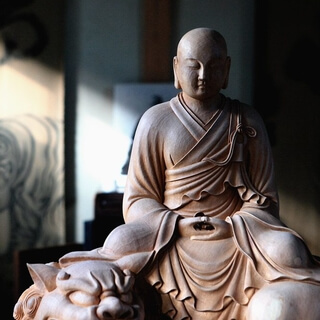
What we are doing is honoring and having great gratitude for the very real human ancient teacher known as Shakyamuni Buddha.
We're remembering that just like us,
This master teacher was a very real person with his own conditioning as a Hindu prince named Siddhartha Gautama,
Who was born into a wealthy family about 2,
600 years ago in Nepal.
You know,
This was someone who struggled with all the difficult emotions,
Feelings of anger,
Fear,
Sadness,
Lust,
All of it,
Just like we do.
He was also someone who suffered from his own cachet of shoulds,
If you will,
And decided at age 29 to leave his home in search of freedom from this seemingly endless torment of shoulds.
In the end,
He not only found that freedom,
But he very graciously decided to share the steps that he took with us to find it.
And here I think it's important to emphasize that Siddhartha didn't find this freedom because he was some sort of supreme being or a god.
He discovered it again as someone who was absolutely human.
This fact always gives me so much comfort and hope.
In one of the stories about the Buddha's life,
It's said that soon after his awakening as he was walking past a fellow traveler on a path,
The man was so utterly struck by his radiant presence that he had to stop him.
And the man said,
My friend,
What are you?
Are you a god?
No,
Siddhartha said.
The man said,
Are you some kind of magician?
Again,
Siddhartha said,
No.
Are you a man?
Siddhartha said,
No.
He said,
Well,
My friend,
What are you then?
And the Buddha said,
I am Buddha.
I am Buddha,
Which means awake.
And so the name stuck,
And Siddhartha became forever known as the Buddha,
The awakened one.
So whenever we say we're taking refuge in the Buddha,
What this means is that we're making the intention to take refuge in our own capacity for freedom,
Our own capacity for spiritual awakening and relief from suffering,
Or our own capacity to become Buddha-awake.
Early in the Tibetan Shambhala tradition,
Which I was raised in,
My first tradition,
It is said that what we're taking refuge in is actually our true home,
Or again,
Our own Buddha nature.
And according to my teachers,
This Buddha nature is actually always here,
Always available.
It's not something we need to earn or develop.
A lot of times,
It's likened to the sky,
Clear,
Beautiful.
It's always here.
It's just so often hidden beneath all the clouds of our beliefs and opinions and shoulds.
So for instance,
Years ago,
When Tara very gently reminded me of this,
I absolutely felt it almost immediately,
That my Buddha nature was just right here,
Was right here waiting for me to tap into it.
The writer Emily McDowell,
Who I don't believe is a Buddhist practitioner,
But she once almost perfectly described our Buddha nature in this passage where she wrote,
Finding yourself is not really how it works.
You aren't a $10 bill in last winter's coat pocket.
You are also not lost.
Your true self is right there,
Buried under cultural conditioning,
Other people's opinions,
And inaccurate conclusions you drew as a kid that became your beliefs about who you are.
Finding yourself is actually returning to yourself,
An unlearning,
An excavation,
A remembering who you were before the world got its hands on you.
Before the world got its hands on you.
Just love that.
I also want to point out that whenever we're practicing taking refuge in the Buddha,
Along with not taking on the identity of the Buddha,
We're also not being asked to take on an identity of ourselves as quote unquote Buddhists,
Which is a term I think the historical Buddha himself would really object to.
In fact,
There's a story that I love to remember about a letter that was written a long time ago to the Insight Meditation Society up in Massachusetts when it first started offering the teachings about 40 years ago now.
In this letter,
The student wrote that when he showed up at his parents' house and told them that he was a Buddhist,
They got really upset and angry with him,
But he said,
Quote,
When I show up as Buddha,
They just love me.
When I show up as Buddha,
They just love me.
Having said that,
I know many people can sometimes become confused about this,
Especially during the longer meditation retreats where practitioners are often seen bowing to the Buddha.
For instance,
You might see people bowing down three times to the Buddha before they sit,
And sometimes others will bow to the Buddha every time they enter or exit the sanctuary,
Which is something I do,
And some will also simply bow to their cushion or bench before they sit,
Which is something,
Again,
I also do.
And what I want to assure people is that,
Especially in the Theravadan Insight tradition,
Whenever we're bowing,
We are in no way worshiping the Buddha or asking him for things.
Again,
We're simply bowing in gratitude for his excellent example and to all the teachers that came after him,
And most importantly,
Again,
To our own capacity for awakening.
That's what we're bowing to.
So,
For instance,
Sometimes when I bow to the Buddha or when I bow to my cushion or even my meditation box or podium when I'm teaching,
I'll silently say an affirmation like,
Please,
May this sit in some way benefit,
Or may this sit help dispel my delusion,
Or please,
May I keep my heart open to whatever arises.
It's always changing.
What doesn't change is that whenever I'm bowing,
I almost always feel a great wave of gratitude for all of my teachers and for all of their teachers and everyone who has practiced this way for the past 2,
600 years,
All the way back to the Buddha himself.
That never changes.
The Zen teacher Robert Aitken once wrote about what we're doing when we're taking refuge in this vast lineage in this way.
This is what he wrote.
It refers,
Of course,
To Shakyamuni,
The enlightened one,
But it also has a far broader meaning.
It includes mythological personages who preceded Shakyamuni and dozens of archetypal figures in the Buddhist pantheon.
It includes all the great teachers of our lineage,
But also everyone who has realized his or her nature,
All the monks,
Nuns,
And laypeople in Buddhist history who have shaken the tree of life and death in a deeper and yet more ordinary dimension.
All of us are Buddha.
We haven't realized it yet,
But that does not deny the fact.
So again,
To take refuge in the Buddha essentially means to take refuge in what we are.
One of the most well-loved teachers of my teachers was an Indian woman named Deepa Ma,
Who many,
Many people say was a truly enlightened being in this lifetime.
Many stories about her.
When she died in 1989,
She actually did this while bowing to the Buddha.
She was that dedicated.
So whenever I'm bowing,
I also think of this and make that same aspiration.
Please,
When I die,
May I do so bowing to the Buddha.
Another way that I often experience taking refuge in the Buddha is something I also learned from Tara,
Who changed the wording a bit to say,
I take refuge in the beloved.
I take refuge in the beloved.
And I so love that.
She taught me that whenever we're taking refuge in this way,
What we're doing is agreeing to surrender into that part of our Buddha nature that offers a sense of boundless compassion.
That place within us that is vast and loving enough to hold all of our difficult emotions,
All our fear,
Our anger,
Our shame,
Et cetera.
And Tara once wrote about this practice in such a beautiful way.
And so before I offer us a brief meditation,
I thought I would end by sharing her explanation,
Which to me reflects exactly what she was asking of me when she asked me to,
Quote unquote,
Put on my teacher hat.
This is what Tara wrote.
We so easily believe limiting stories about ourselves and forget that our very nature,
Our Buddha nature,
Is aware and loving.
When we take refuge in the Buddha,
We are taking refuge in the same capacity of awareness that awakens the dartha under the Bodhi tree.
We too can realize the blessing of freedom.
We too can become fearless.
By directing our attention towards our deepest nature,
By honoring the essence of our being,
Our own Buddha nature becomes to us more of a living reality.
We are taking refuge in the truth of who we are,
In the truth of who we are.
And so to end,
And if it's available,
I thought I would offer us a brief meditation on this practice of taking refuge in the Buddha.
And so if you're somewhere where you can find a comfortable seat,
You might do that now.
Drop everything you may be holding and close the eyes and start to focus on the breath.
You're walking,
You can also focus on the breath and maybe tap into the sense of your feet on the earth connected,
The feel of the body walking on the earth,
Feel that movement with the breath.
You're driving,
Also sense your connection to the earth,
Your groundedness by maybe feeling your seat on the car cushion,
Hands on the wheel,
Eyes open of course,
And maybe tapping into the breath,
Maybe listening to sound.
For all of us,
Taking a nice deep inhale,
Filling the lungs,
Slow exhale,
Letting go.
Maybe a couple of rounds of these on your own,
Stick it in touch with the body and the breath,
A way to bring your attention inward,
Into this body,
Breathing in,
Breathing out.
And as you're doing so,
On each exhale,
Seeing what you can soften,
Relax and open.
Wherever we can relax and loosen,
We can invite that open awareness much more easily.
We can become more expansive.
You might notice your shoulders,
For instance,
See if you can drop the shoulders.
You might notice the whole area of the face,
Maybe softening the forehead,
Eyes,
Cheeks,
Jaw,
Letting the teeth be slightly parted,
Jaw relaxed,
Still breathing.
And here you might even add just a very slight smile to the corner of the eyes and the lips.
Never ever as a way of covering over anything,
Just a way of bringing metta,
Friendliness,
Kindness to your practice.
Bring in that sense of the beloved right away.
That part of us that can compassionately and kindly hold whatever's happening in the mind,
Heart,
And body.
We can invite that with a slight smile,
Or even a sense of a smile in the eyes and the lips,
And maybe even the heart.
You might notice your hands,
See if you can let the center of the palm soften in a gesture of receiving and letting go.
Opening the hands a bit,
Feeling that sense of openness,
And then let that flow through the whole body,
The sense of receiving and letting go.
Still aware of the body breathing.
And as you're ready now,
I'd like to invite you to think of a particular situation in your life right now that maybe feels challenging.
What feels challenging right now?
Pick one thing.
Once you've decided on that challenge,
Really allow it to be here with you.
Be noticing what you've been thinking or believing about this challenge and how it's affecting you.
How are you holding it in the body?
Where does it live?
No editing here.
Just allow,
Really honestly take a look at what you've been thinking about this challenge or believing about it and how it's affecting you.
Maybe even let that get a little fuller so that you can really feel it and see it.
And then as you're ready,
I want to invite you to consider just one question,
Which is what would Buddha do?
What would Buddha do?
Maybe what would love do?
Or what would the beloved do?
If it's helpful,
You can even place one hand or both on the heart or one hand on the heart,
One hand on the belly to get in touch with that wise,
Compassionate,
Expansive part of you that knows the answer,
What would Buddha do?
And finally,
Just listening to these words from the late,
Great Zen Master Thich Nhat Hanh who told us,
When the situation seems to be permanent,
Overwhelming,
Full of suffering,
You have to practice taking refuge in the Buddha,
The Buddha in ourselves.
Each of us has the seed of Buddhahood,
The capacity of being calm,
Being understanding,
Being compassionate,
And taking refuge in that island of safety within us.
This is how we can maintain our humanness,
Our peace,
And our hope.
Namaste and blessings.