I hope you enjoyed this talk.
These talks are always offered freely so that no one is ever denied access to these teachings,
And your support really makes a big difference.
Donna is the ancient Pali word for spontaneous generosity of heart.
If you feel inspired to support these talks by offering Donna,
You can do so by visiting my website at www.
Mindfulvalley.
Com.
Thank you so much.
So tonight I wanted to delve into a practice that's often really confusing because a lot of people didn't,
You know,
Grow up knowing about this particular thing,
Which means that most of us who grew up in this Western culture,
And that thing is the subject of Buddhist prayer,
Right?
So when I was very little,
I didn't know anything about prayer at all actually because my young hippie parents,
They were almost in their teens,
When they,
They were in their teens when they had me,
They were very young.
And they had,
Of course,
At that time in their early 60s,
Completely sworn off their Catholic upbringing.
And so,
You know,
I didn't know anything about prayer,
Even though my family background was Catholic.
And so whenever we would drive from the lower part of Michigan up into the upper peninsula to visit my grandparents,
Usually for Christmas or Easter holidays,
My little sweet Italian grandmother would teach me in secret how to kneel down next to my bed and say the Lord's Prayer,
Which I wasn't supposed to tell my parents I was doing this.
Isn't that funny?
And so,
But I actually dearly love to recite it,
You know,
Especially that part about give us this day our daily bread.
Honestly,
I can't tell you how many years I thought that wonder bread actually came from God.
But I couldn't ask my parents because I wasn't supposed to tell them.
So I thought it was special,
You know.
But honestly,
I also really love that part where I got to ask not only forgiveness for myself,
But of course for those who trespass against us,
Along with the wish to not be led into temptation,
But delivered from evil.
And my grandmother was maybe the sweetest person I've ever known on this earth.
And,
You know,
I didn't get to see her that often,
Sadly.
But she is the one who taught me how good it felt to want to be good,
To want to be kind,
To want to be caring,
To want to be generous.
You know,
How good that felt.
And this is actually what the Buddhist practice is trying to show us as well,
That both having and nurturing the intention to be kind and compassionate and caring and generous and humble and peaceful is what actually brings us more joy and happiness and peace in our lives.
That intention,
Right?
And the truth is that it does this even if our wish for others' happiness or well-being never comes to pass.
It's our intention that is important in our practice.
And this intention is really the opposite of what happens when we pursue more selfish wants,
Which as the teachings show us don't actually lead to happiness at all,
But tend to bring ourselves and others more pain and suffering,
Right?
And as most of us know here also,
This is what our entire practice is aiming at,
Isn't it?
It's this loosening of our strong sense of self and recognizing slowly maybe,
But over time recognizing our innate connection and connecting to that which is larger than our small self.
And prayer in the Buddhist tradition is actually considered one of the ways that we can nurture this intention and train our minds and hearts to live more through these qualities of selflessness.
So Vantisila Wamala,
A Theravadan monk,
Describes our training this way.
If any practice that leads to ultimate purity or ultimate perfection,
Unlimited perfection is defined as a prayer,
Then Buddhism is a prayer because that is what Buddhism is.
It is a practice that leads to an end.
And there are two areas,
Theory and practice.
Practice is what you really do and theory is why you do what you do and what you're going to get by doing what you're doing.
What is the goal,
The end result of the practices?
In that sense,
Perhaps we could say it is a prayer,
Okay?
So as the teachings tell us,
Our whole practice rests on the tip of intention,
The whole practice.
And then the Pali Canon,
The Buddha tells us,
Whatever one keeps pursuing with one's thinking and pondering,
That becomes the inclination of one's awareness.
Isn't that true?
Right?
That's the idea.
And so the teacher Elizabeth Mattis Namdiel expresses the same idea this way.
She says,
Prayer is like riding a bike.
Our steering will always naturally follow our gaze.
The direction we go is up to us.
If we direct the mind towards making money,
We have a better chance of earning money.
If we don't,
It's doubtful we'll have enough money to pay the rent.
The same is true with our spiritual life.
Spiritual progress,
Human progress,
Requires clear intention,
Okay?
So having said that though,
Especially in the Theravadan insight tradition,
Which is what I teach,
We don't often use the word prayer for what we're doing.
Instead,
You might hear the word,
Often hear the word aspiration or wish or vow.
Although sometimes we do call what we're doing a prayer,
Which is where it gets confusing.
The big difference is that in most of the Buddhist traditions,
We are not praying as an appeal to someone or something out there,
As something that is outside of ourselves.
Though,
Before I go on,
I do need to clear up some confusion and say that there does tend to be some confusion when we come to the Vajrayana and Mahayana traditions,
Since these two traditions tend to focus more on the images of certain bodhisattvas or compassionate cosmic Buddhas.
And in the Mahayana tradition in particular,
Sometimes practitioners use different chants to make offerings to various Buddhas and bodhisattvas,
Or take vows before them,
Or some even say they even confess their sins to them and ask for forgiveness.
But again,
Even here,
It's important to remember that the emphasis is less on these beings exist and more on the idea that even these different Buddhas and bodhisattvas are an expression of or a metaphor for our own Buddha nature or awakened mind.
So in Shin Buddhism,
For example,
The central practice is invoking the power and name of Amida Buddha,
Which is reciting six syllables,
The six syllable phrase,
Which is Namo Abhida Butso.
And they do this over and over as a kind of dynamic expression of the all oneness of reality,
Which is translated as I bow and entrust myself to the awakening of infinite light.
Isn't that beautiful?
I bow and entrust myself to the awakening of infinite light.
So in September,
I'll be talking a little bit more about this actually,
Because we'll be celebrating nine years as a sangha,
Which I'm excited about.
And as many of you here know,
One of the ways that we celebrate,
Besides with cake,
Is with a refuge ceremony where we take refuge in the three jewels,
Which are the Buddha,
The Dharma and the Sangha.
How many of you have done that with me?
Wow,
Awesome.
Almost everybody who hasn't done it.
Okay,
I hope you guys will do it in September.
Stay here is fun.
So I bring this up because when we decide to take refuge in the Buddha,
Which is the first jewel,
This does not mean that we are bowing down to some deity or saying that we're somehow true believers or that the Buddha is somehow different from us or that he's a God.
I'm not saying any of that.
We are taking refuge in our own capacity for awakening,
Which means our own capacity to see that we are not alone,
That we're all connected,
Which is again that realization that brings us great joy and so much less suffering to start to see that.
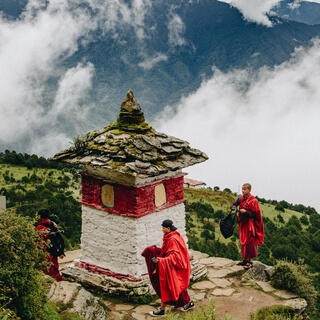
Sometimes,
Especially on retreats,
You'll see students kneel down and bow three times.
They'll prostrate three times before they sit.
Students are going to bow to the Buddha each time they enter or exit the sanctuary.
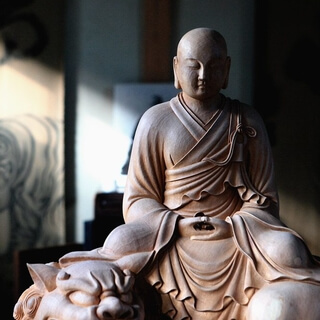
People will stop right in front and bow to the Buddha.
Some people like me will also bow to their cushion or bench before they sit.
I don't do this on retreats when I'm leading because it freaks too many people out.
What is she doing?
And they wonder.
But when I'm on private retreat,
I do that.
Whenever you see this,
Please know that students are in no way worshiping.
They're not worshiping the Buddha.
We are bowing in gratitude for the human example that he presented and to all the teachers that came after him and most importantly,
Again,
For our own capacity for awakening.
We're bowing to that.
So often when I bow,
Especially when I'm bowing before I sit to my cushion,
I'll inwardly say an affirmation or prayer like,
May I learn from this sit or may I keep my heart open to whatever arises,
May I let go,
Whatever it is.
If you're ever on a retreat,
Usually longer retreats,
You'll also see some people bowing their heads before they eat a meal.
And for me,
I have a whole ritual around this that I just love because I have time to do it.
It's like when you're in your busy life,
You just don't always have time for that.
But on retreat,
That's what you're doing.
The whole retreat is like a big prayer.
And so after I filled my bowl,
Which I usually just make about as big as my hand while I'm on retreat,
Believe it or not,
I don't eat that much.
And I'll hold it in my hands and close my eyes and I'll bow my head and I'll smell whatever's in the bowl and I'll feel the warmth of the bowl in my hands.
And I start out by thanking everyone who was involved in the process.
People had to prepare my food for me.
I didn't do that,
It just was there.
People had to go to the grocery store maybe or go to the farmer's market to get the oatmeal that's in the bowl or the cows that had to produce the milk that produced the yogurt that's in there and the people who had to hand bake the granola.
And I just go through that.
And then I give thanks to the earth and the air and the sun and the water for creating this meal for me.
Just grateful,
Just have gratitude.
And then I'll offer a prayer that goes something like this,
May all beans feel warm and held and safe and nourished and loved.
And I'll think of all the beans that I imagine them being held and loved and safe,
Especially the ones that might not be right now.
May they,
Just that longing of may they please have a hot meal,
Maybe they feel held.
So I do that every meal on retreat,
Every meal.
So if you go on a retreat and you see people doing this,
Please know that most of us are not thanking any gods or Buddhas for these meals.
We are thanking real people and real earth,
Air,
Water and sun and offering our prayers and wishes out to real beings who are living on this earth with us.
You might recall again that the Buddha himself was not a god.
He was a human who achieved enlightenment and freedom from suffering and thankfully lived another 45 years to teach all of us that we all have this capacity.
There's a famous story about the time right after the Buddha's enlightenment where he said that everyone who met the Buddha could just tell,
They could sense this change in him,
It was palpable.
And legend has it that soon after he awakened in the Bodhi tree,
As he was walking past a fellow traveler on the road,
The man was struck by the Buddha's unusual radiance and his peaceful demeanor.
So much so that he stopped him and said,
My friend,
What are you?
Are you a god?
The Buddha said,
No,
Not a god.
He said,
Are you some kind of a magician?
No,
Not a magician.
He said,
Are you a man?
The Buddha said,
No.
He said,
Well,
My friend,
What are you?
And the Buddha said,
I am Buddha,
Which means awake.
And the name stuck.
It's the Buddha.
And so today,
Whenever Buddhists pray,
What we're doing again is making an aspiration or a vow to train our own hearts and minds to open so that we can become and then be that kind,
Compassionate,
Generous,
Peaceful,
Awake person for both ourselves and others.
That's our aspiration.
The Tibetan Lama Sarah Harding describes Buddhist prayer this way.
He says it can be seen as aspiration,
As setting your mind in a certain direction.
Whether you have a particular other being or other power in mind is not necessarily the main thrust of it.
The main point is that you are putting your mind in that direction.
For instance,
If you send a Christmas card that says,
May there be peace on Earth,
You are not necessarily asking someone to bestow it.
You are simply making that aspiration.
Similar.
So in Buddhist tradition,
Sometimes this aspiration is expressed in physical objects,
Which act as symbols for our wish for all beings to be free from suffering.
And so you'll find some of these things in homes where Buddhists live.
Some of you may have them in your own homes.
Just like you might find a rosary or a cross in a Christian home,
These are the things that you find in a Buddhist home.
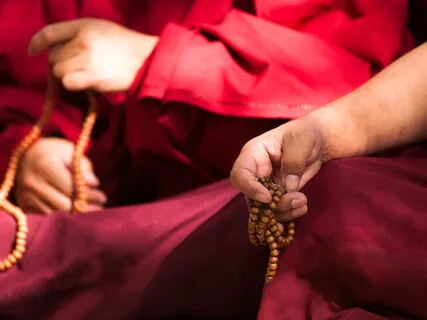
And these things include objects like prayer beads.
They're called prayer beads sometimes.
And these are used to focus the mind on repetition of prayers or mantras,
Just like similar to a rosary.
And I'm sure most of you have seen the colorful string of Tibetan prayer flags.
Who has these?
A bunch of you,
Yeah.
And these are usually covered with auspicious symbols and mantras.
And the idea,
And I love this,
They're so beautiful,
I think.
The idea is that when the wind blows through them,
They're sending blessings and good fortune and well wishes and metta to all beings.
Another beautiful Tibetan practice that I love is the turning of the prayer wheels.
And these actually come in all sizes.
So there's some really giant,
Elaborate wheels that need many,
Many people to turn them.
It's like a whole ritual.
And then there are simply these handheld ones that you can hold in your hand and spin,
Right?
And as they spin,
They're symbolizing our wish or prayer to send blessings and metta to all beings.
And there's one monk,
Gosh,
I can't remember his name.
I watched a whole documentary on him.
And I don't know how he does it.
He's part blind.
But he does this all day.
He goes around all over the world.
And he has a prayer wheel in his hand,
And he just spins it all day,
Sending blessings.
And he looks like just the happiest man you'd ever want to meet,
Ever.
I just love him.
I'm going to come up with his name next week so I can tell you what it is.
And really,
Since none of us here,
I don't think,
Are all-knowing,
Omniscient gods,
We really don't know whether or not anyone or anything is hearing us when we pray,
Do we?
Do we know for sure?
We just don't know.
We don't know if our wish or our aspiration for ourselves and others is actually creating a real ripple effect in the world.
We don't know.
Although personally,
I like to believe that this is true,
That our own prayers and aspirations do create a ripple effect,
Since as the teachings show us,
Again,
We're all connected.
So how can it not?
The Zen priestess,
Zen Chosen Beis,
Tells us,
We know that there are invisible presences all around us.
There are comedies,
Tragedies,
Soap operas,
Rap music,
And 911 calls in the room,
But we can't hear them if we don't have the right receiver,
Such as a radio,
Computer,
Cell phone,
Or TV.
The range of light and sound that our human bodies are able to perceive is quite narrow.
It seems entirely possible that there are many unseen forms of existence surrounding us.
Perhaps they dwell in other dimensions of space-time.
Why not be humble and ask them for assistance?
Our asking makes us a receiver,
A vehicle through which they may be able to move and act.
She's saying,
Why not?
I also recently read a story about the director of the Center of Integrative Medicine at Thomas Jefferson Hospital in Philadelphia.
This doctor has been studying the effect of prayer on the brain for more than 20 years.
This doctor,
Dr.
Andrew Newberg,
Says that when we pray,
It literally changes not only the chemicals in our brains,
But it positively affects things like our heart rate and our blood pressure and even our immune system,
Which of course is absolutely going to affect our well-being and healing these things.
He said that the area of the brain associated with a sense of self began to,
Quote,
Shut down in these studies.
This is the interesting part to me.
He said,
You become connected to God.
You become connected to the world,
And your self sort of goes away.
And of course,
Again,
This sense of no self and our innate connection is exactly what we're aiming at through our practice.
And a wonderful example of this comes from the Dalai Lama,
Who begins every single morning,
Every day,
By reciting the Bodhisattva prayer from Shantideva,
Who's an eighth century Buddhist monk,
Very famous.
And by the way,
When you hear the word Bodhisattva,
Sometimes when I'm writing letters to my students after a retreat,
I confuse them by calling them Bodhisattvas.
But it really means any person who's stepped under the path towards enlightenment,
Which basically means you and me,
Bodhisattvas.
In the Mahayana tradition,
It refers to anyone who has generated bodhicitta,
Which is just a compassionate wish to attain Buddhahood,
To benefit all sentient beings.
How many of us in here want to do that?
Yeah.
OK.
So you're Bodhisattvas.
There you go.
And because this Bodhisattva vow is so ancient,
There are actually many,
Many different versions,
Many versions,
If you look this up.
But this one's my favorite.
And this is apparently the same one the Dalai Lama recites every morning.
And if anybody wants this,
I'll send it to you.
I have it up where I can see it every day.
May I be a guard for those who need protection,
A guide for those on the path,
A boat,
A raft,
A bridge for those who wished to cross the flood.
May I be a lamp in the darkness,
A resting place for the weary,
A healing medicine for all who are sick,
A vase of plenty,
A tree of miracles.
And for the boundless multitude of living beings,
May I bring sustenance and awakening,
Enduring like the earth and sky until all beings are freed from sorrow and all are awakened.
Yeah.
Every day,
That aspiration.
There's also a very shortened version of this Bodhisattva vow,
Which is often called the four great vows.
A little easier to remember.
And it goes like this.
Sentient beings are numberless.
I vow to save them.
Delusions are inexhaustible.
I vow to end them.
Dharma gates are boundless.
I vow to enter them.
The Buddha's way is unsurpassable.
I vow to become it.
And there's also something that's often called the Buddha's Prayer,
Which is the famous Metta Sutta,
And it offers us a very similar aspiration.
And it goes like this.
Happy,
At rest,
May all beings be happy at heart.
Whatever beings there may be,
Weak or strong,
Without exception,
Long,
Large,
Middling,
Short,
Subtle,
Blatant,
Seen and unseen,
Near and far,
Born and seeking birth,
May all beings be happy at heart.
Let no one deceive another or despise anyone anywhere,
Or through anger or irritation,
Wish for another to suffer.
That's a Buddha's Prayer.
So oftentimes,
The actual Metta or loving-kindness practice is considered a type of prayer.
But again,
We're not appealing to someone or something out there.
We are practicing wishing for this,
Really longing for this,
As a way to train our own hearts to become that and to awaken bodhicitta,
Awakened heart-mind,
Bodhicitta.
And the Metta Sutta is a longer version of this,
But most often we practice with shorter prayer phrases that are easier to remember and offer.
Many of you will recognize these as simple phrases such as,
May you be happy,
May you be free from fear,
May you feel safe and at ease,
May you feel cherished and loved and held,
Some of the Metta phrases that we practice.
And of course,
This is just one of the numerous varied ways that we can practice with Metta and the Metta prayers.
But as with all the practices,
The most fundamental practice starts with ourselves.
It starts with ourselves,
Which the teachings show us is not at all a selfish thing,
Not a selfish thing.
Because the truth is,
When we can learn to offer ourselves our own kindness and compassion,
We're going to be much better able to offer it out to others.
So we start with ourselves.
In fact,
Metta,
Which is our deep wish for ourselves and others to be happy,
Is what actually motivated the Buddha not only to search for enlightenment,
Actually that was his motivation,
But to teach it after he discovered it.
Quote,
For the good of the many,
For the happiness of the many,
At a compassion for the world.
So this is actually really crucial for us to understand that our wish and prayers for our own happiness,
It's really important.
So for instance,
Think about what happens to our minds and our hearts when we have the opposite wish,
Kind of an opposite prayer,
If you think about intention.
So what happens when we're feeling hatred or aversion towards ourselves in the mind and the heart?
How does that affect it?
How about even when we maybe feel like we deserve somehow to be punished?
How many of us here punish ourselves,
Beat ourselves up?
Who beats themselves up?
Right,
And how does that affect your quality of life?
How does that affect your ability to offer that kindness and compassion out?
How we interact with other people?
So it's crucial,
It's crucial that we wish ourselves well.
We wish ourselves kindness and compassion and joy and peace.
And so an important part of our practice is to actually notice this.
When we're maybe in some way wishing some sort of punishment on ourselves,
When we're beating ourselves up,
When we're training our mind in that way,
Or when we're wishing other people harm in some way or wishing for bad things to happen to them.
That's a prayer,
Right?
If you really think about it,
Because it's training your mind,
It's an intention.
You know,
For instance,
When you suddenly catch yourself hearing distant thunder and you think,
Oh lordy,
I hope that particular parade gets rained out today.
Don't do that.
It's really important that you've noticed that you're doing it though,
Right?
But then you have to really consider,
Like really consider what am I nurturing here?
What am I praying?
Am I praying for that,
And how is that really affecting my heart?
We're practicing ill will.
So you can catch it.
And again,
When we're practicing or praying in the Buddhist tradition,
We're really practicing to let go of our small sense of self while trying to connect with something that is larger than ourselves,
Our small sense of self.
But importantly,
We do this without also diminishing ourselves in any way.
So we're connecting to a larger whole,
But we're not diminishing ourselves in any way.
My friend and teacher mentor Tara Brock explains it this way.
When we're suffering and turn to prayer,
No matter what the apparent reasons for our pain,
The basic cause is always the same.
It's always the same.
We feel separate and alone.
Our reaching out is a way of relieving ourselves of this pain of isolation,
Yet the Bodhisattva's aspiration radically deepens the meaning of prayer by guiding us to also turn inward.
We discover the full purity and power of prayer by listening deeply to the suffering that gives rise to it.
Like a great tree,
Such prayer sinks its roots into the dark depths in order to reach up fully into the light.
This is what I call mindful prayer,
Opening wakefully to our suffering and allowing ourselves to reach out in our longing for connection.
Irish poet and priest John O'Donohue writes,
Prayer is the voice of longing.
It reaches outwards and inwards to unearth our ancient belonging.
The more fully we touch our pain and longing,
The more fully we are released into boundless compassionate presence.
And so in the Buddhist tradition,
We are asked to keep this kind of longing or yearning for happiness and freedom for ourselves and others in our minds and hearts in a very continual,
Conscious,
Mindful way.
It is not something we just think about every once in a while when we sit down and meditate,
But in each and every single moment.
The great insight teacher Joseph Goldstein gives us a great easy way to practice this in our daily lives.
He says,
As an experiment,
The next time you're doing an errand stuck in traffic or standing on line at the supermarket,
Instead of being preoccupied with where you're going or what needs to be done,
Take a moment to simply send loving wishes to everyone around you.
Then there is an immediate and very remarkable shift inside as we feel more connected and more present.
So it doesn't have to be a difficult thing,
But we need to remember and be mindful of it.
Ah,
Let me try this,
Right?
If you want to go deeper than this,
You might consider how the monastics practice prayer,
Which is again continually,
All the time.
Again,
The Zen teachers,
Dan,
Jose,
And Bay describes this in a wonderful passage that I want to read to you.
It's a little longer,
But I think it's such a beautiful explanation that I really want to read the whole thing.
She's talking here about the Great Vow Monastery in Oregon.
It's an interesting title for the name of the retreat center,
Right?
The Great Vow Monastery,
That's what they do all day.
She says,
We hold chanting services four times a day in which the word pray comes up again and again.
We pray for the wellbeing of a list of people who are ill and for serene transitions for those who have recently died.
We pray that the world be free from violence,
War,
And disasters.
We pray for assistance from all the enlightened and holy beings who have come before us.
We express our deep gratitude to our Dharma ancestors and pray that their vows will be fulfilled through us.
We pray to maintain steady practice up until the time of death and beyond.
One chant begins,
Quote,
Our deepest prayer is to be firm in our determination to give ourselves completely to the Buddha's way so that no doubts arise however long the road seems to be.
And ends with,
Our further prayer is not to be extremely ill or be suffering at the time of departure so that we can quiet the mind to abandon the body and merge infinitely into the whole universe.
We pray with meals.
We reflect with gratitude on all the beings whose life energy has flowed into the food in our bowls,
Sacrificed so that we might have more abundant life.
And we pray that all beings will be as well nourished as we are.
We pray to be able to turn obstacles into fuel for enlightenment.
We pray to cultivate a mind like a lotus growing pure and upright out of the muddy water of delusion.
Before beginning our work,
We pray that our labor will purify our hearts,
Benefit the earth,
And help free all beings from suffering.
We pray that we will cultivate,
Accomplish,
And manifest the enlightened way together.
We do not pray to a person or a god named Buddha.
We pray to the whole that gives rise to and has agency through the many.
We pray that enlightened qualities become our continual way of life,
Bringing benefit to us and all we encounter.
We direct metta towards our self,
Silently asking,
May I be free from fear and anxiety?
May I be at ease?
May I be happy?
Once we are replete,
We turn those prayers towards others.
In that act of vow,
We find humility,
And in humility,
We again enter prayer.
Denon Katergi Roshi,
In returning to silence,
Wrote,
Finally you say,
Please,
Please make me simple,
Please make me free.
The moment that you call saying please is called avalo kichvara.
There is no subject who is calling,
And there is no object you are calling upon,
Because the one who is calling upon something is simultaneously what one is looking for.
That is avalo kichvara,
Which is the bodhisattva of compassion.
The prayer is not directed at ourselves,
Yet we are the place where the prayer is answered.
I'll read that last line again.
The prayer is not directed at ourselves,
And yet we are the place where the prayer is answered.
All right.
In these last five minutes or so,
I want to offer you the metta prayer.
We'll end with the metta practice.
So just coming into a nice posture.
For those of you who would like to,
For this particular practice,
You have some options.
If you feel comfortable,
You can place the hands together in prayer at the heart,
And bow your head.
Or you can hold a hand to the heart,
Or both hands.
Let's connect with the heart.
You can also just flip the palms up in a gesture of offering.
It's helpful to have the body express this idea of aspiration offering.
Breathing right directly into the heart center with the intention of a bodhisattva.
To find freedom for oneself and others,
To be that awakened heart,
Awakened heart mind,
Bodhicitta.
With that intention in mind,
Hearing these words in the mind,
Offering your well wishes,
Your prayer to yourself.
May I nurture gratitude,
Grace,
And ease in my life.
May I be secure and grounded.
May I be happily and successfully contributing.
May I be kind and compassionate to myself as well as to others.
May I be healthy and free from both internal and external harm,
Adding whatever words you need.
Giving yourself your own meta prayer phrases.
Really longing for that.
Let your longing be big.
How big can your longing be?
Breathing with the heart,
Sensing into the heart.
You might now remember your sangha.
All the people here that came to gather tonight to practice together.
You might imagine different faces,
Different people,
Sense their presence here in the room with you.
And how grateful you are to have a sangha every Tuesday,
These people that create sangha,
Including yourself in this circle.
And sense your longing for their happiness,
Their well-being.
Please sense that.
And then offer these words.
May you nurture gratitude,
Grace,
And ease in your life.
May you be secure and grounded.
May you be happily and successfully contributing.
May you be kind and compassionate to yourself as well as to others.
May you be healthy and free from both internal and external harm.
Really wishing this for your sangha members.
Adding whatever prayer you'd like to add.
Your wish.
Your longing.
And then see if you can extend that longing and that wish,
That aspiration out to all the people that you know in your life,
People you care about,
Friends,
Loved ones,
Neighbors,
Community members.
Think about your longing for their happiness.
Sensing that in the heart and offering out these words.
May you nurture gratitude,
Grace,
And ease in your life.
May you be secure and grounded.
May you be happily and successfully contributing.
May you be kind and compassionate to yourself as well as to others.
May you be healthy and free from both internal and external harm.
Staying with it.
Adding whatever you would like to add.
Sensing how big your longing can be for that.
And widening that circle even further to include all sentient beings.
All of us.
All over the planet.
Whole planet.
All of us.
Can you imagine that?
All living creatures,
Including those that fly in the sky,
Swim in the ocean,
Crawl on this earth,
And are planted in the earth,
All of us.
May we all nurture gratitude,
Grace,
And ease in our lives.
May we all be secure and grounded.
May we all be happily and successfully contributing.
May we all be kind and compassionate to ourselves and to each other.
May we all,
Including this planet,
Be healthy and free from both internal and external harm.
Staying with it.
Adding whatever else,
What other words or prayers you'd like to add.
All beings.
Finally listening to these words from Fred Lamott.
You started meditation to find more clarity,
More energy.
You stumbled into the vast ocean of the present moment.
You discovered wonder.
No past,
No future.
No time left for anything but gratitude.
That's when the waves of devotion broke over you.
Not devotion to a saint,
But to your footsteps through this meadow,
Faithfully following exquisite pathlessness.
Who is your teacher now?
A cluster of Queen Anne's lace on a nodding stem.
The vanishing hummingbird,
Hardly even here,
Who awoke your silence.
The next breath gracing your chest,
Her wings,
The sound of moonlight.
Bow wherever you are.
Bow wherever you are.
Bow wherever you are.
Bow wherever you are.