.
.
.
.
.
.
.
So many years ago,
A dear friend of mine and one of my very first teachers,
Pat Coffee from Charlottesville,
Said that those of us who practice meditation should really consider ourselves quote,
Contemplative artists,
Which I really like.
So we might think of our practice then as being like a type of canvas that we want to paint on.
And before we can experiment and get a little more creative,
We really do need to follow the general instructions and have a good idea of how to paint.
We really do need to have a good grounding in the foundations of practice.
But ultimately,
We get to decide what our practice looks like for ourselves,
Especially when we're deciding what we might need the most in the moment.
So for instance,
During our practice of being present and noticing,
We might discover that we're experiencing maybe a lot of aversion,
Either towards ourselves or others or maybe a situation that we're dealing with.
And right there in the moment,
We might decide that what we really need is to dive into the heart practices and consciously work on softening our hearts rather than allowing them to harden.
Other times,
Maybe we notice that our thoughts seem to be what my friend,
The teacher,
Jonathan Faust calls caffeinated chipmunks.
And in this case,
We might decide that what we really need is to apply our concentration practices.
Other times,
Maybe what we notice is that we're really emotional or maybe upset about something and decide that what we really need to use is one of the different contemplative practices that can help us to take a good look at our thoughts and discover what we might be believing about something that's creating the emotion.
And of course,
I could probably go on and on and on about these.
But the idea here is that it really is up to us to decide what's most needed in the moment,
Not just during our practice,
But of course,
In our daily lives,
Which is why we're practicing in the first place.
And as many of you may recall,
The Pali word for mindfulness is sati,
S-A-T-I,
Which ultimately means to remember.
And so an important part of our mindfulness practice is to remember to do this,
To check in with ourselves often and ask ourselves in the moment,
What do I need?
What do I need?
Which of course is not easy,
Which is why again,
It's a practice.
Lately for me personally,
What I've been recognizing is that both my mind and my body have been experiencing a lot more stress than usual.
I've been noticing that I've been holding more things than usual and feeling a bit more heaviness,
More grief,
And also a little less clarity to be honest,
Because stress tends to lend itself to this.
And so as a contemplative artist then,
What I'm sensing is that what I really need right now is to very consciously nurture a quality the Buddha has called pasadi.
And pasadi is a Pali word that points to a sense of calm or tranquility,
Even a sense of joy or contentedness.
It's also often been translated as serenity or composure.
And because I am fully aware right now that I am not at all alone in this,
That so many of us are feeling overwhelmed these days,
I thought that I would explore this incredibly important quality of pasadi,
Starting with a story that I dearly love from the Buddha's life.
The story is actually a memory from the Buddha's childhood that he had,
Which many people believe was a key moment that ultimately led him to his enlightenment and also to the understanding of the middle way itself.
As you may recall,
The Buddha was born a prince,
Prince Siddhartha,
And he was showered with luxury until the late age of 29.
He was mostly sheltered until 29,
Until he made this radical decision one day to leave his home and everything he loved,
Including his wife and his newborn child,
And go out into the forest as a homeless ascetic in search of enlightenment.
And so for the next six years,
Siddhartha dove very intensely into his search and studied with many different teachers.
And near the end of those six years,
He believed very strongly,
As so many spiritual seekers of his day did,
That punishing and depriving his body is what would ultimately lead him to freedom,
To nirvana.
In fact,
He was such a devout student that he nearly killed himself with this practice.
And in the suttas,
The Buddha actually explains how emaciated and painful his body had become over this time.
Quote,
My limbs became like the jointed segments of vine stems or bamboo stems.
My ribs jutted out as gaunt as the crazy rafters of an old roofless barn.
The gleam of my eyes sunk far down in their sockets looked like the gleam of water sunk far down in a deep well.
If I made water or evacuated my bowels,
I fell over on my face.
If I tried to ease my body by rubbing my limbs with my hands,
The hair rotted at its roots fell away from my body as I rubbed because of so little eating.
That's a pretty harsh description of where he was.
And he was basically dying,
As you can imagine,
And was lying under a tree in this state in great pain and suffering when a young woman from a nearby village passed him by and could clearly see that this monk was dying.
And so she offered him some milk rice,
Which finally Siddhartha agreed to eat.
This young woman,
Sujata,
Saved his life,
Really,
And then for many months afterwards continued to gradually nurse Siddhartha back to health.
During this time,
As he was recovering and meditating under a tree at the river's edge,
A memory from his childhood came to him.
In this memory,
He was just eight years old,
And you might imagine this scene yourself from his memory.
It was when he and his family were all attending a big annual ceremony where the whole town had gathered for the first plowing of the fields.
And so people were all dressed up in their best clothes,
And the trees were all decorated with colorful flags and other things.
And there were tables and altars filled with foods and drinks and holy men leading prayers and chants asking for things like healthy and vibrant crops,
Et cetera.
So it was very festive.
And as you might imagine,
After a while,
Many of the children just started to get really antsy with all the adult goings on.
And so they ventured out into the fields,
And Siddhartha followed them and did this as well.
But because he was a very curious child,
He ended up walking alone as close to the fields as he could so that he could watch the men who were plowing the fields with the buffalo.
And so Siddhartha was watching the man who was the closest to him and noticing how tired the man looked and how hot the man's back was bare and the sun was shining off his sweat.
And of course,
The buffalo looked tired too and also seemed hot,
Seemed to really be laboring to pull this heavy plow through the earth and being whipped by the man to go faster.
And in the soil that was being dug up,
Siddhartha noticed hundreds of worms.
And to his great horror,
He explained how they were all wriggling in distress to get away and writhing in pain as they were chopped in half by the blades.
This is what he was noticing.
He also noticed that there was a flock of small birds who were busy eating these helpless worms.
And then there was a hawk who flew down and scooped one of the birds up into its talons.
So in that moment,
This eight-year-old seeing all of this,
He became very overwhelmed and felt all this fear and pain and struggle watching the man and the buffalo and the worms and the birds and the death.
He was really upset about this and he was sweating in the afternoon sun.
And so he instinctively left and made his way to the nearest tree,
Which is a rose apple tree,
Apparently,
Just to get away from all the commotion and the noise of the other children as well.
And as he describes it,
He felt a relief right away to be in the cool shade of this tree.
And there was also a large slab of rock that was also cool where he could sit and feel this kind of relief as well.
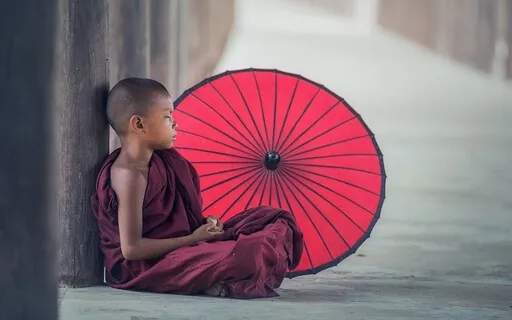
And as he sat down,
He apparently curled his little legs up beneath him and closed his eyes.
And then he rested his hands on his lap and just sat that way,
Breathing,
Reflecting on what he had just seen.
As he continued to sit in this way,
He gradually felt himself becoming saturated by this great feeling of compassion for all the beings that he had witnessed.
And this compassion actually included himself for having had to witness such suffering.
And apparently,
Siddhartha sat like this for hours in what has often been referred to as the first meditation.
This was the first meditation.
And during this time as Siddhartha breathed and focused on his compassion and his innate connection to all these beings,
What he noticed was that his mind had gotten extremely still.
In fact,
His thoughts had quieted down so much that he experienced a deep tranquility and calm that apparently allowed him to see things even more clearly and to have these great profound realizations about life itself.
Apparently he was so absorbed that by the end of the day when his family finally found him there still sitting,
They noticed that while all the other shadows had shifted with the sun that the shadow under the rose apple tree had never moved.
Throughout the day it had just continued to shield this young prince.
And when the older Siddhartha then,
The one who was dying,
Recalled this memory of his childhood,
What he realized was that in order for us to discover freedom on our path,
We not only need joy and compassion,
We also need the qualities of tranquility and calm.
And that striving and punishment is not the way to freedom.
What he realized is that we don't need to beat ourselves up or push ourselves in order to find this freedom.
What we need to do instead is to soften.
To soften.
And what we're softening is mind,
Body,
And heart.
So even back then this idea was considered really radical.
And actually it still is today if we think about it for honest.
Because it's still really the opposite of what we think we need to do,
Isn't it?
In order to gain freedom.
There's a lovely short poem that I love from the poet Nariyah Waheed that really reminds me of this teaching.
She writes,
You do not have to be a fire for every mountain blocking you.
You could be a water and soft river your way to freedom too.
You could be a water and soft river your way to freedom too.
Just love that.
I also like to think of all the great spiritual leaders and how they all exemplify this quality of calm in order to create great change in our world.
The great monk Piyadasi Mahatara said this about the importance of cultivating this quality of calm.
And by the way,
Before I read this,
I took the liberty to change the original quote which used the word man.
So I hope you can hear it better this way.
He said,
The tathagata,
The tamed,
Teaches the Dhamma for the purpose of taming the human heart.
A disorderly mind is a liability both to the owner of it and for others.
All the havoc wrought in the world is wrought by those who have not learned the way of mental calm,
Balance and poise.
Balance is not weakness.
The calm attitude at all times shows a person of culture.
It is not too hard a task for a person to be calm when all things around them are favorable.
But to be composed in mind in the midst of unfavorable circumstances is hard indeed.
And it is this difficult quality that is worth achieving.
Or by such control one builds up the strength of character.
The most deceptive thing in the world is to imagine that they alone are strong who are noisy or that they alone possess power who are fussily busy.
The person who cultivates calm of mind does not get upset,
Confused or excited when confronted with the eight vicissitudes of the world.
They endeavor to see the rise and fall of all things conditioned,
How things come into being and pass away.
Free from anxiety and restlessness,
They will see the fragility of the fragile.
Really great passage.
And as I reflect on this,
I also like to think of the words that are often used to describe the opposite of calm and composure.
Just things like hot headed or hot tempered.
I also like to imagine someone with smoke literally coming out of their ears or maybe someone trying to tear their hair out literally like it's on fire somehow.
Of course we've all been here,
Haven't we,
At some point or another.
We've all experienced being frustrated and angry and upset or maybe even felt like our heads might truly be on fire.
If we think about it,
Whenever caught up in a story of some sort or struggling in some way,
Doesn't it really feel like both the mind and the body are actually hot?
Like there's a kind of fire in the mind,
A fire in the body,
Like we're maybe burning up with something.
I really find that image helpful,
Especially since the quality of basadi has often been described as the cooling factor,
Something that cools the heat or the fire of both the mind and the body.
It actually has a quality of refreshing us.
We also might recall that the Buddha's childhood memory involved his sitting on a cool rock under the cool shade of a tree.
And so basadi essentially is what helps us to chill out,
If you will,
Keep our cool,
Cool down.
The great teacher Joseph Goldstein describes basadi this way.
He says,
It's what a tired worker feels upon sitting down in the cool shade of a tree on a sweltering day or what a child feels when her mother lays a cool,
Soothing hand on her feverish forehead.
In some versions of the story about the rose apple tree,
Actually the tree itself is believed to be a goddess in disguise,
A goddess who offers the Buddha the compassionate shelter of her arms and that same kind of care,
That soothing care like that of a mother or a loved one,
Not allowing the heat of the sun to burn him.
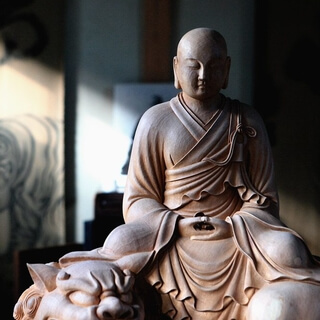
And traditionally Kuan Yin,
The bodhisattva of compassion herself,
Is shown holding a vase.
And inside that vase is the cooling water of basadi.
Many of you may know,
Many years ago I bought a big statue of Kuan Yin,
Which I almost always bring with me when I lead retreat.
And I really always like to look at the vase in her hands and be reminded of how precious that quality of basadi is.
It's like Kuan Yin is cradling this rare,
Precious,
Magical,
Cooling nectar.
And all we need to do to receive some of it is to remember that it's available.
That's all we need to do.
Just remember.
And if we want to receive even more of it,
More often,
What we need to do is to consciously nurture this quality within ourselves.
In fact,
Basadi is so crucial for us.
It's actually one of what are called the seven factors of awakening.
Qualities that are also sometimes called the satapojangas or the seven friends or treasures.
And these are seven profound qualities of mind and heart that are said to eventually lead us to awakening itself.
They're that vital for our practice.
And if you're interested or need a reminder,
The other six qualities,
The seven treasures,
Mindfulness,
Sati,
Investigation,
Vikaya,
Energy,
Virya,
Joy or rapture,
Pithi,
Concentration,
Samadhi and equanimity,
Upeka.
Those are the other six.
The good news for us is that they're actually innumerable ways that we can cultivate this quality of basadi.
But for this talk,
The short time that we have,
I wanted to offer you three main qualities that can help the most.
And traditionally,
These are the qualities of calmness,
Groundedness and spaciousness.
And here we can return to the Buddha's memory of sitting under that rose apple tree and recall the steps that he took.
So first,
He went somewhere really quiet,
Right,
To get away from all the hustle and bustle so that he could cool the fire of both his mind and his body and not add any more flames to it.
And of course,
We ourselves can do the exact same thing.
We can follow his example.
So for instance,
Whenever we find ourselves upset about something or feel anxious or angry or frustrated,
Hot headed,
If you will,
We might very consciously take a time out and find somewhere quiet so that we can start to cool the fire of the body and the mind.
Sometimes for instance,
When I find myself getting anxious in a conversation I'm having with my husband,
I will very gently raise my hand like a stop sign and patiently let him know that I need a little quiet time to calm down or cool down.
And then I'll usually go into my room and I'll practice a little bit and work on getting my footing back,
If you will.
And whenever I'm doing this,
It always helps me to remember that by taking a time out,
I am not somehow being weak or fragile or unable to handle stress.
I'm not simply avoiding what's happening in the moment.
I'm actually following what the Buddha himself did at age eight.
He was fully aware that he was experiencing stress and felt hot and instinctively went away to find quiet and calm along with,
Again,
Some comfort and compassion and some insight.
And so when he discovered that cool tree and rock,
You might recall that the very first thing he did was to curl his little legs underneath him and sit up straight and gently place his hands together,
Mainly because this was the most comfortable way for him to sit and it was a posture that he knew he could hold for a long time.
So again,
We can follow this example and just try to make ourselves as comfortable as possible.
Even by the way,
If this just means sitting in a cozy chair somewhere,
Maybe looking out the window and letting ourselves just be.
And for sitting more formally,
We also want to make ourselves as comfortable as possible by finding the best posture,
Not too tight,
Not too loose.
Again,
The instructions from the sutta.
And then very consciously relax the body,
Which of course helps to relax the mind since the two are not separate.
So this is very important.
In the famous Sadapatana Sutta,
Which is essentially the Buddha's main instructions for how we should practice,
He gives us instructions on how we should do this,
Which you might notice sounds very similar to that first meditation again when he was eight.
Here I'm going to read you the translation of the sutta from the Zen master Thich Nhat Hanh,
Which I like because he makes the pronoun feminine.
The instructions are as follows,
Quote,
She goes to the forest,
To the foot of a tree or to an empty room,
Sits down cross-legged in the lotus position,
Holds her body straight and establishes mindfulness in front of her.
And of course,
Just to say the lotus position was just the most comfortable way for the Buddha to sit,
But this really isn't necessary for us at all.
We truly just want to find a posture again that is stable and comfortable and sustainable and to find a quiet place to do this.
Also when the sutta says in front,
It's not saying to be mindful of something literally in front of us.
What is asking of us is to stay in the present moment right now by paying attention to what's right here in front of us,
If you will,
Not in the future,
Not in the past,
But right here moment by moment.
So we do this by paying close attention to whatever's happening,
Both inside and out.
And so we pay attention to what's happening all around us.
We pay attention to our bodies.
We pay attention to the mind and maybe most especially,
We really pay attention to what's going on in the heart.
And then again,
We might just try to let ourselves be,
Let ourselves be just like a child might,
You know,
Relaxed,
Open and curious.
We might even again imagine that little eight-year-old and how we might have really relaxed into this.
And whenever we're practicing,
We can try to allow ourselves to do the same,
Maybe by allowing ourselves to feel held by our common great mother,
The earth herself,
Who is actually always holding us and always will.
And of course,
This doesn't mean that we collapse in some way and just let everything go.
We do want to find a good balance between efforting and relaxing.
We want to find,
For instance,
An upright posture,
But then we want to balance this by again,
Relaxing the body.
So maybe we consciously drop our shoulders or unclench our hands or our jaw.
We might remind ourselves to relax our eyes and the forehead or remind ourselves to let even our tummy be soft so that we're not holding.
We might even consider,
You know,
How might a child's face look when it's being held by its mother or being held in some way.
Usually there's a kind of slight contented smile there,
Isn't there?
And so when we're practicing,
We can actually invite ourselves to do the same,
Just to place a very slight smile at the corner of the eyes and the lips.
And when we do this,
We're not only inviting a sense of calm,
But a sense of friendliness,
Metta to our practice,
Unconditional friendliness.
Never ever as a way of covering anything over,
But as a way of just bringing a kind of allowing,
A friendliness to whatever's happening right here in the heart.
What I find so interesting about this is that the Buddha actually suggested this thousands of years ago.
And today we know absolutely from modern science that bringing a slight smile to the face really does help calm the mind and the body.
It helps bring on the flow of these feel-good neurotransmitters,
Which can not only relax the body,
But can do things like lower our heart rate and our blood pressure.
So you might even just try it on right now as you're listening,
Just put a slight smile in the eyes and the face and see what happens.
So once we found some sense of calm and grounding,
We can then follow the Buddha's example again and do what the little Siddhartha did next,
Which was to focus on his breathing,
Which helped him to slow and cool both his body and mind.
And again,
Here,
What I find helpful to remember is that this doesn't just apply to our formal practice,
But we can put a very conscious attention on our breathing right in the moment,
Right in the middle of maybe a difficult situation or a difficult conversation.
Right in the moment,
We can take a couple of slow,
Conscious breaths and remind ourselves that we are consciously nurturing them or using them as a way to help us to cool down and to know that.
And here again,
We might recall the teachings and how we're being asked to do this from the Satipatthana Sutta,
Our instructions.
And I'd like to read from Thich Nhat Hanh's version again.
These are our instructions from the Sutta.
She breathes in,
Aware that she's breathing in.
She breathes out,
Aware that she's breathing out.
When she breathes in a long breath,
She knows I'm breathing in a long breath.
When she breathes out a long breath,
She knows I'm breathing out a long breath.
When she breathes in a short breath,
She knows I'm breathing in a short breath.
When she breathes out a short breath,
She knows I'm breathing out a short breath.
She uses the following practice,
Breathing in.
I'm aware of my whole body.
My whole body.
Breathing in,
I calm my body.
Breathing out,
I calm my body.
And the reason that this type of very close,
Curious attention to our breath can help us to cool the mind is because it can really help us to let go of all of those thoughts that are keeping us from being present.
Right?
So again,
The famous refrain from this Satipaṭṭhānasūta tells us we're to do this,
Quote,
Diligently,
Clearly knowing and mindful,
Free from desire and discontent in regard to the world.
I'll read that again.
We are asked to practice,
Quote,
Diligently,
Clearly knowing and mindful,
Free from desire and discontent in regard to the world.
So what this means is that we're being asked to let go of all those,
Quote,
Desires and discontents or all those thoughts that are maybe adding fuel to the fire of our stories,
Into our negative emotions,
Our fears and worries,
Our planning,
Doubts,
Etc.
So again,
The breath can really be like a cool hand settling on our feverish forehead.
We can soften our tight,
Clenched thinking and simply feel that kind touch in the form of the calmness and the sweetness of our own breath.
We can let that breath be refreshing and cooling and calming.
It might also be helpful to remember that this practice of being mindful of the breath is something we can continue to use throughout our lives.
It's not something we need to move on from or graduate from into something much more complicated or complex.
In fact,
20 years after the Buddha became enlightened,
His personal attendant Ananda asked him this question.
He said,
Venerable Sir,
If people ask me whether you are still practicing meditation,
What should I tell them?
The Buddha said,
Yes,
I'm still meditating.
Ananda said,
What kind of meditation do you practice,
Venerable Sir?
The Buddha said,
Mindfulness of breathing.
Mindfulness of breathing.
So,
So important.
At the same time,
Just as the little Buddha did sitting under that rose apple tree,
We are also asked to practice the third thing that he did,
Which is to pay very close attention to our hearts.
So,
When we're practicing,
We're being asked to pay close attention to our own fear and our suffering and to really be with it and to nurture our compassion for both ourselves and for others.
A lot of the time,
What this means is remembering that we are not alone,
That we all experience pain and suffering and that it's okay to feel these very natural human emotions.
They are not wrong.
They are not wrong.
This is actually where the sense of spaciousness,
That third thing comes in,
When we can start to let go of our limited sense of self and get in touch with our innate connection to all beings,
To all things.
You know,
When we can stop taking everything so personally.
And the interesting thing is that the more we can begin to do this,
Instead of this letting go of self being a kind of scary prospect,
It actually ends up bringing us much more calm,
Much more ease and freedom because we become so much less defensive,
Less defensive.
For instance,
We might recall little Siddhartha's sense of connection to all those beings who were out in the field that day and his realization that what connects all living creatures,
All of us,
Is our wish to be happy and our wish to avoid suffering connects us.
We might also remember the truth that our deepest source of suffering and wounding is our sense of feeling separate and alone or maybe disconnected from the whole.
And so sometimes what can really help us with this is to remember and sense into our strong innate connection to the earth itself by reminding ourselves that we are truly literally a part of the earth.
We are each made of earth,
Air,
Fire,
Water and stars,
All of us.
We might also remind ourselves of the day of the Buddha's enlightenment when the demon god Mara stood over him along with his great army of demons and asked the Buddha who do you think you are to become enlightened.
Who is your witness?
He screamed.
And if you recall the Buddha at that moment reached down with his right hand and touched the earth and he said the earth is my witness.
The earth is my witness.
And on cue the earth shook,
Flowers rained down from the tree and the Buddha was enlightened.
And so touching the earth was the Buddha's way of claiming his innate belonging to all things.
Right?
He was saying I belong.
In fact we all belong and earth is our witness.
And again we can all use his example and remind ourselves that whenever we can remember I'm not alone.
That we are all intimately connected to the earth,
All beings and everything.
This is exactly what can help us to feel more safe and therefore more calm.
So I think I'm gonna end here and just for the last few minutes or so I want to invite you if it's available into a brief meditation with me.
So if you're sitting at home listening you might just find again a comfortable posture like the Buddha discovered when he was eight.
Something that's sustainable and comfortable.
Maybe closing the eyes.
If you're walking or driving you might feel your innate connection with the earth by sensing your sit bones,
Your feet connected to the earth,
Allowing the body to relax.
If you're sitting you can feel the same sensing the earth holding you.
Feet connected to the earth.
You might place a slight smile at the corner,
The eyes and the lips is a way of bringing friendliness,
Metta here,
Not covering over whatever's here.
You might relax the body,
Letting the eyes,
The forehead be soft,
Jaw,
Face muscles,
Neck and shoulders dropping,
Letting the tummy be undefended,
The child's belly naturally receiving the breath,
Letting go.
You might even let the center of the palms be soft and open,
The gesture of letting go and receiving.
You might if you haven't already start to get in touch with the breath.
Breathing in,
Aware that you're breathing in,
Breathing out,
Aware that you're breathing out,
Breathing in,
I'm aware of my whole body,
Breathing out,
I'm aware of my whole body,
Breathing in,
I calm my body,
Breathing out,
I calm my body.
Staying with that for a while,
Consciously slowing down,
Cooling down,
Softening,
Relaxing.
And as you're ready you might do the third thing that the Buddha practiced,
Which is to focus on the heart and see what's here in the heart.
You might even imagine breathing right into the heart area and allowing whatever's here to be here with great compassion and kindness for whatever's here.
And so continuing to breathe,
Maybe offering you a contemplation.
So one of the best ways that we can tap into this sense of calm is through the practice of gratitude and metta,
Unconditional friendliness.
These two heart qualities are considered the two main antidotes to our fear and worry.
The two main antidotes,
Gratitude and metta.
And so with a very kind heart,
I'd like to invite you to think of something you feel grateful for and allow yourself to really feel this in the heart.
Could be something small,
It doesn't need to be something big.
Really anything that comes to mind.
Each time you think of something,
Let it fill your heart with sense of gratitude.
Let it resonate in the heart and then gently think of something else and do the same thing.
Continuing in this way,
Remembering also to know that you're breathing,
Be present with whatever you hear in the heart and the mind and the body.
So you can feel free to do this.
I hope you enjoyed this talk.
These talks are always offered freely so that no one is ever denied access to these teachings and your support really makes a difference.
Dhanah is an ancient Pali word meaning spontaneous generosity of heart.
If you feel inspired to offer Dhanah,
You can do so by visiting my website at www.
Mindfulvalley.
Com.
Thank you so much.