So,
I wanted to start this talk with a confession,
Which is that I've been dealing with some pretty big struggles and situations in my personal life lately.
And because of this,
What I've been finding myself doing a lot of these days is leaning into a Buddhist practice that is often very confusing to those of us who might not have grown up knowing anything at all about the Buddhist teachings.
And this is the practice of prayer.
When I was very little,
I actually didn't know a lot about prayer at all from any tradition or religion actually,
Because my very young hippie parents had at that time completely sworn off their Catholic upbringing.
And so whenever we would drive from lower Michigan to the upper peninsula of the UP to visit my grandparents,
Usually for Christmas or Easter,
The holidays,
My little Italian grandmother would teach me in secret how to kneel down next to my bed and say the Lord's Prayer.
And I actually dearly loved to recite this later on when I came home in secret,
Especially that part about give us this daily bread.
It was on my own.
I had no idea.
And so I can't tell you how many years I actually thought that Wonder Bread came from God.
It would come.
But honestly,
I also love that part where I got to ask not only for forgiveness for myself,
But for those who trespass against us,
Along with the wish to not be led into temptation,
But to be delivered from evil.
And my grandmother,
I think,
Was maybe the sweetest person I've ever known on this earth.
And even though I didn't get to see her very often,
She is the one who taught me how good it felt to want to be good,
To want to be kind and caring and generous,
And to want deeply to connect to something greater than my small sense of self.
She showed me that that was possible.
And actually,
As it happens,
This is also exactly what the Buddhist practice is trying to show us as well.
That both having and nurturing the intention to be kind and compassionate,
Caring,
Generous,
Humble,
Wise,
And peaceful for both ourselves and others can not only bring us more joy and ease in our lives,
But can also bring us a sense of not being alone,
Of not being separate,
Which the Buddha tells us is actually our deepest source of pain and wounding,
That feeling of being separate.
And the truth is that as we practice offering up these prayers,
It really does nurture those qualities within us of kindness and compassion,
Caring,
Generosity,
Humility,
Wisdom,
Peacefulness,
Even if our wishes for ourselves and others never comes to pass.
It is actually our intention that is crucially important here.
And it's actually the opposite of what happens when we are pursuing more selfish wants,
Which as the teachings show us doesn't lead to happiness at all,
But instead tends to bring ourselves and others more pain and suffering,
More disconnection.
And of course,
Our entire practice is really aimed at this,
Isn't it?
At loosening our strong sense of self and recognizing our innate connection to a larger and greater whole.
And happily,
The practice of prayer is considered one of the ways that we can nurture this intention for ourselves and further train our minds and hearts to live more through the qualities of selflessness.
Bhanteelila Wamilla,
A Terravan monk,
Describes our training this way.
Says,
If any practice that leads to ultimate purity or unlimited perfection is defined as prayer,
Then Buddhism is a prayer because that is what Buddhism is.
It is a practice that leads to an end.
There are two areas,
Theory and practice.
Practice is what you really do and theory is why you do what you do and what you're going to get by doing what you're doing.
What is the goal,
The end result of the practices?
In that sense,
Perhaps we could say it is a prayer.
And as the teachings tell us,
Our whole practice rests on the tip of intention,
The whole practice.
And that especially goes for how we're being asked to practice prayer.
One of my favorite lines from the Pali Canon is when the Buddha tells us,
Whatever one keeps pursuing with one's thinking and pondering,
That becomes the inclination of one's awareness.
I repeat that.
It's such a great line.
Whatever one keeps pursuing with one's thinking and pondering,
That becomes the inclination of one's awareness.
The teacher Elizabeth Matus Namjel expresses the same idea this way.
She says,
Prayer is like riding a bike.
Our steering will always naturally follow our gaze.
The direction we go is up to us.
If we direct the mind toward making money,
We have a better chance of earning money.
If we don't,
It's doubtful we'll have enough to pay the rent.
And the same is true with our spiritual life.
Spiritual progress,
Human progress requires clear intention.
In the Theravadan Insight tradition,
Which is my tradition,
We actually don't often use the word prayer for what we're doing.
Instead you'll often hear the words aspiration or wish or vow.
Although sometimes we do call what we're doing a prayer.
In other traditions like the Vajrayana or Mahayana,
The word prayer is actually invoked a lot because these other two traditions do tend to focus more on the images of certain bodhisattvas or compassionate or cosmic Buddhas.
In fact,
In the Mahayana tradition in particular,
Practitioners often use different chants to make offerings to various Buddhas and Buddhisattvas or take vows before them.
Some even confess their sins to them or ask for forgiveness.
But again,
Even here,
The emphasis is always less on quote,
These beings exist and more on the idea that even these different Buddhas and bodhisattvas are an expression of or a metaphor for our own Buddha nature or awakened mind.
In Shin Buddhism,
For example,
The central practice is invoking the power and name of Amida Buddha by reciting the six syllable phrase,
Namu ambida butso,
Over and over and over again,
As a dynamic expression of the all oneness of reality,
Which is translated as quote,
I bow and entrust myself to the awakening of infinite light.
I bow and entrust myself to the awakening of infinite light.
So one of the key distinctions about Buddhist prayer as opposed to some other traditions is that we are not praying as an appeal to someone or something out there as something outside of ourselves.
But again,
As a way of nurturing or awakening or connecting to that which is inherently inside of ourselves.
Many of you may be familiar with the practice of taking refuge,
Which is something we can do formally or even informally as a way of dedicating ourselves to these practices.
And traditionally,
We take refuge or safety,
Trust in what are called the three jewels,
Which are the Buddha,
The Dharma and the Sangha,
The three jewels.
And when we're deciding to take refuge in the Buddha,
Which is the first jewel,
This does not at all mean that we're bowing down to some deity or saying that we are true believers or that the Buddha is somehow different from us or that he's a god.
That's not what we're doing.
We are taking refuge in our own capacity for awakening,
Which means our own capacity for compassion and wisdom,
As well as our capacity to recognize that we are not alone,
That we're all connected,
Which is a realization that actually leads to great joy and so much less suffering.
You might even recall that the Buddha himself was not a god.
He was a human who achieved enlightenment and freedom from suffering and then thankfully went on to live another 45 years to teach us that we all also have this capacity for awakening.
There's actually a very famous story about the time right after the Buddha's enlightenment,
Where it is said that everyone who met him could sense a change.
It was really palpable.
And legend has it that soon after he had awakened under the Bodhi tree,
He was walking past a fellow traveler on this wooded path and the man was struck by the Buddha's unusual radiance and his peaceful demeanor and he stopped him.
And he said,
My friend,
What are you?
Are you a god?
The Buddha said,
No,
I'm not a god.
He said,
Are you okay?
Are you some kind of a magician?
Again,
The Buddha said,
No.
But I said,
Well,
Are you a man?
And the Buddha said,
No.
And the traveler said,
Well,
What are you?
The Buddha replied,
I am Buddha,
Which means awake.
And the name stuck,
Buddha.
I am Buddha.
So when it comes to Buddhist prayer,
Though,
Especially if you're new to practice,
It can sometimes feel confusing the first time maybe like you attend an insight meditation retreat where you might see people kneeling down and bowing three times before each sit.
Or you might see people bowing to the Buddha every time they enter or exit the meditation hall.
Or you might see people like me who not only bow to the Buddha when I enter or exit the hall,
But I also bow to my cushion or my bench each time I get ready to sit.
And if you've ever seen this and wondered about it,
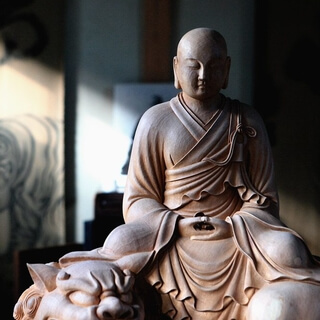
Please know that we are in no way worshiping the Buddha.
What we're doing is bowing in gratitude to his example and to all the teachers that came after him,
And most importantly,
To our own capacity for awakening.
And so for me,
Usually when I'm bowing before the Buddha,
My prayer is simply,
Thank you,
Thank you,
Thank you,
Thank you,
Thank you,
Thank you.
What it usually is,
Thank you for your example.
Thank you for your example.
And when I bow at my own cushion,
I usually inwardly say an affirmation or prayer like,
May I please learn from this sit or may I please keep my heart open to whatever arises during this sit or whatever I need.
Sometimes if you're on your feet,
You might also see people bowing their heads before they eat a meal.
And for me,
I actually have a whole ritual around this and I love it.
It's so helpful.
After I've filled my bowl,
I'll hold it in my hands and close my eyes and bow my head and take a moment to just feel the warmth of the bowl and smell the food.
And then I'll start by giving thanks to everyone who was involved in the process of feeding me,
The people who planted and grew the food,
The people who transported the food and bought it and prepared it,
Et cetera.
And if there are eggs,
I might thank the chickens for their contribution to my meal.
And I even then thank the earth and the air and the sun and the water for also helping to create this food.
And then I'll offer a prayer that goes something like,
May all beings everywhere feel warm and held and safe and nurtured and loved.
And I just love that I have time to do that on retreat because it really does help me to feel connected and not alone.
And it opens my heart.
And again,
If you go on retreat and see anyone doing this,
Please know that most of us are not thanking any gods or Buddhas for these meals.
We are actually thanking real people,
The real earth,
Air,
Water,
And sun,
And offering our prayers and wishes out to real beings living on this earth.
And again,
Whenever we're doing this,
What we're essentially doing is making an aspiration or a vow to train our own hearts and minds to open so that we can become and be that kind,
Compassionate,
Generous,
Peaceful,
Wise,
Awake person for both ourselves and others.
The Tibetan Lama Sarah Harding describes Buddhist prayer this way.
She says,
It can be seen as aspiration,
As setting your mind in a certain direction.
Whether you have a particular other being or other power in mind is not necessarily the main thrust of it.
The main point is that you are putting your mind in that direction.
For instance,
If you send a Christmas card that says,
May there be peace on earth,
You are not necessarily asking someone to bestow this.
You are simply making that aspiration.
So sometimes this aspiration is expressed in physical objects,
Which act as symbols of our wish for all beings to be free from suffering.
And you'll find these things in homes where a Buddhist lives usually,
Just like you might find a rosary or the cross in a Christian home.
These things include objects like prayer beads,
Which are used to focus the mind on the repetition of prayers and mantras.
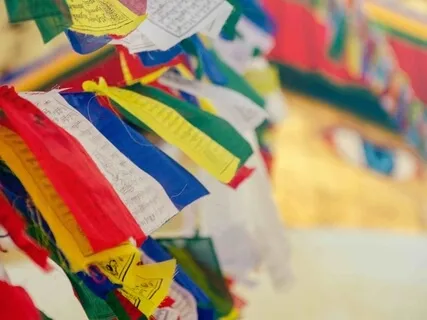
And I'm sure most of you have likely seen or even owned those colorful strings of Tibetan prayer flags,
Which usually are covered with auspicious symbols and mantras.
And the idea with these is that when the wind blows through,
They're sending blessings and good fortune to all beings.
Another beautiful Tibetan practice that I love is the turning of the prayer wheels.
And these come in all sizes.
And some are really elaborate wheels that need many people to turn.
And some are just simply handheld.
And these two are usually covered in mantras.
And as they spin,
Again,
They symbolize our wish or prayer to send blessings and good fortune to all beings.
And honestly,
Since none of us are all-knowing,
Omniscient gods,
We really don't know,
Do we,
Whether or not anyone or anything is actually hearing us when we pray.
Or if our wish or aspiration for ourselves or others is actually creating a ripple effect out into the world.
Although personally,
I like to believe that this is actually true,
That our aspirations really do create a ripple effect.
Since again,
As the teachings show us,
We really are intimately all connected.
The Zen priestess Sanchosin Beis tells us this,
We know that there are invisible presences all around.
There are comedies,
Tragedies,
Soap operas,
Rap music,
And 911 calls in the room.
But we can't hear them if we don't have the right receiver,
Such as a radio,
Computer,
Cell phone,
Or TV.
The range of light and sound that our human bodies are able to perceive is quite narrow.
It seems entirely possible that there are many unseen forms of existence surrounding us.
Perhaps they dwell in other dimensions of space-time.
Why not be humble and ask them for assistance?
Our asking makes us a receiver,
A vehicle through which we may be able to move and act.
I also recently read a story about the director of the Center of Integrative Medicine at Thomas Jefferson Hospital in Philadelphia,
Who has been studying the effect of prayer on the brain for over 20 years now.
This doctor,
Dr.
Andrew Knoberg,
Says that when we pray,
It literally changes not only the chemicals in our brain,
But it also positively affects things like our heart rate and our blood pressure and even our immune system,
Which of course absolutely affects our well-being and healing.
And he said it was particularly interesting to watch what happened inside the brains of a group of Franciscan nuns that he was studying when they joined in meditative prayer.
He said that the area of the brain associated with a sense of self began to,
Quote,
Shut down.
He said,
You become connected to God,
You become connected to the world,
And your self sort of goes away.
And of course,
The sense of no self,
Anatta,
And our innate connection is exactly what our Buddhist practice is aiming at as well.
A wonderful example of this kind of training comes from the Dalai Lama,
Who actually begins every day of his life by reciting the Bodhisattva vow from Shantideva,
Just the famous eighth century Buddhist monk.
And by the way,
When you hear the word Bodhisattva,
This really means anyone who has stepped onto the path towards enlightenment,
Which basically means me and you.
In the Mahayana tradition,
It refers to anyone who has generated bodhichitta,
A compassionate wish to attain Buddhahood for the benefit of all sentient beings.
And because this Bodhisattva vow is so ancient,
There are actually many,
Many,
Many different versions.
But this one is my favorite,
And apparently it's also the same one that the Dalai Lama recites every morning.
Those like this.
May I be a guard for those who need protection,
A guide for those on the path,
A boat,
A raft,
A bridge for those who wish to cross the flood.
May I be a lamp in the darkness,
A resting place for the weary,
A healing medicine for all who are sick,
A vase of plenty,
A tree of miracles.
And for the boundless multitudes of living beings,
May I bring sustenance and awakening,
Enduring like the earth and sky until all beings are freed from sorrow and all are awakened.
There's also a very shortened version of this Bodhisattva vow,
Which is often called the Four Great Vows.
And it goes like this,
Sentient beings are numberless.
I vow to save them.
Delusions are inexhaustible.
I vow to end them.
Dharma gates are boundless.
I vow to enter them.
The Buddha's way is unsurpassable.
I vow to become it.
I really like that one.
There's also the famous metta sutta,
Which is often called the Buddhist prayer.
And it offers us a very similar aspiration.
It goes like this,
Happy at rest.
May all beings be happy at heart.
Whatever beings there may be,
Weak or strong,
Without exception,
Long,
Large,
Middling,
Short,
Subtle,
Blatant,
Seen and unseen,
Near and far,
Born and seeking birth,
May all beings be happy at heart.
Let no one deceive another or despise anyone anywhere or through anger or irritation wish for another to suffer.
So that's the Buddha's prayer.
Sometimes the actual metta or loving kindness practice is considered a type of prayer.
But again,
We are not appealing to someone or something out there.
We are practicing wishing this,
Really longing for this as a way to train our own hearts to become that,
To awaken bodhichitta,
Awaken heart mind.
And the metta sutta is a longer version of this,
But most often we practice with shorter prayer phrases that are easy to remember and to offer,
Such as we might say something as simple as,
May you be happy.
May you be free from fear.
May you feel safe and at ease.
May you feel cherished and loved and held.
And of course,
This is just one of the many,
Many ways that we can practice with these metta prayers.
But as with all the practices,
The most fundamental practice starts with ourselves,
Which as the teaching show us is not at all a selfish thing,
Because the truth is where we can learn to offer ourselves our own kindness and compassion,
We are going to then be much more able to offer it out to others.
In fact,
Metta,
Our deep wish for the happiness of others is apparently what first motivated the Buddha himself to not only begin to search for his own awakening,
But to teach it after he discovered it,
Quote,
For the good of the many,
For the happiness of the many,
Out of compassion for the world.
So this is actually really crucial for us to understand that our wish and prayers for our own happiness is important.
This is the,
For instance,
You might think about what happens to our hearts and minds when we have the opposite wish for ourselves,
When we are somehow feeling hatred or aversion towards ourselves,
Or maybe even if we feel like we somehow deserve to be punished.
How does this affect the quality of our lives and how we interact with both ourselves and others?
Actually an important part of our practice is to notice this when we're maybe in some way wishing some sort of punishment on ourselves,
When we're training the mind in this way,
Or maybe when we're wishing others harm in some way or wishing for bad things to happen to them,
Even in really subtle ways,
Especially if we think they somehow deserve it.
Because that's really a kind of prayer,
Isn't it?
Right?
To wish for bad things to happen to someone.
So we need to honestly remember that those kinds of prayers are really serving to harden our hearts because what we're really practicing actually is ill will.
That's what we're practicing.
I also want to say that when we're praying in the Buddhist tradition,
We're really practicing to let go of a small sense of self while also trying to connect with something larger than ourselves and very importantly,
Without also diminishing ourselves in any way.
My friend and teacher Tara Brach explains it this way.
She says,
When we are suffering and turn to prayer,
No matter what the apparent reason for our pain,
The basic cause is always the same.
We feel separate and alone.
Our reaching out is a way of relieving ourselves of this pain of isolation.
Yet the bodhisattva's aspiration radically deepens the meaning of prayer by guiding us to also turn inward.
We discover the full purity and power of prayer by listening deeply to the suffering that gives rise to it.
Like a great tree,
Such prayer sinks its roots into the dark depths in order to reach up fully to the light.
This is what I call mindful prayer,
Opening wakefully to our suffering and allowing ourselves to reach out in our longing for connection.
Irish poet and priest John O'Donohue writes,
Prayer is the voice of longing.
It reaches outwards and inwards to unearth our ancient belonging.
The more fully we touch our pain and longing,
The more fully we are released into boundless,
Compassionate presence.
In the Buddhist tradition,
We are asked to keep this kind of longing or yearning for the happiness and freedom of ourselves and others in our minds and hearts as a very continual,
Conscious,
Mindful intention.
Not as something that we just think about every once in a while,
But actually in each and every moment.
The great Insight teacher Joseph Goldstein gives us this great and easy way to practice this in our daily lives.
He says,
As an experiment,
The next time you're doing an errand or stuck in traffic or standing online at the supermarket,
Instead of being preoccupied with where you're going or what needs to be done,
Take a moment to simply send loving wishes to all those around you.
Often there's an immediate and very remarkable shift inside us as we feel more connected and more present.
And so I encourage you to try that.
It's a really great way to practice prayer in our daily lives.
If you want to go deeper than this,
You might consider how the monastics practice prayer again,
Which is actually continually.
The Zen teacher,
Again,
Zen chosen bae describes this in a wonderful passage that I'd like to read to you.
It's a little longer,
But it's such a beautiful explanation that I really want to read the whole thing.
And she's talking here about the great vow monastery in Oregon and what they do.
She says this,
We hold chanting services four times a day in which the word pray comes up again and again.
We pray for the wellbeing of a list of people who are ill and for serene transitions for those who have recently died.
We pray that the world be free from violence,
War and disaster.
We pray for assistance for all the enlightened and holy beings who have come before us.
We express our deep gratitude to our Dharma ancestors and pray that their vows will be fulfilled through us.
We pray to maintain study practice up until the time of death and beyond.
One chant begins.
Our deepest prayer is to be firm in our determination to give ourselves completely to the Buddha's way so that no doubts arise,
However long the road seems to be.
And ends with our further prayer is not to be extremely ill or to be suffering at the time of departure so that we can quiet the mind to abandon the body and merge infinitely into the whole universe.
We pray with meals.
We reflect with gratitude on all the beings whose life energy has flowed into the food in our bowls,
Sacrificed so that we might have more abundant life.
And we pray that all beings will be as well nourished as we are.
We pray to be able to turn obstacles into fuel for enlightenment.
We pray to cultivate a mind like a lotus growing pure and upright out of the muddy water of dilution.
Before beginning our work,
We pray that our labor will purify our hearts,
Benefit the earth and help free all beings from suffering.
We pray that we will cultivate,
Accomplish and manifest the enlightened way together.
We do not pray to a person or a God named Buddha.
We pray to the whole that give rise to and has agency through the many.
We pray that enlightened qualities become our continual way of living,
Bringing benefit to us and all we encounter.
We direct metta towards ourself,
Silently asking,
May I be free from fear and anxiety?
May I be at ease?
May I be happy?
Once we are replete,
We turn those prayers towards others.
In that active vow,
We find humility and in humility,
We again enter prayer.
Dyanan Katigari Roshi in Returning to Silence wrote,
Finally,
You say,
Please,
Please make me simple.
Please make me free.
The moment that you call saying please is called Avalokitesvara.
There is no subject who is calling and there is no object you are calling upon because the one who is calling upon something is simultaneously what one is looking for.
That is Avalokitesvara.
The prayer is not directed at ourselves yet we are the place where the prayer is answered.
To think about living every day,
Every action of your day in prayer is pretty powerful.
With that,
I want to say that another incredibly important part of our practice of prayer can also be in the listening,
In the silence,
In the practice of letting go and receiving,
Of sort of asking and then listening for an answer from within rather than trying to constantly direct the show.
In an interview,
Mother Teresa was once asked about her prayer life and the interviewer asked her,
When you pray,
What do you say to God?
And Mother Teresa said,
I don't talk,
I simply listen.
And the interviewer said,
Ah,
Then what is it that God says to you when you pray?
And Mother Teresa replied,
He also doesn't talk,
He simply listens.
There's a long silence and the interviewer seemed a bit confused.
He didn't seem to know what to ask next.
So finally,
Mother Teresa broke the silence by saying,
If you can't understand the meaning of what I've just said,
I'm sorry,
But there's no way I can explain it any better.
I also love the way the poet Gregory Orr writes about this kind of listening.
He says,
Some days it's all fuzzy.
I can't find the world,
Can't find the beloved,
Can't even find the words.
Time to lie back and listen.
Maybe something's being said,
Something I haven't heard.
Time to stop talking and let the beloved speak.
Time to trust it all,
To stop searching and let the beloved seek.
And so I think I will end there and invite you into a brief meditation practice,
Which will include the Metro prayer.
So you might hear a bird in the back and the silence as the windows are open here.
And if it's available,
You might close the eyes,
Take a nice deep breath in,
Slow breath out,
Letting go,
Breathing in,
Breathing out.
And on each exhale,
Softening the body and softening the mind.
You might even do a quick body scan from the top of the head down slowly,
Noticing the body itself and letting there be a softening,
Melting,
Letting go.
You might notice the area of the face,
Allowing the forehead to be smooth,
Cheeks,
Jaw,
Eyes.
As a way of inviting metta kindness,
You might add a slight smile to the corner of the eyes and the lips,
Not as a way of covering anything over at all,
Just as a way of inviting kindness and compassion to be here in the mind,
Body,
Heart,
Still breathing,
Be allowing the shoulders to drop,
Allowing the tummy to be soft,
Maybe sensing the breath here as well,
Maybe sensing your sit bones,
And just allowing yourself to feel held by Mama Earth,
Feel your connection to the earth.
And feeling held,
You might allow yourself to let go even more,
Trust in that support of the earth.
As you're ready,
You might directly breathe into the heart center,
Allowing the heart to soften,
Imagining that,
Allowing there to be more space here,
Warmth.
If it's available and it feels okay,
You might place one hand or both on the heart,
But get in touch with the heart.
You might place one hand on the heart and one on the belly,
Your choice.
And I'm gonna be offering you a very simple metta practice just for yourself today,
Just to focus on your own heart and wish yourself well.
Wish again is the most important fundamental place where we start with ourselves.
And so focusing on the heart center,
You might hear the words,
May I nurture gratitude,
Grace,
And ease in my life.
May I be secure and grounded.
May I be happily and successfully contributing.
May I be kind and compassionate to myself as well as to others.
May I be healthy and free from both internal and external harm.
And then,
Noticing the heart,
Breathing into the heart.
Maybe repeating those words one more time in the mind.
May I nurture gratitude,
Grace,
And ease in my life.
May I be secure and grounded.
May I be happily and successfully contributing.
May I be kind and compassionate to myself as well as to others.
May I be healthy and free from both internal and external harm.
Continuing to offer yourself your kind wishes in however way feels good to you,
And staying with that.
Again,
If you've lost the smile in the eyes and the lips,
You might add these in again and see how that changes your well-wishing for yourself.
And finally,
With the eyes closed,
I invite you to listen to these words from Mary Oliver on praying.
She writes,
It doesn't have to be the blue iris.
It could be weeds in a vacant lot or a few small stones.
Just pay attention.
Then patch a few words together and don't try to make them elaborate.
This isn't a contest,
But the doorway into thanks and a silence in which another voice may speak.
Namaste and blessings.
I hope you enjoyed this talk.
These talks are always offered freely so that no one is ever denied access to these teachings and your support really makes a difference.
Dhanah is an ancient Pali word meaning spontaneous generosity of heart.
If you feel inspired to offer Dhanah,
You can do so by visiting my website at www.
Mindfulvalley.
Com.
Thank you so much.