Company.
It is pollкие.
Absolutely.
So for several years now,
I've become more and more aware that a pretty significant part of my own personal practice involves using what the Buddha called skillful means or kusala as I try to establish a better sense of balance in my life or maybe more specifically as I try to figure out how I can offer myself the same time and care and energy that I offer out so that I'm not becoming too unbalanced with this.
And so essentially what this is requiring of me is to become better skilled at something that historically I've not been very skilled at at all.
I've actually been pretty bad at which is setting good boundaries for myself.
Happily though the teachings I've discovered have quite a bit to say about this topic.
So for this talk,
I wanted to dive into this a little bit and explore what the Buddha has to tell us about how we can set better boundaries for ourselves so that we can find some more balance in our lives.
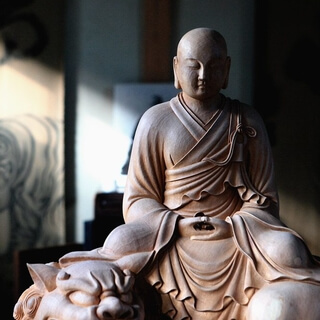
If you've ever seen a statue or an image of the Buddha,
You've likely seen him with his left hand held open on his thigh and his right hand facing outward like a signal to stop.
And to me,
This particular mudra or sacred hand gesture really feels like the mother load of all the sacred mudras because it implicitly implies balance,
Which of course is what we're trying to achieve when we're following the path of the Buddha's middle way.
And honestly,
I think it's my very favorite of all the Buddha's gestures,
Even though it's actually a combination of two different mudras.
So I'll explain that.
The first one is called the Virata mudra.
And this is the gesture of his left hand,
Which is held open at his thigh.
And this symbolizes an attitude of compassion and empathy and listening,
Receiving,
And a kind of softening and opening of the heart,
The Virata mudra.
This is combined now with the second mudra,
Which is the Abhaya mudra,
Which is the gesture of his right hand that's held out in front of him,
Which is said to quote,
Protect from both evil and ignorance,
To protect from both evil and ignorance.
And because of this description,
It symbolizes an attitude of fearlessness,
Protection,
And peace.
And so with these two simple gestures combined,
The Buddha is telling us that we absolutely need both.
We need both hard and soft,
Openness and protection,
Compassion coupled with wisdom.
And the idea here is that if we only nurture that protection piece,
For instance,
What's likely going to end up happening is that we'll maybe start pushing things away or not trusting or even fearing or hating.
And eventually these attitudes can tend to close us off or even harden our hearts.
But if,
For instance,
We're only nurturing our openness and our compassion and our empathy without also being wise about protecting ourselves and others,
Unfortunately,
We're essentially setting ourselves up for being taken advantage of or even harmed.
Recently I was listening to a great interview with Elizabeth Lesser,
Who I love.
She's the co-founder of Omega and she's also incredibly genuine and funny.
And in her book,
Her new book,
Broken Open,
She calls the Buddha's gesture,
Do no harm slash take no shit.
And in a similar,
Though less profane way,
The Zen teacher Joan Halifax has said that our practice involves having a soft front and a strong back,
A soft front and a strong back.
And again,
What we're being asked to cultivate is that sense of balance.
This summer I was introduced to a more modern version of the Buddha's balance gesture by the teacher and scholar,
Kristin Neff.
And as a way of encouraging ourselves to be strong and to offer ourselves a sense of protection or fearlessness,
What she does is invites us to place one fist over our heart,
Okay,
A fist over our heart.
And then she asks us to place our opposite hand very softly over our fist as a way of inviting empathy and compassion.
I just love this.
And if it's available,
You might even try it now,
A fist over the heart and then an opposite hand very softly over the fist.
Maybe just sense into your body and your heart even and see what this feels like.
To have that sense of balance of both fierce protection and fierce compassion,
To have both can be really a powerful gesture.
If you'd like,
You might even try the Buddha's mudra with the right hand held out in front of you like stop and the left hand held open on your thigh as a gesture of receiving.
It can be very different.
And for me,
I've been practicing a little with both of these gestures and they both feel very similar but also very different.
So for instance,
I usually try on the Buddha's mudra when I'm in a more formal practice and when I'm doing sitting practice.
And I try on Christen's mudra maybe like in the middle of my day when I feel like I need something a little stronger,
When I'm feeling like I need some sense of compassionate strength to get through something difficult that I'm experiencing in that moment.
In any case,
Along with that simple yet honestly very profound gesture that the Buddha gives us,
He had so much more to say about boundaries in the teachings,
Although he didn't use those exact words.
He spoke about it through many different teachings.
But again,
As with all the teachings,
It really comes down to developing a sense of balance,
Which means learning how we can offer equal care for both ourselves and others.
And before I begin,
I really want to make sure to clarify that working on our boundaries does not at all mean that we never put our own needs aside and take care of others or be there for them or do something kind for them.
It doesn't mean that at all.
It just means that when we do,
It should really be a choice that feels good for both.
In other words,
We should feel good about doing this.
When the Buddha taught about generosity or dana in the Pali language,
He said that giving should always bring happiness.
Giving should always bring happiness.
If it doesn't,
If it's simply done out of a sense of obligation,
It's likely not going to be the best or even the healthiest choice.
Over the years,
Some of the questions students have asked when they're struggling to understand boundaries to the teachings are things like,
Okay,
If there isn't a solid,
Permanent,
Reliable self,
What am I protecting?
Another question is,
The Buddha says we aren't separate,
That we're all essentially one.
So why is there a need for boundaries?
Another question that comes up is the Buddha says we're all supposed to love others like a mother might love their child.
So when I say no to someone,
I feel mean or unkind or even totally evil and selfish.
Finally another one is if I want to maintain a sense of myself as a kind person and have others see me as a kind person,
Don't I then need to sacrifice my own feelings and needs and put the needs of others first?
So those are some of the more common questions that come up.
So I'd like to start with that first one,
Which is if there isn't a solid,
Permanent,
Reliable self,
What am I protecting?
As most of us know,
The Buddha's teachings about no self or anatta are often the most complicated and probably the most misunderstood of all the teachings.
One of the first misconceptions is that the Buddha is somehow saying that we don't exist,
No self.
But of course we do.
We're all here as is everything around us.
We exist in each moment and we all of course need to live our actual lives.
We need to feed ourselves and go to work and pay our bills.
Buddha acknowledged that we all have very real and unique lives and that we are each precious and important to the whole.
He also taught that we are also constantly and forever changing as is everything else.
The chairs,
The walls,
The trees,
The sun,
The moon,
All of it.
We are all a part of the continuous flow of life and we are all impermanent as again is everything else.
And we are also not separate from one another.
Truly what we do in this world affects all the rest.
The author Stephen Joseph explains it this way,
Says,
We can still function as an apparent separate entity while enjoying the parallel reality of our infinite vast presence.
We need both realms.
When the cop pulls us over,
We still need to show him our license and not simply point to the sky.
So what this means is that while we are all constantly changing,
We also need to honor and respect and cherish and definitely protect the unique,
Amazing,
Actual,
Real person that is right here with all of our past conditioning and everything that has made us who we are today.
Where the suffering of self comes in is whenever we're trying to pin ourselves or anything else down,
When we're trying to hold on to anything or when we're trying to put labels on ourselves and then believing those labels and making them solid.
The Buddha also taught us that along with trying to pin ourselves down,
One of the main ways that we suffer is when we try to create a self that is either better than or worse than,
Better than or worse than,
Which means when we compare.
And this is really big because if you think about it,
You might ask yourself,
How often,
How often am I comparing?
How often am I comparing?
And if we're honest,
Don't we tend to do this with almost everyone in our lives?
Don't we?
Even with whole groups of people?
We all tend to make these evaluations,
Even sometimes as they're very subtle.
And it affects all of our relationships,
This evaluation,
And how we show up for these relationships.
And of course,
It tends to affect our sense of boundaries when we compare.
So if you think about it,
Whenever we're breaking our boundaries,
We're often doing this kind of comparing.
For instance,
We might believe we're quote unquote helping because we think someone is less than and needs our help.
Or we might be making ourselves and our needs in some way less than that of someone else's.
So it's either I need to do this for them because clearly they can't or are unable to do it for themselves.
Or I need to do this for them or allow them to do something because they're bigger or better or more important than I am.
Problem is,
Whenever we're breaking our boundaries in this way,
We might also notice if we are in some way believing that we are supposed to or should be a certain way.
When we're creating some kind of a label or identity or self that might,
For instance,
Be kind or humble or selfless or maybe saint like or sacrificing or nice,
When maybe our heart really isn't in it.
In those instances,
Then we might consider,
Am I doing this or allowing this because it's really the right thing to do or because it's making me feel better?
Or am I really more concerned about how I'm being perceived?
Right?
And by the way,
Perhaps the most painful part of this perception is about how we might be perceiving or judging ourselves in our own minds.
So whenever we're considering doing something or allowing something,
Breaking some kind of personal boundary,
It's super helpful to be aware of what we might be believing about the other person or people and,
Of course,
Especially about ourselves.
We might even ask,
For instance,
What label or identity am I pasting on myself?
Right?
So we can ask something like,
If I do this,
That person or even others will think that I'm fill in the blank.
If I do this,
That person or even others will think that I'm fill in the blank.
Right?
We can also ask,
If I say no,
That person or even others will think that I'm fill in the blank.
If I say no,
That person or others will think that I'm fill in the blank.
Really good inquiry and mindfulness practice to ask ourselves that question.
One of the main ways that the suffering of self can manifest is when we're believing that because we are somehow less than,
We are not allowed to protect ourselves or to say no.
And whenever we are perceiving ourselves as less than,
What happens is that our boundaries tend to become fragile or thin or they tend to break much more easily.
And on the opposite end of this,
Whenever we're believing that we are somehow better than,
We might believe that other people's boundaries somehow aren't as important as our boundaries.
So for instance,
We might believe consciously or even unconsciously that we somehow have a right to break other people's boundaries because we are in some way more powerful or more important.
Of course,
This doesn't need to be egregious like a Harvey Weinstein type of scenario.
It can be much more subtle.
For instance,
We might believe that we can ask some people for more favors because they so often say yes.
Or we might believe that we can take advantage of someone's time or their property in some way.
Or maybe we feel like we can take the bigger piece of cake or even the more comfortable chair or whatever it is.
On the other hand,
If we're feeling less than,
Sometimes we might believe that this is okay.
Like we might give in to some people's requests for favors or for our time.
Or we may in some way agree that we deserve the smaller,
Less comfortable chair or whatever it is.
Or we might think we deserve it when people steal it from us in some way,
Like maybe they're stealing our time or space or our experience or services or maybe even our personal bodies.
We may for instance even feel the need to apologize for taking up too much space since clearly that other person or people deserve so much more than us.
The problem is whenever we're doing this,
Either way,
Making ourselves less than or better than when we're comparing,
We're forgetting what I consider one of the most important teachings of the Buddha,
Which is this.
He said,
Searching in all directions with one's awareness,
One finds no one dearer than oneself.
In the same way,
Others are dear to themselves,
So one should not hurt others if one loves oneself.
I'll read that again.
Searching in all directions with one's awareness,
One finds no one,
No one dearer than oneself.
In the same way,
Others are dear to themselves,
So one should not hurt others if one loves oneself.
What this means is that you yourself are just as deserving of love and your sense of safety or boundaries as anyone.
Even for instance children who might be suffering in a war in another part of the world.
They deserve love and a sense of safety and guess what,
So do you.
You are not less important and you are also not more important either.
I really like the way the teacher and psychoanalyst,
Bill R.
Jennings,
Talks about this.
He says,
Preserving yourself and knowing your boundaries is not the same thing as exclusively seeking your own happiness.
It's about the healing process of learning to skillfully discern what will and will not serve all beings,
Yourself included.
Yourself included.
And so for instance,
Whenever maybe we say yes,
When we really mean no in some way or when we're in some way allowing our own feelings and needs to come second or labeling ourselves as less than or nice,
What we're doing in essence is harming ourselves.
And according to the teachings,
This actually does not help anyone.
In fact,
Harming ourselves is actually the very opposite of what we are trying to practice.
And of course sometimes when the harm is maybe ongoing or even highly toxic,
Our boundary might look like deciding to leave a certain situation or a job or maybe even a relationship or a person who is continuing to not respect our boundaries,
Who's breaking them constantly.
And it almost goes without saying that this might be one of the most difficult things any of us ever chooses to do,
To stop or cut off a relationship.
But again,
It can truly be a way of including ourselves in our circle of care,
Of honoring and protecting ourselves.
I haven't been able to find the author,
But there's a great quote about this that I love which says simply,
I would rather adjust my life to your absence than adjust my boundaries to accommodate your disrespect.
I'll repeat that.
I would rather adjust my life to your absence than adjust my boundaries to accommodate your disrespect.
I really like that.
One way our mindfulness practice can be useful with discerning boundaries is by starting to examine really honestly what brings us suffering and what brings us happiness.
For instance,
We might consider how does it feel in the mind and the heart and the body when we say yes to something that we really wanted to and maybe could have said no to?
What does that feel like in the mind and the heart and the body?
Some of the telltale signs of the suffering that we might experience when we're not honoring our own boundaries can include a sense of confusion or maybe resentment,
Frustration,
Anger,
Sometimes sadness or a sense of despair or even depression.
Whenever we're sensing these things,
We might consider then what we're believing about why we needed to say yes or to let our boundaries be broken.
Sometimes for instance,
We say yes to things or allow things not because of how it's going to land on the other person,
But because of how we ourselves are going to feel about ourselves.
When we investigate,
Discover that we really don't want to face the negative label we tend to put on ourselves,
Which might be I'm a mean person or I'm a selfish person or I'm not nice.
But very often we might also be very concerned about how the other person is going to react to our setting a boundary,
Even though saying yes to something we don't want to do is going to be more harmful to ourselves.
My very favorite Buddhist nun,
Pema Shodran says that one of the reasons we let other people break our boundaries is because we don't want to face the challenging emotions that come with rocking someone else's boat.
She says,
Trying to smooth everything out to avoid confrontation,
Not to rock the boat is not what's meant by compassion or patience.
It's what is meant by control.
Then you are not trying to step into unknown territory to find yourself more naked with less protection and therefore more in contact with reality.
Instead,
You use the idiot forms of compassion and so forth just to get ground.
And as the Buddha teaches us,
Again,
We are not responsible for the reactions of others.
That is their work to do,
Just as our reactions is our work to do.
Many years ago I heard something that really stuck with me,
And though again I can't remember the author,
It was simply the truth that the only person who gets upset when you set boundaries are the ones who benefited from you not having any in the first place.
Choigam Chukpa,
The founder of Shambhala Meditation and also Pema Shodran's teacher,
Was the teacher who first coined the phrase idiot compassion,
Which I have to confess that I use quite often because I do it so often.
Pema describes idiot compassion this way.
She says it refers to something we all do a lot of and call it compassion.
In some ways it's what's called enabling.
It's the general tendency to give people what they want because you can't bear to see them suffering.
This is when we avoid conflict and protect our good image by being kind when we should definitely say no.
Compassion doesn't only imply trying to be good.
When we find ourselves in an aggressive relationship,
We need to set clear boundaries.
The kindest thing we can do for everyone concerned is to know when to say enough.
Many people use Buddhist ideals to justify self-debasement.
In the name of not shutting our heart,
We let people walk all over us.
There are times when the only way to bring down barriers is to set boundaries.
I go back to that description quite a lot to remind myself of that.
There's also a very old story that relates to this from the Jataka Tales,
Which are ancient stories and myths about the Buddha's many past lives before he became enlightened.
In this particular story,
The Buddha is living as a ship captain and he's sailing with about 50 others when the ship is taken captive by a pirate who announces that he's planning to murder everyone on board so that he can take over the ship.
He has a way to do this apparently.
Now,
Of course,
The Buddhist precepts ask us not to kill,
But in this case,
To prevent the lives of 50 people from being taken,
The captain ends up killing the pirate.
The point of this story is that although it was incredibly difficult for the Buddha to be to do this,
His motivation for this act blossomed not from hatred,
But from compassion,
Not only to save 50 people,
But apparently so that the pirate would not suffer the bad karma of killing all those people.
In the very same way,
Whenever we're not saying no or not letting people know that they are in some way crossing our boundaries,
We are in essence fueling their behavior and not allowing them to understand that what they're doing is causing harm.
I think this is actually so harmful in so many ways,
The first being that they might continue to break not only our boundary,
But also the boundaries of others as well when we're not letting them know what they're doing.
To quote Pem again,
She says,
Instead of offering a friend medicine,
Bitter though it may be when ingested,
You feed them more poison.
At the very least,
You don't take it away from them.
This is not compassion at all.
It's selfishness as you're more concerned with your own feelings than attending to your friend's actual needs.
In the very same way,
The teachings are urging us to make an effort to not hold that other person or the other people with contempt or to feel any kind of aversion towards them when we're setting boundaries.
When we're saying no,
We're also practicing having compassion for the other person who might be needing to struggle then with our no in their own way or who might now have to struggle with changing their behavior and the consequences of that.
The idea is that standing up for ourselves whenever our boundaries are being violated can actually be a strong act of compassion both for ourselves and for the other person.
That balance.
Again,
It's really our responsibility to let people know how we want to be treated and how we think others should be treated as well.
I also want to stress here that I don't want that story about the pirate to encourage a violent way of saying no.
Please don't go out and punch anyone or get yourself arrested because of that story.
As the author,
Poet,
And freedom worker,
Dr.
Jaya John tells us,
Your boundary need not be an angry electric fence that shocks those who touch it.
It can be a consistent light around you that announces I will be treated sacredly.
I will be treated sacredly.
So it kind of goes without saying that there's a real art to setting boundaries and our mindfulness practice can be so useful and helpful here.
So to start,
One of the best ways that we can begin to practice is by very consciously not only defining what our boundaries are,
But then using our wise discernment or our panna to better assess when our boundaries are in some way being crossed or violated.
What helped me with this is when I first started diving into the teachings on boundaries,
I actually looked up some modern definitions of the word that I thought were really interesting.
So some of these were something that indicates the farthest limit as in a border or something that shows where one area ends and another begins or a point or limit that indicates where two things become different.
Also the word boundary is made up of two root words,
Which is bound and ari,
A-R-Y.
The word bound means things like tied up,
Inseparably connected with,
Attached to.
And ari means pertaining to or connected with or contributing to for the purpose of.
So in a way the actual word itself is pointing to a sense of being tied to,
Connected to,
Bound up in some way and about discerning where the limits to this tying and knotting begin and end.
So the question becomes,
When does someone else's sense of self become too intimately intertwined with or bound with or in some way crosses into our own personal sense of self?
When does someone else's sense of self become too intimately intertwined with or bound with or in some way crosses into our own personal sense of self?
This kind of crossing over for instance can involve someone crossing the line of where we feel safe.
That's a good indicator.
And if we can think of our bodies as our home,
The place where we live,
We might start to use our practice to notice when this home does not feel safe in some way or when it feels like it's been breached in some way.
Two very simple examples might be when someone's cigarette smoke is interfering with our enjoyment of dinner,
Which just happened to me last week,
Or when someone's having a really loud conversation on their cell phone right next to us.
So in the case of the secondhand smoke,
It's literally crossing over a personal boundary by entering our actual physical space,
Which includes our nose and our lungs and our skin.
The loud conversation is crossing over a personal boundary because it's literally sending vibrations that enter through our ears and vibrate through our whole body.
So these are both simple examples of when our physical boundaries become violated.
And of course,
This can go to the extreme with actual violence.
But this can also include other types of crossing over the line,
Which involves taking up space in another person's personal world,
If you will.
So in this case,
Some questions we might consider might include,
Is someone taking up an unfair amount of our personal space or our time?
That's one question we can ask.
We might ask,
Are they taking up too much of our emotional space or energy?
We might also ask,
Is someone reaching in a little too close to my heart?
And this might take the form,
For instance,
As someone squeezing our heart with critical or judgmental remarks,
Or maybe with too much unsolicited advice.
It's kind of a boundary breaker there.
On the other hand,
Maybe they're asking us for too much help in some way.
On the other hand,
We might even consider,
As part of our practice,
If maybe we ourselves are doing some of these things as well.
So for instance,
We can then ask,
Are we maybe taking up an unfair amount of someone else's personal space or their time?
And really consider that.
Are we taking too much of their emotional space or their energy?
You might consider,
Are we reaching in a little too close to someone's heart or their personal space by offering too much judgment or critique or unsolicited advice?
Or maybe are we asking for too much help?
Too much?
Another way that we can tie ourselves or bind ourselves to others is through what is called enmeshment,
When there's a kind of inappropriate merging of self and other.
And this can take many forms.
For instance,
Maybe our spouse or our best friend tells us what to think all the time.
There's an enmeshment.
Maybe a relative or friend shares way too much information or maybe asks us for too much information that we really don't want to share.
Maybe someone corrects the way we speak to our children in front of our children.
Or maybe our coworker asks us for,
Quote,
Help with work,
But what they're really asking is for us to do it for them.
It can also mean an unhealthy enmeshment of what we consider me or mine,
Something we consider an extension of ourselves,
Which is another way that we create a self.
Maybe through our political party,
For instance,
Or a sports team,
Or maybe even our country.
We also create a sense of self through our children,
Friends,
Groups that we belong to,
Maybe our work.
So the number of boundaries that we can define are really endless,
But it's actually a super powerful exercise to start becoming mindful of what some of these things look like in our own lives.
So for instance,
We might start to ask ourselves things like,
What are my actual boundaries?
What are my actual boundaries?
We might ask,
What have I defined as mine?
What things have I defined as mine?
We can also ask,
Do I recognize when these boundaries are being or have been violated or broken?
Can I recognize that?
And we can even consider,
How might I be violating other people's boundaries?
How might I be doing this?
It's also really important to remember that emotional boundaries are incredibly complicated.
And because of everyone's own personal history,
Their own individual causes and conditions,
The boundaries of others aren't always clear,
Not always clear.
So this is why it's super helpful to be able to start to recognize and know our own boundaries and to be more mindful of trying to honor the boundaries of others,
Be more mindful of this.
Another incredibly useful practice we can apply when we're setting boundaries is to lean into what has often been called the sacred pause.
So whenever we sense that our boundaries have been crossed,
Instead of reacting or maybe doing something that's unskillful or maybe even harmful,
We can use our practice to kind of take a step back and take some time to discern what might be the best and most compassionate response here for everyone.
And then once we've paused,
We also then have more options about how we can then take care of ourselves.
So for instance,
We might start noticing our breath in that moment and then consciously working to calm both the mind and the body so that things can become a little bit more clear.
So we pause,
We stop,
We breathe.
And then,
And most importantly,
We might open up to our sense of hurt and really allow ourselves to feel this,
This sense of a boundary being broken with compassion instead of reacting so that our emotions can flow through.
We can feel these.
And by the way,
This is often the most difficult part of our practice,
But truly is often the most important.
We really can't skip this one,
Although we all tend to want to.
Then once we've allowed ourselves to feel the ouch of our boundary being broken,
For instance,
We might then start to look into what we might be believing,
Know about ourselves,
The situation or the other person.
What are we believing?
Really important.
And then finally,
Once we've assessed the situation more clearly,
We can then use our wisdom or panna to more skillfully respond in a way that feels compassionate again to both ourselves and the other person.
And finally,
And again,
Maybe most importantly,
Whenever we're working on becoming aware of our boundaries,
It is absolutely essential that we learn how to forgive ourselves when we unintentionally cause harm by crossing someone's boundary,
Which we are all bound to do.
We are all going to do this.
We also need to learn to forgive ourselves when we ourselves unintentionally set ourselves up or don't always know how best to protect ourselves from having our lines crossed.
We need to learn to forgive ourselves from that because it's just in our conditioning.
It's part of our makeup.
And of course,
The most important thing we can remember is to practice compassion for ourselves and others as always and remind yourselves that this is truly a practice,
Not a perfection.
And we are all going to mess this up pretty regularly.
Really important to remember.
And before I offer you a brief meditation on boundaries,
I'd like to end with a teaching from the Zen Master Thich Nhat Hanh.
And if you'd like,
You can close your eyes to listen if it's helpful.
This is what he says.
He says,
The person we love needs space in order to be happy.
In a flower arrangement,
Each flower needs space around it in order to radiate its true beauty.
A person is like a flower.
Without space within and around her,
She cannot be happy.
We cannot buy these gifts at the market.
We have to produce them through our practice.
And the more we offer,
The more we have.
When the person we love is happy,
Happiness comes back to us right away.
We give to her,
But we are giving to ourselves at the same time.
I'm going to read that again now.
And I'd like to invite you to consider yourself as the person that you love.
The person we love needs space in order to be happy.
In a flower arrangement,
Each flower needs space around it in order to radiate its true beauty.
A person is like a flower.
Without space within and around,
She cannot be happy.
We cannot buy these gifts at the market.
We have to produce them through our practice.
And the more we offer,
The more we have.
When the person we love is happy,
Happiness comes back to us right away.
We give to her,
But we are giving to ourselves at the same time.
And so if you're ready and if it's available,
I'd like to invite you into a sitting practice to consider how you can set better boundaries.
You might begin by gently closing the eyes and taking a nice drink of air in,
Filling up the body and then a slow exhale,
Letting go.
Maybe a couple of rounds of these on your own.
Breathing in,
Breathing out.
With each exhale,
Letting the body soften,
Release,
Letting the tension fall into the earth.
Here for this practice,
I'm going to invite you if you'd like to try on one or both of those mudras,
Your choice.
So you might try the Buddhist mudra,
Right hand held out in front,
Left hand held open at your thigh.
Or you might try Krishnadeva's practice,
Which is to place one fist at the heart and place the opposite hand gently on top of the fist.
Getting in touch with that sense of fierce compassion and fierce protection.
Maybe breathing directly into the heart center,
Letting the heart center soften,
Allowing the shoulders to drop down a bit,
Letting go.
Maybe allowing the tummy to be soft and open,
Not holding on.
Letting the whole face to be soft,
Eyes,
Cheeks,
Jaw,
Still breathing.
Your balance of compassion and protection.
As you're ready,
I'm going to invite you to consider some questions.
The first is,
What are my actual boundaries?
What are my boundaries?
What might help with this is asking yourself,
What have I defined as mine?
What have I defined as mine?
As you're ready,
You might now consider,
How do I recognize my mind,
Heart,
Body when these boundaries are being or have been broken or violated?
How do I feel when these boundaries are or have been broken or violated?
What tells me that they have been?
As you're ready now,
You might now consider,
What would it be like to actually tell someone how I really feel and to assert my boundaries?
How would it feel to actually tell someone my truth and to assert my boundaries and protection of self?
At the same time,
You might consider,
How might I do this with compassion for both,
For myself and the other person or people?
How could I do this with wisdom and compassion for both?
Finally,
With the eyes still closed,
I'd like to invite you to listen to these words from Naomi Shehabnay,
Who writes in The Art of Disappearing.
When they say,
Don't I know you?
Say no.
When they invite you to the party,
Remember what parties are like before answering.
Someone is telling you in a loud voice,
They once wrote a poem,
Greasy sausage balls on a paper plate,
Then reply.
If they say,
We should get together,
Say why?
It's not that you don't love them anymore.
You're trying to remember something too important to forget.
Trees,
The monastery bell at twilight.
Tell them you have a new project.
It will never be finished.
When someone recognizes you in a grocery store,
Nod briefly and become a cabbage.
When someone you haven't seen in 10 years appears at the door,
Don't start singing him all your new songs.
You will never catch up.
Walk around feeling like a leaf.
Know you could tumble any second.
Then decide what to do with your time.
Namaste and blessings.
I hope you enjoyed this talk.
These talks are always offered freely so that no one is ever denied access to these teachings and your support really makes a difference.
Donna is an ancient Pali word meaning spontaneous generosity of heart.
If you feel inspired to offer Donna,
You can do so by visiting my website at www.
Mindfulvalley.
Com.
Thank you so much.