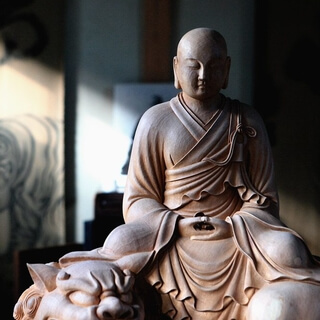
So lately I've been becoming really curious about a particular aspect of our practice,
Which I often like to affectionately call ghost hunting.
And by this,
I mean,
I'm really interested in becoming even more fully aware of all the things that I am not seeing,
But that might in some way be haunting my reality or causing me to think or even behave in ways that might not be so skillful or beneficial either to myself or to other people.
And of course,
In the Buddhist teachings,
This idea of chasing ghosts,
If you will,
Is not new.
Many of you may know the story of the time before the Buddha's enlightenment,
When he was attacked for 49 days by the demon god Mara,
Who was really a representation of all the Buddha's neurosis and fears and false beliefs.
You know,
In other words,
All of his conditioning.
And as the story goes,
What finally released him from this nightmare and torment was when he finally recognized that Mara was in fact a ghost,
That he was an illusion.
And so the idea here is that in the same way,
Through our own practice,
We can also start to more clearly recognize our own ghosts,
If you will,
And understand better what they're trying to tell us,
And how they're trying to manipulate us and maybe lead us into more suffering.
And at the same time,
We really also want to use our practice to become more aware of when other people's ghosts,
If you will,
Are trying to manipulate us as well,
So that we can avoid becoming caught up in the trap of believing what they're trying to tell us.
And of course,
Our entire practice is really aimed at showing us how to do this.
But for this talk,
I thought I'd just offer us one way that we can start to do this,
Which is to practice looking out for something the Buddha called the near enemies.
So just like Mara,
These near enemies are also considered illusions,
And also tricksters,
Because while they can appear as one thing,
They are in fact something totally different.
In modern day terms,
We might think of these near enemies as something we know as frenemies,
Which the Merriam-Webster's dictionary describes as,
Quote,
Someone who pretends to be a friend,
But is actually an enemy,
Someone who pretends to be a friend,
But who is actually an enemy.
And to give us an idea of this type of friend,
I looked up some classic examples of frenemy type statements,
Which look something like,
Wow,
That's a great outfit for someone your size.
Or I'm so happy about your promotion,
You almost make as much as I do now.
Or your makeup looks really cool.
You don't even notice your skin problems.
So sometimes,
Of course,
We're under no delusion about who our frenemies are.
We can clearly see that wolf,
If you will,
Peeking out from under the sheep's clothing.
This person is not fooling us one bit.
We know them.
But more often,
A frenemy is someone who just completely confuses us.
And this might even be someone we've known for years.
And we're confused because,
Well,
Most of the time,
What we see looks like a friendly sheep.
We also sometimes get these quick glimpses of fangs,
Right?
And we have a sneaky suspicion that maybe they're actually a wolf in disguise.
Yet,
For some reason,
We tend to keep trying to convince ourselves that,
No,
No,
No,
Wait,
That wasn't a sharpened fang.
That was just a quick flash of light.
That was it.
That's what I was seeing.
So not surprisingly,
There tends to be a lack of trust in these kinds of relationships.
Because again,
These people often really do display friend-like tendencies.
For instance,
They do continue to act friendly or pretend to be friendly.
But we're just usually not completely sure that they have our best intentions in mind,
Or even that they aren't in some way out to get us.
And so we're often just kind of confused.
And we're not sure what to do.
So the frenemy,
There's a kind of ongoing underlying uncertainty.
It just doesn't feel right somehow.
But we can't seem to put our finger on it.
And usually being around this person doesn't make us feel good either.
We can notice that.
The term frenemy also reminds me of a classic Peanuts cartoon where Lucy keeps convincing Charlie Brown to kick that football,
Right,
Over and over year after year.
A classic example of this is when she's kneeling down and holding the ball for him.
She says,
I'll hold the ball,
Charlie Brown,
And you come running up and kick it.
And the little thought bubble above Charlie Brown's head is saying,
She must think I'm a complete fool.
Every year she pulls the same trick on me.
Well,
This year it's not going to work.
This year,
I'm not going to be fooled.
And then of course,
He runs up to the ball as he always does and then stops.
He's just not sure.
And Lucy says,
You thought I was going to pull the ball away,
Didn't you,
Charlie Brown?
I'm ashamed of you.
I'm so insulted.
Don't you trust anyone anymore?
Has your mind become so darkened with mistrust that you've lost your ability to believe in people?
And so,
You know,
Charlie Brown walks back to where he started.
And again,
He runs as fast as he can towards that ball and ugh,
Womp,
It happens again.
So all of that to say that the definition of frenemy is very close to how the teachings describe the near enemies,
Okay,
Which are qualities that appear to be something or feel like something,
But they're actually not that at all.
So essentially,
The idea is we can't trust them.
Okay.
And before I go into these a little more,
I also want to mention what are called the far enemies,
Which is something we also want to be aware of.
So unlike the near enemies,
Which are usually more difficult for us to recognize,
These far enemies are like those enemies that we are absolutely onto.
Now we can spot these very clearly and we have little delusion about them.
They look exactly like wolves,
If you will.
And so what exactly are these two types of enemies in opposition to?
In the teachings,
These two enemies are qualities that are in direct opposition to the qualities that we are being asked or urged to develop or nurture,
Which are the qualities of kindness,
Or metta in the Pali language,
Compassion,
Karuna,
Sympathetic joy,
Mudita,
And equanimity,
Which is upekka.
And many of you may recognize these four qualities of heart called the Brahma Vaharas or the divine abodes,
Which are considered the highest emotions in the Buddhist teachings.
In the Pali language,
Brahma Vahara means the dwelling place of an awakened being.
So it's a metaphor for where the mind of an awakened being might dwell.
So these divine abodes are essentially the places where we most want to live or dwell.
These are the things that we want to actively,
Consciously nurture and develop so that eventually we will live in those places.
We will become those qualities.
In essence,
It's really what we're aiming for.
As the late great Zen master Thich Nhat Hanh once told us,
As you practice building a home in yourself,
You become more and more beautiful.
As you practice building a home in yourself,
You become more and more beautiful.
And what's helpful to remember is that each one of these Brahma Vaharas has both adversaries or opposites,
Or both near and far enemies.
And we are being asked to use our practice to really be on the lookout for both of these.
So we might start with the first of the Brahma Vaharas,
Which is metta,
Loving kindness or unconditional friendliness.
Metta involves cultivating a sense of kindness or friendliness,
Goodwill towards ourselves and others,
Along with a genuine wish for our own and others' happiness.
So it's really a sense of wishing ourselves and others well.
It's a sense of goodwill.
There are many ways to practice metta,
And there are many traditional loving kindness practices.
But the most essential one is the one that's threaded through really all the practices,
Which is to hold whatever is arising within us with great kindness.
So for instance,
If there's anger arising or sadness,
Grief,
Shame,
Or whatever feeling or beliefs are arising,
We are making a commitment to ourselves to hold all of it with a sense of friendliness and kindness.
And so the essence of metta is really don't throw anyone out of your heart.
Don't throw anyone out of your heart.
This especially includes ourselves.
So as you might imagine,
The far enemy,
The one that we can see very clearly,
The far enemy of loving kindness is ill will or even hatred.
So again,
Here with the far enemies,
We're mostly not fooling ourselves when we're feeling these things,
Either when we're feeling them towards others or even ourselves.
We can very clearly see most of the time that we're behaving in ways that are unkind or feeling or acting in ways that are unfriendly when we're not wishing for the happiness of ourselves or others.
That's the far enemy.
The near enemy on the other hand,
Or the frenemy,
If you will,
Of loving kindness comes dressed up as kindness,
But again,
It's really something else entirely.
This is when we mistake a sense of attachment,
Clinging,
Control,
Or fear as loving kindness,
Dressed up as that.
And of course,
These things are not metta because they do not involve a sense of unconditional friendliness or kindness.
They're conditional.
They're conditional.
So they carry a sense of,
I'm being kind to you only because I need you in some way,
Or I depend on you in some way for something that I need,
Or I need you to boost my ego in some way,
Or I'm afraid of losing you because what will then happen to me?
And here you might notice a common word through all of these,
Which is the word need.
So this is really our clue,
That word need.
So when we recognize it,
It can alert us that maybe we,
Or even someone else,
Is not really offering loving kindness,
But something that's disguised as loving kindness.
Again,
It's really a sheep in wolf's clothing when we can suss out that word need.
This near enemy can also arrive in the disguise of control,
As in,
I'll be kind to you and wish you well only if you're kind to me,
Or only if you give me what I want,
Or only if you are behaving in the way that I want you to.
And here you might recognize another word,
Which is our clue,
Which is if,
Only if.
Again,
It's conditional,
Which means it's not real.
Already we might be sensing a common theme,
Which is that all of these near enemies stem from a sense of self,
From a sense of what am I getting out of this,
Or out of a sense of fear,
Or a clinging to our own personal needs.
So with this one in particular,
We can recognize a set of our thoughts,
Emotions,
Even our actions being based on simply wanting what's best for someone,
Wanting them to be happy.
They tend to be based on trying to meet some need of our own.
And actually,
This is exactly how we can begin to spot or notice all of the near enemies.
We can ask ourselves,
Is how I'm experiencing my kindness,
Compassion,
Joy,
Or peace,
Unconditional,
Or is it in some way attached to a sense of self?
So we might think of that wolf,
If you will,
As the singular I.
The wolf is always really the ego in disguise.
And we can recognize it,
Because again,
There's almost always a strong or very subtle sense of what's in it for me,
What's in it for me.
On the other hand,
We might recognize when we're experiencing the true Brahma Maharas,
When we're feeling connected to the flock,
Maybe,
If you will,
To the sense of a collective we.
When we're feeling less self-centered and more we-centered.
Or maybe when we've kind of let go of the sense of what's in it for me,
And we've let that go.
So we can see this especially in the second Brahma Mahara,
Which is compassion,
Karuna,
In many different ways.
The compassion,
Karuna,
Is what metta,
Or friendliness,
Feels when it encounters suffering.
It just wants the suffering to stop.
The Buddhist text described compassion as,
Quote,
The quivering of the heart in response to the recognition of suffering.
The experience of compassion means that when we encounter someone suffering,
We see that we too experience that same type of pain.
It implies that given all the different causes and conditions,
We could very easily see ourselves in their situation if those things had happened to us.
As the Buddhist nun,
Padma Chodron,
Tells us,
Sorrow has the exact same taste for all of us.
Sorrow has the exact same taste for all of us.
So as we might expect then,
The far enemy of compassion,
The easiest wolf to recognize,
Is cruelty.
This is when we're not only cut off from our compassionate hearts,
But when we consciously do or say something that causes another person or people harm.
And of course,
We can also be so cruel to ourselves in so many ways.
In the traditional Buddhist teachings,
There are actually two near enemies of compassion.
And the first of these is a really,
Truly scary wolf,
Which is pity.
It's a very scary wolf.
Pity implies feeling sorry for someone in a way that separates us.
It somehow puts us above the other person.
So when we're offering our pity rather than our compassion,
What can clue us into this is when we're some way identifying ourselves as,
Quote,
The helper,
Right?
Which means that we are seeing the other person or people as maybe helpless when we're the helper.
A very simple way that this can show up is as unsolicited advice,
Right?
So whenever we offer this without the person first maybe asking for it,
What we're saying in some way is,
Obviously,
You're helpless here,
And I,
The self-designated helper,
Am going to help you.
And you can thank me later.
And we all do that.
We all have moments of offering our unsolicited advice,
Very common habit.
But again,
This is that wolf of ego or self showing up disguised as compassion.
And the resulting feeling in the other person is usually going to be the complete opposite of feeling as if they've been given any kind of compassion.
It's going to be the opposite of that.
Sometimes what can really help us to recognize the wolf of pity is to bring to mind how we maybe felt as a child when someone was kind and compassionate towards us,
And then consider a time when we received pity instead,
And then notice what the difference felt like.
What was the difference?
So the second near enemy of compassion is often called grief or overwhelm.
And again,
This is extremely common,
And it can feel like a sense of helplessness.
So this is when we become in some way attached to another person's suffering or even to the collective suffering.
And we take it on as our own,
As our own suffering.
And then we let it drag us down into the same kind of grief or despair or overwhelm.
And so we personalize it in some way.
We take it on as ours,
And really ours alone.
We take it on as our responsibility,
And then it just completely feels overwhelming.
So another way that this near enemy of compassion can show up is when we feel uncomfortable with someone else's pain or grief.
And instead of offering them our compassion,
What we offer them instead or what we feel compelled to offer them is judgment,
Or maybe we feel a need to fix it.
In other words,
We feel compelled just to want to make the suffering stop.
But when we're feeling this,
What is important to us here is not the other person,
But our own attempts to make ourselves feel better.
And unfortunately,
When we do this,
We can often end up really complicating our lives.
And of course,
We can also just cause so much harm to other people in this way,
Because we aren't actually there for them in a way that's truly benefiting,
When we just want them to stop so that we can feel more comfortable.
In fact,
Often the person we're supposed to be offering our compassion to ends up feeling like maybe they need to take care of us and our feelings.
So just for a moment,
You might just think about when you yourself are needing compassion,
Who is the person you really want this from?
Or who would you want to be with you?
Do you want to receive compassion from someone who might be pitying you in some way?
Maybe someone who's even taking pleasure in their status of helper?
Are you wanting compassion from someone who is distraught or anxious?
Maybe someone who is as upset as you are about whatever it is you're going through?
Or you maybe want someone who is simply there with you with an open,
Tender,
Non-judgmental heart,
Someone who's going to allow you to feel and express your own pain,
Frustration,
Whatever it is you're experiencing,
With a sense of calm and openness,
Right?
Not making it all about them.
Just being there as that kind witness.
And so I'm guessing we all really prefer that last person,
Who is someone we might imagine is embodying those four Brahma Maharas.
And so this is why leaning into and really nurturing these four qualities is exactly how we can become this person,
Not only for other people,
But especially for ourselves.
Through our practice,
Essentially what we're training ourselves to do is to simply be there with ourselves,
However we are,
With no judgment,
With an open,
Tender heart that can really see our suffering and just wish for it to end,
Yet with no judgment.
In the Tibetan Shambhala tradition,
Which I was originally brought up in,
There's actually a third enemy of compassion,
Your enemy,
Which Choy Gum Trungpa Rinpoche called idiot compassion.
And this involves saying yes to something when the most compassionate response is actually a really strong no.
And I love the way Pema Chodron describes this.
She says,
It refers to something we all do a lot of and call it compassion.
In some ways,
It's what's called enabling.
It's the general tendency to give people what they want,
Because you can't bear to see them suffering.
Instead of offering a friend medicine,
Bitter though it may be when ingested,
You feed them more poison.
At the very least,
You don't take it away from them.
This is not compassion at all.
It's selfishness,
As you're more concerned with your own feelings than attending to your friend's actual needs.
I just really love that.
And so again,
Whenever we feel like maybe what we're offering might not be compassion,
We can check out where we might be inserting a sense of self into the mix.
We might even ask ourselves,
Is a need of mine in some way tromping the need of another,
Which leads us to the third Brahma Vihara,
Empathetic joy or mudita,
Which is essentially what goodwill or metta feels when it encounters happiness.
It wants the happiness to continue.
And when we're feeling a pathetic joy,
What we're doing is rejoicing when another person is feeling joyful or happy.
And when we truly feel someone else's joy,
We also happily feel the same thing in ourselves.
It connects us again to that sense of we is a kind of selfless joy.
So in the teachings,
There's actually two far enemies of mudita,
Those wolves that we can see pretty clearly.
And the first of these far enemies of mudita is something you might expect,
Which is envy.
This again,
Something we all experience.
It's a very common emotion.
Unfortunately,
Social psychologists who have studied envy say that quote,
Among the seven deadlies,
It occupies a unique position.
It is the only sin that is never fun.
So true,
Is the only sin that's never fun.
It's not fun for you who's experiencing it.
And in truth,
It's not fun for the person that's on the receiving end of your envy either.
So the second far enemy of mudita is best expressed to the German word scheudenfraud,
Which is when we are actually wishing for someone to experience the opposite of happiness,
Or when we're wishing for bad things to happen to them,
Or when we're basking in the joy of seeing bad things happening to them.
And so these two,
Envy and scheudenfraud,
Are the two far enemies of mudita,
Which again are usually pretty clear for us to see.
So there are also two near enemies of mudita.
And again,
These are ones that are more difficult to see,
The frenemies,
If you will.
And the first of these near enemies is pride.
And this one can often be really confusing because sometimes pride is actually okay,
Right?
It can be a form of mudita.
For instance,
We can believe and say something like,
I'm so proud of you.
That's truly okay,
Since it's like we're saying,
I am so happy for your happiness.
I'm so happy for your happiness.
But when there's a sense of somehow owning that happiness,
When we claim it,
Or identify with it,
Or make it ours in some way,
Again,
That's the wolf of self showing itself.
This type of pride often shows up as a sense of exclusivity.
It's a belief that only I get to ride the wave of this particular person's joy,
But not other people.
It's my loved one,
My family member,
My friend,
My team,
My political party,
My country,
Et cetera.
And that type of pride always involves,
Again,
Propping up a self,
Not expanding it.
And we might remember that pride,
If we think about it,
Is what leads to actual war,
Right?
The second near enemy of mudita sympathetic joy is excessive,
Overexcited exuberance.
And in a way that resembles the near enemy of compassion.
So for instance,
In the same way that we might take on another person's sorrow,
We can also take on another person's joy to the point of making it our own.
So instead of giving the other person a sense of support for their joy,
We're in some way taking it from them or stealing it from them.
Sometimes you might even think about a time now maybe when someone maybe stole your joy in this way,
Maybe took it on as theirs,
Tried to share it or take it away.
And how did that feel?
How did that feel?
So the fourth brahma vihara is equanimity upekka.
And this is considered the culmination or the fruit of our practice.
It's often called balanced awareness.
It involves a sense of balance or ease in the midst of all the changing conditions in our lives.
It's a way of living that is not trying to control everything,
But letting things come and go like a strong tree standing in the middle of all the weather and wind.
So with equanimity,
The tree fully feels the wind.
It's awake for all the joys and sorrows that are flowing through,
But it doesn't let the wind knock it over or become so hard that it breaks.
It's equanimity.
And so as you might imagine,
The far enemy of equanimity,
The one we can see more clearly is reactivity,
Which of course is what we're trying to work on in our practice.
And this is where we react to all the winds when we get knocked over by them constantly and spend lots and lots of energy trying to avoid them or fight them or control them.
Because of this,
The main near enemy of equanimity often appears like the exact opposite of this,
But it's actually not equanimity at all.
This is when we have a sense of indifference or a kind of dry neutrality or a cool aloofness.
At its most painful,
This kind of equanimity might appear as a sense of resignation as in,
Well,
I don't matter anyway,
Or these things always happen to me.
It's just one more thing.
Or even,
I just need to grit my teeth and smile through this.
But both resignation and indifference involve a kind of coldness or a hardness,
Numbness even,
A sense of just feeling disconnected from whatever's happening.
And again,
It's less about feeling a part of,
Part of the flock,
If you will,
And more about feeling like the wolf,
Like we're either hanging out above or below,
But not within that circle.
And when we're indifferent or resigned,
We've actually become separated from our hearts rather than with our hearts or with one another.
We've in some way become cold,
Not warm,
Disconnected.
And with this Owen,
I'm always reminded about a time several years ago when sadly I had to attend the funeral of my brother-in-law who died very suddenly from a heart attack.
And while I was there,
It was so curious for me watching everyone to observe how some people responded to their grief with a real sense of pride for not showing any emotion,
For not expressing any tears.
It was a source of pride.
And to be fair,
I think this is just a very conditioned cultural belief that being stoic in the face of grief or sorrow is somehow respected and that displaying natural human emotion is just something to be frowned upon.
It's a cultural conditioning.
But with equanimity practice,
We're actually being asked to warm up,
To soften,
To really allow ourselves and others to feel whatever it is we're feeling with great kindness,
With lots and lots and lots of metta.
And of course,
We're not being asked to stay there and to live in or wallow in our emotions,
Right?
But we are being asked to awaken to them,
To let them be fully felt,
And to let them simply arise and pass.
Because the truth is,
If we harden our hearts against all the pain that we're feeling,
Guess what?
We're also blacking out,
Sadly,
All the joy.
So with all of these near and far enemies,
Again,
What's important to remember is that we can really use our practice to better recognize when the wolf of self might be showing itself.
For instance,
We might begin to sense what it feels like when we've cut ourselves off in some way,
When we're feeling cold or fearful or separated,
Or if our hearts are feeling tight because we're in some way clinging or holding on.
We can also begin to notice when we're experiencing a sense of selflessness,
When our hearts are maybe feeling warm,
Connected,
More expansive,
Less constricted,
When we're experiencing true kindness,
Compassion,
Joy,
And equanimity,
Untainted by any sense of what's in it for me,
What's in it for me.
And as always,
We're not trying to intellectualize this process in any way or trying to figure it out by kind of psychoanalyzing.
In our practice,
We're learning to stay in direct contact with our wise,
Good hearts,
Learning to trust them to let us know when that wolf might be showing up in sheep's clothing.
And before I offer you a meditation on these near enemies,
I just wanted to offer a quote I like from the author and scholar,
Dr.
Marlena Foyle,
Who writes this of the near enemies,
Only we can do the hard work of determining whether we're showing up lovingly or whether a near enemy is rearing its ugly head.
No one else can discern this for us.
And we can easily fool ourselves for a while.
Eventually,
The joy or suffering in our lives will expose our deepest truth.
Eventually,
The joy or suffering in our lives will expose our deepest truth.
And so as you're ready,
Or if it's available,
I'd like to offer you a meditation on these near enemies.
And so you might find a comfortable posture at home,
Maybe close the eyes.
If you're out walking,
You might bring your attention more inside into the body to the breath,
Maybe feel the bottom of the feet touching the earth,
Feel the movement of walking.
If you're driving,
Same thing,
Become more embodied,
Sense maybe your seat on the cushion,
The connection to the cushion,
The weight of the body in the car,
Maybe taking a nice deep breath in filling the lungs,
Slow exhale.
And on each exhale,
See if you can soften and open a little more,
Might drop the shoulders,
Letting the tummy be soft,
Open at the very center of the palms,
Soften in the gesture of letting go and receiving.
You might notice the whole area of the face,
Just let the face soften,
Forehead smooth,
Eyes soft,
All the little muscles,
The face melting,
Feet slightly parted so the jaw can relax,
Feel the where breathing,
Where the body here breathing,
Letting the mind become a little more clear for contemplation,
Maybe letting go of whatever narrative is in the mind right now,
Making space.
So for this meditation,
I wanted to give us time to consider some of these near enemies and how we can recognize them when they're showing up or haunting us,
If you will,
So that hopefully we can make the intention to nurture their opposites,
Opposites,
Which are the divine abodes themselves.
So as we go through these,
Please,
Please remember there's no right or wrong answers.
And there's especially no judgment in these.
Please remember that we all experience these near enemies,
All of us.
So we're just trying to ghost hunt a little here,
Trying to bring these apparitions up into the light so that we can really see them for what they are.
And so as you're ready,
I'd like to invite you to consider the Brahma Vihara of loving kindness,
Friendliness,
Metta,
And who you may have offered it to recently.
Who have you offered your loving kindness or friendliness to recently?
And then as you're ready now,
Remembering again,
There's no right or wrong answer,
No judgment,
You might honestly consider was the word need in any way involved?
For instance,
Were there any underlying beliefs such as,
I'm being kind because in some way I need you or need something from you?
I mean,
Kind because I need you or I need something from you.
Just consider as you're ready now,
I'd like to invite you to consider the Brahma Vihara of compassion,
Karuna,
And who you may have offered it to recently.
You might now consider,
Is there any way I might've been offering a sense of pity rather than compassion?
Or was I in any way putting myself in the role of helper?
Or is there any way I might've been experiencing a sense of aversion or maybe tried to fix or stop rather than offering compassion?
Remembering no right or wrong answers,
Just an inquiry.
As you're ready now,
You might consider the third Brahma Vihara,
Which is empathetic joy.
And again,
Who you may have offered it to recently,
Your joy about their joy.
And then as you're ready,
You might just consider,
Is there any way I might've been sensing a kind of personal pride rather than empathetic joy?
Or maybe is there any way I might've been letting someone else's joy become my own?
Was I owning it in any way?
And as you're ready,
Finally,
I'd like to invite you to consider the Brahma Vihara of equanimity,
Balanced awareness.
You might consider something that might've been a little stressful in your life recently or in someone else's life.
Might be something big that happened in your community or even in the world.
And you might just consider,
Is there any way I might've been feeling in some way indifferent or maybe not really caring in some way?
Or was I in some way feeling stoic,
Closing off my heart in some way?
Again,
No right or wrong answers,
No judgment.
And finally,
I'd like to invite you to recall just one of these near enemies,
If you will,
And consider what would it have felt like to experience the true divine abode?
What would it have felt like to offer a true sense of selfless,
Unconditional kindness,
Compassion,
Joy,
Or peace?
How would that have felt in the heart?
Just consider.
And finally,
With the eyes still closed,
Just listening to these words from Anwui Nguyen,
Who wrote,
Our world is so full of conditions,
Demands,
Requirements,
And obligations that we often wonder what's expected of us.
But when we meet a truly free person,
A truly giving person,
There are no expectations,
Only an invitation to reach into ourselves and discover there our own freedom.
Namaste and blessings.