So I just recently returned back home from leading a silent meditation retreat in the beautiful mountains of Romney,
West Virginia,
Where for a full week we explored what are called the five hindrances or the fetters.
And it was such a rich and intense retreat for all of us and also just a really challenging one because in the Buddhist teachings these five hindrances are considered the main mental states that block,
Confuse,
Or hinder,
If you will,
Our ability to fully open our hearts and our minds.
And so essentially these are all states that prevent us from finding freedom from suffering.
And yet,
Even though our experience of the hindrances can sometimes be really painful,
They are also just natural expressions of the mind and heart whenever we're suffering in some way.
And so knowing how we can work with these is exactly how we can experience much more relief and release and deepen our spiritual path.
And just to very quickly summarize,
These five include two paired hindrances and one single hindrance to make up the five.
And so the first of these is our clinging or our attachment versus the opposite of this,
Which is when we're pushing something away or rejecting it with aversion or ill will.
Okay,
That's the first pair.
The second pair of hindrances includes something called sloth and torpor versus the hindrance of restlessness and worry.
So that's the second pair.
And the very last of the hindrances is in a completely different category all on its own,
Mainly because it's really considered the most difficult hindrance for all of us to overcome.
And this is the hindrance of doubt,
Doubt.
And so for this month's talk,
I thought I would revisit this last very tricky,
Challenging hindrance,
Which we all tend to struggle with,
And explore how the Buddha himself was finally able to release himself from it in order to gain freedom.
And so to start,
We might first consider all the many different ways that we each experience doubt in our lives,
Right?
So traditionally,
When it comes to our meditation practice itself,
This hindrance points to something called skeptical doubt.
And this is when we're just not convinced about the teachings themselves,
Or when we're just not feeling confident in our own ability to put the teachings into practice,
Right?
But as you might expect,
This hindrance also shows up whenever we're experiencing any kind of self-doubt,
Or maybe confusion,
Worry,
Indecision,
Etc.
And here what might be helpful to remember is that because the future itself is completely unknowable,
It just makes sense that we are all going to struggle with these types of doubt.
It just makes sense.
Now also might be helpful to remember that doubt happens to be the very last hindrance that Prince Siddhartha himself overcame just before he attained enlightenment and became the Buddha.
In fact,
We might even recall that famous story when after more than six years of really trying to discover freedom and almost killing himself in the process,
Siddhartha finally decided to just sit down and bravely and honestly face all of those other hindrances.
You know,
All of his clinging,
And his aversion,
And his restlessness,
And worry,
And all the ways that he fell victim to sloth and torpor,
Which by the way also can include a sense of depression or despair,
Is also included in sloth and torpor.
And as the story goes,
Siddhartha did this for a full 49 days or about seven weeks,
And for the entire time all of these hindrances appeared to him in the form of Mara,
The demon god or tempter,
Who just continued to attack the prince relentlessly.
But because apparently Siddhartha had been working on these things for quite a while,
You know,
Legend has it for millenniums over many different lifetimes,
He was really able to see them clearly for what they were,
Which were delusions.
And so after a while,
As legend would have it,
Each time the demon god Mara threw something at him,
It just instantly disappeared.
And yet,
Even after almost two months of this,
Siddhartha still had not achieved enlightenment because he hadn't yet overcome that very last hindrance.
And of course,
Mara was very aware of this and finally decided to kind of roll up his sleeves and launch his ultimate battle against Siddhartha,
Which was to try to shatter the most stubborn aspect of his doubt,
Which was his faith in his own potential,
Right,
Faith in his own potential.
So for Siddhartha,
This doubt took the form of his faith in his own ability to achieve enlightenment,
Which I know many of us who've been doing this for quite a while also share.
But that being said,
Even if we're not seeking to reach enlightenment,
We're all really being asked to consider for ourselves through our practice how this aspect of doubt manifests,
Even in the smallest ways in our own lives.
So for instance,
We might recognize this kind of doubt when our minds are whispering things to us like,
I just can't do it in some way,
Or maybe I'm not capable of this,
Or this is just too hard,
You know,
I'll never be able to do this.
Or maybe,
You know,
It's just going to take too long,
I'm never going to get there,
Etc.
At its most painful,
We might notice ourselves thinking things like,
Just not worthy of this,
Not worthy of this.
Again,
It's very common for these thoughts to come up around our meditation practice,
Especially if we're very new to practice.
But even many years into it,
Of course,
We can still absolutely still have some of these thoughts.
Right now though,
You might just think of any situation in your life where these thoughts might also be coming up for you.
So maybe just for a moment,
You might think about where in your life you're maybe saying things to yourself like,
I just can't do it,
Or I'm not capable,
Or it's too hard,
Never going to be able to do this,
Or it'll just take too long,
I'll never get there,
Etc.
Or you might even consider,
Are you in some way saying,
I'm not worthy of this.
And as you're thinking about it,
I'd like you to imagine that Prince Siddhartha was struggling with very similar thoughts,
Sitting alone under that tree.
You might even imagine that this is the moment that Mara,
Through his power of illusion,
Decided to conjure up a huge army to stand behind him and start shouting things at Siddhartha to discourage him.
You might even imagine this demon saying things like,
Who do you think you are to want to achieve enlightenment?
Look at you,
You're all alone,
You don't belong,
You don't know what you're doing.
In fact,
You aren't worthy of enlightenment.
You might even imagine this kind of harassment going on for days and days without end until harassment going on for days and days without end until finally,
Mara decides to show Prince Siddhartha how powerful he is and how much better he is by declaring that only he,
Mara,
Is worthy of enlightenment.
So you might imagine him suddenly demanding that all of his armies affirm his claim and hearing them all roar in unison,
We are his witness.
Just think about how that must have felt to be surrounded by thousands of soldiers and all of them supporting this terrifying leader who's shouting,
Who do you think you are?
Who is your witness?
Who is your witness?
And it was right here that Siddhartha did something so simple and yet so profound.
And yet so profound.
He reached down and he touched the earth with his right hand.
And when he did,
Apparently the earth shook and with a shattering roar responded,
I am his witness.
I am his witness.
And according to the story,
Mara and his armies vanished,
Flowers rained down and Siddhartha became enlightened.
He became the Buddha,
The awakened one.
And I need to confess that might be my very favorite story from the entire Pali canon.
This is mostly because it's considered the quintessential moment of the Buddha's enlightenment when he finally realized that he was just innately worthy,
That he didn't have to do anything to prove it.
Siddhartha also realized that Mara himself was simply his own ancient false beliefs and conditioning and that Mara was just an illusion or maybe a delusion.
So in a nutshell,
Really the story of his own enlightenment is essentially the Buddha's profound message to us,
That we can all truly do this ourselves by realizing that by remembering our innate worthiness and our right to be here along with everything else and all things.
There's actually a great phrase in the Buddhist tradition that relates to this and it's another one of those short phrases that we can write on a sticky note,
Which I love and it's also an invitation to us.
This phrase is claim your seat,
Claim your seat.
And so in our daily meditation practice especially,
It can be really helpful to remember this one,
Especially when we first sit down and meditate,
Because right away it can help us to feel that belonging and dispel our doubt and kind of foster our faith in our own potential.
And this is actually where the Buddha's definition of faith versus doubt comes in.
And so in the Buddhist tradition,
Faith is not the kind of faith that we put into some kind of deity or some other authority figure.
It's the faith we put in ourselves.
In fact,
The Buddha told us,
Faith is the beginning of all good things.
Faith is the beginning of all good things.
One of my teachers,
Sharon Salzberg,
Who wrote an entire book on the subject of faith in the Buddhist practice,
Describes it this way.
Sharon wrote,
No matter what we encounter in life,
It is faith that enables us to try again,
To love again.
Even in times of immense suffering,
It is faith that enables us to relate to the present moment in such a way that we can go on.
We can move forward instead of becoming lost in resignation or despair.
Faith links our present day experience,
Whether wonderful or terrible,
To the underlying pulse of life itself.
The capacity for this type of faith is inherent in every human being.
The capacity for this type of faith is inherent in every human being.
We might not recognize it or know how to nurture it,
But we can learn to do both.
We can learn to do both.
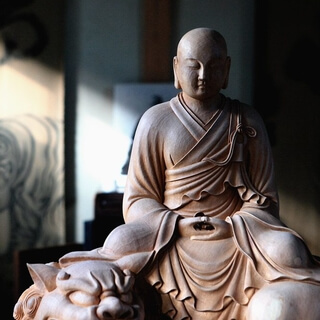
One of my very favorite statues of the Buddha is one that shows him with his hand touching the earth,
And I keep that on a shelf right above my desk.
And I want it to be close to me because whenever I look at it,
It reminds me that I too can actually do the same.
Especially when I'm experiencing this hindrance of doubt,
Or when I'm feeling lonely,
Or afraid,
Or maybe even somehow unworthy,
Or when I'm being attacked by one of my many demons,
It reminds me that no matter how long I've had these feelings of doubt or unworthiness,
I too can reach out and touch the earth at any moment and rediscover that faith in myself.
And by the way,
Because everything is made up of the same materials of the universe,
Sometimes my practice is just to reach out and touch anything,
Right?
A book,
A cup of coffee,
A curtain,
Whatever it is,
Just to remind myself of this teaching,
Which is that again,
We are all innately worthy,
And we don't really need to do anything to claim that worthiness or our belonging,
Right?
We don't need to prove our worth to anyone.
We simply need to reach out and touch the earth and remember,
Remember.
Remember.
Whenever I can remember this teaching,
It also reminds me that everything,
Including my own doubts,
And worries,
And negative beliefs,
All of the other hindrances are again just delusions,
Just like Mara himself.
But given that this hindrance is so powerful,
How do we work with it?
To start,
I want to clarify how the word faith in the Buddhist tradition is very different than what it means in other faith traditions,
Where sometimes we're often told to automatically and very firmly have faith in something that someone in a position of authority told us was the truth.
Just to say,
This is not in any way negating anyone's own experience of any kind of spirituality or transcendence,
Because again,
This is based entirely on personal experience,
And no one can decide that for us.
And even if we weren't brought up in a more Judeo-Christian tradition,
This general dynamic has become so much of our cultural conditioning that so often we might find ourselves kind of unconsciously recreating it with other people in our lives.
So this is a for instance,
Whenever we're under the sway of this hindrance,
And are experiencing maybe some kind of self-doubt,
Or worry,
Confusion,
Indecision,
Sometimes the very first thing we tend to do is to turn to someone we think might have the answers for us,
Someone who can just tell us what to do,
So that we won't need to spend any time to really figure it out for ourselves.
Especially when we're experiencing self-doubt,
We might find ourselves seeking out assurances from others in hopes that they'll somehow shore up our insecurities,
Or maybe assure us that we're okay,
Or that we're going to be okay.
And just to clarify again,
This doesn't in any way mean that we never want to question our own sense of authority,
Or seek out support,
Or maybe get some kind of confirmation about what we've decided about something,
Because that can actually be very wise.
And because we're all human,
Of course we do these things,
Right?
So sometimes we really do need some good advice.
We're not thinking straight,
Or we can't see clearly,
And we might need some assurance.
It's completely okay.
But as a practice,
We just might start to notice if looking to someone else for the answers,
Or for assurance,
Is a kind of reflexive habit for us.
Something that maybe points to the most painful part of this hindrance,
Which is exactly what Prince Siddhartha faced right before his enlightenment,
Which was his belief or faith in himself.
Because to me,
This is where his teachings really come into play,
And here's why.
Essentially,
What the Buddha told us was to not believe a single word that he said,
Which I kind of love.
He basically said,
Don't even trust me as an authority figure.
In fact,
He even told us not don't even trust me as an authority figure.
In fact,
He even told us not to believe what any of our teachers tell us either,
Right?
And so please do not believe a single word that I say here.
I really truly mean it.
Instead,
The Buddha told us that if we're experiencing any doubt,
Worry,
Confusion,
Indecision,
We really want to just investigate and discover for ourselves what is true and what's not true by confirming this experientially,
Not because someone else has told us what they think is true.
There's actually a great ancient story from the Zen tradition that points to this,
And it's about a man who was apparently getting older,
And he was extremely afraid of death.
And so he went to very great lengths and traveled a long way to be able to meet this very wise Buddhist monk that someone had told him about in hopes that he could tell him,
You know,
How he could get over his fear of death.
And when this man was finally able,
After all this time to sit down with this revered master,
He asked him the one question that he'd come all that way to ask,
Which was,
Venerable sir,
Please tell me,
Is there an afterlife?
And this old monk just shrugged and he said,
I don't know,
Which of course made the man completely furious.
But you're supposed to know everything,
He said.
I thought you were a great Buddhist master.
The monk said,
I am a great Buddhist master.
I'm just not a dead one.
So all of that being said,
When we're talking about the hindrance of doubt,
It's really important to remember that in the Buddhist practice,
There are actually two types of doubt.
Okay.
So the first one is the one I was talking about,
Which is our hindrance.
It's the same one Siddhartha struggled with,
Which is considered a kind of unhealthy doubt when we're of unhealthy doubt,
When we're experiencing self-doubt,
Frustration,
Confusion,
Or when we're just mired in indecision or worried about not making the right choice about something.
With this kind of unhealthy doubt,
We tend to just feel stuck or like we just don't feel confident about what we're doing.
We can't seem to make a decision or even see our way forward.
In the suttas,
The Buddha describes the hindrance of doubt this way.
He tells us,
There's a pond of water that is stirred up,
Turbid and muddy,
Set in the dark,
And a person with good sight should consider their own facial image in it.
They could not recognize nor see it as it really is.
So too,
When someone abides with their mind,
Pervaded by doubt,
Overcome with doubt.
Overcome with doubt.
Sometimes we might even be able to relate to the more modern phrase,
Which is plagued with doubt.
Plagued with doubt.
You can just sometimes really feel that way.
Plagued with doubt.
One of my teachers,
The great Joseph Goldstein,
Offers us a wonderful description of how painful our doubt can be sometimes,
And I wanted to share it.
He wrote,
When doubt is strong,
Instead of engaging fully in the experience so that we can see for ourselves whether it is beneficial or not,
The mind simply gets lost in endless speculation.
Then doubt becomes self-fulfilling because staying lost in doubt really is useless,
Doesn't allow for the opportunity to investigate for ourselves.
This endless conjecture is exhausting.
This type of doubt is likened to a thorny mine,
Keeps jabbing and jabbing at us until we feel irritable,
Dissatisfied,
And discouraged.
So ouch,
That kind of doubt.
And here we might notice that he used the words,
When doubt is strong,
Which means there are times when it's just not that difficult for us to know that we're under the sway of doubt.
We're really fully aware of it because it's just that painful.
You can see it very clearly.
But the idea is that through our meditation practice,
We want to be able to start becoming aware of our doubt at more and more intimate levels so that whenever any kind of doubt pops up in our minds during our daily lives,
We'll be better able to recognize it and label it as doubt and understand better how to work with it.
So having said that,
What's also true is that our doubt can sometimes arrive in very sneaky ways where it can kind of hide itself from us or kind of disguise itself.
So just as a,
For instance,
One type of sneaky doubt is when it leads us to just automatically reject things that we would just rather not hear or that we find maybe unpalatable.
Like for instance,
Maybe we have some real doubts about the concept of no self or nada,
But rather than investigating and seeing for ourselves whether it has any meaning for us,
We often use doubt as a way of simply dismissing what is beyond our current level of understanding.
So just dismiss it.
And just for a moment,
You might even consider if there's some area in your life where you feel unclear or uncertain or have some kind of doubt,
Maybe about your own ability around something,
But rather than investigate or try to understand it,
You've instead either dismissed it or turned away from it,
Or maybe convinced yourself that you really don't need to look into it any further,
Or maybe that you're just not capable,
Right?
I know for myself,
I've confessed this before,
That I do this type of dismissing around cooking,
Which I have convinced myself that I just don't know how to do it and I'm not very good at it.
So oftentimes I just don't even try or take the time to look up recipes or learn anything more about it.
And I could actually go on and on describing all the ways that our unhealthy doubt shows up in our lives,
But I wanted to now explore the second type of doubt,
Which is our healthy doubt,
Which paradoxically is exactly what we use to help release our unhealthy doubt.
It's actually the antidote,
Our healthy doubt.
This is because our more healthy doubt involves the quality of investigation or vakaya in the Pali language,
Which is often also called using our wise discernment.
And when it comes to the hindrance of doubt in particular,
I feel very obligated as a Buddhist teacher to mention the most famous teaching about this,
Which is called the Kalama Sutta.
So as many of you know,
For about 45 years after his enlightenment,
Starting at age 35,
The Buddha often traveled through different towns and villages in India to offer his teachings.
And as he did,
The people who had heard of this great enlightened being,
As you imagine,
They would gather in large crowds to hear him speak.
But just like today,
The Buddha was not the only spiritual figure of his time.
And of course,
Other spiritual teachers would very frequently visit these same towns.
But because of his great reputation and the rumor that this former prince was actually enlightened,
The Buddha's wisdom was generally very well respected.
And so as the story goes,
After he had arrived in the town of Kasabuddha,
Then a crowd of people called the Kalamas had settled around him.
A man raised his voice to ask a question.
He said,
Venerable Sir,
There are some monks and Brahmins who visit our town.
They expound and explain only their doctrines.
The doctrines of others they despise,
Revile,
And pull to pieces.
Some other monks and Brahmins too,
Venerable Sir,
Come to Kasabuddha.
They also expound and explain only their own doctrines.
The doctrines of others they despise,
Revile,
And pull to pieces.
Venerable Sir,
There is doubt.
There is uncertainty in us concerning them.
Which of these revered monks and Brahmins spoke the truth and which falsehood?
And so here the Buddha has been given this great opportunity,
Right,
To tell a whole town full of people which teachers are giving them sage advice and which ones are just charlatans.
Instead,
He very famously tells them this.
It is proper for you Kalamas to doubt,
To be uncertain.
Uncertainty has arisen in you about what is doubtful.
Come,
Kalamas,
Do not go upon what has been acquired by repeated hearing,
Nor upon tradition,
Nor upon rumor,
Nor upon what is in scripture,
Nor upon surmise,
Nor upon an axiom,
Nor upon specious reasoning,
Nor upon a bias towards a notion that has been pondered over,
Nor upon another's seeming ability,
Nor upon the consideration,
This monk is our teacher.
Kalamas,
When you yourself know these things are bad,
These things are blameable,
These things are censured by the wise,
Undertaken and observed,
These things lead to harm and ill will,
Abandon them.
Abandon them.
To help explain this a little further,
The Buddha went on to ask the crowd some questions of his own.
He said,
What do you think,
Kalamas,
Does greed appear in someone for their benefit or harm?
The crowd answered,
For their harm,
Venerable sir.
The Buddha continued,
Being given to greed and being overwhelmed and vanquished mentally by greed,
Someone takes life,
Steals and tells lies and prompts others to do so likewise.
Will that be for their harm and ill?
Yes,
They replied.
And what do you think,
Kalamas,
Does hate appear in someone for their benefit or harm?
For their harm,
Sir,
They replied,
Et cetera,
Et cetera.
And so it goes with the Buddha continuing to ask the same questions about delusion.
So here,
Even in his response,
Where he asked questions instead of just answering directly,
The Buddha is giving us an example of this quality of investigation and why it's such a fundamental and even defining element of our practice.
So when I first heard that sutta at Naropa University about 35 years ago now,
I guess,
It prompted me to go out and buy a bumper sticker that was stuck onto the back of my car for the next decade,
Which was question authority,
Question authority.
When I first bought it,
I remember being so pleased with myself because I assumed that the sutta simply meant to not trust what anyone told me,
But to rely on what I considered my own kind of self-righteous opinions and beliefs.
But after a few years of practice and training by the monks and nuns and teachers there,
I very humbly ended up buying another bumper sticker that I put right next to that one.
And it said,
Don't believe everything you think.
One of my favorite insight teachers,
Larry Rosenberg,
Who founded the Cambridge Insight Meditation Society,
Describes our practice of investigation this way.
Larry wrote,
The question is,
How do we balance internal authority with external authority?
In the Kalama Sutta,
The Buddha is not saying that ancient teachings are irrelevant or that you have to reinvent the Dharma wheel every time you think.
He's not saying not to accept the guidance of teachers or not to read the scriptures.
After all,
How else are you going to find out what's criticized and praised by the wise?
No.
What he's saying is,
Do not give final authority to these teachings.
Do not give final authority to your own ideas.
You have to test the teachings and your ideas in the laboratory of your actions.
You have to test the teachings and your ideas in the laboratory of your actions.
So in our practice,
Then,
We're being asked to examine very closely,
Very directly for ourselves,
What thoughts,
Beliefs,
And actions are truly leading to our own happiness,
And which ones are ultimately leading us to suffering.
In fact,
The Buddha once said very famously about his 45 years of teaching,
I teach only two things,
Oh,
Disciples,
The nature of suffering and the cessation of suffering.
And of course,
The way we discern all of this and dispel our doubt is through our practice of investigation.
We need this crucial quality because the truth is,
On its own,
On its own,
Mindfulness does not develop wisdom.
We need to add the crucial factor of investigation,
Vikaya,
For this.
And our investigation also requires our mindfulness practice because our mindfulness practice informs our investigation.
So in other words,
It shows us how we are being asked to investigate,
Which is through our bare,
Direct,
Present moment experience.
So really,
This is what that famous sutta is trying to emphasize,
That we can't truly know something unless we've actually experienced it and investigated it for ourselves.
There's a great phrase that I've often heard over the years that helps me with this,
Which is this idea that,
Quote,
The Buddha loaned us his map,
But the trip is ours to take.
The Buddha loaned us his map,
But the trip is ours to take.
Which means that truly no one else can walk this path for us or live our lives for us.
Others can point the way,
But we ourselves need to actually walk it,
To feel our feet on the path and make our own way,
Which of course includes making our own decisions or determinations.
This practice of trusting in our own direct experience,
In fact,
Was so central to the Buddha's teachings that when he was 80 and was literally on his deathbed,
He was still busy reminding his sangha members about this teaching.
Some of you may know that the Buddha died rather suddenly after he accidentally ate something in one of his meals that was poisonous to him.
And so as you might imagine,
As he was dying,
His surprised and devastated sangha members were all surrounding him,
Were just desperate to know what they would do without him.
But even here in his last breaths,
The Buddha was using his time to again strenuously remind them not to get caught up in the teachings of any authority figure,
But to use the practice of investigation that he had taught them to discover the truth.
In his very last teaching to them,
He told them famously,
Quote,
Be a light unto yourself,
Be a light unto yourself,
But take yourself to no external refuge.
Hold fast to the truth.
Look not for refuge to anyone besides yourself.
I love that teaching so much,
Actually,
That I often think of adding another tattoo on my arm that just says,
Be a lamp unto yourself,
Just to remind me.
If we can go back to the day of the Buddha's enlightenment,
What he essentially wants us to see with the lamp of our awareness is what has been called our inherent Buddha nature,
Or our good wise hearts.
We want to learn to trust in that and recognize that we each have the capability to make the best choices for ourselves and for our lives,
Choices that are going to lead us towards more happiness and away from more suffering.
Again,
This was really the Buddha's profound message to us,
That we all have this potential.
We just need to learn how to recognize it and have faith in it.
As my teacher Sharon Salzberg told us,
Quote,
Faith is the animation of the heart that says,
I choose life.
I align myself with the potential inherent in life.
I give myself over to that potential.
This spark of faith is ignited the moment we think,
I'm going to go for it.
I'm going to try.
I'm going to go for it.
I'm going to try.
And so I think I'll end there and invite you into meditation,
If that's available for you.
So if you're somewhere where you can find a nice,
Comfortable seat and posture,
You might do that now.
Gently close the eyes.
Start to focus on the inhale and exhale.
If you're out walking,
You might also notice the inhale and the exhale.
Maybe shift your focus to the bottom of the feet.
Feel your feet on the earth,
Connected to the earth,
Walking.
Sense the whole body walking and breathing.
If you're driving,
You might sense your hands on the wheel,
Your seat on the cushion.
Also,
Just tap into the breath,
Sensing the inhale,
The exhale.
Might each of you just take a nice,
Deep inhale,
Filling up the lungs,
And a slow exhale,
Letting go.
Maybe a couple of rounds of those on your own,
Just to tap into the breath,
Into the body,
To become more present here in the body in this moment.
On each exhale,
You might consciously let go of whatever you might be holding,
Any tension,
Tightness.
You might drop the shoulders.
You might notice the center of the palms.
Allow the center of the palms to be open in a gesture of both receiving and letting go.
And letting go.
You might notice all the little muscles in the facial area.
See if you can loosen that a little bit,
Let the forehead be smooth,
Eyes soft,
All the little muscles in the face melting,
Teeth slightly parted so the jaw can relax.
Still aware of each inhale,
Each exhale.
You might notice the tummy.
See if you can allow the tummy to just naturally receive the breath,
Just like a two-year-old's belly,
Just undefended,
Letting go here,
Breathing.
You might even bring what's considered the soil of our practice directly here,
Which is a sense of kindness,
Loving kindness,
META,
M-E-T-T-A,
Which is friendliness,
Kindness.
You could do this by maybe just adding a very slight smile to the corner of the eyes and the lips,
Remembering it's never ever a way of painting a smiley face on or covering anything over.
It's inviting kindness,
Like you might invite a friend to be with you with whatever's here in the heart,
The mind,
And the body right now.
Bringing a sense of gentleness,
Ease,
Kindness.
And then as you're ready,
I'd like to invite you to imagine yourself as Prince Siddhartha sitting under that Bodhi tree just before his enlightenment.
Can you imagine yourself as Prince Siddhartha sitting under that Bodhi tree?
And then as you're ready,
See if you can imagine filling yourself with a kind of profound belief in your own good heart,
In your innate wisdom,
In your belonging,
In your right to seek your own enlightenment.
And now as you're ready,
I'm going to invite you now to just reach down and touch the earth,
Or the chair,
Whatever you're sitting on,
And imagine that the earth is fully affirming this.
Your right to seek your own enlightenment,
Your good heart,
Your innate wisdom,
And your belonging.
Imagine that the earth is fully affirming that.
Imagine that you are truly claiming your seat.
Claim your seat.
And with the eyes still closed,
Just listening to these words from Sharon Salzberg,
Who told us,
I stepped onto the spiritual path moved by an inner sense that I might find greatness of heart,
That I might find profound belonging,
That I might find a hidden source of love and compassion.
Like a honing instinct for freedom,
My intuitive sense that this was possible was the faint,
Flickering,
Yet undeniable expression of faith.
Namaste and blessings.