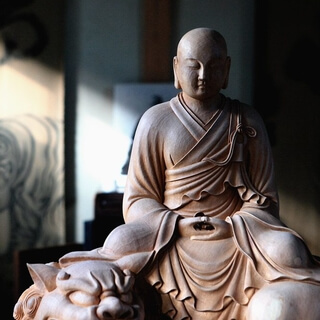
And Many of you may be aware of my love of what I like to call Buddha's sticky notes.
These are short teaching phrases that you can easily fit on a sticky note.
And I actually encourage students to do this,
To put them on sticky notes as a kind of mind training.
Because honestly,
They actually work.
And these phrases are all short,
Usually two to five words,
So they tend to be easy to remember.
And the idea is that if we continue to reflect on them,
They tend to show up for us when we really need them the most,
Like a life draft of sorts.
And they remind us of a much deeper truth or practice.
So for the past several months,
One of these phrases has been arising in my mind a lot.
And it's really been helping me.
It's just four words,
And those four words are,
No feeling is final.
No feeling is final.
It comes from a famous poem by Rilke,
He tells us,
Let everything happen to you.
Beauty and terror just keep going.
No feeling is final.
And if we condense this even more,
The practice that this four word phrase is pointing to can be summed up in just one word,
Which is allow.
It's actually a profound practice.
It's the practice of letting go,
Opening ourselves up,
And allowing ourselves to feel our emotions fully as they naturally arise and pass.
The Zen master Thich Nhat Hanh describes the practice this way.
He says,
In us there is a river of feelings in which every drop of water is a different feeling.
And each feeling relies on all the others for its existence.
To observe it,
We just sit on the bank of the river and identify each feeling as it surfaces,
Flows by,
And disappears.
So again,
Here is the truth that really no feeling is final.
Each one can arise and pass if we don't continue to hold on,
If we allow it to naturally wash through us.
And of course,
As we all know,
This is often one of the most difficult aspects of our practice.
Since we all naturally tend to want to avoid experiencing anything that we perceive as unpleasant,
Especially when it comes to the more difficult feelings,
Feelings like frustration,
Anger,
Sadness,
Loneliness,
Grief,
Shame,
Envy,
Etc.
We also tend to label these emotions as negative or bad or maybe even wrong,
Which often leads us to perceive ourselves as negative or bad or wrong whenever we're experiencing them.
So for instance,
We have a tendency to label ourselves as maybe a sad or an angry person,
Almost as a kind of identity,
Rather than simply noticing that the energy of sadness or anger has arisen and is flowing through us,
That it's simply visiting us for a while.
And while this might seem like such a simple truth,
I need to confess actually that for many,
Many years I just couldn't fully grasp this.
Almost every single retreat that I attended with one of my teachers,
Tara Brock,
She would inevitably end up saying the same words to me,
Which were,
Shell,
You're making it wrong.
Honestly,
Almost every retreat,
Shell,
You're making it wrong.
For years,
I just didn't understand that what I was making wrong was the feeling itself,
The feeling of sadness or grief,
Anger,
Shame,
Or whatever it was.
Instead,
What I was doing or trying desperately was to figure out what was wrong with me for having the feeling in the first place.
And at the same time,
I was trying as hard as I could to somehow just make it go away.
Thankfully,
Eventually,
I learned to remember to not make any of it wrong,
Including myself.
I learned to remember that as a human being living in this body,
In this life,
I am inevitably going to experience normal,
Human,
Often necessary emotions and energies,
And that when they arrive,
They are asking not only to be felt,
But to be heard and contemplated.
So to offer up another one of those sticky phrases,
I learned to say this belongs,
This belongs to all of my emotions.
This belongs as a way of not only offering myself compassion,
But also as a way of not just immediately rejecting my feelings or identifying with them.
And according to the Buddhist teachings,
This is exactly how we grow,
How we evolve both mentally and spiritually,
By allowing and by listening,
Which is another word for contemplating or examining.
We are training ourselves to let go and open up to all our human emotions and then to see what they have to teach us.
It's actually a great teaching from Thich Nhat Hanh about this process that I often feel is a kind of summary of the whole practice.
He says,
Our suffering is holy.
Our suffering is holy if we can embrace and look deeply into it.
If we don't,
It isn't holy at all.
We just drowned in the ocean of our suffering.
So here again,
Thich Nhat Hanh is directly describing the Buddhist teachings in the Four Noble Truths,
Where he urges us to courageously embrace our human suffering so that we can learn from it and so that we can remember that we are not alone,
That we all suffer.
We're intimately connected.
And yet we tend to have this great fear,
A fear of drowning in that ocean of suffering,
Which is exactly what keeps us from being willing to walk into the water.
And for all of us right now,
That ocean does seem pretty wide and deep on so many levels.
Our entire planet is facing a deadly pandemic that is causing great economic insecurity.
We're also facing the truth of global warming.
Just in the past month here in the United States,
We've experienced massive storms in the middle of the country.
We've faced out-of-control wildfires in the West,
Including something terrifying called a fire tornado.
And then on top of that,
Double hurricanes in the South.
And of course,
We're facing major social upheaval around the ongoing pain and suffering of racial injustice and racism in this country.
And on top of everything,
We also have an incredibly important election coming up in just weeks now.
So there's a lot of fodder for all the natural human emotions,
Fear,
Grief,
Anguish,
Sadness,
Loneliness,
Frustration,
All of these energies.
Again,
That most of us would just rather not be with,
Let alone listen to.
In my own life lately,
What I've been experiencing is a lot of grief and sadness and also a sense of loneliness.
I really do miss my students and my community,
Especially.
So my practice has been really focused on how I can best be with these emotions rather than rejecting them or identifying with them.
So I thought it might be helpful for me to explore the phrase,
No feeling is final,
Through the lens of being with sadness.
And whenever I think of sadness,
What helps me is an image I love of this little animated character from a wonderful children's movie called Inside Out.
And when it first came out in 2015,
The mindfulness community was really buzzing about this movie because it offered such an excellent way of explaining the Buddha's teachings to both children and adults.
The directors actually consulted top neuroscientists all over the country in order to come up with this movie.
And for those of you who haven't seen it,
It's about an 11-year-old girl named Riley,
And she's experiencing a kind of big crisis in her life.
Her parents have decided to move the family from this little town in Minnesota to the big city of San Francisco,
Which doesn't sound like a very interesting plot.
But what makes it fascinating is that the movie is set inside Riley's brain,
And the lead characters are her emotions,
Joy,
Sadness,
Anger,
Fear,
And disgust.
And they all battle to control Riley's responses through this control panel in her brain.
So when this big crisis is happening,
This big change,
Joy and sadness actually get lost,
And they're lost deep within Riley's subconscious,
According to the story.
And fear and anger and disgust take control of her brain while joy and sadness are lost.
And I thought this in itself was a pretty accurate description of what can happen when there's a crisis or a big change.
Joy and sadness tend to get lost,
And fear,
Anger,
And disgust,
Or maybe what's called judgment or aversion,
Tend to take over.
So the stars of this movie then are joy and sadness,
Who are in essence partners.
And joy,
If you want to imagine,
Has these big,
Huge eyes and this bright green dress and a literal glow around her,
And she's constantly raising her arms and leaping and spinning around.
The sadness character is just adorable.
She's short with big dark glasses,
And of course she's all blue,
And she tends to fall over flat on her face whenever joy wants her to do anything.
What's interesting is that for most of the movie,
Joy is busy trying to make sadness happy,
Which of course isn't working.
And this is really frustrating to joy,
Who is often shown rolling her eyes at sadness and generally just being completely annoyed with her.
Joy is also constantly trying to keep sadness away from these glowing globes that represent core memories from Wiley's childhood.
This is because whenever sadness touches one of these globes,
They change to the color blue.
So joy has made it her main job in life to constantly keep sadness away from Wiley's memories.
Joy even goes so far as to draw a circle in the floor,
And she makes sadness stand in the circle of sadness,
So she literally puts a boundary around sadness.
Eventually,
Though of course,
Sadness does manage to pick up one of these globes,
And when joy snatches it away,
Sadness pouts and she apologizes.
She says quietly to joy,
I wanted to maybe hold one.
That line just felt so tender to me and profound.
I won't ruin it totally for you,
But in the end,
The movie tells us that it was normal for Wiley to feel sad about something big in her life that was changing,
Which in this case involved moving away and losing all her friends and everything that felt familiar to her.
It was normal for her to feel angry about having no say in this,
And it was normal for her to feel fear when she contemplated her new situation,
The unknown.
The Buddha,
In fact,
Tells us that change or impermanence,
A nitya,
Is one of,
If not the main sources,
Of our stress and suffering.
So it absolutely makes sense that we all experience a range of emotions in the face of change,
Especially when it is truly life-changing.
The movie critic Roger Ebert summarizes the movie this way.
He said,
This movie is saying,
Listen to sadness.
Sadness is important.
Sadness has something to teach you.
It stands in opposition to an entire culture that tells people that happiness is the highest,
Best,
And sometimes only permissible emotion,
And that sadness is an obstacle to being happy,
And that we should concentrate all of our emotional and cultural energy on trying to eradicate sadness so that everyone can be happy.
He goes on to say that he believes that so much of this kind of a cultural pressure creates an insecurity within us about our own sadness.
In fact,
The Dalai Lama,
Mother Teresa,
And other spiritual teachers have commented many times about how in our particular American society they've not witnessed so much self-criticism in any other place on this planet.
And I believe this is because of exactly what Roger Ebert pointed to.
We are culturally conditioned,
Especially through the media,
To believe that if we are not constantly happy and perfect,
That something is somehow wrong,
Wrong with us,
And we should also somehow be ashamed about this.
We might even notice ourselves when we're experiencing some discomfort,
When someone tells us that they're feeling sad about something.
Very often,
Instead of listening or offering empathy,
We might find ourselves offering advice about how that person can quote unquote fix their sadness,
Eliminate it,
Make it go away,
Make it stop,
As if it's wrong.
We also tend to almost automatically believe that whenever it is,
It's not whatever it is,
It's not right,
That in some way it shouldn't be happening.
But the truth is,
What's often making us uncomfortable is not the sadness itself,
But our perception of sadness.
The Buddhist nun Pema Shodran,
One of my favorite nuns on the planet,
Speaks about this kind of uncomfortableness this way.
She says,
The only reason we don't open our hearts and minds to other people is that they trigger confusion in us that we don't feel brave enough or sane enough to deal with.
To the degree that we look clearly and compassionately at ourselves,
We feel confident and fearless about looking into someone else's eyes.
So what's also true is that many of us tend to do the same thing to ourselves.
It's like we have this unconscious voice in our heads,
Just like that joy character in the movie,
Who is constantly telling us to cheer up,
Get over it,
Fuck up,
Buckle up,
Just stop being sad.
You might even think about all the names we might call ourselves when we're feeling sad,
All the labels or identities that we put on ourselves or others even,
Pathetic,
Sensitive,
Loser,
Big baby,
Snowflake.
We might hear ourselves saying things like,
What is wrong with you?
Or you should really be over this already.
Why are you so negative?
Get a grip,
Grow up.
All those things that we say.
And again,
We tend to make the feeling and therefore ourselves wrong.
You might even think that we've somehow failed in our quest to be constantly happy.
Pema Shodran calls this our dream of constant okayness,
Our dream of constant okayness.
All of that being said,
As we all know,
Not trying to push away or reject sadness is actually an ongoing practice for all of us.
As the Buddha taught us,
It is our very natural,
Habitual tendency to not want to be with our sadness,
Especially to want to run away from it or cover it over.
Again,
Just make it somehow go away.
And yet the interesting paradox is that when we don't allow or even maybe acknowledge our sadness can actually turn into depression because we're turning it in rather than letting it out.
When we are rejecting sadness,
Not allowing it,
What we're doing essentially is locking it in just as effectively as Joy did in the movie,
Which she drew a boundary around sadness.
In fact,
We can actually sometimes become angry at our sadness,
Which can really become a very strong wall against it,
Our own anger.
Many years ago when I was offering eight-week MBSR mindfulness workshops,
Near the end I would offer a guided loving-kindness meditation that begins with inviting students to get in touch with any grief or sadness they may be experiencing.
And you know,
Many people tend to cry during this practice,
But one time after the meditation,
A young woman shared that what she kept saying were walls being thrown up.
She actually felt walls and saw walls in this imagery,
And she realized that she felt almost rageful at the sadness.
She just didn't want to experience any of it at all.
And as she was speaking,
I invited her to place a hand on her heart and see if she could hold the actual resistance itself with kindness,
Because that's what was here.
That's what was,
It was what she was experiencing in that moment.
And the resistance itself needed her attention too.
It was really okay.
And as she did this,
As she was able to see and honor even her resistance,
Suddenly there were tears,
Almost like the wall had just crumbled,
Cracked.
And after class she let me know that instead of feeling overwhelmed by it,
The tears actually felt really good to experience.
It felt like a huge relief to her to finally allow herself to feel and express her sadness.
She had finally been able to hold it.
And I wanted to share a passage that I love from a meditation teacher in New York City named Emily Herslin,
Who wrote about how she was able to meet and hold her own sadness that she was feeling during this time.
And it's a little longer,
But I thought it felt relevant to what we're all experiencing right now.
She wrote this,
It's a difficult weekend.
There have been tragedies in our world.
Some of us may be feeling angry,
Sad,
Confused.
All of these feelings are allowed to be here.
One way I sometimes tend to react to tragedy is to immerse myself in information.
TV coverage,
Twitter,
All the articles my friends are sharing on Facebook.
A friend wrote to me that he's been rewatching the news coverage of the Paris attacks over and over,
And it's echoing for him the way he reacted to 9-11.
I'm not sure it's possible to avoid this association,
This remembrance,
Because it's here already,
At least for me.
So I'm not going to try.
I remember obsessively watching the 9-11 news coverage,
As so many of us did,
Trying to make sense of what was happening,
Trying to get rid of the confusion.
I remember I was overwhelmed by sadness.
I had a doctor who was a kind of mentor to me,
And I emailed him,
Asking what I should do with my sadness.
How could I stop feeling so sad?
He suggested I turn off the TV,
Take a box,
Put objects in it that represented my sadness,
And put the box in a closet.
So I did.
I turned off the TV.
I took an old shoe box and put in some pennies,
A little elephant figurine,
A folded-up tissue,
A seashell.
I named them all sadness and put them in a box,
And put the box in my closet.
Strangely,
It helped.
It didn't make my sadness go away,
But it felt more manageable,
Not as unwieldy.
I don't think it was the process of putting the box away in the closet.
I think it was the process of naming sadness,
Touching it,
Holding it in my hands,
In my body,
Being with it.
It was real.
It was something I could be familiar with.
And it wasn't dangerous.
It was safe to hold this feeling.
I think that our meditation practice can give us something similar,
She wrote.
It gives us permission to name what's here,
To hold it,
To touch it.
It gives us the ability to see what we are capable of holding in our hearts.
It teaches us to be kind to our experience in this way,
To give our experience the caring attention that we might give to a friend.
We can see that it is not an enemy.
And this story always reminds me of a quote I love from the Buddha who said,
Our sorrows and wounds are healed only when we touch them with compassion.
Our sorrows and wounds are healed only when we touch them with compassion.
So just like all the other emotions,
The Buddha taught us that the way to get past sadness is to get to know sadness.
He asks us to become intimate with sadness,
To experience what sadness feels like so that it doesn't totally confuse or overwhelm or frustrate us.
And so that we're not so afraid of sadness,
That we're locking it into that circle of sadness.
Through our practice,
We also begin to see that sadness is always a visitor.
So we learn to allow sadness in.
We open the door and we welcome her and we sit with her for a while and maybe we let her cry.
And eventually,
She does decide that it's time to leave.
But if we pretend that we don't see her and lock her out,
She's just going to mope around the house and peek in all our windows and camp out on our doorstep and wail and pound on the door and generally make life miserable for us.
We might even use our practice to start noticing when sadness arrives,
Which is very often when there's change.
Right?
So a relationship ends or someone or something we love dies.
We're fired from a job,
We become ill,
There's a disaster,
Tragedy,
Or maybe a world pandemic.
Maybe when we have a big change in our belief system,
When we have a sort of epiphany about something,
That can often bring sadness with it.
It's change.
And the reason change is often sad is because it almost always involves some kind of a loss.
So sadness is intimately hooked on to grief.
You might recall the Buddha's teachings on suffering here.
And we suffer mostly because of the truth of impermanence,
A nitya,
Change.
Life,
Ourselves,
All of it,
Everything we experience,
Is actually constantly never ending change.
So we will in essence always be saying goodbye to what was.
This means that we will inevitably be faced with grief and sadness,
Even though we all want to avoid this.
We all tend to want to avoid change.
Just like that 11 year old in the movie,
We all tend to want to stay safe and cozy with what is familiar and not have to move away and face the possibility of change.
Right?
We all want to maybe stay 11 too and not have to grow up.
It might also be helpful to know that grief is an actual physical process that our brain goes through after a significant change.
So the limbic system in our brain holds an internal image of life as we know it.
So whenever a change takes place,
New neural pathways have to be built in order to accommodate sort of an updated version of reality.
So sadness is actually really powerful because it can introduce a crack in our limited and limited version of reality.
So maybe we thought it was one way,
We believed it was one way,
But now it's not that way anymore.
Or maybe it was never that way to begin with,
But we just believed that it was.
For instance,
Maybe we go for years or even decades with some relationship that just isn't working.
Or maybe with a belief about ourselves or our lives that isn't working.
And once we allow ourselves to feel the sadness of that,
We might then suddenly allow a new reality to see things in a brand new light.
So building this new picture of reality quite literally takes a lot of energy and time for the brain itself to process,
Depending on the nature of the change.
And if we didn't understand that grieving is a necessary process in order for us to move forward,
We might find ourselves becoming impatient and wanting to skip the sort of unpleasant period of adjustment.
From an actual survival perspective,
Science has suggested that sadness was actually hardwired into us to keep us safe after a significant loss.
So we might begin to notice that sadness is associated with maybe a feeling of heaviness or sleepiness or a withdrawal from activity or social connections.
This withdrawal can make more sense when we consider that grief or maybe the time that our brain is updating actually causes things like impaired short-term memory,
Decreased concentration and attention span,
Absent mindedness,
Forgetfulness,
Distraction.
It's part of the process.
So in primitive times,
If you experienced a major loss,
It would actually be unsafe for you to go hunting or gathering.
At the same time then,
It's also very natural for us to feel afraid or vulnerable when we're feeling sad.
Again,
From that primitive perspective,
If it wasn't safe for us to go hunting or gathering,
It was a very real threat to our survival.
So today it's very natural actually for us to just feel unsafe.
You might even recognize the words we often use to describe sadness,
Words like exposed,
Naked,
Raw.
You might even experience that sense of,
If I let myself feel this,
I really feel like I might die.
I might die from this.
So today we need to remind ourselves that our minds have evolved and that even though it's unpleasant,
We really can actually survive sadness.
It's not going to kill us.
And on that note,
Before I offer a brief meditation,
I'd like to read a passage that I really like from the Zen teacher Joan Sutherland who tells us this.
We believe that if we begin this weeping,
If we open ourselves to the pain and the poignancy and the terrible wounded beauty of life on this earth,
Perhaps we won't be able to stop and we will drown.
But,
She says,
We do not disappear,
Nor do we drown,
Neither do we cry forever.
But if from time to time these tears are called from us,
They're no longer frightening.
They are a small ceremony keeping us close to the world.
They make us less brittle,
More resilient.
We weep because something is pouring in and we are overflowing,
Because it is impossible to say anything in some moments and it is equally impossible not to offer something back.
The salt tears are remnants of our oceanic beginnings and they are also the residue of the difficult sea we cross in this life.
We contain both the timeless depths and the waves washing over the fragile raft that carries us from birth to death.
So to end,
If it's available for you,
I'd like to offer a brief meditation practice.
So if you're sitting or it's available,
I'd like to invite you to find a comfortable posture.
Maybe close the eyes,
Settle.
You might right away start to notice the breath.
You might be taking a nice deep breath in,
Deep breath out.
Focusing on the breath,
Allowing the breath to calm the body and the mind.
Breathing in,
Aware of the breath in.
Breathing out,
Aware of the breath out.
As you continue to focus on the breath,
You might also soften the body.
You might allow all the little muscles in the face to be soft.
The forehead,
Eyes,
Cheeks,
Jaw,
Breathing,
Allowing the shoulders to drop down.
Allowing the belly to be soft.
You might even sense your sit bones.
Imagine your skeleton loosening a little.
And the muscles around the skeleton softening,
Even the skin softening as you breathe.
If it's available,
I'd also invite you to place one hand or both on the heart,
Or one hand on the heart,
One on the belly.
Or you might even just imagine yourself doing this.
Imagine there's a hand on the heart.
As you continue to breathe,
You might sense the movement of the fingers in the heart area as you breathe.
You might imagine breathing right into the heart area.
Maybe even sensing the shape of the heart.
Maybe allowing it to soften a bit with each breath.
You might even imagine the energy of the hand sending a sense of kindness and care to the heart to help it soften.
As you continue to breathe into the heart,
You might start to sense what you've been holding here.
Maybe something you've got a kind of circle around,
Something you might not want to feel.
Not trying to make anything happen,
Just notice what's here.
See if you notice an emotion,
And if you can begin to gently say to it,
Mentally whisper,
This belongs.
Even if what's here is resistance,
This belongs.
Offering yourself compassion for whatever it is that you're feeling,
Not making any of it wrong.
This belongs.
This belongs.
If you begin to sense that you have some kind of an identity around this feeling,
You might notice what you're believing about yourself for having this feeling.
And then invite yourself to just feel the feeling without making it or yourself wrong.
Again,
You might whisper,
This belongs.
Sensing what it feels like in the heart to allow,
To let it belong.
Finally,
To end,
I wanted to share this poem from Rilke,
Who tells us,
You who let yourself feel,
Enter the breathing that is more than your own.
Let it brush your cheeks as it divides and rejoins beside you.
Blessed ones,
Whole ones,
You where the heart begins.
You are the bow that shoots the arrows,
And you are the target.
Fear not the pain,
Let its weight fall back into the earth.
For heavy are the mountains,
Heavy the seas.
The trees you planted in childhood have grown too heavy.
You cannot bring them along.
Give yourself to the air,
To what you cannot hold.
Namaste and blessings.
I hope you enjoyed this talk.
These talks are always offered freely so that no one is ever denied access to these teachings.
And your support really makes a difference.
Donna is an ancient Pali word meaning spontaneous generosity of heart.
If you feel inspired to offer Donna,
You can do so by visiting my website at www.
Mindfulvalley.
Com.
Thank you so much.