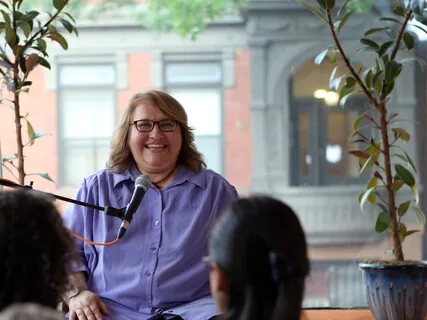
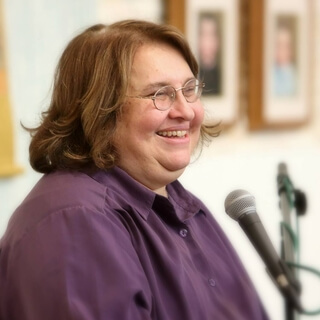
You are listening to Sharon Salzberg's Dharma talk on the introduction of meta loving kindness conducted at Spirit Rock 2015.
I find as I'm getting older I become more and more cynical and that's what's happened to me in terms of the way I view the world and comments come out of my mouth that I'm even surprised to hear after I say them and recently I have two 17 year olds and my daughter commented on something I said and she said well that's why we're so cynical and so it's passing on I'm passing this on to my children sadly and so I'm wondering how maybe I can use loving kindness to as maybe an an antidote to that I Think that's a great question,
And I think it is It could be seen as an antidote to that in a lot of ways Classically loving kindness is considered the antidote to fear and So if there's a kind of fear as there sometimes is in What what we call cynicism in the Buddhist psychology would probably be called doubt and doubt is a complex term because Within that system some kinds of data really useful like why be gullible?
Why just believe something someone tells you you have to check it out for yourself?
You have to insist on seeing the truth for yourself You have to feel empowered in that you have to be able to question,
But there's a kind of doubt which is more like cynicism Where we're not putting ourselves in something to try it out.
We're standing back and just kind of discounting it in some way and Sometimes there's a big element of fear in there somehow So so that would be something to look at like if you sit with the cynical voice and just sit with it in The mindful sense like what do you discover?
What do you see?
What do you find in there?
I think there's also a way in which Any kind of practice of meditation returns us to a Greater appreciation of simplicity and subtlety Mostly we're not awfully trained to subtlety and We count in a kind of intensity in order to feel alive that could be intense pleasure It could be intense pain And it could be a kind of ironic cynical Sense of distance You know because it feels more empowered to us.
We think it's going to be more empowered Than being kind you know or Connecting to something just as it is and I think we see Just through the force or the continuation of the practice of course There are there are lots of changes,
And I would find it very interesting to really focus on loving kindness for oneself Because sometimes that voice Would take the form of you know may I be happy you're right.
You know like you deserve to be happy You know and just to see I mean something we didn't yet do But is is often part of a loving kindness Progression is seeing what it feels like to be in the position of recipient With others offering loving kindness to you how much can we let it in?
How much can we appreciate it?
How much do we reject it or how?
Kind of snarky do we get?
Like sometimes we do that exercise where we visualize a circle of beings and we're in the center and They're all offering loving kindness to us so the beings We are bringing to that circle or either the most loving beings.
We have met or heard about or Have existed They exist now where they've existed historically we've had them for a long time They existed they exist now where they've existed historically or even mythically like that's the circle And we're there in the center and we get to experience ourselves as the recipient and bless you And I remember the first time I ever did it.
I had this incredible urge just to duck down and Let them offer loving kindness to one another Rather than being involved at all in the in the thing and so You know we see all kinds of things that Have us hold back or step away or not Give something a try or not Be cool with something that's simple or repetitive and and once we see that then we can let go of it and kind of come forward That's the experiment If you're saying the same four phrases over and over again How do you how do you keep it from being rote and saying stay focused?
Sometimes you do change the phrases,
But mostly not Mostly you do try to have basically the same phrases for the sake of the you know that dynamic I talked about for the sake of the concentration And that's why there are only a certain number of phrases somebody once said to me.
I can't remember my phrases So I said how many do you have and they said about 15,
And I said no one can remember 15 phrases and What we don't want it may happen anyway,
But we don't want to Further just discursive thinking like a new friend comes to mind and you think what about you?
You know I'm nothing happiness really works for you.
You get kind of lazy when you're happy.
You know like Maybe content now you'd really go to sleep if you were content.
Maybe what what what because then it's like me You know where did she go to dinner and it's like you know and so we lose the power of the concentration So that's why we basically use the same phrases there are few ways.
We keep it from being remote or more Realistically it becomes rote,
And then we see that and we come back to a greater sense of presence One is through this simple almost mechanical aspect called right aim which is at the heart of concentration of any kind so Here's the example that is used over and over and over again whether you're talking about the breath Or a loving kindness phrase or a mantra or whatever it is They use this example in Asia all the time a country like Burma say this piece of food on a plate like a piece of broccoli And in your hand you're holding a fork with the rather obvious goal of aiming the fork Right at that piece of food So you can lift it and eat it so to do that they say we need two things One is what is called right aim you want to take that fork and aim it right at that broccoli If you take the fork and you wave it around in the air,
You're not going to have a lot of dinner,
So it's just like And then the next thing we need is a very sensitive modulation of our energy There's too little energy the fork just hangs there in your hand It's too much energy you take the fork and you bash it through the broccoli and everything goes flying And once again you don't get any dinner so that rather simple example is used endlessly To describe there's something about Asian pedagogy which is a lot about repetition so I really mean endlessly To describe almost the mechanical or technical aspect of concentration We have an object of the present moment maybe it's the breath maybe it's a phrase of loving kindness We aim our attention toward just this one Doesn't matter what the last breath felt like it doesn't matter what the next breath feels like it's just now Or just this one phrase and people sometimes say that to themselves just this one As a kind of setting the stage right and then they connect So that quality is very important the next quality is that sensitivity or the modulation it's like sometimes it's too much energy And it's like where's the love or you know you're trying too hard and sometimes it's just not enough So we try to pick up the energy maybe you get a sharper sense of the recipient either through visualization or you just say their name to yourself Or you might reflect on the good within them which is one of the precursors to loving kindness if that's not realistic for some reason You reflect on the fact that they too want to be happy like with the neutral person you wouldn't necessarily know the good within them But you can reflect on the fact that they want to be happy also And then it's a more meaningful sense of connection in that moment a more meaningful sense of giving So between right aim and just connecting to the moment more fully and ways we can raise energy Including some amount of active imagination that's how we do it and everyone's mind is different You can tell from the way I describe my mind as I keep saying you know structure is very important to me Simplicity is very important to me and I do some of the others sure I imagine somebody happy or I imagine them as an infant Or you know whatever the different and we'll go through some of that you know different ways we try to get more creative and more alive But I can do that endlessly you know so I don't emphasize that in my own practice to the same degree that I practice just the you know being there as much Hi coming back to what you mentioned at the beginning of the day about the connection to equanimity For me sometimes it's difficult when I'm trying to practice these phrases and I'm thinking about someone and I know that they are suffering a tremendous amount Either because of their circumstances and or because of their internal state and how do I sort of deal with all of those reactions and practice equanimity about that While at the same time trying to focus on the loving kindness toward that person Well to some extent I think in practical terms it's actually a movement between loving kindness and then just mindfulness which means equanimity Equanimity is a big factor in mindfulness too toward what you're actually feeling And that might then inspire loving kindness toward yourself because those are often pretty painful feelings Equanimity is a big factor in mindfulness because mindfulness is my big bugaboo does not just mean knowing something's happening like you're hearing a sound It means knowing in a certain way without holding on without pushing away because it's that equanimity hidden or embedded in the mindfulness that makes mindfulness the platform for insight You know so if a certain emotion comes up and right away we're fighting it and trying to make it go away there's not going to be a lot of learning going on And at the same time if we dive into it you're right Lucy you're always right it's hopeless that's who I am there's not enough space for there to be a lot of learning or understanding to develop So if we're practicing mindfulness we're also practicing equanimity and so it might mean some mindfulness and balance toward what you're feeling It also might mean some loving kindness for yourself I think that movement is totally natural to be offering loving kindness or compassion to feel overwhelmed to realize that and to come back into balance So one of the hardest parts is realizing that it's good to come back into balance that doesn't mean you're callous or you're uncaring But there's only let me rephrase that if these practices are practices of generosity it's said that one of the best kinds of generosity comes from a sense of inner abundance And that's whether it's material generosity or generosity of the spirit like in terms of material generosity sometimes people might have an enormous amount externally But they don't internally even have the feeling they have enough and so it's very hard in that circumstance to give happily Whereas you might have very little by external measures but you have that inner sense of abundance and it's much easier to give And the same thing with caring or caretaking or whatever it is if you feel depleted,
Empty,
Exhausted,
Fatigued,
Broken,
Overwhelmed You don't have a lot of wherewithal to keep giving or even being present It's hard to even pay full attention to someone else when that is one's internal state So realizing that we need to replenish,
We need to renew,
We need to find a form of resilience so that we do have a sense of resource inside so that we can give We can care,
We can be present,
That's essential but it's not easy for most people to allow themselves that And they think well I've just got to keep giving so even having that understanding I think is a very big deal And then you just keep reminding yourself and you do what you need to do to go forward and be able to be there Thanks Sharon,
It's good to see you again You too.
The loving kindness practice that you're talking about is for like an entire sitting,
Does it also work like if you're doing your normal mindfulness sitting and then you devote a few minutes at the end or is it better just to do it as an entire practice?
It's really up to you.
Most people I know in a daily sitting will do both,
Not everybody but sometimes people like to do a few minutes of loving kindness practice in the beginning because it helps set the stage for observing with some more warmth and kindness,
The different things that come and go Very often people will do it toward the end so that it is like a dedication,
It's a recognition that our inner work is not just for ourselves alone so it's like an extension I went to Burma in 1985 and that marked,
That three month retreat marked the beginning of a four year period where my entire practice was loving kindness,
That's all I did Because I wanted to,
I was inspired by it,
I was challenged by it and that's all I did and then these days my practice,
I do sit every day and I mostly my formal practice by and large is a kind of mindfulness practice And I also have a resolve to do loving kindness whenever I'm waiting and I count every mode of transportation as waiting,
Every airplane ride,
Taxi,
Walking down the streets of New York As well as waiting,
Literally waiting online in the store or waiting in the doctor's waiting room,
Whatever it might be and it's really fantastic because so many of those situations we just get impatient and fretful Or I do something I actually have no interest in doing,
Like I read something I don't really want to read and instead to say okay this is a time when I can practice and I can practice extending this kind of energy,
It's so much fun And it's just a great exercise,
So that's just a choice now and I may well go back to doing much more formal loving kindness practice,
Sitting,
I don't really know but it's really up to you Hi Sharon,
Can you talk more about that idea that loving kindness is an antidote for fear?
Well the old legend,
Remember it's legend,
So it's got the feeling tone and also the power of myth,
Is that the Buddha first taught loving kindness practice to this group of monks,
He'd sent them off to a forest to meditate And the forest was inhabited by tree spirits who were not very happy about the appearance of the monks,
So the tree spirits tried to drive the monks away So they'd make these ghoulish apparitions and horrible shrieking sounds and all kinds of things and sure enough the monks got terrified and they ran away And they ran back to the Buddha and they said oh Lord Buddha please send us to a different forest And he said I'm going to send you back to the very same forest but I'm going to teach you the only protection you'll really need and that was loving kindness meditation So that was the context,
The story about when he first taught it So they went back to the same forest and he told them don't just like do loving kindness as a recitation,
Do it as a practice,
Like really put your heart into that So they went and did that and as these stories all end so happily the tree spirits were so taken with the beautiful energy coming their way that they decided they were in fact very happy to have the monks there And offered them food and took care of them in those ways,
So I wouldn't count on that And that's where equanimity comes in which we'll talk a lot about tomorrow You cannot count on a certain result,
You know it's not pass fail this thing But we can see it,
We can see it in our lives that fearful energy is withdrawn,
It's shirking,
It's tight,
It's frozen and the energetic state of loving kindness is very different It's open,
It's a lot about space,
There's this beautiful quotation from the Buddha where he says develop a mind so filled with love it resembles space Which cannot be painted,
Cannot be marred,
Cannot be ruined,
Develop a mind so filled with love it resembles space So if someone was standing here in the middle of the room throwing paint around in the air there wouldn't be anywhere in the space for the paint to land So you wouldn't say the paint like ruined the space,
It's that open,
That free,
That unconfined,
That unconstrained Develop a mind so filled with love it resembles space Now that's a very different energy than fear right where we lock down and everything shuts down and the world gets very small So you can kind of see how it works as the antidote Hi,
I'm really grateful that you just mentioned space,
I run a mindful community of 20 and 30 somethings,
It's about 150 of us and we call ourselves MakeSpace And something that we spend a lot of time working on and holding space for each other around is our relationship to work And in light of resilience and in light of loving kindness what we find is that we struggle that there's this Almost this line between what is a breakdown tendency or a laziness tendency,
Like when is it time to make space and walk away from my computer and not work and go to the beach and relax Or is this that moment where I stay on my cushion and I keep going and I really need to push past this fear or this resistance And we find that folks in our community really fall in one way or the other and some are very much around nurturing their creative process and being very kind of cushy and loving and others are like no,
You've got to keep going,
That's how you build the resilience And do you have any guidance I can take back to San Francisco around really cultivating a craft in a way that is still loving Well I,
Again I think it's a few things,
One is that's the dynamic we're all in in one sphere or another,
That's what we're trying to find balance within And so there is a certain kind of sensitivity that one develops I think just through mindfulness because you can see more and more what's motivating you to give,
To kind of let go or to hang in there Am I hanging in there just through a sheer sense of endurance or because I really am working with and challenging a tendency I have to give up Am I creating a space and hanging in there that is still open and interested or am I just gritting my teeth,
You know,
Waiting for the clock to wind down And the same with saying I'm taking a break,
Sometimes that's like the healthiest,
Smartest thing to do Even in the context of intensive practice I was talking to someone earlier and talking about my teacher,
Saira Upandita,
Who is the Burmese teacher who I studied loving kindness with in 1985 So I first met him in 1984 when he first came to the states,
He came to the Insight Meditation Society to teach a three month retreat and we invited him never having met him because we heard he was a really great teacher And I sat that retreat as did Joseph and Jack,
I think for half of it,
And he was a really great teacher and he also turned out to be extremely fierce and intense and demanding,
Really demanding And one day he was doing a question and answer session in the hall and somebody said to him,
How long should I pay attention to physical pain before I move my attention to somewhere else that's easier to be with So that's also a very deep question because we use physical pain as a template for emotional pain,
All kinds of pain So how long should I hang in there with it before I take a break and go to something that's easier to be with,
Maybe that's listening to sound,
Maybe it's doing loving kindness,
Maybe it's shifting the object of loving kindness,
Something like that So I thought given his personality he was going to say,
You should be with the pain until you fall over,
I honestly did And much to my surprise he said,
I'm really astonished,
He said,
Don't be with the pain for very long He said,
Be with the pain,
Move your attention to something that's easier to be with,
Go back to the pain,
Leave it again,
Go to something that's easier to be with He said,
It's not like it's wrong to just be with the pain and be with the pain and be with the pain,
But you'll likely get exhausted So he said,
Why not build in balance all along the way So I was sitting there in the hall and I thought,
Wow,
If those words are coming out of his mouth,
That must really be true Because he is like the farthest thing in the universe from somebody who would say something just to be nice I mean like,
Never And it's become a really important lesson for me and something that I really try to encourage We can be so hard on ourselves,
You know,
I've got to break through this Instead of realizing,
I'm getting tired,
You know,
I need a break,
I can come back,
I need that sense of renewal And I will also say,
In all my years of teaching,
Which are considerable now because I'm getting older There are two instructions that I've given which are the least popular This is one,
Just be with the pain,
Move to something that's easier to be with People often think that means she thinks I can't do it I can't do the real thing,
It's copping out,
That's like cowardice to get a break,
To get some lightness And the other is,
If you are offering loving kindness,
And they're very similar If you're offering loving kindness to a difficult person,
Do not start with the most difficult person in your life Or the person who has behaved so hideously on the world stage that it's just unimaginable And they're kind of similar instructions,
Right?
People don't tend to like that either So I think about that,
You know,
Maybe there's something in us that thinks,
It's not going to count Certainly there's something in me When I went to Burma in 85 to do the Metta,
It took six weeks to get to the point of offering loving kindness to a difficult person You know,
It took three weeks,
Just myself and a benefactor,
And then slowly move on And for a while then my benefactor was my teacher Deepa Ma,
Who I really loved And just thinking about her made me happy,
And I felt so guilty I thought,
Well,
This isn't going to really count as spiritual practice Till I'm with,
Like,
My,
They call it an enemy too,
They don't say difficult person,
So it's even more dramatic Till I'm with my enemy,
And I'm like sweating and struggling and probably crying,
And that's spiritual practice Sitting here,
Filled with delight and joy,
Thinking about my teacher,
That doesn't count So I said,
I must have said something that indicated that in talking to Upandita And he basically looked at me like I was crazy and he said,
Why do you want to do things in the hardest way possible?
This is meant to be done in the easiest way possible,
Which is hard for us Right?
So it's not about struggle,
It's about changing our relationship to everything To joy,
To sorrow,
To ourselves,
To others,
And we do that,
And sometimes we need rest And we go forward and we come back,
And that's the natural movement of a practice So you can tell after a while,
I think,
Where you're coming from,
And what's motivating you And just sort of see a way,
You know,
To go forward Thank you.
Can you explain the difference between loving kindness and compassion?
Of course these qualities are very close,
And they're very supportive of one another I think they have different flavors,
Sometimes they have different challenges So I usually go to the Buddhist psychology to have some sense of how to distinguish them Each of these four qualities is said to have a near enemy,
A far enemy,
And a proximate cause So the far enemy is the clear opposite,
You'd never confuse the Brahman Vihara state for its far enemy The near enemy is like that near miss I was talking about earlier,
Where at a superficial level you can easily confuse the two And it's only through some real awareness that you realize,
Oh,
Those are very different And the proximate cause is the nearest arising condition,
Or a likely springboard for this desired quality to arise It's not the only springboard,
But it's a very likely one Okay,
So the far enemy of loving kindness is aversion,
Which is anger or fear In some Buddhist psychological systems,
Those are considered the same mind state Anger being the outflowing,
Expressive,
Energized form,
Fear being the held in,
Frozen,
Imploding form Of striking out against what's happening,
Wanting to separate from it,
Or declare it to be untrue So that's the far enemy.
The near enemy of loving kindness is attachment And that doesn't mean attachment in the way it's used in the psychological sense these days Of nurturing or bonding,
Or appropriate attachment relationships compared to disordered attachment relationships It really means a kind of clinging or control,
So that's the expectation,
That's the demand,
That's the breakability I will love myself as long as I never make a mistake,
Right?
So that's why it's so fragile There's an attachment there,
I will love you as long as,
I will love you as long as you get better,
Right?
That is attachment,
It might look like loving kindness on the surface,
But when you really look,
It's very different So compassion is known as the trembling or the quivering of the heart It's a movement toward to see if we can be of help Oh,
And the proximate cause of loving kindness,
To go back for a moment,
Is seeing the good in someone Because if we obsess about what's wrong,
Including with ourselves,
We just go over and over and over You know that pattern we have,
Like you're thinking of somebody and you're going over their list of faults And then you go over it again,
You go over it again,
It's like you don't even think of a new fault You're just like going over the same list,
You know,
So as we do that,
We will naturally feel more distance and alienation Whereas if we can find one good thing about someone,
Even if it's like a little thing,
Then we feel some sense of connection And from that vantage point,
We can look directly at what's wrong or what seems to us to be wrong And sometimes you will not find one good thing at all,
And so this other reflection comes into play That all beings want to be happy,
That this is an urge within all of us,
And this is rightful,
We should be happy No one left out,
It's because of the force of ignorance that we don't understand where happiness is actually to be found But that urge toward happiness is a good thing,
It's an appropriate thing And if we can align it with wisdom instead of ignorance,
It would be like a homing instinct toward freedom So compassion,
The far enemy is cruelty,
Which I often think of as such a profound sense of otherness That it doesn't matter,
It's not like you have that empathic sense that there's a being there being harmed The near enemy is another interesting translation challenge Some people say pity,
But that's a little complicated The translation these days is usually sorrow or grief,
But it doesn't mean sorrow or grief again in the Western psychological sense It means basically burnout,
You know,
We see suffering and we're overwhelmed,
Or we're exhausted We feel broken by that,
Rather than feeling that energy to go toward,
To see if we can be of help One scholar suggested the word despair to me as a translation So we recognize the suffering,
But we don't feel any sense of resource inside So it's a little different And the proximate cause of compassion is seeing suffering as suffering Sometimes we look at our own fear or anger or greed and we call those states wrong or bad or terrible But if we actually remembered that those were states of suffering,
We would have a different relationship to them Which would be more one of compassion rather than rejection So it's like that,
You know,
That's how I try to describe the difference They're so close and they also have kind of distinct challenges and manifestations and platforms from which they arise Compassion also arises when I say see suffering as suffering,
It arises from recognizing our vulnerability,
All of us Because we certainly don't share the same measure of pain,
That's just not happening But we all share vulnerability,
Everybody is living a life where life can just turn on a dime You get one cell phone message and you have a different life than the moment you picked up that phone And it's true for everybody,
So if loving kindness is more based on realizing the universal wish to be happy Compassion is more based on the universal recognition of vulnerability So that's how you tell the difference