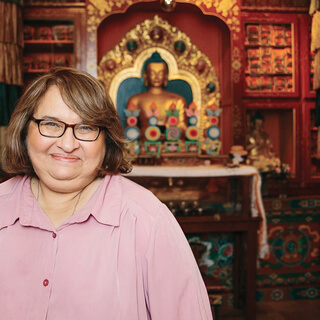
You are listening to Sharon Salzberg's Real Happiness at Work talk,
Originally recorded at Spirit Rock in 2014.
My book,
Real Happiness at Work,
It came out on January 1st,
And I'm sure I was here a couple of years ago when my book,
Real Happiness,
Came out and talked about how that particular title wasn't something I'd chosen,
It was something the publisher had given to me out of a series of circumstances.
The book was going to be called something else and then I got an advanced copy of a friend's book with that something else as the title.
And so we quickly had to find another title and that came up with Real Happiness which I felt some ambivalence about.
On the one hand I think it's what we all actually want and it strikes a chord.
We want something that around inner sustenance,
Resourcefulness,
A sense of wholeness that isn't going to be so dependent on circumstance,
Isn't going to shatter and break as things shift and we don't get what we want or someone disappoints us or we get afraid even,
You know,
There still can be something.
That is like a resource for us.
I think that's what we actually want.
And on the other hand I thought,
Well that's going to be difficult.
And I was right.
The first interview I had,
The very first question was something like,
Are you trying to tell me that the kind of happiness I feel when I'm having a lovely dinner with my wife isn't real?
And I said,
Of course I think it's real.
We also know as joyful and wondrous as those experiences are,
They're not forever.
They come and they go.
And I said to him,
What about the night you don't like your dinner all that much?
And I thought but didn't say,
What about the night you don't like your wife all that much?
Because they happen,
Right?
So it's not to put down or disdain those experiences,
But I know we can have a much deeper,
More refined,
More sustainable sense of happiness.
So we enjoy the pleasure fully when it comes and we don't feel so defeated and so defined by the difficulty when that comes.
So I went on tour with that book and it was really very funny because people were not very happy with the word happy or happiness.
So often seems like something happy-go-lucky and superficial and just the endless pleasure seeking which we're used to.
People say,
Well that's why I started practice,
To unhook from that.
You know,
What is this happiness obsession?
And I kept trying to redefine the word so that it didn't mean just pleasure or it certainly didn't mean something selfish.
Because when I would go on tour,
People would say to me,
Town after town,
Haven't you ever seen the bumper sticker that says if you're not depressed,
You're not paying attention?
And I'd say,
Well actually I have seen it and I understand the sentiment.
And what about when we are depressed and we're exhausted and we feel depleted and we feel overcome,
We feel overwhelmed?
There's not a whole lot in us that we feel we can give to somebody else.
We don't have that sense of wherewithal.
And it reminds me a lot of the teachings about generosity where they say that the best kind of generosity actually comes from a sense of inner abundance.
It's not dependent on how much you have externally.
And we know that,
Right,
Because we probably all know people who might have very little materially externally,
But they're very generous and perhaps know people who have a huge amount more externally,
But don't ever seem to have the internal feeling that they ever have enough.
And so it's so much harder to give or to share.
And it's not just about material generosity,
It's about generosity of the spirit.
When I teach loving-kindness meditation,
And one of the categories that we offer loving-kindness to is someone known as a benefactor,
Someone who's helped us.
Maybe they've helped us directly,
They help pick us up when we've fallen down,
Or maybe not.
Maybe we've never met them,
But they've inspired us,
They embody this sense of possibility of love and kindness for us.
And so many times people,
You know,
I give that instruction,
Okay,
Now it's time to offer loving-kindness to a benefactor,
And afterwards somebody will come up to me and say,
You know,
I chose the Dalai Lama as my benefactor,
And things were going fine,
And then suddenly I thought,
Wait a minute,
He's the Dalai Lama,
What does he need me for?
And I find that so interesting.
First of all,
How do we know that,
Right?
For all we know,
Every single day of his life he's sustained by the prayers and well-wishing and loving-kindness of others.
And what an interesting assumption.
What I have to give is so nothing,
It's so negligible,
It couldn't count,
Couldn't possibly ever,
Ever make a difference.
So from that state,
We don't have a lot of generosity,
Because we don't have a lot of that sense of inner abundance to feed it,
To be the wellspring.
We can't even pay that much attention to somebody else.
It feels like an intrusion,
Because we feel so impoverished within.
And so,
When I say happiness,
I don't mean,
You know,
Just like endless delight and enjoying yourself,
But more that sense of that wellspring and being able to access it.
One of the things we did,
The book,
Real Happiness,
Came out in January,
And the full title is Real Happiness,
The Power of Meditation,
A 28-day program.
Because it's like this program to establish or reinforce your meditation practice.
So it came out in January,
In February,
Conveniently had 28 days.
So we ran this challenge on my website,
And we're still doing it,
This is the third year,
Where we asked people to blog or comment,
If they wished,
And talk about their meditation practices.
They went through the program,
And we said to people,
Please be really honest.
Unless it actually happens,
Please don't say,
I sat down for two and a half minutes and I floated away in a sea of bliss.
You know,
Just tell it like it is.
And it's been a beautiful,
Beautiful experience,
Because people have been honest,
And a tremendous sense of community has been engendered.
There's one going on right now.
I really urge you to look at my website and find it,
You know,
If you're interested in,
And a real sense of sharing in this journey and on this path.
And because people were so honest,
As I would read those entries,
One of the things I was really struck by was,
Given the tremendously wide variety of livelihoods represented by people,
How so many common themes were emerging,
Like,
I feel like a different person at home and a different person at work,
Or the hardest place of all to bring forth these values,
Which are so important to me,
Is work.
And I thought it was just so interesting,
Because amongst the people,
Even in the first group,
Who were writing,
You know,
There was a hedge fund manager and a divorce lawyer and a special ed teacher and a longshoreman and a few firefighters and an undercover policewoman and hospice nurses and a minister.
And there was just like this big variety of people,
Artists,
Writers,
People who worked at home,
People who worked outside the home.
And the themes were so common.
This is hard.
It's very hard to integrate.
It's very hard to have a sense of seamlessness.
And as people went on and wrote,
I could sense that there were some common kind of threads in terms of turning that around.
You know,
What were people relying on?
How were they finding resiliency and resourcefulness and so on in bringing these values into the world of work?
And so that was really the genesis of this book,
Real Happiness at Work,
Which is kind of a cute title,
I think,
Actually,
Since it can be taken both ways.
And if you notice the cover of the designer very cleverly,
There's like a lotus and it's made of paper clips,
Which is really cute.
So I got intrigued and inspired.
I did go to India to learn meditation and lived there for many years with this extremely supportive community as we were establishing these tools and building confidence and clarity in using these tools.
And basically nobody had a job.
Nobody was doing anything.
We were having a life,
Right?
And,
You know,
Like every once in a while you'd mail a letter or something,
Which took a long time.
It's true.
But,
You know,
And it was only after coming back here and teaching and starting to encounter so many kinds of people that it became obvious that the challenges were as strong as they were and that we had to create systems.
We had to create communities.
We had to create supportive networks and ways of being and sharing information and knowledge and expertise as it was developing about how you handle a moral dilemma and how you handle this and how,
You know,
What this might look like and what might better communication look like.
And so it all began to come together in a different way because we need it.
It's like a pioneering time in many ways.
So then when this book came out,
Because of the title,
Even though I find it very cute,
I've already gotten a hard time,
A fair amount,
Because people say,
As you might expect,
We don't call it play.
We call it work.
You're not supposed to be happy.
If you're supposed to be having a good time all the time,
We call it play.
Or how can you be expecting to enjoy something that you're working at,
You know,
And just have fun at it?
And,
You know,
So again,
It comes down to this much deeper examination of what is happiness.
And can we take the investigation to that depth and really look,
Really pay attention?
Because the things we find,
I believe,
Are the things we find in any relationship,
The things we find within ourselves,
As those qualities that have to do with connection,
They have to do with presence,
They have to do with awareness,
They have to do with balance.
And in any context,
In any situation,
That's what we can rely on.
So they say,
For example,
The biggest predictor of happiness at work is a sense of meaning.
And that sense of meaning may not be what we find in the job description,
It may not be the job description of our dreams.
But it's something we infuse into the job through our commitment to compassion,
To listening,
To caring,
To doing something well,
Whatever it might be.
So right after my book came out,
Somebody in New York City,
A friend gave me a dinner party.
And someone at the dinner party,
At one point,
Asked for the just to be one conversation,
Everybody talking to the table.
And she posed the question,
What was your happiest time at work?
Can you think of something that may have been a particular interlude or a time or an aspect of your work that just made you really happier?
And it was a very interesting question.
Somebody,
As we went around the table,
Somebody brought up something that happened just that very day as his happiest time at work.
And I was so kind of taken with the quality of the conversation that every once in a while when I was teaching subsequent to the book coming out,
I would ask,
You know,
If you want to bring up something about your happiest time at work,
That would be really interesting to hear.
So this is the most recent.
I've had a lot of experiences since the book came out where I thought,
Oh,
No,
I needed that in the book.
How can that be?
The first of which,
By the way,
Was somebody who was interviewing me telling me there was such a thing as email apnea.
What about that?
It's actually a syndrome that we stop breathing,
Or we take very,
Very shallow breaths when we're checking email.
Take a look.
It's very interesting.
And it's got a lot of consequences.
Anyway,
So there have been a few things like that,
Many of which I'll probably talk about tonight.
So I brought up that possibility with the script.
I said,
If you want to talk about your happiest sense of being at work,
Your happiest time at work,
What would it be?
And this woman raised her hand and she said,
I work in a call-in center doing customer service,
Which means complaints.
And she said,
I'm totally committed to caring about everybody who calls.
And I'm completely honest.
If I say I'm going to get back to you by 3 o'clock,
I'll get back to you by 3 o'clock.
And I know by the time people are talking to me,
They've already been through three or four people,
And they're so frustrated and they're so upset.
And she said,
I listen,
I'm totally present,
And I really care.
I just want to do the best I can for them if I possibly can.
And I swear,
This woman was absolutely radiant.
She was like beaming when she was talking about this.
And I can't help but believe that from childhood on,
She did not yearn to be working in a call-in center.
Perhaps it's not the job of her dreams.
And it was so beautiful.
Just to see the degree of awareness and compassion that she was bringing to that work.
And it was.
It made everyone in the room really happy just listening to that.
It reminded me of a story in the book,
Which is really one of my favorite stories about a time I was in New York City.
And I was trying to get a taxi to go further uptown to go hear Thich Nhat Hanh give a talk.
It was a few years ago.
And those of you who are not New Yorkers may not know that as taxis change shift certain times of the day,
It's almost impossible to get a cab.
And occasionally one will stop and ask you where you're going because if where you're going is close to where they need to drop off the cab at the end of their shift,
Then they'll take you as the last fare of the day.
So that's what happened.
I waited and waited and I couldn't get a cab.
And finally one stopped.
And he said,
Where are you going?
And I told him,
He said,
OK,
Get in.
So I got in the taxi and we ended up stuck in the most terrible,
Unbelievable,
Oppressive,
Awful,
Awful traffic.
I'd never seen anything like it.
And first I thought,
Well,
Forget Thich Nhat Hanh.
I'm never getting there.
And then mostly I felt really bad for the taxi driver.
I thought he was nice enough to pick me up.
He's going to be really late turning in his cab.
I don't know what happens.
I don't know if he gets fined.
I don't know if he gets penalized in some way.
And I said to him,
I am so sorry.
I'm so sorry that this happened.
I've never seen traffic like this.
I know you're going to be late.
It's so terrible.
I'm so,
So sorry.
And he said to me,
Madam,
Traffic is not your fault.
And then he said,
And nor is it mine.
And then I thought,
I don't even need to get to see Thich Nhat Hanh because I just had an enlightened taxi driver.
And I was especially moved by that second statement,
Nor is it mine.
I thought,
How many times a day is he likely blamed for something that is not his fault?
A bridge is closed.
There's terrible traffic.
There's an erratic driver.
And to have that much dignity and self-possession to say,
Nor is it mine,
Right,
In the kindest possible way,
It was a tremendous lesson.
And I had really tremendous respect for him.
And I made it to the talk with no seconds to spare.
I catapulted myself into the seat just as Thich Nhat Hanh was walking up on the stage.
But it was an amazing moment.
He made a difference in my day.
He made a difference in my week.
So,
I mean,
Of course,
Some situations are terribly oppressive.
They're really difficult.
And this is a hard time.
I don't mean to be glib about that.
It's not that easy to find another line of work,
Even if you're really unhappy at what you're doing.
But to whatever extent we are where we are,
Then we can infuse our values into an encounter,
A conversation.
And it does make a difference.
It really,
Really does,
Not only to oneself,
But to the other people.
One of the,
And it manifests in a lot of different ways,
One of the programs that I've done,
Which has been really powerful,
Was this four-year pilot program through this place called the Garrison Institute,
Working with frontline domestic violence shelter workers and offering the tools of yoga and meditation to people who are clearly doing a very,
Very,
Very hard job with,
They're not very heralded and not very supported,
And it's a really hard job.
And of course,
There are many people like that.
I sometimes would look at those women and I'd think,
Boy,
If they stopped doing their job,
It's like the whole society would crumble.
But we don't pay that much attention to them.
So the first thing we did,
Which was really fun and interesting,
Was we asked people to make a list.
First of the,
In one column,
The stressors in their work.
And sometimes that was surprising,
You know,
It may be a colleague rather than the work.
I mean,
There's all kinds of stuff that is interesting in that.
And then the second column is what do you do?
What do you reach for,
For a sense of upliftment or resiliency or lifting your spirits or getting some perspective,
Getting a break?
And then in the third column,
In a way,
It was a column,
We said,
Why don't you take a look at those things in the second column,
Like what you do,
And see how you feel about them.
And then for those who wished,
They would describe certainly what was in that second column and how they felt about it,
Because every single person wrote down music,
Listening to music,
Although it was very different kinds of music.
Sometimes people wrote down things they were clearly worried about,
Like drinking a lot.
One woman who chose to speak,
She said that she watched an enormous amount of American Idol to relax.
And I laughed and I said to her,
Oh,
God,
That's like so depressing for me.
You know,
Like the one time I watched it,
I felt like I was watching constant rejection.
And I ended up much more stressed out than when I started,
So that wouldn't work for me.
And then we turned to yoga and meditation as things to experiment with,
To see if having having experienced them,
It was something that they felt they wanted to to bring into their life and to have that sense of relief and balance.
So we did that program for a while,
And then we started getting calls from the directors and supervisors of the shelters,
Because they were so impressed with the changes that had happened with the frontline staff.
And so then we started doing programs for directors and supervisors.
And then by the time that went on for a while,
They themselves coined a phrase,
Which I found a really incredible phrase.
They started talking about creating a culture of wellness at work.
And everybody talked about different things.
And of course,
The domain of one's sphere of influence could be different.
It could be an entire shelter or a classroom or a corporation.
It could be just your desk.
It could be just your body and mind.
Right.
But it's something.
And so these directors were talking about maybe growing a rooftop garden or everyone talked about having some area like a physical area of tranquility,
Somehow creating that.
And one woman said,
I'm going to start to take a lunch break and that will help create a culture of wellness.
Now,
Everyone in that room who did not work at a shelter was really,
Really surprised.
And we said,
You don't take a lunch break?
Like,
Isn't it in your contract?
And she said,
It's too hard.
There's too much to do.
The demands are incessant.
And,
You know,
These are not the urgency is strong.
But she was determined because it became clear to her through her own experience that you cannot go on forever in service to others without somehow restoring or renewing that sense of resiliency.
So because we were meeting in between retreats periodically,
She would report in on her progress.
So the first time she said,
Well,
I determined to take a lunch break and I went into my office and I locked the door.
But it didn't work because somebody crouched down and looked through the keyhole and saw that I was in there.
So the next time she came in,
She said,
It worked.
She said,
I locked the door and I turned off the light and I got a break.
That's like a culture of wellness,
Right?
Right there.
As hard as it can be.
And it seems so selfish in a way or self-centered.
But really,
Realistically,
If we look at the cost of getting that disconnected and feeling that cut off,
It's just not going to be sustainable over a period of time.
And so I get very excited about that phrase and feeling like,
Well,
We all have something we can work to create.
If it's changing the way we communicate,
If it's ritualizing certain pauses,
Like really taking breaks.
And these,
You know,
Because I learned so much from talking to all these people who've had jobs other than my job,
Which is different.
I was trying to explain to somebody,
You know,
I've worked,
I mean,
I started teaching meditation when I was 21.
We started the Insight Meditation Society when I was 23.
And that meant kind of the nonprofit world,
As I've said,
Not really jokingly.
I don't know if Jack or Joseph or I actually even knew what a mortgage was when we bought the building and opened it up.
But we quickly learned.
So it's not that I haven't worked,
But I haven't worked in a conventional setting ever.
And what I said to somebody,
What I realized was I've never had a boss.
That's different.
So I really learned a lot from talking to so many people and really hearing from them.
And even just that sense of pausing.
You know,
People would say those simple exercises like Thich Nhat Hanh's where he says,
Don't pick up the phone in the first ring,
Let it ring three times and breathe,
Makes a difference in a day of crazy momentum and getting lost and getting defined by others and overcome just being able to stop using the breath to that wonderfully portable vehicle to return to ourselves,
To return to the moment.
Because when we return to ourselves in that way,
We return to what we really care about.
We remember our priorities.
We remember our intention.
We remember our values.
We realize we have a choice.
But people talked about writing out the email and not pressing send right away as a matter of course,
Like write out the email,
Breathe,
Read the email again and then decide if you want to press send.
Or in one somewhat more intense version of that,
People said if they thought their email was going to be somewhat controversial or provocative,
They would send it to themselves.
So they got to read it as the recipient.
And what does that feel like to get that email?
And then they would make a decision.
So it's understanding a kind of fluidity to our intelligence.
We don't have to be stuck in a rut.
We can play.
We can expand.
We can experiment.
And we can just bring in these moments of stopping,
Of pausing,
Of taking a break,
Taking a breath,
Out of which a lot of different kinds of clarity will come.
So the basic framework of these transformations is the development,
First of all,
Of concentration,
Greater concentration,
Mindfulness and compassion,
Which are like the three great skills of meditation.
Concentration being a greater stability of attention so that we don't feel like we're flying all over the place.
We're not so distracted.
We're not so scattered.
We're not so fragmented.
Because the larger manifestation of that feeling of distractedness is fragmentation.
Right?
We feel like we are different people at different times.
We're torn apart or we compartmentalize.
My favorite expression of that still is when I was teaching in New York City and someone raised her hand and she said,
I feel filled with loving kindness and compassion for all beings everywhere as long as I'm alone.
But when some with others,
It's really rough.
And everybody laughed because we all knew what she meant.
Or it could be the other way around.
We feel fine when we're with others and very ill at ease being by ourselves.
And so our lives can be very torn apart.
So the development of concentration is a kind of gathering of all that scattered energy,
That disparate attention,
Bringing it together and resting,
Settling,
Centering.
Maybe 10 seconds later,
We have to do it again and then we do it again and then we do it again.
But over time,
What happens is we do kind of weave a coherent sense,
An integrated sense of who we are.
And our minds can settle and stabilize,
Not that we never get distracted,
But it's much shorter.
We come back much more gracefully.
We have a sense of being centered,
Whatever might be happening.
We do develop greater concentration.
So that's like stability of attention.
And on that,
We build the practice of mindfulness,
Which is God knows the word of the hour.
I mean,
When I came back from India in 1974,
If you use the word mindfulness in casual conversation,
Nobody would have a clue what you were talking about.
You know,
I had a very specific classical meeting in Buddhist psychology and practice.
And so it's really funny for me and quite wondrous,
You know,
But it's also very funny just to hear it.
So classically,
Mindfulness does mean a quality of attention where our perception of what's happening is not so distorted by bias.
We don't have so many assumptions running.
We don't have a big agenda going.
We're not so guided by what we hope,
What we fear.
We can see things more clearly,
More accurately,
Because even if those kind of veils arise,
We don't have to get caught in them.
We see them.
We can relinquish them more easily and come back to the moment.
So,
You know,
Projection is one example of something we get caught in a lot.
Maybe we have a difficult physical sensation or emotional state going on.
And right away we start thinking,
What's going to feel like next week?
It's going to be even worse.
What's it going to feel like next month?
Oh,
My God,
It's going to be here for the rest of my life,
Right?
So not only are we facing the genuine difficulty of the moment,
We now have all of that anticipated difficulty that we've added on top of it as though we knew,
As though we're real.
And we're trying to bear it all at once.
And we generally feel overcome and defeated.
And we give up.
So we notice that habit of projection.
We remind ourselves,
OK,
Tomorrow is not now.
What's happening right now?
Well,
We don't know what will happen.
Let's be with what's happening now.
Or maybe historically there's certain emotions we've just felt very frightened of feeling,
And that very emotion arises.
And so our immediate tendency is try to push it away,
Make it go away or disguise it or cover it over.
And mindfulness tells us you can be with it without all of that,
You know,
The shame and the fear and the whole thing.
Like,
What is it?
Pay attention to it.
Or maybe we have,
And some people do have,
Not uncommonly,
A real reluctance to experience joy and delight and the good things.
It's not uncommon.
So that something comes up and it's wonderful and we're kind of pushing it away.
Now,
These days I tell the story about a couple of Decembers ago.
Remember,
I live in the East Coast,
Right?
So December is a very cold,
Snowy,
Icy,
Miserable month.
I went to Maui to teach with Ram Dass and Krishnadas in that magnificent retreat that Jack went to this last December.
And Maui is Maui,
You know,
It's like Maui.
It's heaven,
Exactly.
It's unearthly beauty.
And that particular retreat,
They take over a resort and the resort's right on the beach and it's just like gorgeous.
It's really beautiful.
It was on my schedule because it was a retreat,
It was a public event,
But I did something extra,
Like I tweeted about it or something.
And all of a sudden I started getting all these messages saying,
Wow,
You're on Maui.
And I found myself immediately writing back saying,
It's very humid here.
It's really,
It's horribly humid.
You wouldn't believe how terrible it is,
Really.
And I could see what I was doing and I mentioned it in the hall,
You know,
When I was speaking and it became like this theme in the course because I was walking out of the hall once and behind me were,
It was a friend and the now adult son of another friend.
And he was saying,
Oh,
You know,
My mother almost came to this retreat.
She was really,
Really,
Really close.
And then she decided at the last moment she just couldn't do it.
And she's so filled with regret and she's so sorry she didn't come.
And without missing a beat,
My friend said,
Did you tell her how humid it is here?
You know,
So we see all kinds of habits around pleasure,
Around pain,
Around neutrality,
About who we think we should be,
What we think should be happening.
All kinds of habits come up,
But they don't have to dominate,
Right?
They don't have to take over.
If we can see them,
We can relinquish them.
Then we can pay attention much more fully.
And authentically to what our experience actually is,
That's mindfulness.
It's not just knowing what's going on,
That you're,
You know,
Drinking a cup of tea and that you feel the warmth of the teacup and all that,
Which is great,
Because it makes it a much better cup of tea.
It's how we pay attention,
That we pay attention without clinging,
Without condemning,
Without identifying,
Which creates the space for insight,
For understanding.
You know,
If a certain emotion comes up and we hate it and we fear it and we blame ourselves,
Why am I still feeling this?
I've been meditating for over 40 years,
You know,
I shouldn't have this anymore.
I spent $10,
000 in therapy just last year.
It shouldn't be here.
There's not going to be a lot of learning going on because we're just fighting,
We're struggling.
And at the same time,
If that emotion comes up and we dive right into it,
Like,
Yes,
I'm such an angry person,
I will be forever,
There's not enough space for there to be a lot of learning going on.
So there's not a lot of insight.
So mindfulness,
The main function of mindfulness classically is not only to have us have a better cup of tea,
Which is great,
But to be the platform for insight or understanding.
It's changing our relationship to everything.
So we can see deeply,
We can see more accurately what our experience actually is,
Who we actually are,
Where happiness actually comes from,
All of that.
So mindfulness is the second great skill of meditation.
And the third is compassion itself,
Compassion or loving-kindness,
Which also can sound a little bit funny in the West.
It sounds so cold or mechanistic,
Like I'm going to cultivate compassion,
I'm going to develop compassion.
And I don't know if that's because we tend to think of it as like a gift where you either have it or you don't.
And if you don't,
You're out of luck or just a kind of spontaneous emotional expression.
But in terms of Buddhist psychology,
It's believed absolutely compassion is like a skill that can be developed because attention is a skill that can be developed.
And the quality of compassion will rest upon how we're paying attention.
Now,
Who do we pay attention to?
Who do we look right through?
Who do we ignore?
Who's become the other just through the force of our indifference?
If we change the way we pay attention,
We go into that grocery store.
Instead of looking through that clerk,
We look at them.
Something shifts,
Right?
Not because you're giving yourself a lecture,
Like I spent all weekend at Spirit Rock doing compassion meditation,
I really should be feeling,
You know,
Is not like that.
But you pay attention differently and something shifts.
There's a different quality of connection.
Or what do we pay attention to?
If you're the kind of person who at the end of the day kind of goes through your day almost as though to evaluate yourself,
Like how did I do today?
And let's just say you're the kind of person who pretty well only remembers the things you did wrong and the mistakes you made and what you didn't say quite right.
Let's just say.
What if we kind of stretched and admitted,
Yeah,
I said that really stupid thing at lunch at that meeting,
But was there anything good in the day?
Right?
Any good within me?
It's not to deny or pretend that the difficulty didn't happen,
But that's such a magnet usually for our attention.
What about if we gave a little airtime to what was less common,
But also true?
Right?
And we open to a more inclusive picture.
That's the development of loving kindness and compassion through paying attention in a different way.
So those three,
Concentration and mindfulness and loving kindness or compassion,
Are like the platform.
And out of that,
As kind of expressions and manifestations and different forms,
We have resiliency,
Which is the ability to begin again.
We have a sense of meaning,
Which is going to be what we invest.
How much presence,
How much connection we will manifest in any situation.
We have a sense of integrity because we have a sense of authenticity.
We remember we're in touch.
We can see our motivation.
That's also a very interesting exercise.
Like before a conversation,
Before a phone call,
Before a meeting,
Just kind of pivot your attention to what do I really want?
What do I want the most out of this,
Let's say,
Conversation?
Do I want to be helpful?
Do I want to be harmful?
Do I want to be seen as right?
Do I want to come to a resolution?
Just pay attention because that will show us a lot about the choices we're about to make.
We see a lot about communication,
Right?
The possibility of being more mindful in all the ways that are so familiar in some sense.
When I walked in here and I was feeling rather warm,
Even though Marian had just given me two shawls thinking I was going to be rather cold,
I thought of this time I went to see the Dalai Lama speak in,
I think it was Seattle.
And when he spoke,
I just thought it was the funniest thing because he was saying something like,
Perhaps it's not so skillful to say it's warm in the room because maybe not everyone is feeling warm.
Perhaps it's more skillful to say I am feeling warm.
And I thought,
Wow,
He sounds like every communications coach I've ever heard.
Use I language.
Don't use you language.
And I thought,
Who's he been talking to?
And I realized he's probably been talking to different kinds of communications coaches because he talks to all kinds of people.
And as formulaic or stylized as it can sometimes seem,
Isn't it true?
Like if you go to the movies with a friend and you walk out and the friend says that was the best movie ever made,
There's now not enough room in the universe for you to say I didn't like it that much.
They have now laid out absolute gospel truth forevermore is the best movie ever made.
Whereas if you walk out of the movie and they say I loved it,
There is room for you to say I didn't like it that much.
And that's when a true conversation could actually happen.
So these are all like applications of mindfulness,
Concentration,
And compassion.
And that's really what we try to take into our work.
It's what we try to take into every facet of our lives because then our lives truly,
Truly do become seamless and are of one piece.