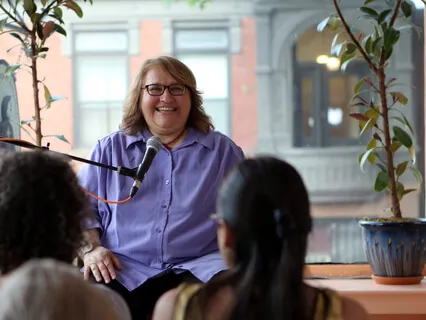
You are listening to Sharon Salzberg's Metta Meditation,
Originally held at the Insight Meditation Society in 2018.
So tomorrow morning we're going to turn our attention to more formally doing loving-kindness practice.
And of course,
Needless to say,
There are any number of ways of deepening and cultivating the qualities like loving-kindness and compassion.
I think that we do that even in what we've been doing,
You know,
That moment that we keep talking about when you realize you've been distracted is such an opportunity for self-judgment or self-compassion,
Right?
It's one breath,
It's two breaths,
It's three breaths,
Maybe it's five breaths,
And you're gone.
You're just gone.
Our minds jump to the past,
Jump to the future.
We're all over the place.
And then we realize that the very common tendency in that moment would be just a barrage of self-judgment.
You know,
I can't believe I'm thinking.
No one else in the room is thinking.
Surely I'm the only one who's thinking.
They're all sitting here bathed in brilliant white light.
I forget the color of the light.
It's some light,
Everybody gets.
It's blue light or golden light or white light.
Anyway,
They have light.
They're all sitting here in the corner of light.
All I have is thoughts.
They're not thinking.
They're enlightened or they're very,
Very close,
One little breath and they'll be enlightened.
I wonder what that feels like.
I'll never get there because all I do is think.
They're not thinking,
I'm thinking.
Maybe they are thinking,
But they're thinking beautiful thoughts.
They're thinking spiritual thoughts.
Only one who's sitting here thinking stupid thoughts,
Which came first,
Barry Maas or Barry Vermont.
I bet there's a way to find that out,
But why do I care?
I don't care.
I'm not the mayor.
I don't live here.
I'm so bad,
I'm so terrible,
Right?
So that's the common thing we do when we find we've become distracted.
So what's the practical consequence of that?
We have added perhaps a considerable length of time to the distraction and we're so demoralized.
We feel so bad that it's not really the place from which we can with a full heart begin again or look for lessons learned and then apply them or make progress,
Move on.
You know,
We're so stuck and we're so depleted and it's quite a difficult space to be learning from and opening from and growing from.
So it sounds like nothing,
I know,
As we said before,
But it is a radical thing to be able to realize you've gotten distracted,
In effect to forgive yourself,
To come back with compassion for yourself rather than that kind of very isolated and corrosive sense of blame.
And we do that over and over and over again.
What happens is that that self-compassion muscle actually gets stronger and stronger.
So that's one way just inevitably we apply ourselves to something.
We learn how best to get it done,
Which is through compassion,
For ourselves to begin with,
And we keep strengthening that and we find that we're different.
We also certainly develop qualities like loving kindness or compassion through insight,
Through understanding when we realize I didn't get that person at all.
You know,
I made certain assumptions about them and I held tight to those assumptions and there was no sense of connection at all and then for whatever reason,
I dropped the assumption or it got shattered in some way.
Look at that.
We're so much more like than I might have imagined or I can kind of get why their life went there,
You know,
Why it went in that direction.
My life might have too if I'd been in their situation or whatever it might be,
You know,
It's just a sense of understanding which is the ground out of which we have this sense of connection,
Which is loving kindness.
We understand the interconnection of life.
We can do actually let's do just for a few moments my favorite reflection right now together.
So as you sit here,
Just see who comes to mind as having played any role at all in your being here in this room right now.
Because no one was just driving down Pleasant Street,
Right,
And decided to turn in.
Where are those cars going?
We're all here because of conversations we've had,
Relationships,
Encounters,
Challenges.
Somebody gave us a book,
Somebody told us about their meditation experience,
Someone told us about loving kindness.
They read us a poem.
And look how many people come to mind.
This moment in time like every moment in time is a confluence of all of this connection.
We didn't just arrive,
Isolated,
Cut off.
It may feel that way,
But every single moment is a display of how intertwined our lives are.
Sometimes I do this reflection and I think about the Board of Regents of the state of New York,
This government department which gave away scholarships if you went to a state school,
Which is how I ended up being able to go to college.
And it was through this college program that I ended up going to India.
So they are really a part of why I'm sitting here right now in this room.
And sometimes I do this reflection and I think about those people whose actions have really,
Really hurt me.
Not the ones I just find annoying,
But I think about those times I've really felt like I was at an edge.
And I thought,
You know what,
I will never be free until I can work this one out in a different way because they're part of why I'm here right now too.
Think about the food that we ate today.
Even if it wasn't a distinct animal product,
Somebody planted a seed in some soil and grew a crop and harvested the crop and someone transported it and prepared it and sold it.
The Zen teacher,
Thich Nhat Hanh,
He has this kind of exercise he does.
Last time I saw him was in New York City.
I think it was a town hall.
It was on the stage.
And there's this huge bouquet of sunflowers next to him.
And he pointed to the sunflower and he said,
See all the non-sunflower elements in this sunflower,
Like the sun and the soil in which it grew and the rainfall,
Which affects the quality of the soil and everything that affects the quality of that rainfall.
You look at that sunflower and suddenly it's like part of a network,
Right,
Of connection.
It's not just the thing in that vase.
And you realize everything is like that and everyone is like that and that we really do live in a world of connection,
Which isn't always pleasant.
You know,
It's not like a romanticized version of things,
But it's true.
Our lives all have something to do with one another.
And the more we see that,
The more there is this kind of the heart's response,
Which is loving kindness.
So loving kindness,
Like love,
Is really hard to understand,
I find.
You know,
As I said last night,
It's really easy to almost like put quotes around the word or something and just have the sense of it being very arcane and kind of a little sanctimonious or you don't hear people talking about it as a living challenge,
You know,
Day to day on your commute or at work.
But yet it is.
I thought once I was teaching in Brooklyn,
I was about to teach in this yoga center and I got out of the car and these young women were walking down the street talking about loving kindness.
So I thought,
Oh,
I know where they're going.
And they walked right by the yoga center,
Never to be seen again.
And I thought,
This is like the hippest block in Brooklyn.
Everybody's talking about loving kindness,
You know,
But loving kindness is the standard term,
So of course we use it.
I think of it primarily as connection.
It's this profound knowing that our lives are connected,
That there's a sense of belonging for us because we are part of this whole.
And as we look at others,
We recognize our lives do have something to do with one another.
It's interconnection.
My friend Bob Thurman has this image he uses quite a lot,
Which I use even more.
It's very New York.
He says,
Imagine you're on a subway and these Martians come and they zap the subway car so that you're going to be together forever.
He says,
What do you do?
You know,
If somebody's hungry,
You feed them.
Somebody's freaking out.
You try to calm them down,
Not because you necessarily like them or you approve of them,
But because you're going to be together forever.
Guess what?
That construct of self and other and us and them that we might find useful at times is just a construct.
The actual underlying reality,
Like all those non-sunflower elements in that sunflower,
Is that we are connected again and again and again and again.
And we're moved to respond to that,
To live in a way that takes that into account because it's true.
And that's why a state like loving kindness is actually a very powerful state.
Many people think of it as sort of weak and a little snively or something,
Like sentimental,
Gooey and phony.
But it's empowered by the truth that it's revealing,
That our lives really do have something to do with one another.
That's why it's a state of strength and a state of power because it does reflect those deeper truths.
And I often say,
Like when I was writing my most recent book,
Real Love,
It actually,
Almost the whole book was born out of one line in this movie.
The movie is called Dan in Real Life and it's maybe like 11 years old,
Something like that.
And a character in the movie says this.
He says,
Love is not a feeling,
It's an ability.
Love is not a feeling,
It's an ability.
And that so resonated with the experiences I had had in meditation practice where I realized that up until certain experiences,
I'd always thought of love,
Connection,
All of that as being in the hands of someone else.
And they could bestow it upon me,
But they could also take it away from me.
And if they were to take it away from me,
I'd have nothing.
I'd just be bereft.
And I kept getting this image of like the UPS person standing on my doorstep,
Looking down at the package in his hand,
Checking out the address and saying,
I don't think so,
And going somewhere else.
I'm going,
Wait a minute,
Then I have nothing.
But really,
What if it's an ability,
A capacity inside of us?
It's a way to respond no matter what.
It's ours.
Ours to generate.
Ours to offer.
Of course,
Certain people's circumstances,
All kinds of things help ignite it or threaten it.
But ultimately,
It's ours to tend.
So it's very much the spirit of loving kindness.
It's a capacity.
It's an ability.
I don't even like to call it a feeling.
Of course,
I call it a feeling all the time,
But that's because you sort of have to describe it as something,
Right?
But I don't know that it needs.
It doesn't,
I know that it does not need to be an emotion as we normally categorize that.
And I've seen generations of meditators really frustrated because tremendous shifts were going on within them during the practice,
And they weren't necessarily highly emotional,
Which is what people long for.
I want to have that big breakthrough experience.
I could say at 4 or 15,
I loved myself completely.
It was like sparkles and rapture and balloons.
We want that,
And that's natural.
But maybe our sense of kindness toward ourselves is shifting,
Or our worldview is shifting,
Or our fear of others is shifting,
Or our rigid holding on to the sense of us and them is shifting.
Lots of things are happening without it being that rush,
Right?
And they're important,
Important fundamental things.
So I have just seen so many people so frustrated,
And yet from the outside you think,
Really?
You know,
Is there a problem?
And so we come back again and again to can we disengage the full extent of the power of loving kindness from a particular emotional strand,
Which may be there,
May not be there,
It doesn't matter.
And it's part of my other plea,
Which is evaluation came up this morning and the questions and it inevitably does.
I would really urge you to do something really hard,
Which is just put that aside for a week and just do it.
You know,
Just make the experiment with the practice.
The judgment will come up.
I have no heart.
This isn't pure love.
I'm so tainted.
My love is so conditional.
Yesterday I had pure love,
But only lasted a minute and a half.
Why isn't it here for five minutes today and 15 tomorrow?
But as you see these thoughts,
See if you could just say,
Not now.
Not right now.
Because definitely you want to evaluate a practice and assess it and see if it's worth continuing.
But one of the confounding things about loving kindness meditation,
I think all meditation,
But definitely loving kindness meditation,
Is that whatever changes it is bringing forth may not at all reveal themselves in the course of the formal practice.
Let's say you sit 20 minutes a day doing loving kindness meditation.
You may not see much difference there,
But you will see a difference in your life,
Which is where it counts.
I have one friend who took me out for lunch in New York City,
And it was one of those confessional lunches.
He said,
I just have to confess something.
So I said,
Oh,
What?
He said,
I've been doing loving kindness practice now as my main practice for about three years.
And he said,
When I sit now three years later,
It's not that different from when I started.
He said,
But I'm like a completely different person.
He said,
I'm different with myself.
I'm different with my family.
I'm different ethically.
I'm different in my community.
And then he looked at me and he said,
Is that enough?
I said,
Yeah,
I kind of think it's enough.
But I actually understood the question.
So if you can,
For this week,
Give yourself the gift of just exploring.
You're just experimenting.
You're not going to know till the end if it's something you want to continue or not.
And that's absolutely up to you,
Of course.
And that way,
All of that incessant evaluation.
It's like,
Just not now.
And that brings me to one of the things I wanted to talk about,
Which is really about the art of concentration,
Which we began last night.
As Warren said,
Sometimes the word concentration itself seems kind of fearsome.
But in many ways,
For loving kindness practice,
It's one of the main engines for deepening the practice.
Sometimes people have an association with concentration as he is saying,
Like this kind of fierce rigidity.
And you kind of force your attention.
You squeeze it down to hold on to some object of awareness.
And then you resent and try to reject anything else that comes up.
And you just get more and more tight.
I was once teaching somewhere.
It was a non-residential weekend.
And by Saturday before lunch,
This man came to me.
And he said,
How much money would it take for me to offer to you,
For you to promise not to use the word concentration again for the rest of the weekend?
So clearly,
He had one of those associations with the word.
So I said,
Well,
How would it work for you?
Would it work for you if every time I said concentration,
You mentally translated that as stabilize,
Like just stabilize your attention or gather kind of wild energy and attention that's all over the place,
Just gathering.
Or you steady your attention.
Would that work for you?
And he said,
That would work.
So I said,
Well,
You just saved yourself a lot of money.
Because that's the word.
That's the classical translation.
So we concentrate.
We rest our attention.
In the case of loving kindness practice on certain phrases,
Say,
Many of you obviously know this because you all raise your hands.
Our attention wanders.
We see if we can let go,
And we come back.
And then again,
We see if we can let go,
And we come back.
I think sometimes I use the example of like if a car mechanic was repairing my car,
And they were suddenly beset by worries about their mortgage,
What I really want them to do more than anything is to say to themselves,
Not now.
That's doing a craft well.
It's saving my life,
Maybe.
It's really important that that person be able to pay attention.
It's not that it's wrong to think.
It's not that it's wrong to think about those things.
Maybe they have to sit down and really figure out their mortgage problem.
But not quite now because this is what I'm doing.
So there's intentionality,
But not like force or violence or coercion.
It's out of interest.
What happens when I keep turning my attention toward this?
What happens?
And it might be,
Certainly it can happen that,
Well,
What we're looking for really is balance all along the way.
Balance is the secret ingredient to many,
Many things.
There's balance in that kind of larger picture which I mentioned,
Like sort of discovering from within the balance between loving ourselves and loving someone else.
Or the balance between having compassion for someone and realizing it's not in my hands.
It's the wisdom to know I can't fix it.
I once said to a group,
I felt like if I was in charge of the universe,
It would be a lot better world.
And someone in the room challenged me and I said,
Are you sure?
And I thought about it and I said,
I am really sure.
It would be a lot better.
But it's not that way.
And it's never going to be that way.
So that's not a call to apathy or indifference or giving up.
That's just wisdom.
And it helps us.
It doesn't harm us when wisdom infiltrates all of our efforts and our relationships and our ways of being with ourselves and with one another.
It's just wisdom.
So we're working with balance,
Even if it's not verbalized in these sort of immense ways.
We're working with balance in very immediate ways because that's how the practice actually moves forward.
We want not just calm and peace and relaxation.
We also want some energy and alertness and interest in our experience.
And we're always kind of working with those two facets.
If we have an awful lot of calm that's cooking and not enough energy to match it,
We do go into the state called sinking mind.
I call it the ooze.
You might have oozed some today,
Actually.
You're just kind of there.
It's really sort of peaceful.
You're not really asleep quite.
If it deepens,
You will fall asleep.
It's not a bad state.
It's just out of balance.
You know,
Like half the picture of the desired goal is really cooking.
But we need to pick up the energy.
Or maybe you've got a lot of energy and you're enthusiastic and you're interested and there's not quite enough calm to balance it out.
So you get more excited and then you get agitated and then you get worried and then you get anxious and then you get restless,
Right?
So again,
It's not a bad state.
In fact,
The energy is fabulous,
You know,
But it's not channeled.
It's not useful for us when it's not balanced.
And so we learn how to balance it.
And that's a lot of what happens in practice,
In any practice.
We talk about balance in our posture right away.
You want some energy in your body if you're sitting,
But not like so much energy.
You're really stiff and uptight.
You also want to be relaxed and at ease,
But not like so relaxed that your waist slumped over,
Right?
So we say feel your way into what feels like a balanced posture for you.
And all along the way we're looking at the nature of that balance,
You intuitively and we as we ask you about your practice.
You know,
We cultivate,
We find that qualities like love deepen through practice.
They deepen through wisdom.
They deepen through the particular dedication to loving kindness practice.
That's what it's designed for,
Is to uncover that ability and nourish it,
Bring it forth in a whole variety of different situations.
And it is based on being able to bring those energies into some balance so that we can go further.
So things that deepen calm,
Peace,
You could say concentration,
Are things like simplicity,
Repetition,
Structure,
Right?
That's why when we do loving kindness practice where we choose say three or four phrases at most and they become the object of meditation rather than the feeling of the breath,
The anchor for the meditation,
For the concentration,
Someone once said to me,
I can't remember my phrases.
So I said,
How many do you have?
And they said about 15.
And I said,
No one can remember 15 phrases.
No one,
Right?
So we keep it kind of simple.
The phrases need to be,
You know,
Of course,
Begin this more thoroughly tomorrow,
Pretty general because if they're too precise,
May I beat the traffic on Sunday,
You know,
And then you move to offer loving kindness to a friend,
It's useless.
You've got to start all over again.
What about you?
And that's just a lot of discursivity.
That's a lot of energy,
Right?
And we want energy because we want it to be alive and meaningful,
But we don't want so much energy that we're just spinning more stories.
And there is nothing easier than to do that in this practice,
Which is why when I teach,
I tend toward the side of structure,
Simplicity,
The method,
Because it will give us a container even as we work with,
Say,
Active imagination or creativity to bring that aliveness.
I say that,
You know,
There's nothing easier because these are real relationships that we are bringing forth in our minds and relationships are complicated.
You know,
We're not asked to say,
Make up an image of a homeless person in the streets of Boston or something like that.
If it's a homeless person that you're offering loving kindness to,
It's someone you know or it's someone you've met or someone you've seen,
Right?
It's a real being.
And even just going through the evolution of the practice reveals the complexity of this.
Over the coming days,
Not in every session,
But you know,
Fairly slowly over the course of the days,
But also fairly quickly,
We're going to move through the classical categories of offering loving kindness.
It means we begin with ourselves and then we offer loving kindness to someone known as a benefactor.
And that's somebody who has helped us.
Maybe they've helped us directly some time in life.
They've picked us up when we've fallen down or we've never met them.
They've inspired us from afar.
This is the being who represents the power of love for us.
The texts say this is the one when you think of them,
You smile.
Could be an adult,
Could be a child,
Could be a pet.
And if you can't think of anybody by tomorrow morning,
Don't worry about it.
Don't despair.
You can just stay with yourself or we'll figure something else out.
And then we offer loving kindness to a friend.
We offer loving kindness to a neutral person.
I'm going to go back and talk about that a little more in a minute.
Neutral person is someone we don't strongly like or dislike.
They're there,
Right?
We offer loving kindness to a difficult person.
And then we offer loving kindness to all beings everywhere.
So this is your map of the week.
This is what the week is going to look like.
And we are moving fairly quickly in terms of getting it all in.
It's not imagined that you're going to feel complete with everybody or anybody.
But my goal in Retrieve This Length is to really give you the lay of the land so that if you choose to keep doing this practice,
You have some sense of that arc.
But anyway,
So life's so complicated.
Maybe offering,
And many people say this,
I was offering loving kindness to my benefactor and everything was going fine.
And then I remembered,
There was that one time when I called you and you weren't really there for me.
Maybe you're not my benefactor.
Maybe you're my difficult person.
As the Dalai Lama says,
Quoting Shanti David,
This great Tibetan sage,
Friends become enemies.
Enemies become friends.
Life is so changeable.
It's so molten.
It's so complicated.
So in trying to adhere to some structure just so we can unfold the practice,
I usually say choose a good enough benefactor.
It doesn't have to be perfect.
And you'll find challenges.
You'll find all kinds of things happening along the way.
And usually a tremendous amount of stories,
Which is why I like to really go back to the concentration.
Because at the same time we want the energy and the aliveness,
You really don't need to be sitting here just spinning endless,
Endless,
Endless stories.
Because you could stay home to do that,
Right?
So I mean,
I certainly experienced that.
For example,
When I went to Burma in 1985 and I did three months of intensive loving kindness practice,
At one point my teacher who was Saida Upandita,
He said to me,
I want you to go back to your room and offer loving kindness to a friend.
So I did that.
I went back to my room.
And right away I thought of this friend.
And I thought,
What's the time difference between Northampton,
Massachusetts and Rangoon?
I think it's dinner time in Northampton.
I wonder if she went out to dinner.
Oh,
I bet she went out to dinner.
Where would she have gone to dinner?
Let's see.
She could have gone to the Greek restaurant.
She could have gone to the Italian restaurant.
I don't think she could have gone to the Japanese restaurant because that restaurant closed.
It's funny.
Restaurants on that corner always close.
This is a completely true story.
I'm not making this up as I go along.
I thought,
Why do they always close?
It's really close to Smith College.
It's got really good parking.
There's no reason for restaurants on that spot to always close,
But they always close.
Maybe it's got bad feng shui.
It is feng shui anyway.
Right?
Of course,
This is before the internet if I had a computer.
But if I hadn't turned in my phone.
That's very far from like,
May you be happy.
May you be peaceful.
We do work a lot with the structure,
Not to have it be boring or redundant or rote because we don't want that at all,
But to give us that container to keep channeling our energy toward this intention of wishing well,
Of offering,
Of giving.
This practice really is a practice of giving.
It's a practice of generosity.
It's generosity of the spirit.
Sometimes we go to material generosity as a kind of model because it really exemplifies some of the different elements that we face.
We know,
For example,
There are lots of ways of giving a gift.
We can give a gift that's really a freely given gift.
May you enjoy it.
I hope it really brings you some happiness.
We can give a gift because we want to be thanked.
So right away,
That's layered in a different fashion.
We can give a gift because we see the recipient has something we want.
And we think,
Oh,
Wow.
I'll give you this and maybe you'll give me that.
We can give someone a gift because we don't like them.
And we think that what we're giving is going to really annoy them.
It's like the same smile and the same gesture.
But the inner state,
The motivation or the intention is completely different.
So there are lots of ways of giving a gift.
And loving kindness practice is gift giving.
It's generosity.
It's offering.
It's a blessing.
That's the best description of it I can come up with.
The phrases commonly,
And remember these are all translations,
Are commonly phrased in a grammatical construct that makes some people uneasy.
And that's things like may I be happy,
May you be happy.
The may I,
The may you sounds to some people too much,
Like pleading or imploring or begging.
But it really is gift giving.
As my friend Sylvia Boorstein would say,
It's like you hand someone a birthday card and you say may you have a happy birthday.
May you have a great new year.
It's got like some verve to it,
Some juice to it.
It's offering.
And we don't,
You know,
We're not like squeamish and timid in that offering.
You don't really hand someone a birthday card and say life is tough.
If you have some good experiences,
I hope they're okay.
I hope you're present enough to appreciate them.
And they'll pass anyway.
So you might as well gear up.
Everything's changing and maybe there's no you either.
To enjoy it.
You say have a great year.
So that is the level on which loving kindness practice is working.
Have a great year.
May you enjoy it.
May you be peaceful.
Okay?
So that sequence that I described,
The classical sequence,
Is based on a principle you may find mystifying.
Which is the idea is that we're supposed to do this practice in the easiest way possible.
That I frankly found confounding myself because I was quite used to doing things in the hardest way possible.
But also like it's the order is based on an ancient experience,
I imagine,
Not just a belief that you yourself should be the easiest person of all to offer loving kindness to.
And then as we move on,
It's kind of degrees away from that.
You know,
A little harder,
A little harder,
A little harder.
And then that principle comes up very strongly again in the choice of a difficult person.
Which you don't have to start worrying about now.
It's days away.
But they say there too the recommendation is that we not choose like the most unthinkable person who has hurt us so badly that you can't even really imagine or has behaved or is behaving so despicably from our point of view on the world stage that you just,
It's unthinkable.
They say start with somebody like you're a little annoyed with.
It's a little bit like strength training,
You know,
Because what we are building up is that embodied knowledge of what it is to care about somebody's well-being and realize it's not up to me.
Or I'm not giving in.
That would be the wrong thing to do.
Or I need to care about myself as well.
Something like that.
You know,
It's a pretty sophisticated and subtle state that we're aiming toward and we get there.
But usually more slowly than people would like.
Now I found that in all my now gazillion years of teaching,
I've given two meditation instructions that I find are quite related to one another that are the least popular.
One is this one.
Don't start right away with like this person,
You know,
Who it's unimaginable,
Really.
But people don't like hearing that,
You know,
And I've often gotten a lot of pushback from that.
You think I'm a coward,
You know,
I can't do it right.
You're giving me a remedial practice.
What do you mean go back to myself?
How awful is that?
That's just selfish.
But it's really not.
This is like,
Remember it's like strength training.
It's too hard,
You go back to something that's easier.
That's the right thing to do.
That's not cowardice,
That's not making a mistake.
That is how we do it.
So I'll tell you the other instruction,
Even though it's more mindfulness instruction,
Because it's also I think kind of similar and it's a good life instruction anyway.
So I said that my metateacher,
My loving kindness teacher was this Burmese monk named Sayada Upandita and I went to Burma in 1985 and did three months of loving kindness with him.
Well,
The year before,
1984,
We brought him here to teach a three month retreat.
And Joseph and I had never met him,
But we heard he was a really great teacher.
So we brought him over and we started sitting the next day for three months under his guidance.
So that's a kind of intense thing to do actually.
I mean these days if you go to sit with somebody you've heard them on line or something,
You know their voice,
You just have a feeling,
Right?
It was like nothing.
And he was a really great teacher and he also turned out to be extremely fierce and demanding and tough,
Tough,
Tough,
Tough teacher.
And it worked for me.
It worked very well for me actually for a number of reasons,
But it was intense.
So one day he was doing a question and answer session here and somebody said to him,
How long should I keep my attention on physical pain before I move my attention to something that's easier to be with?
Listening to sound or feeling something else,
More of a relief in your body or maybe loving kindness.
So how long should I keep my attention on something that's difficult,
That's painful?
And physical pain,
Remember,
Is also a template for like emotional pain.
It's the same lesson we're learning in terms of skill of how to work with it.
So it's a pretty profound question.
How long should I be with something painful before I move my attention to something that's easier?
And I thought given Upaditya's personality,
He was going to say you should be with the pain until you fall over.
I honestly did.
And to my complete shock he said don't be with it for very long.
He said be with the pain,
Move your attention to something that's easier,
Go back to the pain if it's still there.
Move your attention to something that's easier.
It's not that it's wrong to just like be with the pain and be with the pain and be with the pain,
But he said you'll likely get exhausted.
So why not build in balance all along the way?
Because the point is not to sit and suffer.
The point is to develop a different relationship to everything.
Because if we actually look,
Most of us tend to have a pretty weird relationship to pleasure,
To joy,
To delight,
To wonder.
Maybe we're so uncertain,
We're so insecure that if it appears we grab it like I've got to keep this forever,
Which never works,
That kind of grasping.
Or we feel we don't deserve it.
So even as it's appearing we're kind of like sort of shoving it aside in some way.
Or we've got these impossible weird overly perfectionistic standards about how everything should be and something great happens but it's not good enough.
There's so many ways in which we can have a really kind of distorted relationship to pleasure and we certainly have a really distorted relationship to pain.
It's humiliating.
I should have been able to control it.
Why is it here?
I'm the only one.
It's going to last forever.
This is all that I'll ever feel.
None of which helps and keeps us from opening in the kind of sense of commonality and compassion that we could have even in the face of pain and difficulty.
And we also tend to have a kind of weird relationship with neutral objects.
A moment it's just a breath or it's just a sound.
No big deal.
Not highly pleasant,
Not highly unpleasant.
And that's when we tend to numb out.
We snooze.
We disconnect.
We wait for something better to happen.
And actually we can transform our relationship with everything.
And that's the point.
It's not changing what happens.
Sometimes people think if I really,
Whatever technique you're using,
If I really meditate hard everything will sort of flatten out and there won't be any more highs.
But that's okay because there won't be any more lows.
It's just this sort of gray blob.
And some people long for that and other people dread it.
But it's not what happens anyway.
So it doesn't matter.
One of the core lessons,
Just like beginning again is a core lesson.
The core lesson is we're not so concerned with what's happening.
We're very concerned with how you are with what's happening.
That's the transformational field.
How much presence,
How much balance,
How much kindness can you bring forth in the face of whatever it is that's happening?
That's the whole point.
That's why we say you cannot have the wrong experience in meditating.
You can have the experience you dreamt of,
Maybe.
And it's funny because now it's different.
When I first came back from India,
For example,
You'd never talk about your meditation practices in terms of content or experiences.
Now it's kind of part of social cache.
So what we want,
All of us in truth,
Is probably to leave here,
Leave the retreat and run into a friend and have them say,
How was it?
And you say,
Well,
I was a little sleepy in the beginning,
But then,
I don't know,
It was like this peace descended,
Just this unfathomable peace.
And it's like it filled me.
Every cell in my body was just filled with peace.
And then the bliss came,
And then the bliss was surrounding the peace.
And then it was like peace and bliss and peace and bliss.
And it was amazing.
We don't want to say,
Well,
I got really bored.
You know,
My knee hurt,
Or I kept thinking about that person who hurt me.
But how we are with those less comfortable experiences,
As well as how we are with the beautiful,
Glorious ones,
That's the point.
And that's much harder to talk about,
And it's hard to measure.
You know,
It's left for us to understand that that's the point,
And that's where freedom really is.
So people go through all kinds of things,
And every level of it.
You know,
I used to compare meditation practice to going into an old attic.
There's no reason not to do it anymore.
I just haven't done it in about 15 years.
Meditation practice is like going into an old attic room and turning on the light.
And it doesn't matter if the room has been dark for a day or a week or 10,
000 years.
We turn on the light,
And we see everything.
We see everything a human being can want and know and feel and fear.
It's all there,
And it's all okay.
Because being with it in a different way is our goal,
And we can definitely do that.
So loving kindness,
I'd say in these years,
You know,
Just as a method,
As a topic of a retreat,
Has had a couple of big controversies.
What is the idea?
Is it strength or is it weakness?
If you go back to something the Buddha said,
A kind of fundamental teaching of his is when he said everybody wants to be happy.
All beings want to be happy,
And not just happy in the superficial sense,
But deeply happy.
We want to feel we belong somewhere.
We want a sense of home somewhere in this body,
In this mind,
With one another on this planet.
We all want to be happy,
And it is really difficult to figure out how.
Really,
We're fed so many lies and myths and fables and so many stories about where happiness is to be found.
Endless accumulation,
Demeaning others.
One of my favorite stories these days is about this time I kind of temporarily almost ruined this young woman's life because I was co-teaching this six-day program.
And the first night I got up in front of the microphone and I started talking about the phrase,
It's a dog eat dog world,
And how awful a phrase it is.
Don't take care of anybody else.
They're not going to take care of you.
No one's going to give you anything.
You make sure you don't give anything to them.
Put them down as much as you need to to feel better about yourself.
It's a dog eat dog world.
Many of us are raised with that ethic.
This young woman came up to the microphone and she said,
I never knew that was the phrase.
It's a dog eat dog world.
I thought the phrase was it's a dog eat dog world.
Like doggy dog world.
Like puppies in meadows jumping up and down.
What a horrible concept.
So six days went by.
And it was the last day,
It was like the closing morning,
And she came up to the microphone and she said,
I refuse to live in a dog eat dog world.
I'm going to live in a doggy dog world.
But you think about all the things we're led to believe.
And we've got to disentangle that and take a look.
Does vengefulness really make me strong?
That endless obsession with someone else's faults,
Which I cannot change?
That's the way to live a life.
That took a lot of time,
Didn't it?
Is love really that weak,
That gushy?
Is compassion that stupid?
And we get the chance to take a look at our own experience.
And it has to be our own experience for us to have that kind of understanding.
So everybody wants to be happy.
It's not easy to figure it out.
Therefore our problem,
Collective problem is ignorance.
And that's the way to understanding how we can actually have compassion for someone,
Even when we don't like them at all.
So we look at all these flavors of loving kindness that can develop and that emerge.
And it's not really weak at all.
And the second great contrast has to do with the idea that these qualities are trainable.
You know,
I think we tend to have this idea that love,
As an example,
Is like a gift.
And you either have it or you don't.
If you don't,
You're out of luck.
Rather than think of it as an ability,
Right?
A capacity inside of you that you can actually train.
And it's not that we train in forcing ourselves to feel something we're not feeling.
We train ourselves to pay attention differently.
And it's because we can pay attention differently,
Which is almost the definition of meditation,
That's creating the ground out of which qualities like loving kindness can emerge.
And so that's very much the nature of the practice we're going to begin tomorrow.
So how do we pay attention differently?
The question comes up,
What are we paying attention to?
Like let's say you're the kind of person who at the end of the day,
Whatever you did during the day,
You evaluate yourself.
Like how did I do today?
Let's say you're the kind of person who pretty well only remembers the mistakes you made and the things that didn't work out that well and the things you could have done better,
Let's just say.
So much so that your whole sense of who you are and all that you'll ever be just collapses around this really stupid thing you said at lunch at this meeting.
So the promise,
The prospect of loving kindness is accomplished almost through asking yourself anything else happened today?
Like any good within me?
And we do that through the offering of the phrases toward ourselves.
It's not that we're perfect and it's not that we're in denial and it's not that we're conflict avoidant.
But usually that other side wishing ourselves well,
Joy in our urge to be happy gets so little air time.
We're just going to change that and give it some air time and see what happens.
So what do we pay attention to?
Is it pretty well only the negative?
And can we expand that?
And how do we pay attention?
Are we really there?
Are we fragmented or are we distracted?
Are we really thinking about our email when we're talking to this stranger that we met?
And what if we realize that?
That we're not really listening,
We're not really taking them in and we just do exactly what we do in the meditative process.
We gently let go and we arrive.
Here we are.
In that moment,
Because the attention is there,
The connection can emerge.
Because if you're not paying attention,
It will never emerge.
So I found I pretty well always use this example of meeting a stranger and somebody said to me,
You know,
It's the same in very long term relationships too.
You don't really listen and you think,
I know how that joke ends.
You're not really paying attention with any kind of relationship,
Friendship or anything.
And I thought,
You know,
That's actually true.
So attention is really the most powerful conduit for the emergence of these other states of relating.
And then the very profound question of who do we pay attention to?
Who doesn't count?
Who doesn't matter?
Who do we objectify?
Who is part of that great big other out there?
Sometimes,
Of course,
The prejudice or bias,
Sometimes just indifference,
Like we just don't even notice.
And so if you go to my website,
One of the many interesting things on it,
I think,
Is this really,
Really cute cartoon.
I went into a studio and recorded just some stories and this company,
Haplify.
Com,
Made a couple of cartoons out of them.
And one of them,
I think,
Is so cute because every character in it is a dog.
And so you see this dog's mouth move and my voice comes out of it,
Which I think is just adorable.
But it's basically this story.
Even though I live here,
I have long had different sublet apartments in New York City when I could.
And so this was two sublets ago.
I was living in a certain neighborhood and I have a friend who's a writer who was also living in that neighborhood.
And one day he showed me a copy of his forthcoming manuscript.
And in it,
He tells the story about going into the corner grocery store,
Which he went into very often.
And mostly it was the same woman working behind a counter.
And it just struck him that he had really virtually no sense of who she was.
He had a vague,
Vague impression,
Maybe she wasn't that happy or she was a little bit grim,
But very vague.
And he was so shocked,
The way he put it in the book,
He said,
I realized that for all I recognized,
She was a living,
Breathing human being who wanted to be happy,
Just as I do.
She might as well have been a cash register with arms.
And he was so upset in himself that he said,
OK,
I'm going to go into the store and I'm going to pay absolute complete attention to her.
So he did that.
And he said the first thing he noticed was that she was singing along to something playing on the radio.
And she had an exquisitely beautiful voice.
So he said,
Wow,
You have a beautiful voice.
And she lit up.
She just got radiant.
She gave him this big radiant smile.
So I was reading this and I thought,
Wow,
I know exactly the store he's talking about.
I know exactly the woman he's talking about.
I don't really pay any attention to her either.
I go in there all the time too.
I have a vague impression.
Maybe she's a little bit unhappy or something,
But very vague.
So I thought,
OK,
I know.
I'm going to go into the store and I'm going to say to her,
I heard you have a really beautiful voice.
I thought,
You can't really go in there and say I read you have a really beautiful voice because that's really weird,
Right?
But you could say,
I mean,
That could have come up in conversation or something.
So I'm going to go in there and I'm going to say,
I heard you have a really beautiful voice.
I'm going to watch her a little bit sorrowful,
Grim countenance just light up.
She's going to give me this big radiant smile and I'm going to make her so happy.
So I went into the store and the first thing I noticed was that she already had a big smile on her face.
I thought,
Oh,
All right.
And I realized I did not have a clue who she was.
Maybe once I saw her looking slightly unhappy and I froze it.
That's who she is.
And it was only because I actually thought about her and the quality of attention that things shifted.
So that's the core element is changing the way we pay attention to include those we might normally exclude,
Like the neutral person,
The shopkeeper,
The people we look through instead of look at.
And it's a very powerful means.
So we work on that level of shifting the way we pay attention through the offering of these phrases and that is actually that's the trajectory that creates the conditions for loving kindness to arise.
And I would say,
You know,
In keeping with what I said earlier,
If you choose a neutral person who's not here,
If you choose somebody in your home life that you see now and then and you don't feel anything at all while you're here,
Just wait until you get back there and you go to the store and then see what happens.
Right.
So in that way,
If you can have that spirit,
We're just going to have an adventure together for all these days.
You're just going to do it.
Do it in a balanced way.
No one is served if you stop sleeping and stop eating and you try too hard.
It's like,
You know,
Only wanting to be with the pain and not being able to move away from it and moving back to it.
But really do it with a full heart.
And it's a tremendous gift really you'll be giving to yourself.
And I really believe ultimately giving to the world.